History & heritage
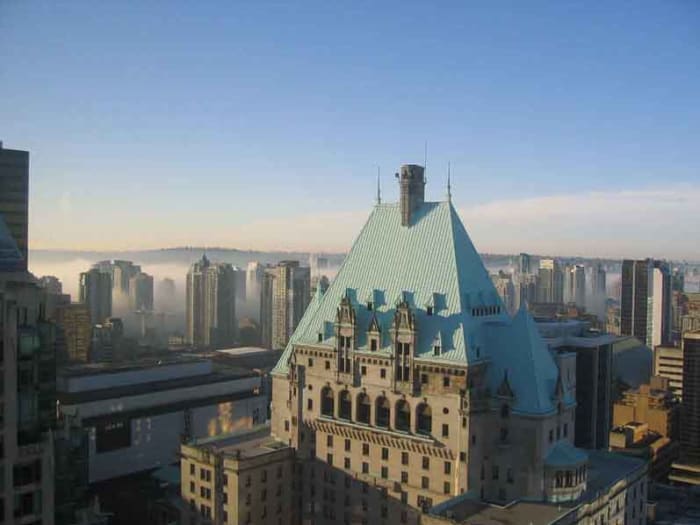
In Vancouver's hotel landscape, Fairmont Hotel Vancouver holds a particular place: that of a grand urban address whose presence extends beyond accommodation alone. Its classical architecture, instantly recognisable, belongs to the tradition of the great North American hotels conceived as civic landmarks as much as places to stay. Here, the idea of luxury is not built on display or effect, but on continuity of style, a certain poise, and a sense of hospitality shaped over time.
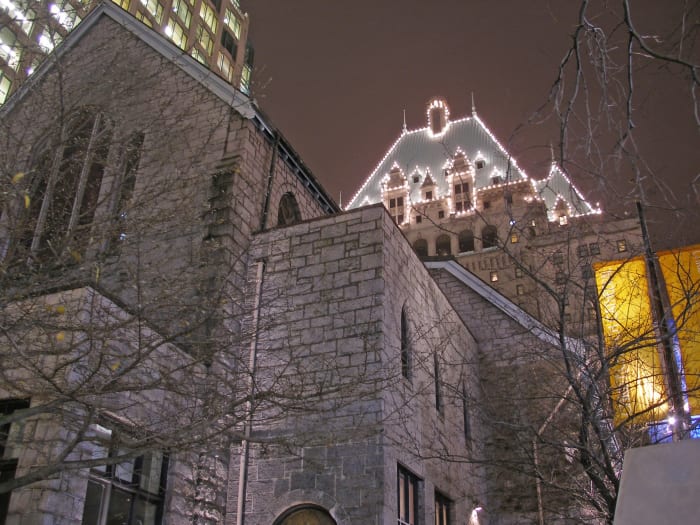
The property first asserts itself through its silhouette and the way it converses with the city centre. In Vancouver, a city often associated with glass, contemporary lines and openness to the Pacific, an address of this kind offers an interesting counterpoint: a form of permanence, elegant gravity, almost ceremonial in spirit, recalling the age of grand travel, lively lobbies, business appointments and social stays. This heritage dimension does not imply stillness. On the contrary, Fairmont Hotel Vancouver seems to hold together two temporalities: that of an assumed legacy and that of a city in motion.
Inside, the décor blending tradition and modernity extends this reading. One finds the spirit of historic hotels, with the volumes, materials and details designed to endure, yet without slipping into heavy-handed nostalgia. Contemporary comfort is set within a framework that retains a certain nobility. It is precisely this balance that gives the address its appeal: it speaks equally to travellers drawn to places with character and to those seeking a central, efficient and polished base from which to discover Vancouver.
Fairmont Hotel Vancouver also belongs to a clearly recognisable service culture. For many travellers, the Fairmont name suggests an art of hospitality founded on consistency, discretion and attention to established codes. In a city welcoming both international business travellers and leisure guests, as well as those in transit towards the Rockies, the hotel acts as a bridge. It offers a legible, reassuring and refined setting capable of accommodating very different rhythms of stay.
Finally, the property should be understood as a witness to Vancouver's own urban evolution. Staying here means inhabiting a fragment of local city history: that of a downtown shaped by major institutions, shops, stations, theatres and avenues where residents, professionals and visitors intersect. The hotel thus preserves something of a classic Vancouver while remaining fully part of the city of today. This ability to move through eras without losing clarity is perhaps what underpins its true prestige.
The hotel
Fairmont Hotel Vancouver's first advantage lies in its location, in the heart of Vancouver. For a traveller discovering the city for the first time as much as for a regular visitor on business, this centrality immediately changes the quality of the stay. It allows one to experience Vancouver on foot, to reach the main attractions with ease, to organise the day flexibly, and to return to the hotel between appointments or visits without feeling that time is being lost in transit. In a metropolis where districts differ markedly in atmosphere, having such a clear point of anchorage is a genuine asset.
Downtown Vancouver brings together several faces of the city: economic activity, major shops, cultural addresses, transport links and an appreciated proximity to the waterfront. From the hotel, one can easily access shopping districts, promenades and many of the places that shape a first stay. This ease of access, reinforced by nearby public transport, makes the address particularly relevant for those wishing to combine logistical efficiency with urban pleasure.
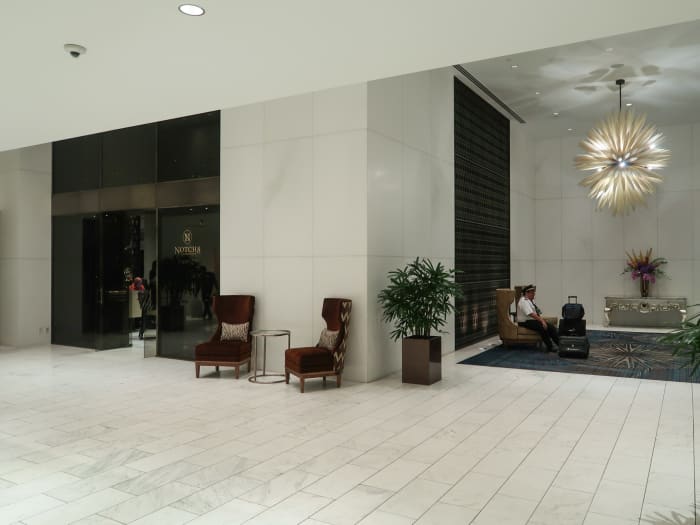
The property itself cultivates a classical presence. Its façade, bearing and public spaces suggest a certain idea of the city-centre hotel in its most accomplished form: a place where one enters with the sense of arriving somewhere, rather than simply spending the night. The lobby and circulation spaces contribute to this impression. They establish a rhythm different from that of the street, more hushed and more ordered, without ever entirely severing the link with the outside movement. It is an urban refuge, but one that remains connected to the city.
The interior décor, described as a blend of tradition and modernity, reinforces this identity. The aim is not to oppose heritage and present-day comfort, but to allow them to coexist with restraint. Travellers attentive to atmosphere will appreciate this aesthetic continuity, which avoids both impersonal coldness and excessive theatricality. There is a readable elegance suited to an international clientele, yet also warm enough for a leisure stay as a couple or family.
Because it is suited to both business and leisure stays, Fairmont Hotel Vancouver works as a synthesis address. One may organise a demanding business trip here, with meetings, appointments and late returns, just as easily as a weekend devoted to museums, shopping, dining and walks. This versatility does not erase the property's character; it confirms it. The hotel does not attempt to be everything to everyone, but to provide a setting sufficiently well judged to accommodate varied uses with the same sense of composure.
In practical terms, this address will particularly suit travellers who prefer to experience a city from within. Those who like to head out early to watch the streets wake, return in the late afternoon for a pause, then go out again for dinner or a performance will find a natural rhythm here. It is also an excellent starting point from which to understand Vancouver in its most accessible form: a city compact at the visitor's scale, open, active, and always close to the sea, the mountains and its broad horizons.
Rooms and suites
In a grand city-centre hotel, the room must fulfil a double promise: to offer a genuine retreat and to extend, without rupture, the identity of the property. At Fairmont Hotel Vancouver, this expectation takes on particular resonance. After the activity of the downtown streets, business appointments or urban exploration, one seeks here a sense of order, calm and comfort that allows one to breathe again. The décor blending tradition and modernity finds in the rooms and suites its most intimate expression: measured elegance, designed to endure, and a setting that privileges clarity over fashion-led effect.
Travellers may expect spaces conceived to answer varied uses. For some, the room will above all be an observation point over the city and a place to rest between outings. For others, it becomes a true temporary office, where to prepare a meeting, answer messages or extend a working day in a more peaceful environment. This versatility is essential in an address welcoming both business trips and leisure breaks. It implies thoughtfully considered furniture, fluid circulation and an atmosphere neutral enough to support concentration, yet warm enough to invite relaxation.
Suites, by nature, heighten this sense of ease. They are particularly suited to travellers staying several nights, couples seeking more space, or families who appreciate a more flexible organisation of the stay. In a hotel of this category, a suite is not merely a larger room: it is another way of inhabiting the address, with a freer rhythm, the possibility of receiving guests, resting separately, or creating quiet moments without feeling confined.
One of the strengths of a historic or classically inspired property also lies in the atmosphere it provides. Where some contemporary hotels rely on radical minimalism, Fairmont Hotel Vancouver appears to favour a more enveloping form of comfort. Materials, tones and overall composition aim less to impress than to create a feeling of continuity. One should be able to feel immediately at ease here, whether arriving late after a long-haul flight, enjoying a city weekend, or undertaking a more formal stay.
Service naturally contributes to this experience. Daily housekeeping and turndown service are part of that discreet but decisive quality of stay that keeps a room welcoming at any hour of the day. One finds here the codes of grand hospitality attentive to practical details: luggage taken care of, assistance available, the rhythm of the room respected. These are elements often barely visible in the narrative of a stay, yet decisive in the memory that remains.
Ultimately, the rooms and suites at Fairmont Hotel Vancouver speak to travellers expecting more than simply central accommodation. They seek a form of balance: between city and retreat, between classicism and present-day comfort, between efficiency and pleasure. In that sense, the property answers less through ostentation than through coherence. And it is often this coherence, more than any other attribute, that distinguishes the hotels to which one wishes to return.
Dining
In a grand urban address, dining plays a role that extends well beyond mere convenience. It structures the day, sets the tone of the stay and can even become one of the first memories the hotel leaves behind. At Fairmont Hotel Vancouver, it is reasonable to approach dining as a natural extension of the overall experience: a setting where service, atmosphere and rhythm matter as much as the plate itself. The advice to reserve a table upon arrival says something essential, moreover: the main restaurant is not simply an ancillary service, but a sought-after place in its own right.
In the morning, in a hotel of this category, breakfast often has the value of a ritual. It is the moment when the different temporalities of the stay intersect: business travellers already in motion, visitors taking time to shape their day, families organising themselves before heading out to explore the city. The pleasure lies as much in the quality of the welcome as in the sensation of gradually entering Vancouver from a protected interior. A good hotel breakfast is not merely nourishing; it orders the day and gives the feeling that everything begins properly.
At lunch or dinner, the dining offer of a grand city-centre hotel must answer multiple expectations. Some seek the efficiency of a well-handled lunch between appointments; others want a more settled dinner in a setting that allows conversation to continue without haste. The value of an address such as this lies precisely in its ability to accommodate these differing uses without losing its identity. The atmosphere must remain elegant enough for a business meal while still being approachable for a couple on a weekend break or for travellers who prefer to dine in after a full day.
In Vancouver, hotel dining also belongs to a city where culinary influences are numerous and where one often expects a certain freshness, attention to produce and openness to contemporary tastes. Without advancing unconfirmed details, one may say that a property of this standing is expected to offer cuisine that is clear, polished and suited to an international clientele. Luxury here often lies in precision of execution, consistency of service and the ability to make the guest feel they are exactly where they ought to be, at exactly the right moment.
Service in the dining room fully contributes to this impression. In the best hotels, it knows how to be present without weighing on the guest, attentive without excessive familiarity, efficient without dryness. This relational quality is especially important in a gateway city such as Vancouver, where travellers arrive with very different expectations. A successful dinner depends not only on the menu, but on the whole set of signs that compose the experience: the welcome, the tempo, the light, the availability, the way guidance is offered without being imposed.
For guests of Fairmont Hotel Vancouver, dining therefore represents more than a practical option. It offers a moment of recentring in the heart of the city, a way of recovering calm after the movement outside, or conversely of giving shape to an evening without leaving the hotel. On a short stay, that ease matters greatly. On a longer stay, it becomes a reference point. And this is often how grand addresses establish themselves: through the quality of ordinary moments they know how to make memorable.
Concierge & services
The luxury of a grand hotel is often measured less by what it displays than by what it makes possible. At Fairmont Hotel Vancouver, this idea finds full expression through a set of services designed to smooth the stay and lighten the logistics of travel. The presence of a 24-hour concierge and a front desk available at all times is first and foremost a promise of simplicity. Late arrival, early departure, need for recommendations, last-minute adjustment: in a city-centre address frequented by an international clientele, this continuity of service is not a detail but an essential condition of comfort.
The concierge in particular plays a decisive role in the quality of an urban experience. In Vancouver, where one may wish to organise anything from a day of sightseeing to a more business-led programme, having interlocutors able to guide, reserve, suggest and quickly resolve the unexpected profoundly changes the perception of the stay. A good concierge does not merely provide information; they make the city accessible, taking into account the time available, the traveller's rhythm and priorities. In a hotel of this category, one expects precisely this practical intelligence.
Daily services also contribute to this impression of discreet control. Daily housekeeping keeps the room in a constant state of freshness, while turndown service creates a pleasant transition between day and evening. Luggage storage, often underestimated, becomes invaluable when one wishes to enjoy the city before check-in or after check-out. Laundry service answers the needs of longer stays, business trips or more complex itineraries. Wake-up service, finally, is a reminder that high-level hospitality remains attentive to the simplest usages, those that secure an important departure or a tightly scheduled day.
The presence of multilingual staff, mentioned among the known amenities, also deserves emphasis. In an international hub such as Vancouver, this ability facilitates not only practical exchanges but also the relational quality of the stay. To be understood quickly, to be able to formulate a request precisely, to receive a clear explanation about a service or reservation: these elements contribute to a sense of ease that makes all the difference, especially after a long journey or during a demanding business trip.
Beyond the list of amenities, what matters is the way they work together. In the best hotels, services never feel merely juxtaposed; they form a coherent, almost invisible system that supports the traveller without imposing additional constraints. One does not always notice this quality in the moment, because it manifests precisely through the absence of friction. Yet it is this quality that allows a stay to move from simply comfortable to genuinely well handled.
For couples, families or business travellers, Fairmont Hotel Vancouver thus appears as an address where one can rely on the overall organisation of the place. That confidence is valuable. It frees time, attention and energy for what truly matters: discovering Vancouver, meeting one's commitments, or simply enjoying the stay. In high-end hospitality, service is never an add-on; it is the very structure of the experience.
The Vancouver way of life
Staying at Fairmont Hotel Vancouver also means choosing a certain way of approaching Vancouver: not as a simple succession of sights to tick off, but as a city to feel, to walk through and to understand in layers. Its central location allows precisely that. One may set out on foot in the morning, observe the light on the downtown façades, cross shopping streets, reach livelier districts, then return within minutes to the relative calm of the hotel. This proximity lends the stay valuable flexibility and encourages a more organic experience of the city.
Vancouver has a distinctive way of life, shaped by a balance between urban energy and the call of the wider landscape. Few metropolises offer so clearly this coexistence of city-centre life, maritime horizon and the constant presence of mountains. Even when one remains mainly in the central districts, this geography can be felt. The air, the light, the open perspectives and the ease with which one moves from an active street to a more peaceful promenade all contribute to a very particular identity. From a hotel located in the heart of the city, this duality becomes immediately perceptible.
For the visitor, the experience of Vancouver often lies in a sequence of measured pleasures: a coffee taken without haste, a walk through a shopping district, a cultural stop, a detour towards the waterfront, then a return to the hotel before going out again for dinner. The city lends itself to this rhythm because it remains legible, accessible and relatively fluid at the traveller's scale. Fairmont Hotel Vancouver suits this way of living the destination especially well. It allows one to shape each day without rigidity, with the possibility of changing plans according to the weather, the mood of the moment or the concierge's recommendations.
This flexibility is particularly valuable in a city where one may wish to combine several registers within the same day: shopping, business, walking, architectural discovery, a gourmet pause, a cultural engagement. Vancouver does not impose a single narrative; it can be approached in different ways depending on the season, the length of stay and one's interests. A well-located hotel then becomes a tool for reading the city. It helps one grasp its continuities, connect its districts and maintain a guiding thread in a destination that, despite its apparent gentleness, is rich in nuance.
For business travellers, this way of life translates into a rare quality: the possibility of creating genuine breathing spaces within a dense schedule. For couples, it takes the form of an urban stay in which elegance, simplicity and openness to the outdoors alternate naturally. For families, it means a city that remains manageable, where getting around is relatively straightforward and where the hotel can serve as a stable base between activities. In every case, the address allows one to enter Vancouver without excessive effort.
Perhaps this, in the end, is where Fairmont Hotel Vancouver's lasting charm lies: in its ability to connect a grand hotel tradition with a city whose identity rests on fluidity, light and balance. One stays here for comfort, location and service, certainly. But one also returns because it offers a particularly apt way of inhabiting Vancouver, for a few days or longer.
Book with MyConciergeHotel
Choosing Fairmont Hotel Vancouver through MyConciergeHotel means favouring an editorial reading of travel as much as a booking. For a city-centre address with strong character, this approach makes sense. Not all well-located hotels are alike, and not all historic properties answer the same expectations. Here, the appeal lies not only in the five-star status, but in a precise combination: classical architecture, a central setting, décor that brings tradition and modernity into dialogue, and a genuine ability to accommodate both business stays and leisure interludes.
Booking with discernment means understanding what one is coming to find. Fairmont Hotel Vancouver will particularly suit travellers who wish to experience Vancouver from a structuring address that is immediately legible, with continuous service and simplified logistics. It is a relevant choice for a first stay, because it places the city within easy reach. It is also a sound option for a return to Vancouver, when one already knows how much centrality, service quality and the reliability of a grand house can transform the experience.
MyConciergeHotel makes it possible precisely to place these qualities in perspective. The aim is not to multiply promises, but to help identify the fit between a place and a style of travel. In the case of Fairmont Hotel Vancouver, that fit is clear for several profiles: business travellers needing an efficient and elegant base; couples seeking a grand classical hotel for an urban stay; families prioritising comfort, dependable service and ease of movement; visitors wishing to alternate city life and moments of retreat without moving away from the centre.
Booking early remains good practice, particularly when travelling in high season or when one wishes to organise the stay with precision. The advice to reserve a table at the main restaurant upon arrival can also be integrated into a broader preparation: think through timings, anticipate appointments, allow for pauses, and use the concierge as a natural extension of travel planning. In a grand hotel, anticipation takes nothing away from spontaneity; it simply makes it more comfortable.
The value of booking through a specialised editorial platform also lies in the quality of the interpretative framework. One is not choosing only a category or a list of amenities, but an atmosphere, a way of inhabiting the city, a level of service and a certain overall coherence. Fairmont Hotel Vancouver speaks to those who appreciate hotels with presence, perceptible history and a clear urban function. It does not seek to charm through eccentricity, but through consistency, bearing and relevance.
Ultimately, booking this address through MyConciergeHotel means making an informed choice: that of a grand Vancouver hotel capable of offering orientation, comfort and continuity all at once. For a short stay, this guarantees an efficient base. For a longer trip, it establishes a rhythm. And for every type of traveller, it allows one to approach Vancouver with an address that, without ever overstating its case, knows how to give the stay its proper poise.