History & heritage
Fairmont Ajman belongs to a newer hospitality landscape than that of historic capitals, yet its appeal lies precisely in this distinctive setting. Ajman, the smallest of the United Arab Emirates, has long lived to a maritime rhythm, shaped by the Gulf, coastal trade and regional movement. In this context, a seafront hotel is more than a place to stay: it extends the city’s longstanding relationship with its shoreline. Fairmont Ajman interprets that idea through the codes of an international luxury hotel, adapted to a destination that often favours calm over spectacle.
The Fairmont name provides a clear framework. Rather than relying on excess, the brand is associated with a certain idea of the grand hotel: structured service, public spaces designed to endure, and close attention to daily comfort as much as to ceremonial moments. In Ajman, that signature takes on a distinctly coastal form—lighter, brighter and more open to the outdoors. The sea is central, not merely as a backdrop but as an organising element of the experience. Views, light and the flow between lobby, restaurants, pool and beach create a continuity that defines the stay from the moment of arrival.
The property also makes sense at the scale of the emirate itself. Ajman does not offer Dubai’s vertical drama or Abu Dhabi’s institutional grandeur. Its appeal lies more in a sense of relative remove, even while remaining connected to the wider region. For many travellers, this changes the quality of time spent here: days unfold with fewer demands, stays feel more residential, and the hotel becomes an anchor rather than a simple base. Fairmont Ajman responds well to that expectation, with an atmosphere suited both to a restorative break and to a few days of decompression after a busier itinerary elsewhere in the UAE.
To speak of heritage here is therefore less about recounting centuries of history than about describing a contemporary way of inhabiting Ajman’s shoreline. The hotel participates in the transformation of the coast into a destination in its own right, while preserving a direct relationship with the marine horizon that remains its defining luxury. It is neither a museum hotel nor a heritage address in the European sense. Its identity comes from a balance between international standards, Gulf hospitality and seaside ease. For the traveller, this results in a clear proposition: a grand beach hotel designed for comfort, with the sea as its guiding thread and Ajman as a quieter alternative to neighbouring destinations.
The property
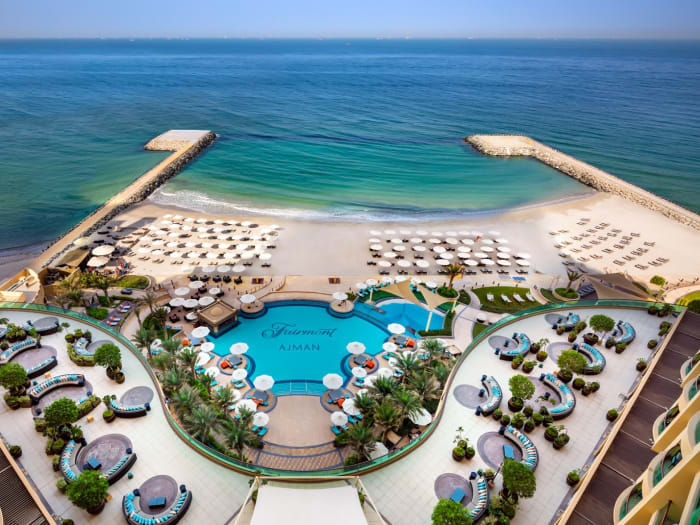
Fairmont Ajman is defined first and foremost by its seafront setting, facing the Persian Gulf. This direct relationship with the water shapes the entire perception of the place: light enters generously, sightlines open towards the horizon, and it quickly becomes clear that the stay unfolds as much outdoors as indoors. In a region where urban hotels can sometimes favour spectacle, this address adopts a calmer language. Ajman’s coastal setting gives it a particular sense of space, with days naturally structured around the beach, the pool, meals and the softer hours of evening.
The property accommodates several types of stay without losing coherence. Couples will find an environment suited to an easy, comfortable break centred on rest, treatments and dinners with a view. Families, for their part, tend to appreciate the clarity of the layout and the convenience of a hotel organised around the sea. Business travellers may also see it as a useful point of balance: a less intense setting than the major neighbouring hubs, yet with the services expected of a five-star hotel. This versatility is not a sign of vagueness; rather, it rests on a clear structure and a well-kept promise—that of an upscale seaside stay without unnecessary complication.
Architecture and public spaces contribute to this impression. Even without relying on dramatic gestures, a hotel of this category works through volume, transitions and practical comfort. The lobby performs its role as threshold, circulation remains fluid, and movement between air-conditioned interiors and outdoor areas facing the sea feels natural. In the Gulf, this articulation is essential: it allows guests to enjoy the landscape while preserving moments of cool retreat. Fairmont Ajman appears to have been conceived in precisely this logic of balance, between openness and shelter, panorama and privacy.
The beach is naturally one of the property’s principal assets. In Ajman, it is not an optional extra but a true centre of gravity. Guests come to swim, read, settle in for a few hours, or simply watch the light change across the water. The pool complements this with a different rhythm—more social, more fluid—often suited to families as much as to travellers alternating between swimming, lunch and rest. In the evening, as temperatures ease, the hotel takes on another tone: terraces and restaurants become places of observation as much as conviviality.
What ultimately defines the property is its ability to offer a sense of retreat without isolation. One is in Ajman, in a coastal environment calmer than many destinations in the region, yet still within the framework of a well-run international luxury hotel. For travellers, that combination has real value. It allows for a restorative stay, supported by reliable service standards, without sacrificing the feeling of genuinely being elsewhere. Fairmont Ajman does not overplay its setting; it lets it speak for itself. That, very often, is where the quality of a grand beach hotel lies.
Rooms and suites
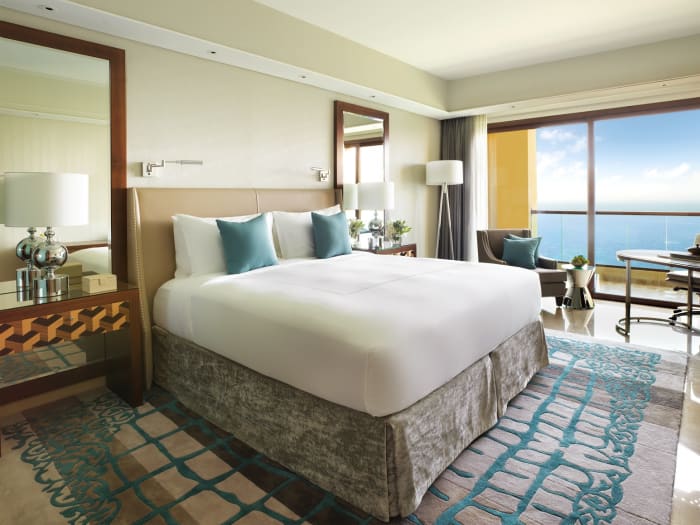
In a seaside hotel of this category, the room is not merely where one sleeps; it becomes an extension of the stay, a place to return to between swims, to retreat during the hottest hours, and to recover calm at the end of the day. At Fairmont Ajman, this function is especially important, because the overall experience rests on a balance between outdoors and indoors. Rooms and suites therefore need to meet a double requirement: to provide genuine comfort and to maintain a perceptible connection with the maritime setting that defines the property.
The first criterion here is the sense of space and light. In Gulf destinations, travellers expect accommodation capable of absorbing the external heat while preserving a serene atmosphere. That depends on well-managed air conditioning, good bedding, bathrooms designed for ease of use, but also on a clear organisation of space. In a property such as Fairmont Ajman, one looks less for decorative effect than for legibility: comfortable furniture, tones suited to the local light, and enough room for the stay to remain pleasant over several days.
The view naturally plays a central role. When a hotel faces the Persian Gulf, the room acquires another dimension if it allows guests to follow the changing sky and sea. In the morning, the light is often crisp; by late afternoon it softens and alters the perception of the space. For many travellers, this visual relationship with the water is one of the most enduring pleasures of the stay. It is not simply an aesthetic advantage, but an element of rhythm: curtains are opened, the day is measured by the colour of the sky, and the room offers continuity with the beach and outdoor areas.
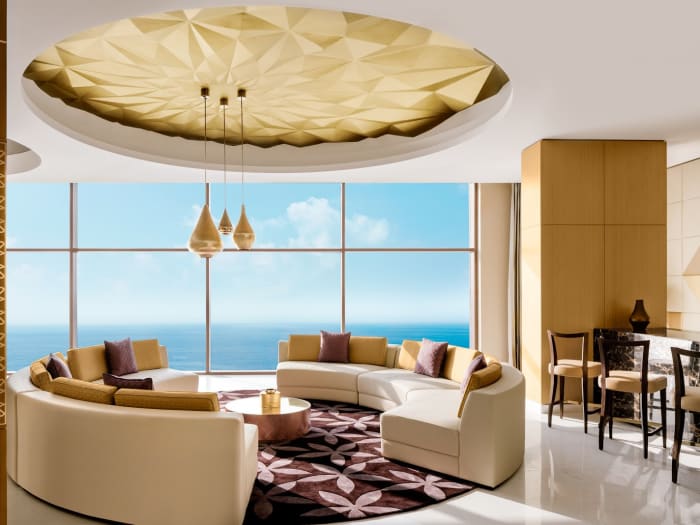
Suites, when chosen, generally add a more residential dimension to the stay. They are particularly well suited to families seeking greater ease, or to travellers who value time spent in the room, whether for work, rest or informal hosting. In a hotel aimed at both couples and families, this gradation of accommodation is essential. It allows the experience to be adapted without changing address or giving up the advantages of the seafront setting.
The associated services complete this impression of well-judged comfort. Daily housekeeping, turndown service, and the availability of a 24-hour reception and concierge all contribute to that invisible quality which distinguishes a good stay from one that is merely functional. After a day on the beach or an evening at dinner, returning to a room that has been refreshed, cooled and prepared for the night is a discreet but decisive luxury. At Fairmont Ajman, the strength of the rooms and suites lies in their ability to support the rhythm of the stay: restful without being impersonal, practical without dryness, and open to the sea without neglecting the very concrete demands of contemporary comfort.
Dining
Dining plays a strategic role in a seaside resort, particularly when it is designed for stays of several days. At Fairmont Ajman, the presence of varied dining options answers a very simple need: allowing guests to inhabit the hotel at different moments of the day without a sense of repetition. Breakfast, a light lunch between beach and pool, a more settled dinner, coffee in the shade, or an evening drink facing the sea do not serve the same purpose. A strong culinary offering knows how to accompany these distinct rhythms, and that is precisely what one expects from a five-star address on the Gulf.
In this kind of property, gastronomic quality is not measured solely by the sophistication of the plates. It also lies in the appropriateness of the formats, in the ability to offer cuisine suited to the climate, to the international habits of the clientele, and to the local context. In Ajman, where many guests come in search of ease, meals should be able to alternate between controlled simplicity and more elaborate moments. A lunch taken after swimming should not answer the same expectations as a terrace dinner once the temperature has fallen. Variety is therefore less an argument of quantity than a sign of sound hotel intelligence.
The setting matters just as much. Facing the Persian Gulf, a restaurant or lounge cannot be reduced to its menu; it forms part of the gentle staging of the stay. The view, the slanting light at the end of the day, the discreet sound of the shore, the possibility of lingering over a meal without haste—all of this creates an experience. In Gulf beach destinations, where the heat can shape the day, morning and evening hours become especially valuable. Dining spaces that know how to make the most of them immediately gain in relevance.
For families, the diversity of options is also decisive. It allows meals to be adjusted to the day’s wishes and constraints without turning every lunch or dinner into a logistical exercise. For couples, it offers the chance to vary the mood over the course of the stay: a relaxed meal one evening, a more polished dinner the next, a quieter moment when the aim is simply to enjoy the setting. Business travellers, too, benefit in practical terms, being able to combine meetings, pauses and meals without leaving the hotel.
What one ultimately remembers from good hotel dining by the sea is its ability to accompany the stay without rigidifying it. Fairmont Ajman appears to follow that logic: dining conceived as a sequence of moments rather than a demonstration. That is the essential point. In a place where the sea remains the principal horizon, eating should extend the feeling of holiday, comfort and availability. It is this continuity between landscape, service and way of life that gives the on-site dining experience its value.
Spa & wellbeing
In a beach hotel, wellbeing is not confined to the spa; it often begins with the simple act of slowing down. Fairmont Ajman appears to have been designed for precisely this gradual deceleration, with the sea as backdrop, outdoor spaces suited to pause, and the possibility of punctuating the stay with treatments on site. That combination matters. It allows guests not to oppose activity and rest, but to shape the day freely according to their energy: a swim in the morning, reading in the shade, a treatment in mid-afternoon, a walk along the beach as the light softens.
The on-site spa treatments are naturally one of the pillars of this experience. In a coastal setting, they take on a particular meaning. After sun, travel and several days shaped by heat, the body asks less for performance than for recovery. Massages, facials and relaxation rituals then find their full relevance: they rebalance, soothe and restore a sense of availability. In a five-star address, one expects such moments to be delivered with precision, in a calm environment, with a well-judged sense of pace and welcome.
Wellbeing here also depends on the quality of transitions. Being able to move from room to pool, from beach to spa, and then return to a space refreshed by daily housekeeping contributes to a sense of continuity without friction. This is often what distinguishes a truly restful stay: nothing is theatrical, yet everything seems to support relaxation. Turndown service, for example, may appear secondary; in practice, it contributes to a feeling of overall care, preparing the room for the night and marking the shift into another rhythm.
For couples, the spa often becomes a distinct moment, almost a ritual within the stay. It allows a day to be structured around a reserved, quieter, more inward-looking experience. For families, by contrast, it offers an individual breathing space within a more shared programme. Business travellers, meanwhile, may find in it an effective way to turn a functional trip into a more balanced interlude. This plurality of uses is essential in a hotel that welcomes different profiles without giving up a clear identity.
At Fairmont Ajman, wellbeing therefore seems to rest on a broad and intelligent definition. It is not simply a matter of adding services, but of creating the conditions for a more breathable stay. The immediate proximity of the sea, the availability of treatments on site, the fluid organisation of spaces and the quality of daily service all contribute to this impression. For many travellers, that is precisely what they come to Ajman for: not an austere retreat, but a form of restorative comfort in which time, sleep, light and a simpler relationship to body and landscape can be regained.
Concierge & Services
The quality of a grand hotel is often measured by what is not immediately visible. At the Fairmont Ajman, a 24-hour reception, 24-hour concierge service, daily room service, turndown service, luggage storage, laundry, and wake-up calls form a cohesive offering. When executed well, these services transform the experience of the stay, allowing guests to focus on their time spent on-site rather than on practical arrangements.
The concierge plays a central role here. In a destination like Ajman, it serves not only to book transfers or answer logistical questions but also to enhance the rhythm of the stay, suggesting the best times to enjoy the beach, helping to organise outings in the vicinity, or facilitating the details of daily life.
Daily room service and turndown service elevate the experience to a more intimate level. They allow the room to accompany the various moments of the day. In a warm climate, this attention to detail takes on even greater significance, fostering a sense of cleanliness, relaxation, and control.
Laundry services and luggage storage cater to very practical needs. They are particularly useful for extended stays, family trips, or itineraries spanning multiple emirates. The ability to have clothes maintained, to travel lighter, or to enjoy the last hours on-site without luggage is an essential convenience.
Finally, the continuous availability of the reception and concierge ensures true peace of mind. In a region where late arrivals, night departures, or changes in plans are common, knowing that a point of contact is available at any hour is invaluable. The Fairmont Ajman thus meets a key expectation of its five-star clientele: a constant, discreet, and reliable service.
The art of living in Ajman
To stay in Ajman is to choose a different tempo within the landscape of the United Arab Emirates. Where some neighbouring destinations rely on intensity, scale or the accumulation of experiences, Ajman offers a simpler relationship with the coastline and with time. That difference is far from incidental. It influences the way one travels, plans the day and even inhabits the hotel. At Fairmont Ajman, this local tone is naturally felt: guests come readily to slow down, to enjoy the sea without an overfilled programme, and to recover a form of seaside comfort that does not depend on a crowded agenda.
The art of living in Ajman often begins with light. In the morning it is clear, almost graphic on the water; by late afternoon it softens and gives the shoreline a more contemplative quality. Between those two moments, the day organises itself according to the climate. One alternates between outdoor time and air-conditioned refuge, between swims and pauses, light meals and quieter hours. This adaptation to the rhythm of the Gulf forms part of the experience. It invites a different way of travelling, accepting that a stay need not be a succession of occupations but rather a more flexible composition of chosen moments.
Ajman also has the appeal of destinations less saturated with imagery. Travellers often find here a more direct relationship with place, less mediated by expectations of spectacle. This does not mean that less happens; it means that attention shifts. One notices details more closely: changes in light, the movement of the sea, the quality of service, the pleasure of an unhurried dinner. For French or European guests accustomed to reading luxury through the rarity of time and calm, that nuance matters greatly.
From a seafront hotel such as Fairmont Ajman, this art of living takes on a very concrete form. It may mean devoting an entire morning to the beach, returning to the room during the hottest hours, booking a spa treatment, then extending the evening over dinner with a view. It may also translate into a family stay without heavy logistics, where each person finds their own rhythm between swimming, rest and meals. The success of such an address then lies in its ability not to overload the experience, to leave room for spontaneity and for the simple pleasure of being there.
That is perhaps what makes Ajman especially appealing to certain travellers: the possibility of a less demonstrative, more breathable luxury, founded on continuity of comfort and immediate proximity to the sea. In a hotel world often dominated by novelty and effect, this controlled simplicity has real value. It is a reminder that a great stay does not always need to be spectacular in order to be memorable. Sometimes a good hotel, a well-positioned shoreline, dependable service and a few days restored to their proper tempo are enough.
Book with MyConciergeHotel
Booking Fairmont Ajman through MyConciergeHotel means approaching this seaside stay through selection rather than simple transaction. A property such as this lends itself particularly well to editorial and concierge guidance, because its value lies not only in its five-star status but in the way it is used. Depending on whether one is travelling as a couple, with family, or on a business trip extended by a period of rest, priorities will differ: immediate access to the beach, the rhythm of meals, the appeal of the spa, the need for flexibility around timings, or the importance of a room conceived as a genuine refuge.
The value of a well-prepared booking lies in this alignment between the traveller’s profile and the hotel’s actual tempo. At Fairmont Ajman, it is useful to anticipate a few simple points: the type of stay desired, the place one wants to give to beach days, any wish to enjoy treatments on site, or the need for smooth service around a late arrival, early departure or a stay combined with other stops in the Emirates. These may appear modest details, yet they often determine the perceived quality of the stay.
MyConciergeHotel makes it possible to read the hotel beyond its technical factsheet. The point is not merely to know that it is a seafront property with varied dining, a spa and round-the-clock services; it is to understand who it suits best and at what moment. For a couple, the main attraction may be the possibility of a stay facing the Persian Gulf, shaped by the beach, treatments and unhurried dinners. For a family, it may be the simplicity of a legible resort where several generations can coexist without excessive constraint. For a business traveller, the appeal may lie in the balance between international service standards and a calmer environment than that of the major neighbouring hubs.
Booking through MyConciergeHotel also means benefiting from a perspective that privileges the coherence of the stay. In luxury hospitality, that coherence often matters more than an accumulation of promises. Good advice at the right moment—thinking to reserve a sun lounger on arrival, scheduling a first treatment outside the busiest hours, allowing a comfortable margin for transfers—concretely improves the experience. It is this practical intelligence, discreet yet decisive, that makes the difference between a correct stay and a truly fluid one.
Fairmont Ajman will particularly suit those seeking a seaside interlude in the Emirates, with strong service standards and a more peaceful atmosphere than in some neighbouring destinations. Booked with discernment, it becomes more than a beach hotel: an elegant base from which to slow down, breathe and recover a simpler relationship with the coast. This is exactly the kind of address that MyConciergeHotel knows how to place in perspective, taking into account not only what the hotel offers, but how you wish to live it.