History & identity
Fairmont Bab Al Bahr belongs to that generation of hotels which speaks less of inherited grandeur in the European sense than of a distinctly contemporary Gulf vision of hospitality: large-scale, internationally minded, and designed around comfort, efficiency and a direct relationship with the landscape. In Abu Dhabi, where urban development accelerated remarkably at the turn of the 21st century, landmark hotels often became visual markers as much as places to stay. This property fits that pattern with its modern architecture, clean lines and a setting that frames water, light and the city skyline.
The very name Bab Al Bahr, which may be understood as a ‘gateway to the sea’, captures the spirit of the place. More than a convenient base, the hotel acts as an interface between city and shoreline, between the energy of a regional capital and the sense of retreat sought by business travellers, couples and families alike. That duality is central to its identity. One does not come here for a historic palace atmosphere, but for a contemporary form of luxury that privileges space, fluid circulation, open views and clearly organised service.
In this context, the Fairmont aesthetic translates into a discreet sophistication. Public areas are designed to create an immediate sense of ease: generous volumes, modern materials, abundant light and restrained tones lifted by warmer accents. The mood is neither ostentatious nor austere. Instead, it aims for a balance between representation and relaxation, which explains why the hotel suits conference guests just as well as slower leisure stays.
In a destination such as Abu Dhabi, a hotel’s legacy is also measured by its ability to respond to the city’s evolving uses. Fairmont Bab Al Bahr does so by offering a setting structured enough for business travel while retaining the attributes of an urban resort: pools, on-site dining, wellness areas and water views. This versatility forms part of its deeper identity, allowing each guest to shape a personal rhythm between meetings, rest and exploration.
What endures, beyond trends, is the feeling of a hotel fully settled into its environment and conceived for stays in which everything should work with ease. Luxury here does not depend on theatrical gestures, but on overall coherence: a clear location, confidently modern architecture, continuous service and a privileged relationship with Abu Dhabi’s maritime landscape. That consistency, more than any dramatic historical narrative, defines the character of Fairmont Bab Al Bahr today.
The property
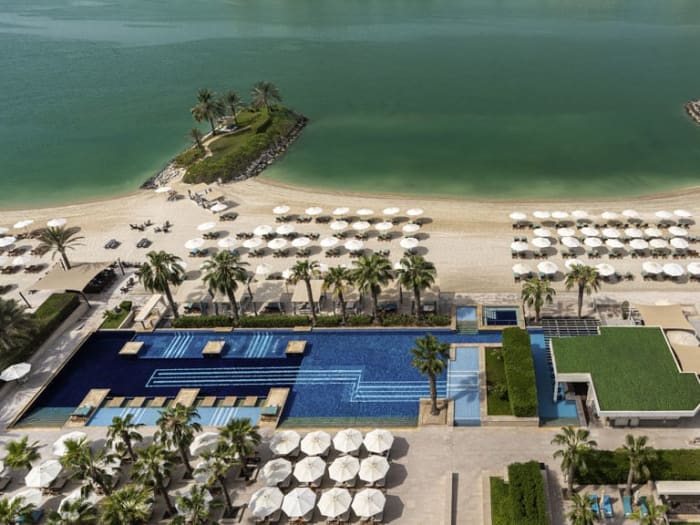
Fairmont Bab Al Bahr is first understood through its relationship with the site. In Abu Dhabi, where the presence of water strongly shapes the travel experience, a hotel is never merely an urban address: it is also a vantage point. Here, sea views form an integral part of the stay. They accompany arrival, extend moments of pause in the public areas and give the outdoor spaces an almost cinematic quality, particularly as the light softens towards evening. This openness to the landscape provides welcome breathing room in a capital whose infrastructure, major roads and institutional districts can at times feel highly composed.
The property’s contemporary architecture plays precisely that mediating role between city and horizon. The lines are clear, the volumes legible, and the whole favours a sense of order and clarity. There is an evident intention to make circulation intuitive, to frame perspectives and to bring light into the reception and dining areas. This modernity is not abstract: it responds to a very practical hotel lifestyle in which one moves easily from a meeting to lunch, from time by the pool to an outing in the city.
The public spaces contribute greatly to this impression of fluidity. The décor is elegant without excess, with a welcoming atmosphere that avoids stiffness. This matters in a hotel of this category: refinement is present, yet it does not create distance. Guests staying several nights quickly find their bearings, while those on shorter visits benefit from efficient organisation. That immediate readability is one of the signs of thoughtful hospitality.
Outdoors, the pools naturally act as one of the property’s focal points. They lend the stay a resort dimension, even for travellers primarily in Abu Dhabi for sightseeing or business. Their presence alters the rhythm of the day: one may devote several hours to them, or simply enjoy a brief interlude between obligations. In a destination where the climate often invites guests towards the water, such areas become true open-air lounges.
The hotel’s other major strength lies in its relatively easy access to Abu Dhabi’s attractions. Without reducing the city to a short list of sights, the property allows guests to move with ease towards different districts and points of interest. This is valuable for travellers wishing to alternate visits, shopping, appointments and downtime. Fairmont Bab Al Bahr thus answers a very contemporary expectation: to offer a comfortable, aesthetic and practical base rather than complete seclusion. One stays here with the sense of being both sheltered and connected, which may be one of the most convincing forms of urban luxury today.
Rooms and suites
At a hotel such as Fairmont Bab Al Bahr, the room is not conceived as a mere stopover. Instead, it extends the qualities that shape the wider experience: modern lines, a sense of space, immediate comfort and a strong emphasis on light. Even without detailing every category, it is clear that the intention is to offer accommodation suited to different uses, from the highly efficient overnight stay to a more settled visit in which one takes time to inhabit the hotel.
The first important element here is the legibility of the décor. In well-designed contemporary properties, elegance often lies in restraint: a calming palette, furniture with balanced proportions and materials chosen for discreet presence rather than demonstrative effect. This approach suits Abu Dhabi particularly well, as the intensity of the outdoor light often calls for interiors able to provide visual calm and coolness. The room thus becomes a tempered refuge, a place where one genuinely rests after a day of travel, sightseeing or meetings.
Views naturally play an essential role. When a hotel enjoys a privileged relationship with the sea, that dimension transforms the very perception of the room. The landscape is no longer a simple backdrop; it becomes part of the stay itself, especially in the early morning or as the city slows towards evening. For many travellers, this connection to the outside makes the difference between comfortable accommodation and a memorable address. It adds depth to time spent in the room, even during the simplest moments: opening the curtains, having coffee, reading a few pages before going out.
Comfort in an international five-star hotel also rests on a series of practical attentions. Daily housekeeping, turndown service and a continuously staffed reception all contribute to a sense of continuity. Nothing is theatrical, yet everything helps make the stay smoother. For families, this means easier logistics; for couples, greater tranquillity; for business travellers, reassuring reliability at any hour.
Suites, by definition, add a further sense of generosity to this foundation, whether in terms of space, separation of functions or a greater ability to host. In a city where many stays combine obligations with private time, such a configuration can be particularly relevant. One may work without encroaching on rest, or extend the day in a more residential setting.
Ultimately, what characterises the rooms and suites at Fairmont Bab Al Bahr is less decorative theatre than the promise of a stay without friction. Everything appears oriented towards a simple yet demanding idea: allowing the traveller to feel immediately at ease, with the right measure of refinement, functionality and openness to the landscape for the room to become a genuine living space rather than a mere interval between activities.
Dining
Dining adds depth to a stay in a contemporary luxury hotel, and Fairmont Bab Al Bahr is no exception.
In a venue that welcomes leisure travellers, families, and business guests alike, the dining experience must cater to a variety of needs.
In the morning, breakfast plays a central role. In Abu Dhabi, where schedules can be packed, it sets the tone for the day.
Served in a bright setting with expansive views, it becomes a very tangible luxury. It is often here that the quality of a hotel is truly measured.
Variety, the pace of service, and the comfort of the dining area are just as important as an offering that suits both a quick meal and a more leisurely morning.
At lunch and dinner, several on-site options eliminate the need for extensive travel. This is a real advantage in a capital where distances can be surprising.
The restaurants cater to multiple scenarios: a romantic dinner, a family meal, a business meeting, or an extended evening on-site.
Refinement here is understood as a combination of atmosphere, consistency, and precision. A good hotel restaurant provides the right setting, a clear menu, and attentive service.
In an international destination like Abu Dhabi, this expectation often includes a broad range of culinary inspirations.
The dining spaces also contribute to the identity of the venue. They extend the contemporary architecture and the welcoming ambiance.
One can transition from a discreet café to a more ceremonial meal, from an informal break to a more dressed-up evening.
At Fairmont Bab Al Bahr, dining naturally enhances the stay. Guests can enjoy meals with pleasure, host with ease, and punctuate their day with well-timed moments.
Spa & Wellness
In Abu Dhabi, wellness spaces play a crucial role in enhancing the overall experience of your stay. The Fairmont Bab Al Bahr features on-site wellness facilities and pools.
After a flight, a day of meetings, or several hours spent in the city, finding a dedicated space can transform your perception of the trip. One shifts from the pace of the itinerary to a rhythm of self-care.
In a large international hotel, this transition should remain seamless. Descending from your room to a tranquil area, reconnecting with water, refreshing breezes, and a slower pace of time.
The pools are central to this experience, structuring both the social and sensory life of the hotel.
Depending on the time of day, they provide a gentle awakening, a midday pause, or a more serene late afternoon. For families, they serve as an obvious focal point.
For couples, they offer a moment of relaxation. For business travellers, they provide a chance to unwind without leaving the hotel.
The wellness spaces cater to a more intimate expectation. Here, one seeks rejuvenation, treatments, or simply a break from the general pace.
Equally important is the coherence with the rest of the establishment. At Fairmont Bab Al Bahr, the contemporary architecture, sea views, and relaxed atmosphere naturally extend this experience.
A stay can thus be organised around simple sequences. A morning by the pool, a city outing, followed by a quieter return before dinner.
At Fairmont Bab Al Bahr, wellness accompanies the balance between activity and rest.
Concierge & Services
The true measure of a great hotel often lies in the services that go almost unnoticed, as they make everything simpler. Taken individually, these services may seem expected in a five-star establishment; however, when combined and executed well, they create an invisible framework that transforms a satisfactory stay into a seamless experience. The concierge service, available around the clock, is particularly valuable in an international destination like Abu Dhabi. Late arrivals, early departures, changes in plans, or last-minute requests are part of the travel reality. Being able to rely on a team that can guide, confirm a reservation, assist with travel arrangements, or simply respond efficiently to a practical question is a considerable advantage. Here, luxury is less about theatrics and more about genuine availability. The continuously open reception follows the same logic. In hotels that cater to an international clientele, time zones, overnight flights, and irregular schedules necessitate a flawless continuity of service. This permanence is reassuring. It means that the hotel remains fully operational at all hours, whether for a late check-in, a logistical need, or a room-related request. For business travellers, this reliability is essential; for families, it provides immediate peace of mind. The daily housekeeping and turn-down service represent another dimension of comfort: that of repeated attention. A well-maintained room, discreetly tidied, profoundly enhances the quality of the stay, especially for those staying multiple nights. The turn-down service, in particular, belongs to that hotel tradition which reminds us that the evening deserves preparation as well, even if light. These gestures create a sense of ongoing care, without ever becoming intrusive when executed well. Laundry, luggage storage, and wake-up calls are more pragmatic services, but their importance is real. They allow for lighter travel, help manage the time between two flights or meetings, and enable a more serene approach to the day. In a city where one can seamlessly transition between professional obligations and leisure moments, this efficiency is as significant as the decor. Finally, the presence of multilingual staff directly contributes to the quality of the welcome. It facilitates communication, reduces friction, and allows for a more personalised relationship. In an international hotel, this skill is not a detail; it often determines the feeling of being understood immediately. At Fairmont Bab Al Bahr, the services appear to be designed to support all styles of stay. They impose nothing but make everything simpler. It is precisely this operational discretion, combined with genuine human continuity, that defines one of the most compelling forms of contemporary hotel luxury.
The Art of Living in Abu Dhabi
Staying at the Fairmont Bab Al Bahr offers a unique perspective on Abu Dhabi. The capital does not reveal itself immediately but unfolds to attentive travellers.
Abu Dhabi possesses an institutional restraint that profoundly influences the experience of the stay. The city is discovered in layers: the sea, major thoroughfares, residential neighbourhoods, cultural sites, shopping centres, and promenades. A well-located hotel thus becomes a point of equilibrium.
One of the pleasures of Abu Dhabi lies in the interplay between monumental grandeur and moments of respite. One transitions from composed urban landscapes to more open vistas. The Fairmont Bab Al Bahr, with its sea views and easy access to the city’s attractions, allows for this alternation with ease.
You can dedicate part of your day to exploration, then return to the hotel to embrace a calmer atmosphere. For first-time visitors, the local art of living is often understood through its rhythm. It requires accepting distances, organising outings according to the most pleasant times, and allowing space for comfort.
In this context, a hotel equipped with pools, restaurants, and wellness spaces makes perfect sense. It enables you to craft your day with precision.
Abu Dhabi also lends itself to mixed stays, balancing business and personal time. Contemporary hotels play a significant role here, providing a setting where one can transition from a meeting to dinner, from a cultural visit to a pause by the water. The Fairmont Bab Al Bahr clearly fits into this logic. Its relaxed yet sophisticated ambiance aligns well with the spirit of the city.
The most pleasant period generally extends from November to April. The climate makes travel and outdoor activities more comfortable. Terraces, poolside areas, and outings take on a new dimension. Booking in advance during this period is advisable.
In Abu Dhabi, the art of living emerges from a balance between modernity, hospitality, sought-after comfort, and a constant relationship with water. From the Fairmont Bab Al Bahr, this equation is clearly visible. The city remains accessible, and the hotel maintains enough distance to make each return a true respite.
Book with MyConciergeHotel
Booking Fairmont Bab Al Bahr through MyConciergeHotel means choosing an approach to travel that favours thoughtful preparation over improvised compromise. In a destination such as Abu Dhabi, that difference matters. The city is easiest to enjoy when the broad outlines of the stay are well defined: travel period, preferred room type, desired rhythm between relaxation and discovery, any logistical needs, and expectations regarding dining or wellness. Editorial and concierge guidance helps clarify these points before arrival.
The first advantage of a carefully considered booking lies in the match between the hotel and the traveller’s profile. Fairmont Bab Al Bahr suits several uses: a couple’s escape, a family stay, an extended business trip or a blend of work and leisure. Yet these scenarios do not imply the same priorities. Some guests will privilege the view and time spent on site, others access to the city’s attractions, and others still the flexibility of services available at any hour. Booking with an expert perspective helps rank those expectations more clearly and shape the stay accordingly.
Seasonality is another key consideration. Between November and April, when the climate is generally at its most pleasant, Abu Dhabi attracts more visitors and the best availability may tighten. Booking ahead then becomes particularly relevant. This is not only about securing a room, but also about preserving the coherence of the trip: more comfortable timings, a smoother programme, activities considered in advance and greater room for specific requests.
MyConciergeHotel also adds value in the way the hotel experience itself is interpreted. Beyond standard categories, the point is to understand what the property genuinely offers: contemporary architecture, sea views, pools, refined dining venues, wellness areas, an atmosphere that is both relaxed and sophisticated, and practical access to Abu Dhabi’s different facets. Such perspective helps guests book for the right reasons, with accurate expectations and therefore more lasting satisfaction.
For discerning travellers, a reservation is never limited to a rate or an availability. It reflects a certain idea of time spent on site. Does one wish to experience the hotel as an urban resort? Are active days followed by quieter returns anticipated? Is particularly responsive service required because of a professional schedule? All these questions can be addressed in advance so that the stay feels smoother from the moment of arrival.
Finally, booking through MyConciergeHotel also means benefiting from an independent editorial eye attentive to the hotel’s real uses. This approach avoids generic promises and instead privileges coherence between the place, the destination and the traveller. In the case of Fairmont Bab Al Bahr, that means recognising what it does well: offering a clear, comfortable and versatile form of contemporary luxury in a capital where the balance between city and relaxation defines the quality of the stay. It is on that well-prepared basis that the most successful journeys are built.