History & heritage
In Seoul, the hotels that matter are not defined solely by height, address or the quality of their finishes, but by the way they fit into the city’s rhythm. Fairmont Ambassador Seoul belongs to a generation of international properties that express a contemporary idea of luxury without attempting to imitate Europe’s historic grand hotels. Here, heritage is conveyed less through centuries of archives than through a dual lineage: that of a hotel brand known for attentive service, and that of a capital in constant transformation, where business districts, cultural venues and everyday city life intersect at speed.
The Fairmont name suggests, for many travellers, a tradition of high-end hospitality built on elegant interiors, smooth service and genuine attention to the overall guest experience. In Seoul, that identity takes on a distinctly urban form. The hotel speaks to guests who expect a major international address to function both as a base and as a privileged vantage point over the city. It is not a retreat cut off from its surroundings; it is a place designed to accompany movement, offering continuity between business appointments, cultural discoveries and moments of rest.
In a metropolis where royal palaces, glass towers, traditional markets, contemporary galleries and major retail districts coexist, luxury hospitality often takes the form of order and clarity. Guests come looking for space, calm and legibility. Fairmont Ambassador Seoul answers that expectation through a refined atmosphere and modern shared spaces that give the stay a clear structure. Travellers find the codes of a major international house, but also a distinctly Seoul way of combining efficiency, discretion and comfort.
The heritage of such a place is therefore built through use. It can be read in the consistency of service, in the attention paid to practical details, and in the hotel’s ability to welcome both business stays and leisure breaks. It is measured by the way the property becomes, for a few days, a reliable address: the one to which guests return after a full day, where they prepare the next, and where they recover a calmer tempo without losing touch with the city.
That is also what separates a contemporary grand hotel from a merely upscale one. It does not simply assemble amenities; it creates a framework. At Fairmont Ambassador Seoul, that framework rests on a simple yet demanding promise: to offer Seoul an interpretation of international luxury that privileges coherence, quality of execution and the feeling of being exactly where one ought to be. In a city that changes quickly, that kind of stability can matter as much as old-world pedigree. It creates a memory of place shaped less by ceremony than by precision.
The hotel
Fairmont Ambassador Seoul’s first strength lies in its location at the heart of the capital. In a city as vast and varied as Seoul, location is not merely a matter of convenience; it shapes the entire stay. To be well placed means being able to move from a business district to a lively neighbourhood, from an appointment to a visit, from dinner to a late return without turning every journey into an expedition. The hotel answers precisely to that urban logic. Its address offers practical access to business hubs, public transport and several of the major routes that structure life in Seoul.
That centrality is not only functional. It also gives the hotel a particular energy, that of a property which lives with the city rather than apart from it. The setting is decidedly metropolitan, with all the density, movement and contrast that implies. For the traveller, this translates into a very legible experience: one stays here in order to be within reach of Seoul, not to withdraw from it. Luxury therefore takes the form of a controlled transition between the intensity outside and the calm within.
The modern shared spaces play an essential role in creating that distance. In successful urban grand hotels, the lobby, lounges, circulation areas and meeting points are not merely transitional spaces. They act as buffers, places to breathe, quiet settings in which guests can regain the thread of their day. Fairmont Ambassador Seoul appears to have been conceived in that spirit: to offer contemporary volumes, immediate comfort and an ordered atmosphere that restores a sense of calm without severing the connection to the city’s tempo.
The property will naturally appeal to business travellers, for whom proximity to economic centres and ease of movement are decisive. Yet it is not limited to that purpose. Couples and visitors coming to discover Seoul will also find it a relevant base, not least because the city does not lend itself easily to improvised stays unless one has a well-connected address. From a central hotel, it becomes far easier to alternate between heritage sites, shopping, museums, walks and evenings out, shaping a programme at one’s own pace.
What stands out most is a sense of balance. Fairmont Ambassador Seoul is neither a resort-like retreat nor a strictly corporate hotel. It occupies an intermediate, very contemporary position that reflects the way people now travel in major Asian capitals: with mixed agendas, high expectations of comfort and a desire to remain mobile. Its dynamic urban setting is therefore not simply a location advantage; it is the very substance of the stay.
For first-time visitors to Seoul, this position makes the city easier to read. For those who already know it, it allows a more refined use of the capital, saving time and simplifying movement. In both cases, the hotel fulfils one of the most valuable functions of a modern grand address: making the city more accessible, more fluid and, ultimately, more liveable.
Rooms and suites
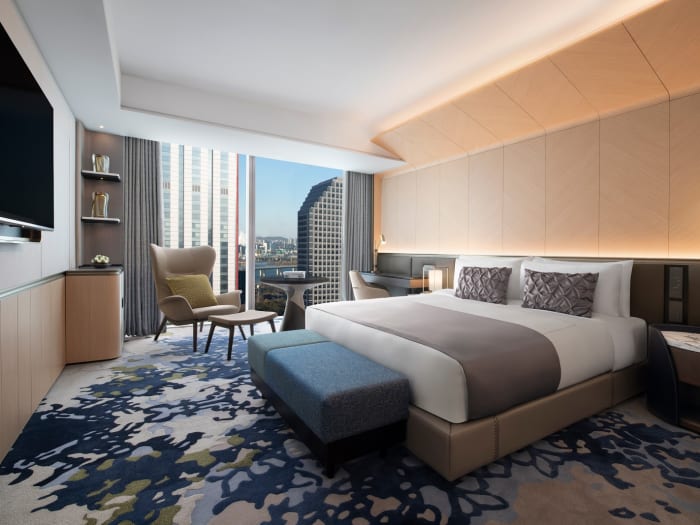
In a major urban hotel, the room is never merely a place to sleep. It must absorb the noise of the outside world, restore a more intimate scale and offer a sense of continuity after days that are often fragmented. At Fairmont Ambassador Seoul, one may expect this private realm to extend the property’s broader promise: contemporary comfort, carefully considered lines and immediate legibility. Luxury here lies not in decorative display, but in the quality of the experience once the door is closed.
For the business traveller, that means a space in which one can prepare efficiently as well as decompress after a day of meetings. For the leisure guest, the room becomes a point of re-centring between two sequences of city life. In both cases, the essential quality lies in the balance between function and rest. A good room in a Seoul grand hotel should allow one to work for a while, rest properly, unpack without effort, move freely and recover, at the end of the day, a sense of order. It is often this well-executed simplicity that distinguishes dependable properties from more demonstrative addresses.
Suites, when chosen, extend that logic through additional space and a clearer separation of uses. They are particularly well suited to longer stays, to trips combining professional obligations with personal time, or to travellers who wish to receive guests in a more generous setting. In a dense city such as Seoul, a few extra square metres often change the quality of a stay. One gains rhythm, comfort in preparation, privacy and flexibility.
Beyond size, it is the service details that matter. Daily housekeeping and turndown service contribute to that very specific sensation associated with well-run grand hotels: the feeling of a space that quietly resets itself. One leaves the room for an active day; one returns later to find it ready to accommodate another tempo, slower and calmer. That ability to support transitions is one of the most convincing forms of contemporary luxury.
The comfort of a room is also measured by what it allows one not to think about. Not worrying about luggage thanks to smooth organisation, not losing time over logistical details, not being constrained by a space poorly adapted to the real duration of the stay: these elements, taken together, transform the experience. In a hotel such as Fairmont Ambassador Seoul, this discreet mastery is precisely what one expects, this ability to make use feel simple and natural.
For couples, the room becomes a refuge within an energetic city. For solo travellers, it offers a calming neutrality. For business stays, it serves as a comfortable operational base, serene enough to move from a call to a moment of rest without friction. It is this versatility, more than any stylistic flourish, that gives value to high-end accommodation in a metropolis such as Seoul. A successful room there is not only attractive or well equipped; it makes the stay feel more exact.
Dining
In a capital such as Seoul, dining extends far beyond the walls of any hotel. The city possesses a culinary culture of remarkable density, where popular traditions, refined Korean cuisine, international influences and highly animated neighbourhood scenes coexist. For a property such as Fairmont Ambassador Seoul, the challenge is therefore not simply to feed its guests, but to offer a coherent reading of that urban standard. A grand hotel’s food and beverage offering must be reliable, elegant and flexible enough to answer very different uses throughout the day.
In the morning, the expected experience is that of a breakfast that sets the tone for the stay: smooth service, a comfortable environment and a controlled rhythm. In a hotel welcoming an international clientele, this moment matters particularly, as it must reconcile efficiency with pleasure. Guests seek not only quality of welcome, but also the ability to begin the day without friction, whether heading to a meeting or setting out to explore. Luxury here is expressed through precision of organisation and the feeling that everything is in its place.
At lunch or dinner, the hotel table takes on another function. It becomes an obvious option for travellers wishing to save time, host in a polished setting, or simply allow themselves a pause without leaving the property. In a city as active as Seoul, that possibility has real value. After a full day, it is reassuring to find a culinary offering immediately at hand without giving up a certain level of expectation. Major international hotels are often judged on this point: their ability to provide cuisine that is clear, well executed and suited to a cosmopolitan clientele, while allowing room for local accents where appropriate.
The value of a good hotel restaurant also lies in its capacity to support the different registers of a stay. A business meal does not call for the same atmosphere as dinner for two; a light pause between appointments has little in common with a more settled moment at the end of the day. The property must therefore offer, if not a multiplicity of venues, at least a degree of flexibility in use. It is this versatility that distinguishes dining that is merely convenient from dining that becomes part of the experience.
At Fairmont Ambassador Seoul, one may reasonably expect this kind of control: spaces in which guests are happy to linger, attentive service without excess, and a culinary approach conceived for travellers who alternate between speed and slowing down. In the context of Seoul, this matters all the more because the city is constantly stimulating. The hotel must then provide a counterpoint, not by opposing the energy outside, but by translating it into a calmer language.
For some guests, dining will be a simple logistical support. For others, it will become a daily ritual, a stable reference point within a changing programme. In both cases, it contributes to that overall impression of a well-composed grand hotel: a place where one may decide, according to mood and schedule, either to plunge fully into the city or remain within a controlled setting, without feeling that anything essential has been sacrificed.
Wellbeing & the rhythm of the stay
In a high-end urban hotel, wellbeing does not necessarily depend on the presence of a spectacular spa. It lies first in the way the property allows the stay to be regulated. In Seoul, this question is particularly acute. The city is stimulating, fast, dense and often extends late into the evening. One walks a great deal, moves through multiple sequences and shifts from one world to another with notable intensity. In this context, a grand hotel must provide points of balance: moments, spaces and services that help restore physical and mental availability.
Fairmont Ambassador Seoul lends itself well to this reading of wellbeing as the art of transition. The comfort of the shared spaces, the expected quality of the rooms, the fluidity of services and the presence of a readily available concierge all contribute to the feeling of a better-managed stay. Rest does not depend only on a massage or treatment; it also arises from the absence of unnecessary friction, from the ability to re-centre quickly, and from returning to an ordered setting after the city.
For many travellers, the first luxury lies in being able to slow down without losing time. Returning to the hotel between appointments, allowing oneself a pause before dinner, organising the day with greater flexibility, benefiting from turndown service that subtly changes the atmosphere of the room at the end of the evening: these simple gestures profoundly alter the quality of a stay. Contemporary wellbeing, especially in a major capital, often belongs to this discreet intelligence rather than to any overt ritual.
Business travellers are particularly sensitive to this. After hours of meetings, transport and constant demands, they seek less a decorative setting than effective recovery. Couples, meanwhile, appreciate the possibility of introducing slower moments into an urban programme that can otherwise become very dense. As for visitors discovering Seoul, they quickly understand the value of a hotel capable of acting as a restorative base, a place where one can catch one’s breath before setting out again.
If the property offers dedicated wellness facilities, these make full sense within that wider logic: not as decorative extras, but as a natural extension of comfort. And even without detailing every feature, one may say that a hotel of this category is expected to provide a regenerative experience, whether through calm interiors, sleep quality, attentive staff or ease of use.
This is perhaps one of the most convincing traits of well-conceived urban luxury: it does not promise to suspend the world, but to soften its impact. At Fairmont Ambassador Seoul, wellbeing can be understood as an architecture of the stay. It resides in successful transitions, in calmer returns, in the feeling of being able to inhabit the city intensely while retaining a centre of gravity. For the contemporary traveller, that quality often matters more than any emphatic discourse on relaxation. It makes the stay not only more comfortable, but more enduring in its effect.
Concierge & Services
What sets a great hotel apart from a mere nice address is the quality of its services. At Fairmont Ambassador Seoul, this aspect is of paramount importance.
The 24-hour concierge and continuously open reception cater to the needs of today’s travellers. Late arrivals, early departures, and changes in plans are seamlessly accommodated. In an international city like Seoul, this availability shapes the entire stay.
A well-thought-out concierge service goes beyond practical matters. It assists in selecting neighbourhoods, organising transportation, and crafting a coherent itinerary. For first-time visitors to Seoul, this support can transform the travel experience immediately.
Daily room service, turndown service, luggage storage, laundry, and wake-up calls extend this philosophy. Together, they create a discreet and continuous comfort, allowing travellers to focus on what truly matters, free from unnecessary friction.
The presence of multilingual staff is equally significant. In an international hotel, the quality of communication influences the accuracy of requests and the appropriateness of recommendations. In Seoul, this clarity facilitates every step of the stay.
These services benefit both business travellers and leisure guests alike. The former find a reliable environment, while the latter save precious time in organising their days and reservations.
Good service is also measured by its tone. The attention remains discreet, the efficiency flexible, and the precision unyielding. At Fairmont Ambassador Seoul, the announced services create a consistently supportive experience characterised by simplicity and professionalism.
The Seoul way of life
Seoul resists summary. The city juxtaposes periods, uses and intensities with unusual freedom. In the course of a single day, one may move from a heritage site to an ultra-contemporary shopping avenue, from a discreet café to a department store, from a business district to a more contemplative walk. It is precisely this mixture that makes Seoul such a compelling destination, but also a demanding one. To experience it well, one needs a base capable of simplifying movement and bringing order to the stay. Fairmont Ambassador Seoul answers that need through its central position and its deliberate integration into the urban fabric.
The Seoul way of life owes much to this capacity for movement. The city rewards travellers who are curious, mobile and attentive to shifts in atmosphere. One does not come only in search of monuments; one observes rhythms, habits, contrasts of light and ways of inhabiting space. A well-located grand hotel makes it possible to absorb that richness without becoming scattered. It provides a stable framework from which guests may compose their own reading of the capital according to their interests and their energy at a given moment.
For some, Seoul will first be a city of culture, with its institutions, historic districts and creative scenes. For others, it will reveal itself through design, fashion, gastronomy, major retail complexes or urban walks. Many also come for its efficiency: transport, organisation and a very tangible sense of modernity. What is striking, ultimately, is the way the city combines sophistication with everyday use. Refinement here is not always ceremonial; it often appears in the quality of details, in attention to service and in the fluidity of movement.
Staying at a hotel such as Fairmont Ambassador Seoul allows one to enter that logic without undue effort. Thanks to proximity to public transport and practical access to business districts, valuable time is gained and may be reinvested in more personal experiences. A morning may begin with a visit, continue with lunch in another neighbourhood, give way to shopping or an appointment, and end in a calmer setting back at the hotel. That flexibility is one of Seoul’s great luxuries when properly prepared.
It is also worth accepting that the city reveals itself in layers. It does not give everything at once. Its charm often arises from repetition, from returning, from comparing neighbourhoods and from observing the details of everyday life. A central hotel helps precisely with that gradual reading. It allows guests to return, set out again and change plans without excessive penalty. It turns the capital into a practicable territory rather than a merely impressive backdrop.
From this perspective, Fairmont Ambassador Seoul is not only a comfortable address; it becomes a tool for the stay. It supports a way of experiencing Seoul that privileges precision over accumulation. Seeing less, but seeing it better. Moving intelligently. Alternating intensity with withdrawal. For a discerning traveller, the Seoul way of life may well reside there: in the ability to embrace the city without being overwhelmed by it, relying on a hotel that genuinely understands its rhythm.
Book with MyConciergeHotel
Choosing Fairmont Ambassador Seoul through MyConciergeHotel means approaching the stay with an editorial logic rather than a simple booking mindset. In a destination as active as Seoul, that distinction matters. A central, well-equipped hotel provides an excellent base, but the true quality of a trip often depends on how the details are prepared: arrival times, visiting priorities, useful reservations, the structure of each day, and the balance between obligations and free time. Booking intelligently is already a way of travelling better.
The value of concierge-style support begins before departure. It allows guests to anticipate what should be anticipated without overloading the programme. In Seoul, certain experiences benefit from advance thought: dinners at precise hours, business appointments, shopping sequences, visits organised by neighbourhood, and moments of rest placed at the right time. A successful stay is not necessarily the one in which the most is done, but the one in which transitions are fluid. This is especially true in a metropolis where psychological distances can feel greater than they really are if one improvises badly.
MyConciergeHotel brings precisely this reading of rhythm. For a couple, it may mean a more balanced programme, alternating discoveries with quieter intervals. For a business traveller, it often means optimising dead time, securing practical arrangements and preserving a few breathing spaces. For a first stay, such support helps prioritise desires. For a return visit, it allows the experience to be refined, moving towards more personal uses of the city.
Booking through an attentive interlocutor also offers a very concrete advantage: coherence. Rather than accumulating options, one builds a stay adapted to the traveller’s profile. The hotel, its location, its services and the city’s tempo are considered together. This editorial approach is particularly relevant for Fairmont Ambassador Seoul, whose strength lies precisely in its ability to act as a pivot between several ways of using Seoul. One still needs to know how best to make use of that position.
The role of MyConciergeHotel is not to overpromise, but to clarify. To say what is worth booking in advance. To advise on the right time slots. To avoid overburdened days. To take account of the realities of the stay, whether it is a short stop, a business trip or a more expansive city break. In the luxury segment, this precision often matters more than an accumulation of standardised attentions. It creates a rare feeling: that of a journey which seems simple because it has been well conceived.
Fairmont Ambassador Seoul is particularly well suited to this kind of tailored preparation. Its dynamic urban setting, practical access to business districts and transport, and the expected quality of its services make it an address that can easily be personalised according to need. Booking through MyConciergeHotel therefore means choosing more than a room: it means choosing a way of staying in Seoul with greater precision, comfort and clarity. In a city of such richness, that sense of order is already a form of luxury.