History & Presence in Amman
In Amman, luxury hospitality often reflects the city itself: a capital in motion, at once political, economic and cultural, where layers of Levantine history coexist with a distinctly modern outlook. Fairmont Amman belongs to this contemporary reading of the city. More than a place to stay, it expresses a certain idea of urban luxury in the Middle East: one defined by ease, measured comfort and service, designed for travellers who expect efficiency as much as elegance. In a capital where stays frequently combine business appointments, cultural visits and social engagements, the hotel occupies a distinctive place thanks to its central position and cosmopolitan character.
The Fairmont identity provides an immediately recognisable framework. Internationally, the brand is associated with hotels that favour a form of contemporary classicism: thoughtful architecture, public spaces designed to be lived in, and close attention to the rhythm of a stay rather than decorative excess. In Amman, this approach takes on particular relevance. The city does not always reveal itself at first glance; it is discovered through its hills, neighbourhoods, cafés, institutions and contrasts between pale stone, busy roads and genuine hospitality. A hotel of this level must therefore act as an interface: sheltering guests from the city’s intensity without disconnecting them from the destination.
Fairmont Amman answers this expectation with a presence that feels designed for multiple uses. One can just as easily imagine a business stay structured around meetings as a family trip organised around excursions, or a short urban break before exploring the rest of Jordan. This versatility does not diminish its identity; it defines it. In a city that welcomes diplomats, entrepreneurs, families in transit, leisure travellers and regional visitors, the ability to serve different guest profiles without losing coherence is an essential quality.
Understanding Amman also helps explain what a hotel like this represents. The Jordanian capital does not rely on immediate spectacle in the way some regional metropolises do. Its appeal lies more in its topography, its viewpoints, its residential quarters, the softness of late afternoons, the proximity of major heritage sites and a deeply rooted culture of welcome. A grand hotel here becomes a privileged vantage point on this particular urbanity: more understated than ostentatious, more relational than theatrical. Fairmont Amman fits this logic as a refined city address designed to accompany the pace of an active capital.
What ultimately stands out is a sense of relevance. The hotel does not attempt to imitate a historic residence or invent a heritage narrative that is not its own. Its legitimacy comes from elsewhere: from its place within contemporary Amman, from its ability to provide a clear and highly comfortable setting, and from a service promise aligned with present-day expectations. In a capital where visitors often come to combine efficiency, representation and discovery, this address holds its place with assurance. It belongs to that generation of hotels that understands that true urban luxury often lies in the quality of the overall experience: a smooth arrival, well-conceived spaces, reliable dining options, constant service and the feeling of being immediately at ease.
The Hotel
Fairmont Amman is defined first by its location in the heart of the city, a major advantage in a capital where travel times can quickly shape the day. Being central here is not merely a geographical convenience; it is a way of experiencing Amman with greater ease. From the hotel, guests can more readily reach business districts, dining addresses, selected cultural venues and the main roads leading both to the city’s landmarks and, beyond them, to the wider stages of a Jordan itinerary. For business travellers, this means a tangible saving of time. For leisure guests, it allows days to be planned without cumbersome logistics.
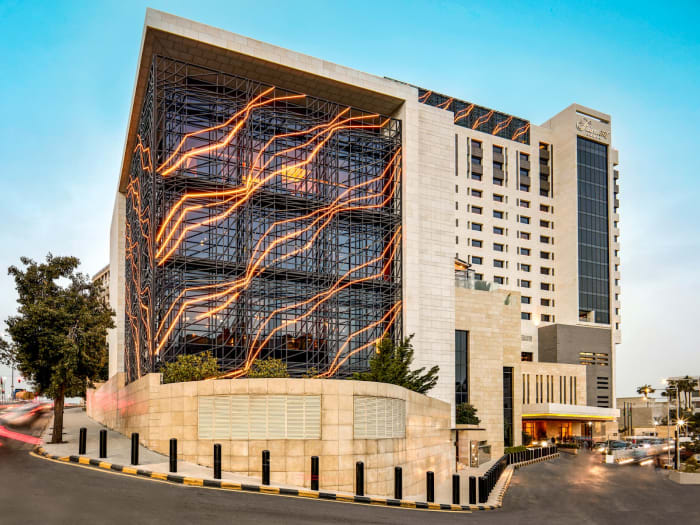
The hotel speaks a contemporary language in keeping with the image of a modern, international Amman. It offers what one expects from a major urban hotel of this calibre: public spaces designed for movement, volumes capable of accommodating both representational moments and quieter pauses, and an atmosphere in which refinement does not come at the expense of usability. Luxury here is expressed through quality of execution, coherence of mood and the sense that each space has been conceived to support a particular moment: arrival, meeting, pause, dinner, return from the city.
This clarity matters in Amman. The capital can be dense, active and at times rhythmically intense. Returning to a hotel that creates a clear transition between the energy outside and a calmer interior world changes the experience of a stay considerably. Fairmont Amman appears to answer this expectation with an elegant yet welcoming atmosphere, formal enough for professional use, but warm enough never to intimidate families or travellers simply wishing to enjoy the destination. It is a delicate balance, and often where the success of a great city hotel is decided.
Its well-equipped meeting spaces are part of this identity. They clearly signal that the hotel knows how to host a corporate and institutional clientele, with all the demands this entails in terms of organisation, discretion and comfort. Yet this business dimension does not define the property entirely. It coexists with an offer designed for more personal stays: several dining options, continuous services and an ambience suited to unwinding at the end of the day. This coexistence of uses gives the hotel a particular depth. Guests do not come for one reason alone; they find a setting capable of absorbing different tempos.
For families, the central location and children’s activities are a genuine advantage. In a city that can feel unfamiliar on a first visit, knowing that the hotel also considers younger guests makes the stay easier to plan. For couples, the appeal lies more in the quality of the urban retreat: the possibility of dining on site, slowing the pace and then setting out again to explore the city on one’s own terms. Solo travellers, meanwhile, find an environment that is legible, practical and reassuring, with the constant presence of staff and the flexibility of a major international hotel.
Fairmont Amman is therefore best understood as a true city address: not simply an upscale place to sleep, but a base from which to organise, meet, discover and rest. In a capital as nuanced as Amman, this ability to combine centrality, comfort and versatility often matters more than spectacle. It gives the stay its fluency, and in contemporary luxury, that fluency makes all the difference.
Rooms & Suites
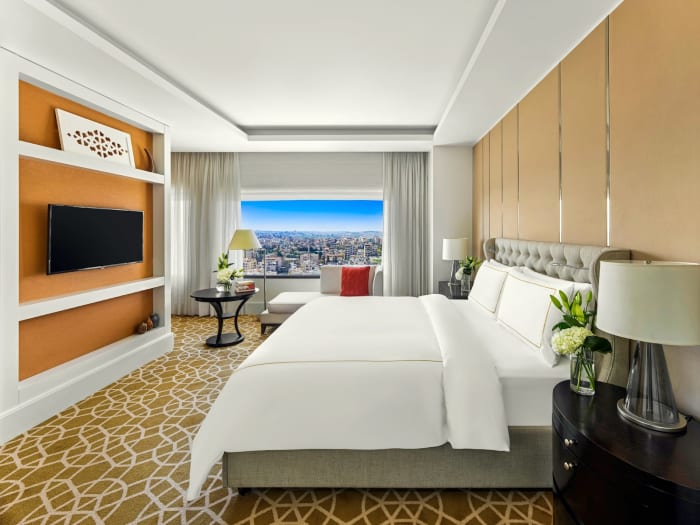
In a major city hotel, a room is never merely a place to sleep. It becomes a decompression space, a temporary office, a refuge after traffic and appointments, and sometimes the true centre of gravity of the stay. At Fairmont Amman, this expanded role seems especially important. The clientele the hotel attracts — business travellers, families, couples, visitors in transit or on a discovery trip — needs accommodation able to adapt to varied uses without losing coherence. That is precisely what one expects from an international address of this calibre: rooms and suites designed to be as pleasant to inhabit as they are efficient in daily use.
The declared register is one of modern, refined comfort. This suggests a contemporary, legible aesthetic without excess, where materials, light and ergonomics matter more than decorative effect. In Amman, such elegant restraint makes perfect sense. After a day spent between meetings, urban traffic, cultural visits or excursions, spaces that immediately calm the senses are particularly welcome. A good grand-hotel room does not try to compete with the city; it offers a counterpoint instead: relative quiet, controlled temperature, quality bedding, a functional bathroom, sufficient storage, thoughtful lighting and that essential feeling that everything is in its place.
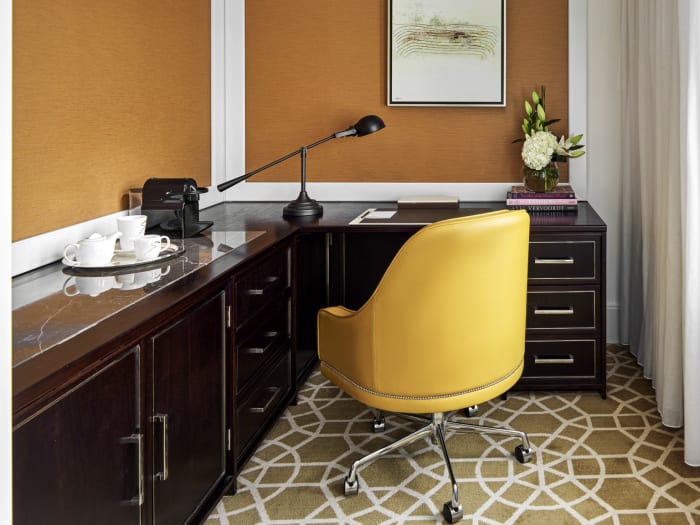
For business travellers, the room must also allow the day to continue smoothly. One expects a setting conducive to concentration, comfortable seating, simple organisation and the possibility of preparing for a meeting or answering a few messages without feeling trapped in a purely utilitarian space. Fairmont Amman, by virtue of its positioning, appears to answer this logic of the versatile room, capable of accommodating both recovery and light work. It is often underestimated, yet decisive in the overall appreciation of a professional stay.
Families assess accommodation differently. They look for space, practicality, easy circulation and, above all, a sense of serenity. In a hotel said to suit families, the room or suite must make it possible to settle into a simple rhythm at the end of the day: pausing, planning the next day and managing children’s rest times without complication. Even without detailing precise categories, it is clear that the address has been conceived with these uses in mind, which is not always the case in large hotels with a strong corporate focus.
For couples, the appeal lies elsewhere: in the room’s ability to become a pause. Discreet luxury is then measured in very concrete elements — the quality of linens, turndown service, impeccable daily housekeeping, a sense of privacy — rather than in overt display. Turndown service, in particular, belongs to that hotel ritual which transforms the return to one’s room into a moment of transition, almost a settling of the senses. It is a detail, but in the world of five-star hospitality, details shape memory.
Suites generally extend this promise with greater ease, whether for briefly receiving visitors, staying longer or simply enjoying additional space. In a city such as Amman, where stays can be hybrid and schedules change quickly, this flexibility has real value. The rooms and suites at Fairmont Amman are therefore best understood as temporary living spaces designed to accompany the different faces of contemporary travel: work, rest, discovery and shared time. It is this adaptability, more than any grand statement, that defines high-end comfort here.
Dining
In a capital such as Amman, hotel dining plays a more important role than one might initially assume. The city has its own food scene, made up of local addresses, contemporary tables, cafés and social meeting places, but a grand hotel must also respond to a very simple reality: not every guest has the desire or the time to go out for every meal. Fairmont Amman clearly understands this by offering several dining options, an essential point for a clientele with varied rhythms. This culinary plurality is not a mere extra; it forms a central part of the stay, especially in a property welcoming business travellers, families and urban leisure guests alike.
The diversity of dining venues first allows moments to be modulated. Breakfast does not call for the same atmosphere as a business lunch, a more settled dinner or a light bite between appointments. In a hotel of this category, quality is measured as much by this ability to adjust as by what is on the plate. One expects legible settings, attentive service, consistent execution and the possibility of choosing according to mood, available time or the context of the stay. In Amman, where days can be full, such flexibility becomes a real luxury.
The advice to reserve a table at the main restaurant upon arrival says something important: the hotel’s dining spaces are sufficiently sought after to shape the life of the house. This suggests an address that does more than simply feed its residents; it contributes to the rhythm of the stay. In contemporary grand hotels, dining is no longer an ancillary service; it is often a place of sociability, meetings and pause. Guests gather there after a day of visits, extend a professional conversation or choose to dine without having to rethink the logistics of the evening.
For business travellers, having several options on site is particularly valuable. It allows the day’s sequences to flow more easily, makes it possible to arrange an informal meal without leaving the hotel and simply saves time. For families, this variety offers a very concrete form of comfort: everyone can find a rhythm and a format that suits them, without turning each meal into an expedition. For couples, meanwhile, on-site dining contributes to the quality of the urban retreat. Being able to choose to remain at the hotel for dinner, in a carefully considered setting, is often one of the simplest and most appreciated pleasures of a city stay.
One may also reasonably expect that in Amman, the dining offer of a grand hotel engages in a discreet dialogue with the regional context: a sense of welcome, measured generosity, attention to sharing and to the tempo of a meal. Without over-interpreting, it is fair to expect from such an address a cuisine capable of speaking to an international clientele while remaining sensitive to the place in which it stands. It is often in this balance that authenticity lies: offering an experience that is accessible, elegant and sufficiently rooted not to feel interchangeable.
At Fairmont Amman, dining therefore appears to be one of the pillars of the stay. It supports the constraints of business travel, simplifies life for families, offers couples more intimate moments and gives everyone an additional reason to enjoy the hotel fully. In a major capital, eating well on site is never incidental. It is a way of making the stay smoother, more enjoyable and more complete — in other words, more considered.
Concierge & Services
What enduringly distinguishes a grand hotel from a merely upscale place to stay is often the quality of its invisible services: those one barely notices when they work perfectly, yet whose absence is immediately felt. At Fairmont Amman, this dimension appears to be fundamental. The presence of a 24-hour concierge and a round-the-clock front desk sets the tone: the stay is conceived as a fluid experience, able to absorb time differences, late arrivals, changing plans and last-minute requests — all part of the daily reality of international travel.
In a capital such as Amman, this permanent availability has real value. Stays here are often composite. Some guests arrive for an early meeting the next day, others return from an excursion, while others are organising a wider Jordan itinerary with specific logistical needs. Being able to rely at any hour on reception and concierge teams changes one’s relationship to travel. It allows part of the organisation to be delegated, information to be obtained, details to be adjusted, assistance to be requested or simply for guests to feel supported in an environment they do not yet know fully.
Daily housekeeping and turndown service belong to the same logic of consistency. In luxury hospitality, comfort is not only a matter of facilities; it depends on the regularity with which the hotel takes care of the stay. A room maintained with precision, reset at the right moment and prepared for the night creates a very particular sense of continuity. The traveller does not have to think about practicalities: each evening, the room is ready to receive them. This apparent simplicity is the result of rigorous organisation, and it remains one of the surest markers of genuine service.
Luggage storage, laundry and wake-up service also belong to those attentions that may seem modest yet become decisive in practice. Luggage storage facilitates early arrivals and late departures, especially useful when working around flight schedules. Laundry becomes particularly valuable during longer stays, consecutive business trips or broader journeys through the country. As for wake-up service, it remains a classic of international hospitality, less anecdotal than it may seem when an important meeting, an early departure or a scheduled excursion requires absolute reliability.
The presence of multilingual staff is equally significant in an address welcoming an international clientele. Beyond simple translation, it implies an ability to understand expectations, prevent misunderstandings and establish trust immediately. In a city where guests may need help arranging transport, understanding local habits or adjusting a programme, this relational competence is invaluable.
Finally, the hotel’s well-equipped meeting spaces complete this service framework. They show that the property does not merely host business travellers; it also provides the conditions required to work, receive and represent. Yet once again, the appeal of Fairmont Amman lies in its ability to combine this professional efficiency with an atmosphere flexible enough to suit families and leisure stays. This is the strength of a contemporary grand hotel: solid, available and discreet services capable of supporting every travel scenario without ever weighing down the experience.
The Amman Way of Life
Staying at Fairmont Amman also means choosing a particular way of entering the Jordanian capital. Amman is not visited like a static museum city; it is experienced in sequences, through neighbourhoods, viewpoints and contrasts. Its way of life lies less in immediate spectacle than in an accumulation of sensations: light on pale stone, hills that reshape every route, cafés where one lingers, the coexistence of daily life and history, the courtesy of exchanges and that sense of a city lived in before it is staged. A well-located hotel makes it possible to grasp this subtlety without undue effort.
Spring and autumn are often regarded as the most pleasant seasons in which to discover Amman, and it is easy to understand why. The climate lends itself to gentler exploration, whether wandering between districts, reaching historical sites or extending the day on a terrace. In this context, a centrally located property becomes a genuine strategic advantage. It allows guests to set out in the morning without an overly rigid plan, return for a pause and then head out again for dinner or to discover another face of the city. This breathing between outside and inside forms part of the pleasure of a successful stay.
Amman also has the rare quality of being both a destination in itself and a gateway to the rest of the country. Many travellers pass through before continuing towards other Jordanian landscapes, yet the capital deserves to be experienced properly. Its interest lies not only in monuments or institutions, but in its urban fabric, its habits and the way it blends regional influences with contemporary life. From a hotel such as Fairmont Amman, this dimension becomes particularly legible. Guests are not cut off from the city; rather, they have a comfortable base from which to observe its rhythms and organise their discovery.
For business travellers, this way of life may seem secondary, yet it often transforms the perception of a stay. A well-chosen dinner, a calmer late afternoon, a few hours to see a neighbourhood or absorb the local atmosphere can be enough to turn a work trip into something richer. For families, Amman can be both reassuring and stimulating, combining international reference points with local distinctiveness. For couples, the city offers a setting suited to stays that alternate visits, pauses and more intimate moments.
The hotel supports this discovery through its welcoming atmosphere and continuity of service. This matters, because a city’s way of life is not defined only by what happens outside. It also depends on the quality of the return: the moment one finds a calm place again, can dine without complication, ask for advice, prepare the next stage of the journey or simply let the pace subside. Fairmont Amman seems to play this relay role with accuracy: sufficiently anchored in urban life to extend its energy, yet sufficiently protective to offer a genuine pause.
To discover Amman from this address is therefore to adopt a balanced approach to the city. Neither forced immersion nor complete withdrawal, but a fluid circulation between local experience and international comfort. For many travellers, this is exactly the right distance: the one that allows a capital to be understood without becoming fatigued by it, and appreciated for what is most lasting about it — its measure, its hospitality and its discreet depth.
Book with MyConciergeHotel
Booking Fairmont Amman through MyConciergeHotel means approaching the stay not as a simple transaction, but as an experience to be prepared with discernment. In an urban address of this calibre, the quality of the trip is often decided before arrival: choosing the right period, understanding the rhythm of the city, anticipating meals, balancing professional obligations with time for discovery, considering a family’s practical needs or the more intimate expectations of a stay for two. Editorial and concierge guidance therefore becomes particularly meaningful, because it transforms a booking into a genuinely considered stay.
Amman requires a certain degree of prior reading in order to be appreciated properly. The city is not difficult; it is nuanced. It helps to choose a centrally located hotel, to allow for pauses and to organise key moments without overloading the schedule. Fairmont Amman is especially well suited to this approach. Its position in the heart of the capital, several dining options, well-equipped meeting spaces and profile that is both business-friendly and family-friendly make it an easy address to recommend, provided the stay is well calibrated. This is precisely where an accompanied booking makes the difference.
For a business trip, it may be wise to anticipate arrival times, concierge needs, meeting schedules and on-site dinners in order to reduce friction. For a family stay, the challenge lies more in defining the ideal length, the right rhythm between outings and time at the hotel, and the services that simplify logistics. For a couple, the value often lies in more discreet orchestration: reserving a table upon arrival, preserving moments of pause and receiving advice on the best times to discover the city. In every case, the aim is not to over-plan, but to make the stay smoother and more accurate.
The Concierge’s advice to reserve a table at the main restaurant quickly illustrates this philosophy well. Practical details, when anticipated, profoundly change the perception of a stay. Avoiding a wait, securing dinner on the evening of arrival, knowing that certain services are available at all hours: all these elements reduce the traveller’s mental load and leave more room for the experience itself. Contemporary luxury often lies precisely there, in the removal of unnecessary friction.
MyConciergeHotel also makes it possible to place the hotel within its proper context. Booking a room is not always enough; one must also understand who the address suits, what type of trip it answers best and how to make the most of it. Fairmont Amman appears to be a particularly coherent choice for those seeking a central, elegant and reliable base in Amman, with a genuine ability to absorb different uses. It is an address suited to demanding business stays, but equally to leisure travel wishing to maintain a high level of comfort and service.
Booking through MyConciergeHotel is therefore not only about accessing a major international address, but about benefiting from an editorial perspective capable of revealing its most appropriate use. In a city such as Amman, that precision matters. It allows travellers to move with greater confidence, to use their time better and to enter the destination at the right pace. Fairmont Amman can then be appreciated for what it truly is: an excellent urban base, practical, refined and remarkably adaptable.