History & heritage
In Amman, luxury hospitality takes on a particular tone. Jordan’s capital is not a museum city defined by a single period, but an urban landscape of hills, residential districts, diplomatic addresses, contemporary cafés and historical layers revealed in fragments. In that context, The St. Regis Amman belongs less to a classical European notion of heritage than to a refined tradition of hospitality, shaped by international expectations yet rooted in a Levantine capital where welcome remains a central value. The hotel draws on the codes of the St. Regis brand, known for discreet ceremony, butler service and a carefully orchestrated sense of stay.
Its true heritage lies as much in the house style as in its place within a city that has long functioned as a crossroads between Arab, Mediterranean and international worlds. In Amman, business travellers meet cultural visitors, regional families and guests en route to other Jordanian landscapes. The St. Regis Amman responds to that diversity with a language of contemporary elegance: polished public spaces, structured service, a hushed atmosphere and the ability to reconcile the pace of a capital with the feeling of a well-run retreat.
The hotel should also be understood through the role major international addresses now play in Middle Eastern capitals. They are not simply places to sleep; they become urban reference points, meeting salons, business settings, weekend refuges and logistical bases for exploring the city. In that sense, The St. Regis Amman does not attempt to imitate an old palace. Instead, it offers a current reading of the grand hotel: interiors designed to impress without excess, fluid circulation, staff trained to anticipate needs, and a sense of detail expressed through daily gestures rather than display.
The St. Regis legacy is equally visible in the rhythm of the stay. Guests are not merely accommodated; they are looked after. That is reflected in service rituals, round-the-clock reception, continuous concierge support and the impression that the hotel can adapt to very different profiles without losing its identity. Couples, families, business travellers and longer-stay guests all find a coherent setting in which luxury is measured by ease.
Ultimately, the story of The St. Regis Amman is that of a contemporary address inserted into an ancient, evolving city. Its heritage is not that of a monument, but of an international hotel tradition interpreted at the scale of Amman: a capital that is restrained, cultivated and often more subtle than it first appears, and whose finest addresses know how to combine reserve, comfort and hospitality.
The Establishment
One of the foremost advantages of The St. Regis Amman lies in its central location. In a city built on several hills, a well-situated neighbourhood profoundly alters the experience. The hotel allows for relatively easy access to business districts, embassies, dining establishments, and some of Amman's points of interest. This centrality is not merely practical; it also fosters a sense of truly inhabiting the city rather than merely passing through.
Upon arrival, the prevailing impression is that of a grand urban hotel designed to provide a stark transition between the bustling exterior and a more controlled environment. The communal spaces play a crucial role here. They serve not only as a backdrop but also as a breath of fresh air. The lobby, lounges, waiting areas, and circulation spaces create a welcoming atmosphere. The volumes, materials, and light contribute to a sensation of measured calm. In an active capital, this quality of ambiance is as significant as the list of amenities.
The St. Regis Amman is particularly well-suited for those seeking a versatile base. Business travellers find an environment conducive to meetings, quick transitions between appointments and relaxation, as well as the need for privacy. Couples appreciate the well-maintained spaces, the quality of service, and the opportunity to return to a serene setting after a day in the city. Families also find their place here, thanks to a flexible organisation that accommodates various travel rhythms.
What often distinguishes major urban addresses is not the spectacular display but the coherence. Here, it manifests through a clear understanding of contemporary expectations. Accessibility, comfort, attentive staff, on-site meeting spaces, and a sophisticated atmosphere come together seamlessly. The hotel is equally suitable for a tightly structured short stay or a more open few days, balancing meetings, cultural discoveries, and moments of retreat.
In Amman, the experience of a hotel heavily depends on its ability to absorb the city's rhythm. The St. Regis Amman seems designed for this purpose. It embodies the codes of a high-level international establishment, adapted to a capital where social, professional, and family life constantly overlap. The address thus functions as an elegant filter, connecting the visitor to the city without exposing them to its intensity continuously.
Rooms and Suites
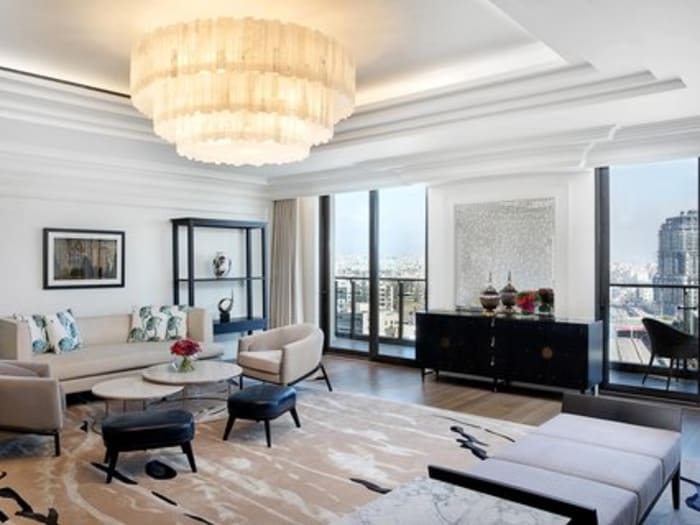
In a hotel of this calibre, the room is not merely a place to sleep; it becomes the gravitational centre of the stay. At The St. Regis Amman, the rooms and suites extend the promise of the communal spaces. Elegance, contemporary comfort, precise organisation, and a sense of retreat.
The identity of the establishment hints at accommodations suited for varied uses, from highly structured business stays to more relaxed visits for couples or families.
In a capital like Amman, relative calm often ranks among the top criteria. A good urban room is not just aesthetically pleasing; it must allow guests to reclaim their time. This is achieved through high-quality bedding, careful soundproofing, a bathroom designed for daily comfort, and a clear layout. Work, rest, and preparation times each find their place.
In an establishment catering to business travellers, this clarity of space is essential. One should be able to open a laptop, take an important call, change before dinner, or simply unwind after a busy day.
For couples, the appeal of a St. Regis room often lies in the continuity between refinement and intimacy. Nothing needs to be ostentatious. The materials, lighting, and service create a coherent ensemble. The turndown service contributes to this culture of detail, transforming the return to the room into a moment of transition. The daily housekeeping also maintains an impression of order and freshness, which is particularly appreciated during multi-night stays.
The suites follow a complementary logic. More space, greater separation between reception and rest areas, and better adaptability for families or hosting guests. In a city like Amman, where stays often blend professional imperatives with private moments, this flexibility holds real value. It allows guests to inhabit the hotel in a less transient, almost residential manner, without sacrificing the services of a grand establishment.
Finally, the butler service adds a unique dimension to the in-room experience. It is not merely a prestige attribute but a tool for fluidity. Unpacking and repacking a suitcase, arranging laundry, adjusting certain details of the stay, or facilitating small everyday requests. This type of service alleviates the invisible logistics of travel. It is often here that true luxury is measured—not in accumulation but in the elimination of friction. At The St. Regis Amman, the rooms and suites thus emerge as spaces of gentle mastery, offering the expected comfort of a five-star establishment, with a precious serenity in the context of an active capital.
Dining
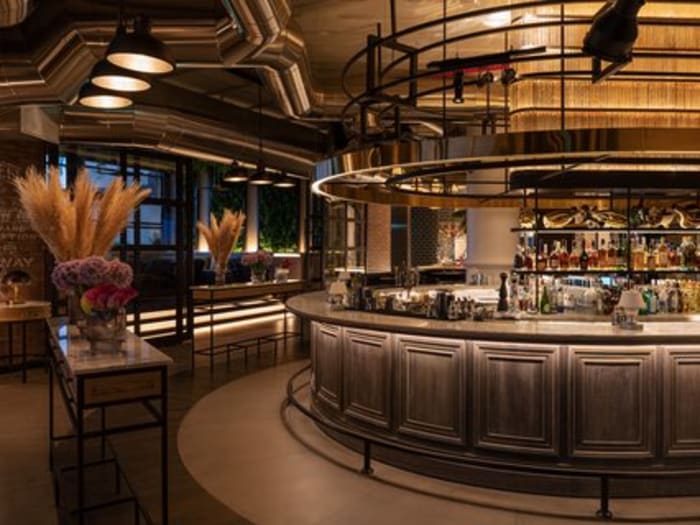
In a grand urban hotel, dining plays a broader role than that of a simple ancillary service. It structures the hours of the stay, provides meeting places, allows a meeting to continue, opens an evening or, conversely, offers a moment of retreat without leaving the property. At The St. Regis Amman, even without confirmed details on individual concepts or culinary signatures, dining can be read as one of the pillars of the overall experience. An address of this level in a capital such as Amman must balance several registers: efficiency for business travellers, an agreeable setting for couples, flexibility for families and consistently polished service at useful hours.
Breakfast deserves particular attention in this type of hotel. It is not merely a buffet or a menu, but a moment of orientation. In a city where days may begin early, a property’s ability to offer service that is smooth, well-paced and sufficiently varied is decisive. The hurried traveller expects punctuality and clarity; the guest with more time seeks atmosphere, morning light and a table at which to linger over coffee. The quality of a grand hotel is often measured by this dual ability: to serve quickly without seeming rushed, and to host leisurely without ever letting attention slip.
At lunch or dinner, dining in a St. Regis generally functions as a natural extension of the public spaces. One finds the same elegance, the same control of rhythm and the same ability to suit several uses without losing coherence. A business lunch requires discretion and precise service. A dinner for two calls for a different intensity, more hushed and more atmospheric. A family meal, meanwhile, demands flexibility without sacrificing standards. In a central Amman address, that versatility is especially important, as the hotel is likely to welcome both local and international guests with different yet equally high expectations.
It is also worth considering the role of in-room dining, even if it is not explicitly detailed. In a major five-star hotel, the ability to dine late, take coffee before an early departure or prefer the privacy of one’s room to the restaurant is part of the comfort itself. This is not spectacular luxury, but the luxury of availability. It aligns with the broader promise of the hotel: allowing the stay to unfold according to the guest’s rhythm rather than the other way round.
Finally, dining in Amman cannot be entirely separated from the local context. The city has a culture of generous hospitality, sharing, extended conversation and meals that also function as social bonds. A high-level international hotel need not reproduce all those forms, but it benefits from respecting their spirit. When service is attentive, spaces invite lingering and one senses an understanding of local habits, dining ceases to be merely functional. It becomes a language. At The St. Regis Amman, it is likely in this balance between international precision and a local sense of welcome that the dining experience finds its right tone.
Spa & wellness
Even when a stay in Amman is driven by business or a dense sightseeing programme, wellness is never secondary in a hotel of this category. It is not limited to the possible presence of a spa in the strict sense; it also includes the way the property helps travellers recover, slow down and regain a sense of balance. At The St. Regis Amman, this dimension appears to belong to a broader vision of comfort: quality of space, controlled service, a feeling of order, staff availability and the ability to organise one’s time without unnecessary friction.
In the best urban hotels, wellness often begins before any treatment. It lies in the ease of arrival, the possibility of leaving luggage, having the room prepared, requesting prompt laundry service or relying on a concierge available at any hour. All these elements, confirmed or suggested by the known amenities, contribute to a less fragmented experience. The body rests better when logistics cease to occupy the mind. It is an often underestimated truth, yet central to high-end hospitality.
If the hotel offers a dedicated wellness area, one may expect it to be conceived as a counterpoint to the city: quieter atmosphere, slower tempo, attention to gesture and privacy. In an active capital, a spa is not merely a place for treatments; it is a decompression device. It reintroduces long time into a stay that may otherwise be highly segmented. A massage after a flight, a facial before an evening out, a restorative pause between meetings: the uses vary, but the aim remains the same—restoring the traveller’s sense of availability.
For couples, this wellness dimension can become a structuring part of the stay, especially on an urban escape where one seeks to balance outings with moments of retreat. For business travellers, it takes another form: efficiency, discretion, ease of booking and an immediate benefit to the quality of rest. Families, meanwhile, tend to value properties able to maintain a serene atmosphere even when not everyone keeps the same pace.
More broadly, wellness in a St. Regis is also expressed through service culture. The butler, 24-hour reception, continuous concierge support, daily housekeeping and evening turndown create an environment in which guests feel looked after without feeling watched. That nuance is essential. True comfort is not staff omnipresence, but their sense of timing: being there at the right moment with the right answer, then stepping back.
Whether it takes the form of a full spa, relaxation facilities or simply a remarkably fluid hotel experience, wellness at The St. Regis Amman seems to rest on the same idea: allowing travellers to recover their own tempo. In a city of hills, traffic and appointments, that ability to recreate calm is far from incidental. It is part of the destination itself.
Concierge & services
It is often in the services, more than in the décor, that a grand hotel reveals its true level. On this point, The St. Regis Amman offers clear indicators: 24-hour concierge, 24-hour front desk, daily housekeeping, turndown service, luggage storage, laundry, butler service and wake-up service. Taken separately, these may seem expected in a five-star property. Taken together, they outline a more demanding promise: that of a stay without rough edges, in which every practical stage of travel is absorbed by the organisation of the house.
The round-the-clock concierge plays a central role. In a city like Amman, where transport, reservations, timings and local habits may require some anticipation, having a capable point of contact at any hour changes the quality of the stay. The concierge is not merely there to answer a single request; he or she acts as an interface between guest and city. This can mean helping to structure a day, arranging a transfer, suggesting a coherent route or simplifying the details that would otherwise scatter attention. The advice already present in the short description about booking airport transfers in advance illustrates this logic of ease before arrival.
The continuously staffed reception reinforces that sense of permanent availability. Late arrival, early departure, change of plans, administrative need or simple practical question: the traveller does not have to adapt to the hotel’s rhythm. The hotel adjusts to theirs. In luxury hospitality, that reversal is fundamental. It turns service into the invisible infrastructure of comfort.
The butler service adds a further layer of personalisation. It is not merely a status marker, but a form of support that can make a stay noticeably simpler. Handling personal effects, coordinating certain requests and assisting with daily organisation all help reduce the traveller’s mental load, especially on stays that combine meetings, outings and time constraints. For guests familiar with the St. Regis brand, this presence is part of the property’s very identity.
The quieter services matter just as much. Laundry allows guests to travel lighter or extend a stay. Luggage storage offers genuine freedom on early arrivals or later departures. Turndown and daily housekeeping maintain a consistent room standard, directly affecting the quality of rest. As for wake-up service, it is a reminder that a grand hotel also thinks about the simplest needs, provided they are executed with precision.
Finally, the on-site meeting spaces confirm the hotel’s hybrid vocation. The St. Regis Amman is not aimed solely at leisure nor exclusively at corporate travel; it accommodates both, and likely often within the same stay. Such versatility requires a particularly well-calibrated service mechanism. When it works, it gives guests a rare impression: that of moving through an environment that is both sophisticated and perfectly legible. That may well be the most accurate definition of contemporary luxury hospitality.
The art of living in Amman
Staying at The St. Regis Amman also means entering a particular reading of Amman itself. Jordan’s capital does not always reveal itself immediately. It asks for an attentive gaze, sensitive to the contrasts between residential hills and busier arteries, between contemporary cafés and ancient traces, between diplomatic life, creative scenes and everyday sociability. For travellers used to more demonstrative capitals, Amman may at first seem restrained. That is precisely what makes it interesting. The city is often discovered in successive layers, through its districts, viewpoints, tables, conversations and its particular rhythm, at once dense and measured.
In that sense, a well-run central hotel becomes an excellent vantage point. It allows guests to go out easily, return between appointments or visits, then set out again without every movement becoming an expedition. That flexibility is especially valuable in Amman, where days are often composed in sequences. A morning devoted to a historical site, lunch in a lively district, a stop at a more contemporary address, a return to the hotel to rest or dress, then dinner: the city lends itself well to this way of inhabiting it. The St. Regis Amman supports that movement by offering an elegant fixed point in the middle of a hilly capital.
Local art de vivre is deeply tied to hospitality. It is expressed in generous exchanges, time given to coffee, the importance of meals as social moments and a form of courtesy that does not need to be theatrical to be genuine. A major international hotel need not imitate these codes, but it benefits from understanding them. When a property knows how to welcome warmly while maintaining impeccable standards, it naturally aligns with the spirit of the city. That is where luxury becomes relevant: not as a bubble cut off from context, but as a refined interpretation of place.
Amman also has the advantage of serving as a base for other Jordanian imaginaries. Even on a short stay, the city carries the promise of a wider country shaped by desert, ancient heritage and mineral landscapes. This awareness of elsewhere gives the capital a particular tone. One may stay for business, as a stopover or as a point of departure, yet often discover more than expected. A hotel such as The St. Regis Amman responds well to that plurality of uses precisely because it combines urban comfort, solid services and an atmosphere calm enough to make one want to stay longer.
For couples, Amman can take the form of a discreet city break, made up of good tables, walks punctuated by views and returns to the hotel at day’s end. For families, the city offers an interesting blend of modern comfort and cultural openness. For business travellers, it imposes a more functional rhythm, though not one devoid of pleasure if a few pauses are preserved. In every case, the art of living in Amman rests on a balance: being in motion without dissolving into it. The St. Regis Amman seems designed precisely to support that balance, with enough presence to accompany and enough restraint to let the city speak.
Book with MyConciergeHotel
Booking The St. Regis Amman through MyConciergeHotel means approaching the stay not as a simple transaction, but as an experience to be prepared with care. In an address of this category, the difference is not determined solely by the choice of room. It is also built through the anticipation of details: arrival time, airport transfer, purpose of travel, particular expectations, pace of the programme, needs linked to a business stay or, conversely, to a more private interlude. The more demanding the setting, the more valuable preparation becomes. It aligns hotel, city and traveller before departure.
The St. Regis Amman is particularly well suited to this tailored approach. Its central positioning, suitability for business stays, on-site meeting spaces and the expected quality of service make it an address where needs may vary considerably from one guest to another. Some will seek flawless logistics in order to move efficiently between meetings and appointments. Others will favour a more flexible stay, with time to discover Amman, enjoy the public spaces and return to the comfort of the room at day’s end. Others still may be travelling as a couple or family and require more precise support with the overall organisation. In every case, the booking benefits from context.
That is precisely the value of support from MyConciergeHotel: turning a reservation into a considered stay. This may involve recommending an airport transfer booked in advance, particularly useful after an international flight; identifying the room type most coherent with the length and purpose of the trip; or anticipating certain services that materially improve the experience, such as luggage handling, arrival and departure timings, or coordination with professional commitments. These are details, yet they often determine the true quality of a high-end stay.
Booking intelligently also means understanding what one is seeking in a city like Amman. A central hotel allows one to experience the capital more fully, but time still needs to be organised realistically. Journeys, meetings, rest and meals must be arranged without overload. Good advice in advance prevents an elegant stay from becoming an over-packed programme. Conversely, it helps guests make the most of the address: returning to the hotel at the right moment, using its services, preserving pockets of calm and turning the property into a genuine travel partner.
For a couple, that may mean a smoother, more serene escape. For a family, better anticipation of practical needs. For a business traveller, sharper execution with less wasted time and energy. In every case, The St. Regis Amman is an address worth booking with precision, because its appeal lies as much in the intrinsic quality of the hotel as in the way it fits into the wider stay. MyConciergeHotel adds that extra layer of reading: not simply selling a night, but helping shape an experience that is coherent, comfortable and true to the spirit of the place.