History & heritage
In Astana, a city of monumental plans, broad vistas and architecture firmly oriented towards the future, The St. Regis Astana holds a distinctive place in the local hotel landscape. The property does not rely on a centuries-old heritage in the European sense; rather, it belongs to another kind of legacy, that of a contemporary capital built at speed with the ambition of becoming a major political, economic and cultural centre in Central Asia. In that context, the hotel expresses a certain idea of international luxury: one of precision, calm and service, designed for guests who travel frequently and expect consistent standards without giving up a genuine sense of place.
The St. Regis heritage itself is immediately legible. It lies not only in a recognised name, but in a particular way of orchestrating a stay. In this world, refinement is not limited to décor; it is measured by the smoothness of each gesture, the discretion of the staff and the ability to create a feeling of effortless ease. The experience rests on well-established codes of high-end hospitality: attentive welcome, butler service, public areas conceived as lounges rather than mere circulation spaces, and careful attention to the traveller’s rhythm, whether one arrives for business, a diplomatic visit or to discover the Kazakh capital.
What makes the address especially compelling is the way it engages with its surroundings. Astana is a city of climatic and visual contrasts, with severe winters and sharply defined seasons. In such a setting, the hotel assumes the role of an urban refuge. It offers an interior that feels cocooning, orderly and comfortable, where one finds continuity between the city’s energy and the need for retreat. This function of shelter, essential in major continental capitals, is central to its identity.
Rather than invoking a distant past, The St. Regis Astana expresses a contemporary heritage: that of international hospitality established in the heart of a young, ambitious and fast-moving city. The result is neither ostentatious nor impersonal when properly understood. It is a form of contextual luxury, suited to a capital where delegations, entrepreneurs, long-haul travellers and curious visitors intersect. For French travellers in particular, the interest of the property lies precisely there: in the meeting between the proven codes of a grand hotel name and the singular atmosphere of Astana, a steppe city turned metropolis. The hotel is not a historic monument; it is the reflection of an era, a geography and an urban ambition. That alone makes it worth lingering over.
The Establishment
Staying at the St. Regis Astana means choosing an urban address that is both central and slightly removed. The hotel is located in the heart of Astana, close to the main attractions. This location is significant in a city structured by distances, thoroughfares, and large complexes. From the hotel, one can more easily access the business districts, institutions, as well as several cultural and architectural landmarks of the capital. For a short stay, this positioning saves time. For a longer visit, it provides a coherent base to understand the urban logic of Astana.
The hotel stands out with its modern and elegant setting. Luxury is expressed through a carefully curated composition. Generous volumes, clean lines, sustainable materials, and communal spaces designed for relaxation characterise the ambiance. In a city with sometimes extreme weather, the quality of the interiors takes on particular importance. Guests appreciate the lounges, transitional areas, comfortable seating, and the subdued atmosphere. These elements allow for a moment of pause between meetings or after a day of exploration.
The St. Regis Astana caters to various types of travellers without losing its coherence. Couples find a sophisticated environment, ideal for an urban getaway. Business travellers benefit from a seamless operation and services tailored to tight schedules. The lobby can serve as a starting point for city exploration, a discreet meeting place, or a temporary refuge when the wind and cold remind one of Kazakhstan's continental nature.
The appeal of this address also lies in its ability to convey the essence of Astana without imposing it. From the hotel, one perceives a capital in motion, lively during major events and more contemplative at other times of the year. Returning to the establishment becomes a breath of fresh air. The communal spaces absorb the varying intensities of travel. One can read, wait, or sometimes work there, without ever feeling out of place.
The St. Regis Astana is more than just its location. It transforms this central situation into a stay experience. It offers a stable anchor point in a spectacular capital, sometimes bewildering at first glance, and provides a more serene interpretation of the city.
Rooms and Suites
In a hotel of this calibre, the room is never just a place to drop your bags. It should allow for recovery, work, privacy, and sometimes even entertaining. At the St. Regis Astana, this promise rests on refined comfort, without any dramatic flair.
Daily room service, turndown service, laundry, concierge, and butler service structure the experience. The butler remains a strong marker of the St. Regis universe. He adds a more personalised dimension, especially during multi-night stays, after a long flight, or between meetings. His role is to simplify the details, from check-in to returning to the room in the evening.
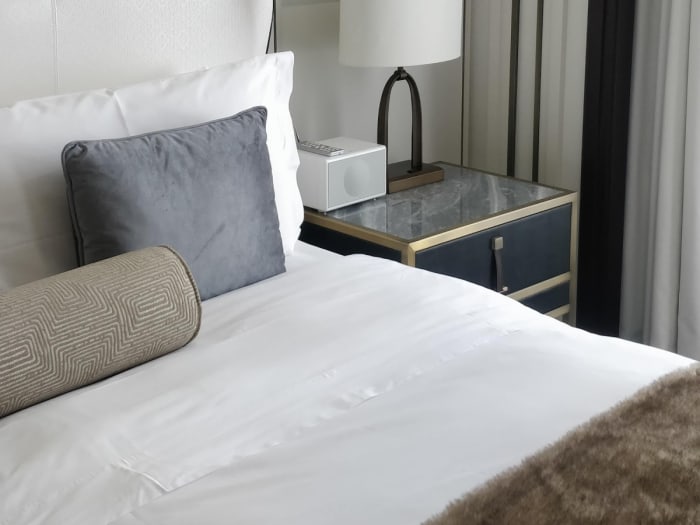
The expected atmosphere embodies contemporary luxury tempered by warmth. In Astana, a successful room protects against both the climate and noise. It offers pleasant light and allows for a seamless transition from the outside to the inside. Business travellers find a stable environment to work and rest. Couples and leisure visitors seek an urban cocoon, elegant yet unpretentious.
The suites extend this logic of ease. They offer more space and a clearer separation of functions. They allow for entertaining, relaxing, or extending a stopover with greater flexibility. In a capital marked by institutional and professional stays, this aspect is significant.
The essence remains the coherence between the private space and the rest of the hotel. Here, intimacy extends the overall tone of the establishment: contained elegance, attentive service, and comfort without ostentation. The turndown service accompanies the transition into the evening. Daily housekeeping maintains this continuity. In a city like Astana, this trust makes all the difference.
Dining
Even when a brief does not specify restaurants or culinary signatures in detail, dining remains central to the experience of a grand hotel. At The St. Regis Astana, it should be understood as a natural extension of the house’s hospitality: food and beverage able to accompany varied rhythms, from a business breakfast to a more settled dinner, including the discreet pauses that punctuate a day in the city. In a capital such as Astana, where one may alternate between institutional meetings, architectural visits and restorative time at the hotel, that flexibility is essential.
The first issue is setting. In a property with such a defined positioning, dining spaces are not mere ancillary functions. They contribute to the staging of the stay while needing to remain legible and comfortable. One expects places where it is equally possible to sit alone with a coffee or share a more formal meal. The quality of a grand hotel is often measured by this ability to accommodate very different uses without losing its tone. A room that is too ceremonial discourages everyday use; a space that is too neutral weakens the identity of the house. The balance sought here is that of contemporary elegance, polished enough to mark the address, fluid enough to remain liveable.
Breakfast, in this context, deserves particular attention. It is often the first true moment of the stay, the one in which guests take stock of the city, the light, the climate and the day ahead. In a hotel serving an international clientele, it must combine efficiency with quality, with service able to adapt to early departures as well as slower mornings. Leisure travellers seek a gentle beginning to the day; business guests look for a frictionless mechanism. When this sequence is well conceived, it immediately sets the tone of the property.
Beyond meals, dining at a St. Regis also implies an art of receiving. This includes in-room dining, especially relevant in a city where thermal contrasts and the pace of movement may make one prefer dinner in the privacy of a room or suite. It also includes transitional moments: tea, a light bite, an informal meeting in a lounge. In the best hotels, these are never treated as secondary; they form part of the way one inhabits the place.
For curious visitors, gastronomy can also be a gateway to contemporary Kazakhstan. Without claiming to summarise the country’s culinary richness within a single hotel, a major address can offer glimpses of flavours, products or regional inspirations while still meeting the expectations of a cosmopolitan clientele. It is often in this articulation between local anchoring and international readability that the relevance of a hotel table is decided. At The St. Regis Astana, one comes less in search of a manifesto than of underlying quality: well-executed meals, precise service, spaces that are pleasant to inhabit and the possibility, at any reasonable hour, of recovering that sense of continuity which distinguishes a well-run house.
Spa & wellness
In a destination such as Astana, the notion of wellness carries a particular resonance. The climate, the sharp seasonal contrasts, the fatigue associated with long-haul travel and the often demanding rhythm of business stays all give recovery time a very concrete value. Even when a brief does not detail every facility, it is reasonable to expect from a five-star hotel of this level an approach to wellbeing conceived as an essential complement to the stay rather than a mere extra. At The St. Regis Astana, this dimension naturally fits the idea of an elegant urban refuge, a place where one comes to recentre as much as to stay.
Wellness, moreover, begins before the spa in the strict sense. It can be read in the quality of the welcome, in the smoothness of arrival, in the ability to leave luggage, settle quickly into one’s room, benefit from evening turndown and rely on impeccable daily housekeeping. All these elements contribute to the hygiene of a stay. They reduce the traveller’s mental load and create the conditions for genuine rest. In grand hotels, the spa is never isolated from the rest; it extends a broader philosophy of care and attention.
When thinking about relaxation in a modern capital, one must also consider the need for sensory decompression. After large urban volumes, transfers, meetings or visits, the body often calls for quieter spaces, controlled temperatures and slower gestures. A successful wellness area responds to that need without overstatement. It proposes another tempo. Guests come to release muscular tension, restore a calmer rhythm, carve out a pause between obligations or simply offset the effects of the outdoor climate. For business travellers, it is a recovery tool; for couples, a shared retreat; for leisure guests, a way to balance a dense urban programme.
In the world of international luxury, personalisation matters as much as equipment. A treatment is only truly memorable if it adapts to the traveller’s condition, available time, the season and level of fatigue. That is why the most convincing wellness experiences are often those that privilege listening and accuracy over accumulation. In a city of contrasts such as Astana, that precision makes particular sense. One is not necessarily looking for theatrical staging; one expects serene effectiveness, quality of touch and a controlled atmosphere.
The real luxury here may simply consist in recovering a sense of balance. Being able to move from an energetic capital to a soothing interior environment, from a tightly structured day to unhurried time, from sometimes demanding weather to a feeling of enveloping comfort: this is what a grand hotel should make possible. The St. Regis Astana, through its service promise and its setting designed for relaxation, naturally lends itself to that reading. Wellness is not a separate chapter here; it runs through the entire experience. And for many travellers, that is precisely what turns a good stay into a well-judged one.
Concierge & Services
In the realm of luxury hospitality, services are not merely an inventory; they form a grammar. Their value lies in their articulation, making the stay simpler, smoother, and more authentic. At The St. Regis Astana, this promise is upheld by a 24-hour concierge service, a 24-hour reception, daily room service, turndown service, luggage storage, laundry, wake-up calls on request, and butler service. Together, these services define a level of attention that significantly enhances the traveller's experience.
The availability of reception and concierge services at all hours is particularly important in a city like Astana. They assist with late arrivals, connections, and international flights. This continuity of care is well-suited to an international clientele with varied schedules. It accommodates unforeseen circumstances, secures transitions, and provides immediate responses to both simple needs and more complex requests.
The butler service deserves special mention. It is not merely a symbol; it is a tool for personalisation. In the finest establishments, the butler becomes a privileged point of contact. They quickly grasp the client's habits and adjust the stay accordingly. For a business traveller, this translates into time saved. For a couple, it allows for a more flexible organisation of private moments. For a guest exploring the city, it serves as a discreet mediator between the hotel and the outside world. When executed well, this service provides a rare continuity to the stay. One does not have to deal with multiple contacts; one moves forward with coherence.
The fundamental services, such as daily housekeeping, turndown service, laundry, and luggage handling, are equally crucial. They ensure the material stability of the stay. They are often unnoticed when functioning perfectly, which is precisely their role. A room tidied at the right moment, clothes meticulously cared for, luggage handled without friction—these details free the mind. They allow one to focus on work, rest, or exploration. In a capital where days can be long, this reliability holds immediate value.
The true hallmark of exceptional service is anticipation. Knowing how to offer without insisting, to resolve without dramatizing, to be present without occupying space—this is what distinguishes a well-maintained establishment from one that is merely well-equipped. St. Regis hospitality is founded on this principle. It combines international standards with a form of tact. For the discerning traveller, it is often this tact that lingers in memory. Not an accumulation of services, but the sensation of a stay orchestrated with intelligence. At The St. Regis Astana, the services do not merely embellish the experience; they underpin it.
The Astana way of life
Choosing The St. Regis Astana also means agreeing to look at Astana as more than a purely administrative capital. Still young by the standards of major metropolises, the city has a singular identity that can feel disconcerting at first glance before gradually convincing through its own coherence. Broad avenues, architecture of assertion, open horizons and light that changes dramatically with the seasons all remind visitors that this is a steppe city turned centre of power and projection. For travellers, the experience lies not only in visiting sites, but in understanding a particular urban rhythm made of monumentality and silence, political intensity and space.
The hotel’s central location enables precisely that reading. One can organise days around the main points of interest, alternate cultural discoveries, professional appointments and moments of pause, then return to the hotel as to a stable base. It is a very contemporary way of inhabiting a city: not by trying to cover it exhaustively, but by constructing sequences. Astana lends itself well to this approach. Certain hours invite architectural observation, others the exploration of institutional or cultural venues, and others still simple contemplation of the city and its immense sky.
The local way of life is also shaped by climate. Depending on the season, the city changes texture, light and pace. Winter imposes a different discipline of movement, another attention to interiors, transitions and moments of warmth. Milder seasons open the city further and alter the way it is enjoyed. For visitors, this dimension is far from incidental: it structures days, desires and schedules. A well-conceived hotel then becomes a true partner in the stay, capable of offering the right degree of comfort and flexibility in response to such variations.
Astana is also a city where influences meet. One senses both international ambition, a regional culture of hospitality and a very clear desire for representation. Attentive travellers discover less a form of folklore than a situated modernity, with its own codes, uses and contrasts. That is what makes a stay here interesting for guests accustomed to major capitals: one finds some of the markers of the globalised world, but within a geographical and cultural configuration that remains distinctive.
Seen in this light, The St. Regis Astana plays the role of a discreet interpreter. It does not replace the city; it helps one approach it. Its comfort, service and position make it possible to move from one universe to another without rupture: from outside to inside, from meeting to rest, from curiosity to retreat. Perhaps that is, ultimately, the Astana way of life for a discerning traveller: accepting the city’s visual and climatic power while giving oneself a framework capable of ordering it. The hotel then becomes more than accommodation. It becomes a point of measure, a place from which Astana can be discovered with greater clarity, calm and pleasure.
Book with MyConciergeHotel
Booking The St. Regis Astana through MyConciergeHotel means approaching the stay through a logic of selection rather than mere transaction. In a destination still less familiar than major European capitals for many French-speaking travellers, that nuance matters. The role of an editorial concierge is not simply to confirm a room; it is to help choose the right pace of stay, the right accommodation category, the right moments to enjoy the city and the services that will genuinely make a difference once on site.
The value of an accompanied booking becomes clear from the planning stage. Astana is not a destination improvised in quite the same way as a conventional city break. Climate, the purpose of travel, length of stay and the balance between professional appointments and cultural visits all strongly shape the experience. Whether one is travelling as a couple, for business or as part of a wider Central Asian itinerary, expectations will differ. Relevant guidance can therefore help direct the choice towards a more suitable room or suite, think through arrivals and departures with greater comfort and anticipate needs linked to the rhythm of the stay.
In a property where service plays such a structuring role, the quality of intermediation also matters. Knowing how to communicate a preference, organise a late arrival, prepare a specific request or simply clarify a traveller’s priorities can transform the perception of the stay. It is often these details prepared in advance that allow the hotel to express its service level fully. Booking through a partner who understands the codes of luxury hospitality therefore also means creating the conditions for a more coherent experience.
MyConciergeHotel fits precisely within that approach. The idea is not to overload the journey with unnecessary options, but to fine-tune it. For The St. Regis Astana, that may mean recommending the most suitable period according to the purpose of travel, highlighting the value of booking ahead during busier periods, or drawing attention to the services that truly matter at this address: central location, elegant atmosphere, relaxation-oriented shared spaces, St. Regis hospitality and butler service. In other words, bringing forward what belongs to the substance of the experience rather than the incidental.
For discerning travellers, booking is never a neutral gesture. It is the first act of the stay. When properly accompanied, it allows one to enter the experience with greater clarity, serenity and well-judged expectations. In a city such as Astana, where visitors may be struck at once by the urban scale, climatic conditions and singular context, that preparation becomes even more valuable. Booking The St. Regis Astana through MyConciergeHotel therefore means choosing a more precise reading of travel: less standardised, more attentive and faithful to what grand luxury hospitality should always provide—not merely a place to sleep, but a stay conceived with discernment.