History & Urban Silhouette
Fairmont Baku Flame Towers belongs to that rare category of hotels whose identity is inseparable from a skyline. In Baku, the Flame Towers are not merely an architectural landmark; they have become one of the Azerbaijani capital’s most recognisable images. Set within this contemporary complex, the hotel reflects a city that has long balanced several narratives at once: a port on the Caspian Sea, a crossroads between Eastern Europe, the Caucasus and Persian and Turkic worlds, an ancient city framed by resolutely modern urban expansion. To stay here is therefore to inhabit an address that speaks less of traditional palace heritage than of a 21st-century urban ambition.
The appeal lies precisely in this tension between inheritance and projection. Baku has a walled old town, palaces, caravan traces and a memory shaped by trade, energy and exchange. The Flame Towers represent another chapter: that of a metropolis asserting itself through design, height and light. Their form evokes flame, a motif deeply associated with Azerbaijan, often described as the land of fire. Without slipping into thematic décor, the hotel benefits from that powerful symbolism: it occupies a building that does not imitate the past, but translates a national identity into a contemporary architectural language.
The Fairmont name adds another layer. The brand is known for an international grand hotel approach, where one expects a certain level of service, ease and comfort, but also an ability to connect the property to its surroundings. Here, that promise takes on a distinctly urban form. This is not an isolated retreat or a converted historic residence, but a hotel that fully embraces its place in a spectacular, fast-moving Baku, suited equally to business and leisure stays.
That distinction matters. Fairmont Baku Flame Towers is not built around period luxury, with antique wood panelling and aristocratic memory, but around clean lines, volume, views and discreet technology. Its heritage is therefore less chronological than contextual: that of an address born in a capital that chose to present itself to the world through bold architecture. For the traveller, this creates a particular impression. From arrival, the hotel feels engaged with the city rather than removed from it. The building is not simply a container; it is already a destination, a vantage point, almost a statement.
That is what makes the address compelling over time. It is not only about a view or a visual feat. It embodies a contemporary way of inhabiting Baku: elevated, observant, within a city of constant contrasts between old stone, boulevards, waterfront, towers and hills. For travellers who want to understand the capital as much as stay in comfort, that narrative dimension matters. Fairmont Baku Flame Towers is not merely a five-star hotel with modern architecture; it is an address through which to read Baku via one of its most assertive symbols.
The Hotel
What strikes first at Fairmont Baku Flame Towers is the relationship between interior space and landscape. Because the hotel sits within one of the city’s most emblematic structures, the experience begins well before one reaches the room. Arrival unfolds in a contemporary setting designed for an international clientele familiar with major urban hotels, yet with Baku’s own particular character: the sense of being in both a business capital and a city oriented towards the sea. From this elevated position, one’s reading of the city changes. The avenues seem more ordered, the curve of the shoreline more legible, and the Caspian becomes a structuring element of the stay, even before one heads down to the waterfront.
The overall atmosphere rests on a balance between scale and restraint. The modern architecture gives the place an obvious presence, yet the hotel is not limited to a signature effect. Its public spaces are designed to establish a rhythm: fluid circulation areas, lounges suited to a meeting or a pause, and a layout that works equally well for business travellers and guests in town to explore. That versatility is part of its identity. One can stay here for meetings, an event, a long weekend or a first introduction to Baku without feeling that the hotel privileges only one type of guest.
The location itself is central to the experience. It allows a degree of visual distance from urban activity while remaining connected to the city’s principal sights. For many travellers, this is a decisive advantage: one enjoys a sense of elevation, almost of calm, while the city remains within reach. The setting particularly suits those who like to begin their exploration with a broad perspective. Baku reveals itself well from above, because its urban geography is layered: the old city, the waterfront, newer districts, major cultural infrastructure and the slopes framing the bay.
The hotel also appeals through its aesthetic language. Luxury here is not theatrical; it is expressed through the coherence of a contemporary whole. Materials, volume and light create a refined atmosphere without excess. One finds the idea of an international hotel firmly rooted in its time, where comfort is measured as much by the quality of the spaces as by their clarity. There is no need for overstatement when the setting, architecture and views already provide character.
For a stay in Baku, the property offers one further practical quality: it allows guests to modulate their pace. One can leave early for a full programme, return in the afternoon for a pause overlooking the city, then head out again in the evening or choose to dine in and prolong the sensation of hovering above the capital. That flexibility is valuable in a destination where heritage, promenades, business appointments and moments of rest often alternate. Fairmont Baku Flame Towers responds to that variety with quiet assurance, offering a contemporary base that is visually striking yet highly functional for experiencing Baku with comfort, perspective and a real awareness of the urban setting.
Rooms & Suites
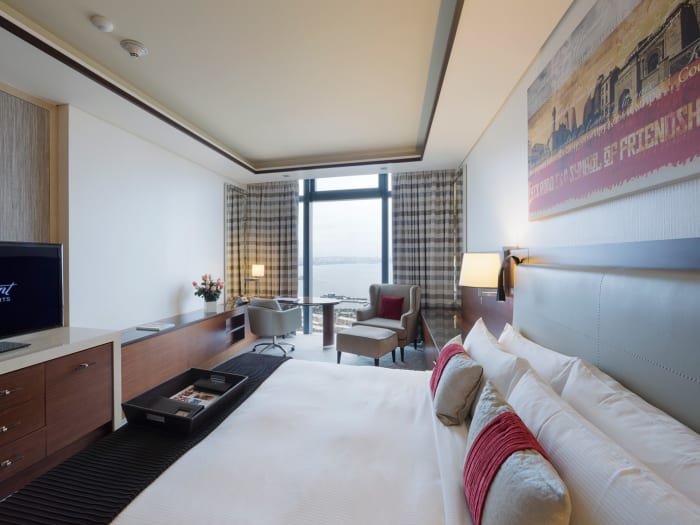
At a hotel such as Fairmont Baku Flame Towers, the room is not merely a place of retreat; it extends the very idea of the property. Guests come, of course, for the level of comfort expected from a five-star address, but also for the particular sensation of inhabiting Baku from a privileged vantage point. The rooms and suites follow a contemporary aesthetic consistent with the architecture of the complex: clean lines, a calming palette, volumes designed to let space breathe and, above all, careful attention to natural light and views over the city or the Caspian Sea.
That relationship with the outside changes the experience considerably. In many urban destinations, the room is simply a pause between outings. Here, it readily becomes an observatory. In the morning, the city reveals its contrasts of relief, density and openness towards the water; in the evening, Baku’s lights create an almost cinematic backdrop. For business travellers, that visual quality provides a welcome pause between appointments. For leisure stays, it gives genuine value to time spent in the room beyond simple rest.
Expected comfort is expressed through a fluid layout and services that support the rhythm of the stay. Turndown service, daily housekeeping, and round-the-clock reception and concierge all contribute to a sense of discreet continuity. Nothing needlessly interrupts the day; everything is designed to simplify late returns, early departures or changes of plan. In a major urban hotel, that reliability matters as much as décor. It allows guests to move easily between work, relaxation and exploration.
Suites, when chosen, make particular sense in a setting such as this. They suit those seeking more space, wishing to receive in greater comfort, or simply wanting a more residential dimension to their stay. In Baku, where visits can combine business, events and leisure, that flexibility is especially valuable. A suite allows distinct moments to be created within the day: working without occupying the sleeping area, taking coffee against the panorama, preparing for an evening out without haste.
The appeal of the accommodation at Fairmont Baku Flame Towers also lies in its timelessness. The contemporary approach avoids the trap of luxury that feels overly dated or overly demonstrative. The emphasis here is on clarity, ease and quality of execution. It is a style that often ages better because it relies on proportion, materials and functionality more than effect. For the traveller, this translates into a sense of visual calm and control.
Ultimately, the rooms and suites perfectly support the hotel’s broader promise: to offer an elevated urban experience within an iconic architectural setting without sacrificing everyday usability. One finds what is expected of a major international hotel, but with an added sense of perspective in the most literal sense. In Baku, where the city is discovered through both detail and skyline, sleeping in the Flame Towers means extending the exploration into the privacy of one’s own space.
Dining
At an address such as Fairmont Baku Flame Towers, dining first contributes to a particular idea of the urban stay: that of a hotel where one can begin the day efficiently and also settle into a more leisurely dinner without leaving one’s base. Even without overstatement, food and drink play an important role here because they support two essential dimensions of the experience: the view and the rhythm. Views over Baku and the Caspian on the one hand; the rhythm of a stay that may alternate between meetings, visits, walks and downtime on the other.
Breakfast, in this context, often carries special value. In major cities it sets the tone for the day, but in an elevated hotel such as this it also becomes a moment of observation. Watching the capital wake from above changes one’s perception of the trip. One better grasps the bay, the urban axes, the light on the sea. It is a calm and highly legible way to enter Baku before heading into its streets, museums, historic quarters or business districts.
At lunch or dinner, the appeal of a major international address often lies in its ability to provide a reliable, elegant setting without imposing excessive formality. For business travellers, that means the possibility of arranging a meeting in a controlled environment. For couples or leisure guests, it offers the comfort of staying in when one prefers to extend the day at the hotel rather than go back out into the city. That flexibility is part of contemporary luxury: not having to choose between practicality and quality of experience.
Baku is a crossroads city, and that reality naturally shapes expectations at the table. Travellers arrive with the idea of discovering a destination positioned between several cultural and culinary influences. Without assigning the hotel any precise signatures not established here, one may say that an address of this level generally responds by offering something that speaks to an international clientele while leaving room for local anchoring. It is often in that balance that the experience feels right: providing familiar reference points while also inviting guests to taste the destination.
Setting matters as well. In a property so closely tied to its panorama, dining naturally benefits from urban scenography. A coffee facing the city, a drink at the end of the day, dinner as Baku’s lights come on: each sequence takes on another dimension when accompanied by that depth of field. The landscape is not a mere backdrop; it shapes the memory of the meal.
Ultimately, dining at Fairmont Baku Flame Towers should be understood as an extension of the hotel’s wider hospitality. It is not only about nourishment; it is about structuring moments. An early departure with efficient service, a pause between appointments, a quiet dinner after a full day, a more intimate moment for two: each use calls for a different response. In a contemporary grand hotel, success often lies in that adaptability. Here, it unfolds within a setting that naturally lends depth to the experience. In Baku, where one can move within hours from ancient walls to the waterfront and then to highly contemporary architecture, dining in the Flame Towers extends that dialogue between modernity, horizon and the art of receiving guests.
Spa & Wellness
In a city as visual and contrasted as Baku, wellness takes on a particular meaning. One may easily move from a full programme of meetings, visits, waterfront walks and exploration of the old city to moments when the need is simply to slow down. Fairmont Baku Flame Towers responds to that need through an approach to comfort that goes beyond the room itself. In a contemporary grand hotel, the wellness area often plays a balancing role: it reintroduces quiet, slower time and a sense of recalibration within an urban stay.
This type of address naturally attracts travellers with different expectations. Some seek recovery after a flight, a demanding business schedule or a day spent walking. Others want to build a more complete routine into the trip, with time dedicated to treatments, relaxation or exercise. The appeal of a hotel in this category lies precisely in its ability to accommodate these uses without opposing them. Wellness is not reserved for a stay devoted entirely to the spa; it fits flexibly into the real life of travel.
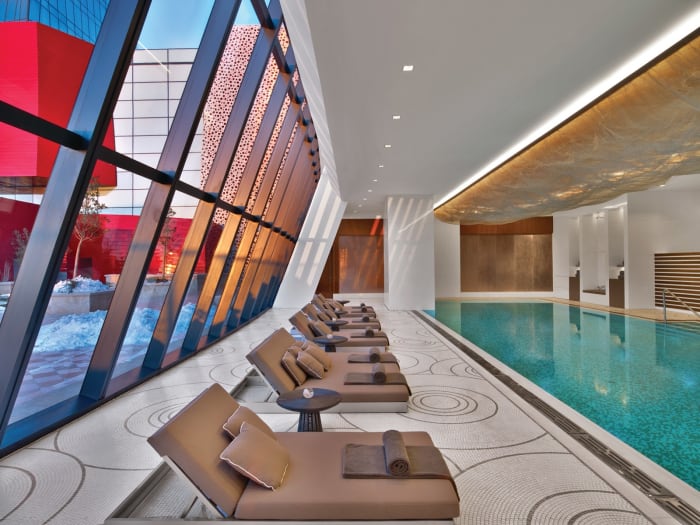
The setting of the Flame Towers adds an almost psychological dimension to the experience. After spending time facing the scale of the panorama, one appreciates all the more spaces designed for slowing down. The contrast between exterior monumentality and the inwardness of a restorative moment works particularly well. In this context, a few lengths in the pool, a fitness session, a treatment or simply a pause may be enough to rebalance the day. That is often the essence of true urban luxury: the ability to modulate one’s energy without leaving the hotel.
For business travellers, this aspect is far from incidental. A property suited to professional stays gains greatly from offering spaces where one can decompress without logistical complication. After meetings, events or transfers, the possibility of returning to an environment conducive to recovery changes the overall quality of the stay. For couples, wellness takes on another tone: it becomes a shared moment, a pause between outings, a way of enjoying the hotel as more than a mere base.
The hotel’s contemporary style lends itself well to this reading of wellbeing. One readily imagines spaces that are clean-lined, bright or calming, where the experience relies less on ornament than on a sense of control and comfort. Again, the point is not to multiply promises, but to offer an environment coherent with the rest of the hotel: international in its standards, refined in execution and flexible enough to suit different travel rhythms.
In Baku, a destination that can encourage visitors to pack in discoveries, it is useful to preserve moments of withdrawal. Fairmont Baku Flame Towers allows precisely that: returning from the city, regaining height in both the literal and figurative sense, then taking a wellness interval that restores proportion to the trip. Here, rest is not a mere interruption; it forms part of the wider experience. It helps guests enjoy the city more fully, understand its energy more clearly and ultimately inhabit a stay shaped by contemporary architecture, maritime horizon and grand-hotel hospitality.
Concierge & Services
Hotel luxury is often measured less by what is visible than by what works without apparent effort. At Fairmont Baku Flame Towers, that idea takes a very concrete form through the services supporting the stay. A 24-hour front desk, round-the-clock concierge, daily housekeeping, turndown service, luggage storage, laundry, wake-up service and multilingual staff create an essential foundation of reliability for an address welcoming business travellers, couples and international visitors discovering Baku for the first time.
The presence of a 24-hour concierge is particularly valuable here. In a capital where stays may be short, dense and organised around shifting schedules, having someone available at any hour genuinely changes the experience. This may concern very simple needs—orientation, transport, opening times, neighbourhood recommendations—or more structured requests linked to travel logistics. In a grand hotel, the quality of concierge service often lies in its ability to make the city more legible. In Baku, where old town, seafront promenades, contemporary districts and business areas coexist, that mediation is especially useful.
The continuously staffed reception serves the same purpose of fluidity. Late arrivals, early departures, changes of plan and last-minute requests are all part of international travel. Being able to rely on a constant presence removes unnecessary friction and gives the stay welcome flexibility. That permanent availability matters all the more in a hotel serving varied profiles. The business traveller does not have the same constraints as a couple on a city break, yet both expect the same thing: that the hotel can adapt without complication.
Room and housekeeping services also contribute to this underlying quality. Daily housekeeping and turndown are not merely procedural; they shape the feeling of comfort. Returning to a room perfectly reset after a day in the city, finding the space prepared for the evening, being able to request discreet yet efficient assistance: such details build continuity into the stay. They allow the hotel to remain a true place of rest even when the outside programme is demanding.
Laundry, luggage storage and wake-up service, sometimes considered secondary, become genuinely important in an international urban context. A stay of several days, a connection, an important meeting, an arrival before check-in or a late departure can all turn these services into decisive elements. It is precisely here that a major address distinguishes itself: in its ability to absorb practical constraints and leave the traveller with more mental space.
Finally, multilingual staff contribute to the overall ease of the stay. In a city attracting a growing international clientele, this is not merely a convenience; it shapes the quality of the welcome and the accuracy of exchanges. It facilitates requests, reduces hesitation and reinforces the feeling of being assisted with precision.
At Fairmont Baku Flame Towers, services are therefore not decorative extras. They form the invisible framework of the experience. In such a strong architectural setting, with views that immediately impress, it would be easy to remember only the image. Yet what sustains the quality of a stay is often this discreet, constant and well-calibrated organisation. It is what turns a striking address into a genuinely dependable hotel.
The Baku Way of Life
Staying at Fairmont Baku Flame Towers also means choosing a particular way into Baku. The city does not reveal itself all at once; it is understood in successive layers. There is first the powerful image of a contemporary capital marked by visible architectural gestures. Then come the nuances: the walled old city, promenades along the Caspian, traces of a mercantile past, the multiple influences crossing its culture, and that singular way of combining recent monumentality with historical depth. From the Flame Towers, this reading becomes almost intuitive, because one begins by seeing the city as a whole before exploring its details.
Baku lends itself especially well to a stay shaped by walking, viewpoints and shifts in atmosphere. One can move from a highly urban environment to more open spaces facing the sea, then return to districts where old stone and fortifications speak of another tempo. For the traveller, that diversity is valuable. It allows cultural discovery, strolling, business appointments and more contemplative moments to alternate with ease. The hotel, by virtue of its position, supports that dynamic ideally: it offers visual distance that helps one organise the day and better understand the city’s distances, slopes and main axes.
The local way of life also lies in the relationship between hospitality and sociability. Baku is a city where one senses the importance of exchange, shared tables, evening walks and a certain urban elegance. The waterfront in particular plays a central role in this experience. It gives the capital breathing space and openness that contrast with the density of some districts. Returning afterwards to the heights of the Flame Towers creates a very pleasing play of perspectives: one leaves the city’s horizontal animation to regain a broader, calmer reading of it.
For couples, Baku can offer an original city break, less expected than some major capitals yet rich in contrasts. For business travellers, it presents the face of an active metropolis where contemporary infrastructure coexists with readily accessible heritage. In both cases, the stay benefits from moments of observation. It is a city understood as much from its streets as from its panoramas. Fairmont Baku Flame Towers responds precisely to that duality: it allows guests to experience Baku up close and then rediscover it from a distance, as an urban and maritime composition.
Seasonality also plays its part. Milder periods, especially spring and autumn, make walking particularly pleasant and encourage a slower discovery of the city. Yet beyond climate, Baku has a constant quality: that of a destination still capable of surprising travellers well acquainted with major metropolises. Its blend of history, Caspian geography and contemporary self-assertion gives it a tone of its own.
Choosing this hotel ultimately means adopting a privileged vantage point on that identity. One does not merely stay at a comfortable address; one takes up residence within one of the city’s symbols in order to grasp its defining lines more clearly. The Baku way of life, seen from the Flame Towers, may lie precisely in that: moving between monumental scale and intimate experience, between panorama and promenade, between declared modernity and the older details that give the capital its real depth.
Book with MyConciergeHotel
Booking Fairmont Baku Flame Towers through MyConciergeHotel means approaching the property through the logic of the stay rather than through price alone. A hotel so closely tied to its setting, its views and the rhythm of the city deserves to be chosen with care: the type of trip, the length of stay, the importance of panorama, the need for flexibility, and the balance between time spent exploring and time spent at the hotel. Our role is precisely to help align the property with your way of travelling so that the experience feels right from the moment of arrival.
This address suits several profiles particularly well. Business travellers will find a contemporary, legible environment well adapted to professional stays, with the services expected from a major international hotel. Couples, meanwhile, appreciate the strength of the setting, the views over Baku and the Caspian, and the possibility of alternating city outings with quieter time within the hotel. For a first visit to the capital, the property also offers an obvious advantage: its emblematic position provides an immediate reading of the city, helping guests structure their stay and prioritise what to see.
Booking with guidance makes it easier to anticipate certain essential choices. In a hotel where the panorama plays a central role, room orientation and category can have a real impact on the feel of the stay. Likewise, whether you are travelling for business, for a weekend for two or as part of a wider itinerary, expectations will differ in terms of pace, services and time spent on site. A well-considered booking is not simply about confirming a room; it is about preparing a coherent framework for the trip.
MyConciergeHotel can also help place the hotel within a broader experience of Baku. The city is best discovered by combining heritage, promenades, viewpoints and moments of pause. Fairmont Baku Flame Towers lends itself particularly well to that approach because it allows guests to return easily to a comfortable base between visits. We therefore favour both an editorial and a practical reading of the stay: when to go, what pace to adopt, how best to benefit from the hotel’s location and for what kind of escape this address is most relevant.
The value of human guidance is that it avoids generic choices. Not every five-star hotel tells the same story, and not every traveller expects the same experience from a major international address. Here, contemporary architecture, the position within the Flame Towers and the opening onto the city form the core of the promise. If that is what you are seeking, a stay at Fairmont Baku Flame Towers can be especially compelling. It simply helps to approach it with the right frame of reference.
Booking with MyConciergeHotel therefore means choosing contextualised advice attentive to the real uses of travel. We help turn a striking address into a stay that is relevant, smooth and memorable, taking into account what makes the place distinctive: emblematic architecture, commanding views over Baku, a refined contemporary atmosphere and genuine versatility for both business and leisure. In a city best read as much as explored, that precision makes all the difference.