History & heritage
In Baku, the idea of grand hospitality takes on a particular resonance. A crossroads city between Eastern Europe, the Caucasus and the Caspian shores, the Azerbaijani capital has been shaped by a dialogue between older heritage, modern architecture and a constantly evolving urban culture. The Ritz-Carlton Baku belongs to this contemporary landscape, offering a distinctly current interpretation of international luxury hospitality: an address designed around fluidity, service and precision, in a city where stays often combine business appointments, cultural discovery and a fast metropolitan rhythm.
The hotel is part of a brand long associated with a certain notion of service: attentive presence, discretion, consistency of standards and care in the smallest daily gestures. Here, that heritage is not expressed through an overtly historical narrative, but through a subtler continuity: that of an urban hotel conceived for travellers familiar with major capitals, while remaining responsive to Baku’s own character. The result is less a heritage landmark than a contemporary address, rooted in a lively district and aligned with the realities of modern travel.
In a destination that has changed considerably over recent decades, high-end hospitality plays a particular role. It accompanies the city’s international outlook, economic development, event calendar and growing appeal to both business and leisure guests. The Ritz-Carlton Baku is part of that momentum, offering a setting that values efficiency as much as comfort. One finds the codes of a major international house here, adapted to a local context in which the city’s energy is always close at hand.
What makes the property interesting is therefore not a period story or a collection of anecdotes, but the way it reflects a particular phase in Baku’s evolution: that of a capital fully embracing its urban, cosmopolitan and ambitious identity. The hotel can be read as a vantage point onto that transformation. It welcomes travellers arriving to conduct business, attend events, explore the old city, walk the waterfront or simply pause in a metropolis still relatively unfamiliar to many European visitors.
In that sense, its heritage is also that of a style of hospitality codified by a major brand and then reinterpreted within a distinctive local environment. Luxury here takes the form of seamless organisation, spaces designed for recovery after the city, and service able to support stays with very different rhythms. This combination of international standards and a strong connection to contemporary Baku gives the hotel its coherence: a five-star address that does not need to overstate prestige, but instead offers an elegant, dependable and relevant point of balance in one of the Caucasus’s most compelling capitals.
The hotel
The Ritz-Carlton Baku is defined first by its location: a city address in the heart of the capital, set within a lively district that immediately conveys the rhythm of Baku. For travellers, this changes a great deal. This is not a retreat cut off from its surroundings, but a hotel that engages with the city as it is lived today: active, mobile, shaped by business as much as leisure, with striking contrasts between contemporary architecture, major avenues, cultural venues and more historic areas that can be reached with ease.
This central setting is one of the property’s clearest strengths. It simplifies movement, whether the aim is to reach business hubs, local attractions or appointments across town. For a business stay, that efficiency matters: less time lost to logistics, more flexibility in structuring the day. For a leisure break, it allows guests to build an itinerary without friction, alternating walks, visits, shopping, dining pauses and returns to the hotel in genuine comfort.
The overall atmosphere rests on elegant design with an urban sensibility. This is expressed less through display than through controlled visual language: clean lines, public spaces designed for circulation, and a sense of order and calm despite the energy outside. In a major city hotel, that quality is essential. After meetings, traffic, sightseeing or evening engagements, it is reassuring to return to an environment that absorbs the pace of the day rather than amplifying it. The elegance here lies in that ability to create a gentle transition between the intensity of Baku and the slower tempo of the hotel.
The public areas typically perform this role of threshold. One looks for functionality as much as comfort: a place to wait for a transfer, meet someone, review documents, pause between outings or simply observe the discreet movement of an international clientele. In this kind of address, the lobby is never merely a transit space; it becomes a vantage point onto hotel life and, indirectly, onto the city itself. The guest profile is often mixed, bringing together business travellers, couples, short-stay visitors and guests accustomed to the standards of major international brands.
The hotel is well suited to that variety of uses. It can serve as an efficient base for a tightly scheduled few nights or for a more open-ended stay shaped by the desire to discover Baku at one’s own pace. Its identity is neither strictly business nor purely leisure: it rests on balance. That is what makes the address relevant in a city like Baku, where the boundaries between work trip, cultural escape and upscale urban stay are often fluid.
In practical terms, choosing this hotel means favouring a capital-city experience: easy access, an animated setting, contemporary design, calibrated service and the sense of being well placed to understand the city without giving up the comfort of a major five-star hotel. For many travellers, that combination is precisely what gives a successful urban address its value.
Rooms and Suites
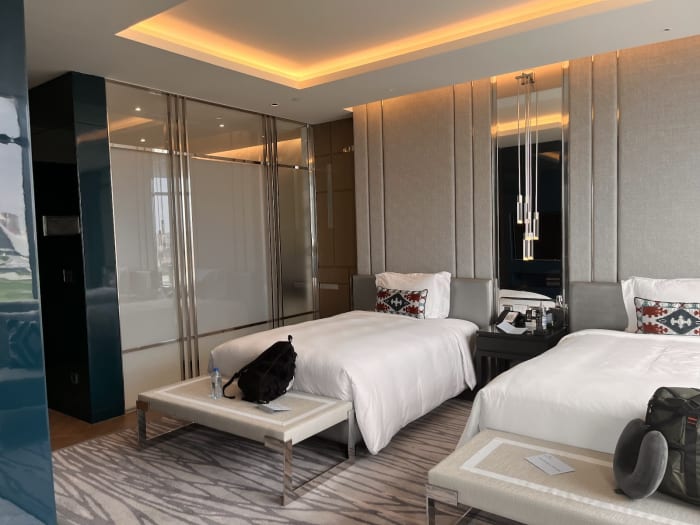
In a hotel of this calibre, a room serves not only as a place to sleep but also as a space for relaxation, preparation, and sometimes work. At The Ritz-Carlton Baku, the interiors are designed with comfort and elegance in mind, reflecting the ethos of the establishment.
After a day exploring Baku, one expects a room to provide a sanctuary from the outside pace while remaining functional.
The overall impression is one of measured luxury. Elegance is conveyed through the balance of volumes, the quality of materials, the clarity of layouts, and a soothing colour palette. The urban design situates the spaces within a contemporary aesthetic that resonates with Baku. Thus, the traveller finds in their room a continuity with the spirit of the city, albeit in a calmer register.
Comfort is also evident in the details of service. Daily housekeeping and turn-down service enhance the feeling of a room maintained with regularity. One returns to an immaculate space after several hours out. There is also an orderly environment for preparing dinner, reviewing notes, or organising the next day’s departure.
The suites cater to a different temporal experience. They are suitable for longer stays, for travellers who require more space, or for those seeking a more residential experience. In a bustling capital like Baku, this extra space alters the perception of one’s stay. It allows for genuine moments of respite, informal meetings, or travelling as a couple with greater ease.
Ultimately, what matters is the room's ability to accommodate varied uses. An early departure, a late arrival, an afternoon break, or a quiet evening after a busy day—all these scenarios call for different responses. The best rooms know how to adapt to these rhythms with discretion.
At The Ritz-Carlton Baku, the rooms and suites extend the promise of the address: a refined, urban, and comfortable setting, suitable for both business trips and leisure stays.
Dining
In a major urban address, dining plays a more complex role than it first appears to. It is not simply about eating; it structures the day, creates meeting points and can sometimes reduce the distance between hotel and city. At The Ritz-Carlton Baku, even without detailing a specific culinary scene here, dining can be understood as a natural extension of the hotel’s positioning: elegant, urban and suited to varied guests and rhythms.
In the morning, a hotel of this category must respond to several expectations at once. Some travellers want a swift, efficient breakfast before a day of meetings; others prefer to take their time, observe the life of the hotel and begin the day in a calm setting. This duality is typical of major city hotels. Service needs to be flexible enough to support both hurried departures and slower mornings, without compromising either the quality of welcome or the clarity of the experience.
At lunchtime, hotel dining often takes on a strategic function. For business travellers, it allows a meeting to be arranged without leaving the property, in an environment where service levels and discretion are controlled. For leisure guests, it offers a practical pause between explorations of Baku. In both cases, what matters most is reliability: well-executed cuisine, a comfortable setting, suitable opening hours and an atmosphere that is neither overly formal nor too casual.
In the evening, the restaurant becomes a different kind of stage. After the city, it is welcome when a hotel offers a place to extend the day without additional effort. In a capital such as Baku, where influences intersect and urban life can be intense, dining in the hotel may be as much about comfort as convenience. Guests then look for an experience consistent with the rest of the stay: attentive service, the right tempo and a carefully considered environment. More than a dramatic signature effect, it is often consistency and quality of execution that leave the strongest impression.
One should also account for the in-between uses: a coffee between meetings, a reading moment in a lounge, a drink at the end of the day, an informal conversation in a well-kept public space. In international luxury hospitality, these sequences matter as much as the meals themselves. They help make the hotel feel inhabited rather than merely functional. For a property set in a lively district, this ability to provide interior pauses is especially valuable.
Dining here should therefore be understood as a set of experiences shaped by rhythm and service. It supports the traveller in practical ways while contributing to the overall tone of the stay. At The Ritz-Carlton Baku, one may expect the food and beverage offering to fulfil precisely that role: creating moments of continuity, comfort and understated elegance in a city that constantly invites one to go out, discover, meet and return.
Spa & wellness
In an active capital such as Baku, the idea of wellbeing is not limited to treatments in the strict sense; it also depends on a hotel’s ability to offer credible moments of decompression. Even on a short trip, the need for recovery is real: travel fatigue, dense schedules, shifts in rhythm and the constant stimulation of a major city. In that context, the wellness dimension of a five-star hotel takes on particular value. The point is not necessarily to multiply promises, but to provide a setting in which body and mind can regain a sense of balance.
At The Ritz-Carlton Baku, this aspect can be understood as a natural extension of the hotel’s overall service philosophy. In an address of this level, wellbeing often begins before any treatment: in the quality of silence, the control of atmosphere and the feeling of being looked after without friction. A space dedicated to rest, relaxation or fitness then becomes an essential part of the experience, especially for travellers who combine professional obligations and personal time within the same stay.
The spa of a major city hotel generally serves several purposes. It may be a refuge after a day of meetings, an organised pause between outings, or an arrival ritual marking the transition from travel to stay. For couples, it is often a moment of recentring; for frequent travellers, a way of preserving continuity of wellbeing despite constant movement. In every case, what matters is not only the technical quality of a treatment, but the calibre of an environment genuinely capable of slowing the pace.
Fitness belongs to the same logic. In international luxury hotels, it responds to guests who wish to maintain their habits while away. A well-conceived wellness area makes it possible to keep a routine, restore energy in the morning or release tension built up during the day. In Baku, where one may move quickly from business engagements to an evening out or a cultural visit, that ability to recalibrate is far from incidental.
There is also a subtler dimension: wellbeing as the luxury of availability. Being able to grant oneself an hour alone, without complicated logistics, within the hotel itself, can significantly alter the quality of a stay. It means one does not have to oppose exploration and rest, efficiency and pleasure, city and retreat. The best urban spas are precisely those that make this balance feel natural.
So even without detailing a specific treatment menu here, the wellness promise of The Ritz-Carlton Baku can be understood as a counterpoint to the energy of the capital: a place to release pressure, recover a more measured rhythm and reintroduce breathing space into days that may otherwise be full. In the overall economy of a stay in Baku, that dimension often matters more than one initially expects when booking.
Concierge & Services
One of the most tangible markers of a great hotel is the quality of its daily services. At The Ritz-Carlton Baku, the 24-hour concierge, round-the-clock reception, daily housekeeping, turndown service, luggage storage, laundry service, wake-up calls, and multilingual staff create a clear promise. Together, these services form the backbone of the stay. It is often here that the perception of a hotel's level is determined.
The availability of concierge services at all hours is particularly important in a city like Baku. Arrivals can be late, departures early, and schedules ever-changing. A business traveller may require swift assistance between meetings. A couple might wish to organise their transport, book an activity, or receive tailored recommendations based on their available time. The value of a good concierge lies in its ability to anticipate, simplify, and adjust its offerings to suit the profile of the stay.
The continuous reception also provides a sense of reassurance. In major international cities, travel schedules are rarely ideal. Knowing that the welcome remains seamless, regardless of the hour, enhances the quality of arrival. This constant availability is one of the most tangible luxuries of high-end hospitality.
Daily housekeeping and turndown service represent another dimension of service. They ensure that the room caters to the various moments of the day with the same level of care. Laundry services, luggage storage, and wake-up calls address very practical needs. A garment prepared on time, luggage stored for a few hours, a reliable wake-up before a flight or meeting—these are often the details that make a difference.
The multilingual staff also deserves special mention. In an international destination like Baku, this skill facilitates communication, reduces misunderstandings, and fosters a relationship of trust. For the traveller, being understood quickly and accurately is a comfort in itself.
Ultimately, these services have a simple function: to make the stay more comprehensible, flexible, and serene. At The Ritz-Carlton Baku, this service architecture supports the identity of the establishment: a refined urban hotel designed for discerning travellers.
The Baku way of life
Staying in the heart of Baku means entering a city of very legible contrasts. The Azerbaijani capital cannot be reduced to its waterfront, its historic core or its contemporary architecture; it lies precisely in the coexistence of these registers. For the traveller, that plurality makes a stay especially stimulating. One can move from an urban walk to a heritage visit, from a business meeting to a more social evening, from a quiet coffee to observing a city still in transformation. Thanks to its central location, The Ritz-Carlton Baku lends itself well to this mobile reading of the destination.
The first pleasure of Baku is often that of wandering. The city reveals itself in sequences: broad avenues, open perspectives, livelier districts, the breathing space of the seafront, then a return towards areas where history is more visible. This alternation gives the stay its texture. It shows that Baku is not only a business capital or an architectural showcase, but a lived space shaped by multiple uses and different temporalities. From a well-located hotel, that diversity becomes easier and more natural to explore.
The local way of life also rests on a certain urban sociability. People take time to meet, linger over a meal, observe the city from a café or a place of passage. Even on a short stay, it is worth preserving these moments without a strict programme. They allow one to sense the real texture of a destination beyond the expected sights. In a city like Baku, where international image can sometimes precede intimate understanding, this openness to detail is especially rewarding.
For leisure travellers, the appeal lies in composing a stay on several levels: a few cultural landmarks, walks, time for contemporary addresses, and regular returns to the hotel so that the experience does not become a race. For business travellers, the challenge is often the reverse: using the spaces between obligations to grasp something of the city. A central, well-serviced hotel makes that possible. It becomes a point of support from which Baku stops being merely the backdrop to a trip and begins to exist as a destination.
It is also worth accepting that Baku reveals itself in touches. Some cities seduce immediately through a single clear image; others require more attention. Here, interest often comes from juxtaposition: tradition and modernity, monumentality and everyday life, international ambition and regional anchoring. That is precisely what makes it appealing to travellers who are drawn to capitals in motion.
In that sense, The Ritz-Carlton Baku works as an ideal base from which to read the city. Its lively surroundings, easy access to local attractions and positioning between business and leisure make it possible to experience Baku without rigidity. One returns to the hotel to rest, prepare, pause, then heads back out with the sense of grasping the city’s nuances a little better. Perhaps that is the real luxury of a successful urban stay: not merely seeing the city, but learning, however briefly, how to inhabit it.
Book with MyConciergeHotel
Booking The Ritz-Carlton Baku through MyConciergeHotel means choosing an editorially led, supported approach to high-end travel. In a city that can still be less immediately legible than some heavily codified European capitals, that mediation is meaningful. It helps place the hotel within its real context, assess the relevance of its location, understand the kind of stay to which it is best suited and anticipate the practical uses that will make a difference once on site.
The value of a well-considered booking goes beyond rate or availability. It lies in the accuracy of the choice. A city hotel such as this one is particularly well suited to travellers seeking a central base, structured service and an elegant setting capable of supporting both a professional agenda and a discovery-led stay. One still needs to know that before booking, and to connect those qualities to one’s own plans. That is precisely where a specialist platform adds value: by turning a hotel page into a genuine decision-making tool.
MyConciergeHotel also allows the stay to be approached more fluidly. Once the booking is under way, practical needs quickly emerge: arrival times, transfer arrangements, the rhythm of the stay, desired activities, time available to discover the city, room preferences or service priorities. In a hotel where concierge and front desk operate around the clock, this kind of preparation makes complete sense. It helps guests make use of the address rather than simply occupy it.
For a business trip, that may mean optimising travel times, planning useful services from the moment of arrival, or ensuring that the stay remains comfortable despite a dense schedule. For a stay for two or an urban break, it may involve shaping a balanced programme, alternating time in the city with moments of rest. In both cases, booking intelligently means thinking about the experience as a whole rather than as a simple sum of nights.
There is also a more qualitative dimension: editorial trust. On MyConciergeHotel, the aim is not to multiply vague promises, but to highlight what makes an address relevant for a particular kind of traveller. The Ritz-Carlton Baku stands out for its central location, elegant urban atmosphere, easy access to local attractions and suitability for both business and leisure stays. These are concrete, legible elements that allow for a more discerning booking.
In practical terms, choosing this address through MyConciergeHotel therefore means favouring a booking that is better informed, more coherent and ultimately more useful. One is not simply selecting a five-star hotel in Baku; one is choosing a stay base adapted to the city, its rhythm and one’s own expectations. In luxury travel, that precision is often what matters most: not an abundance of options, but the fit between a place, a moment and a way of travelling.