History & architectural inspiration
In Abu Dhabi, The Ritz-Carlton Abu Dhabi Grand Canal is defined less by inherited history in the European sense than by a carefully staged architectural vision inspired by the grandeur of Arab palaces. The property does not claim centuries of lineage; instead, it presents a composed aesthetic language of scale, symmetry and materials that resonates with the contemporary identity of the Emirati capital. That distinction matters: the sense of occasion here comes not from an ancient past, but from a refined interpretation of regional architectural codes within the framework of a large urban resort.
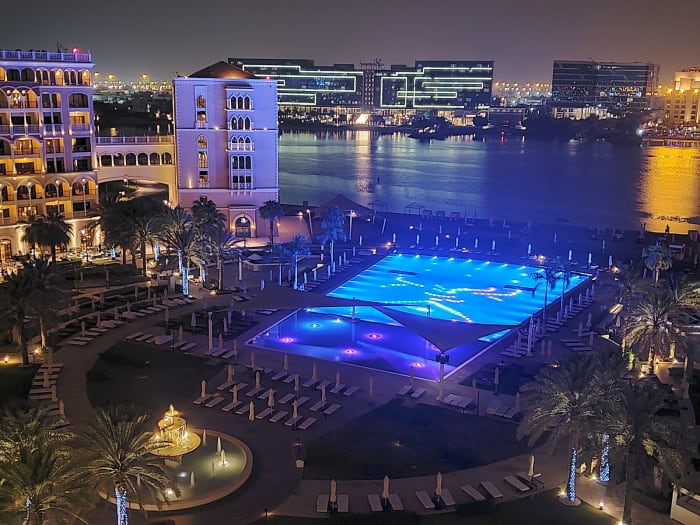
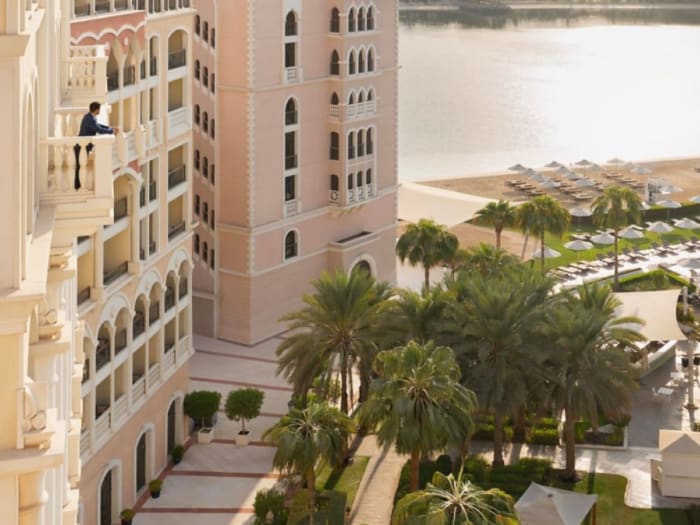
The hotel unfolds in the spirit of a waterside palace, with pale façades, arcades, courtyards, generous volumes and a layout that balances monumentality with climatic softness. The Grand Canal is central to this composition. Water is not merely decorative; it structures the view, opens perspectives and brings the sense of breathing space that separates destination resorts from strictly urban hotels. In a city where contemporary architecture often favours height and iconography, this address opts instead for horizontality, symmetry and the depth of landscaped gardens.
This palatial inspiration is also evident in the way interiors and exteriors are connected. Circulation appears designed around transitions: from shade to light, from stone to greenery, from lobby to terrace, from pathways to waterside outlooks. Luxury here does not rely on ornament alone. It is expressed through a feeling of space, the generosity of proportions and the way a stay begins to slow down from the moment of arrival. It is a form of hospitality closely associated with major destination hotels, where one does not simply sleep, but temporarily inhabits a composed landscape.
The Ritz-Carlton name naturally provides a clear frame of reference: polished service, international standards and a certain classicism in the hotel experience. In Abu Dhabi, that signature takes on a local tone through the architectural vocabulary and the relationship to the site. The result is a grand address suited to business travellers, leisure guests, families and more contemplative stays alike. That versatility is part of its identity.
The hotel ultimately stands out through its ability to leave a lasting impression without resorting to excess. Palace-inspired architecture, landscaped gardens and the presence of the canal create a coherent narrative that is immediately legible. For the traveller, this translates into an experience shaped as much by atmosphere as by amenities: an address that values poise, fluidity and the feeling of being in Abu Dhabi while remaining slightly removed from its pace. It is precisely in that in-between space, between city, water and garden, that its character is formed.
The Establishment: Between Canal, Gardens, and Perspectives
The primary allure of The Ritz-Carlton Abu Dhabi Grand Canal lies in its location. The hotel combines the convenience of a large establishment close to Abu Dhabi's main attractions with the sensation of being in a self-contained estate. This duality is essential to its success. Guests enjoy the ease of access expected in an international capital while relishing a setting that offers visual respite and a genuine feeling of seclusion.
The Grand Canal gives the place its identity. Its views introduce a presence of water that softens the overall atmosphere and enhances the landscape. Depending on the time of day, the ambience changes significantly: sharper light in the morning, golden warmth in the late afternoon, and calmer reflections at dusk. For the traveller, these variations matter. They transform a simple panorama into a lived experience and imbue the hotel with a unique temporal quality, almost meditative at times.
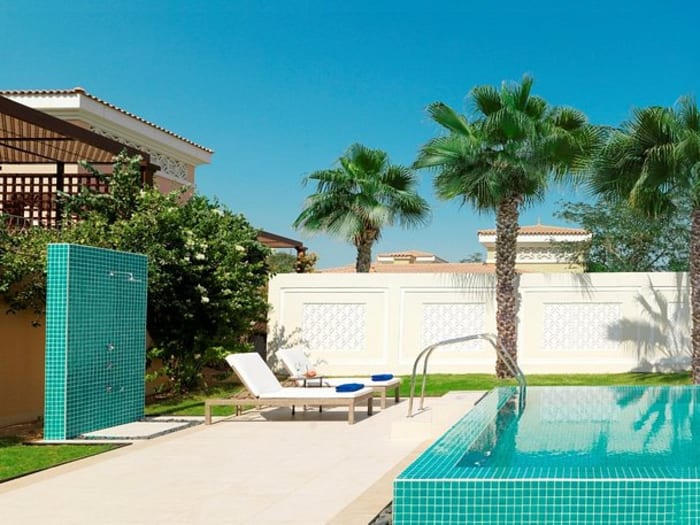
Surrounding this aquatic framework, the gardens play a major role. This is one of the elements that distinguishes the property. In an environment often associated with a mineral aesthetic, the presence of generous landscaped spaces brings freshness, intimacy, and depth. The pathways, lawns, and plantings help to obscure the proximity of the city. They also serve as a filter between the different parts of the estate, creating more intimate sequences within a large-scale ensemble.
The architecture, inspired by Arab palaces, reinforces this impression of a composed estate. The buildings, through their design and placement, organise sightlines, thresholds, courtyards, and recesses. For guests, the consequence is tangible: one does not traverse the hotel as a mere functional volume; rather, it is discovered in fragments, moving from one perspective to another. This is a valuable quality in a resort of this size, as it avoids the impersonal effect often associated with very large accommodations.
The proximity to Abu Dhabi's major attractions is another advantage. For a stay that combines relaxation and exploration, the property allows easy access to cultural sites, business districts, and the city's main thoroughfares. This accessibility appeals to both leisure travellers and professionals with limited time. It also allows for the hotel to be considered a stable and serene base from which to organise one's days without sacrificing the comfort of a resort.
In practice, The Ritz-Carlton Abu Dhabi Grand Canal accommodates various rhythms of stay. Couples find a calm environment conducive to slow interludes and end-of-day moments by the water. Families appreciate the space, the clarity of the estate, and the feeling of being less confined than in a typical urban hotel. Business travellers benefit from a setting that allows for work or meetings in a more relaxed atmosphere. It is this ability to cater to different uses without losing its unity that adds to the value of the place.
Ultimately, the establishment captivates with a simple yet elusive quality: balance. Balance between city and resort, between representation and relaxation, between architecture and landscape. In Abu Dhabi, where the high-end hotel offering is vast, this address stands out for its coherent staging of the canal, gardens, and volumes. Guests come for comfort, of course, but they also stay for the sense of controlled space that alters the way one inhabits the city.
Rooms and Suites: Comfort as an Extension of the Place
In an establishment of this nature, the rooms and suites extend the narrative of the location. At The Ritz-Carlton Abu Dhabi Grand Canal, this continuity is essential. Following the grandeur of the exteriors, the views over the canal and the presence of gardens, the in-room experience offers a calm and orderly retreat. The space remains generous, without breaking the sense of openness that characterises the entire property.
A Ritz-Carlton hotel in this segment adheres to a classic approach to international luxury. Elegant lines, sustainable materials, a soothing palette, and thoughtfully designed furniture create a coherent ensemble. Guests find in their rooms the same sense of mastery present in the common areas. The environment is clear, comfortable, and immediately inviting.
The views are a determining factor. When they overlook the Grand Canal, they provide the rooms with an additional depth. They also remind guests of the property's connection to water. Others favour landscaped gardens, offering a more intimate and botanical perspective of the estate. In both cases, the relationship with the outside is significant. It prevents the sense of confinement often felt in large urban hotels. It contributes to a feeling of resort-like leisure, even for a short stay.
For couples, the room becomes a silent refuge between two highlights of the day. For families, the appeal often lies in the fluidity of organisation. Adapted spaces, attentive service, rigorous daily upkeep, and an overall sense of ease structure the stay. The daily housekeeping and turn-down service enhance this comfort. They keep the room in a constant state of freshness, providing an effortless continuity to the stay.
The suites cater to various needs. Extended stays, family trips, business travel, or simply a desire for more space. The interest lies not only in the size but also in the ability to experience the hotel at one’s own pace. One can entertain, rest, or even work there, without friction between these functions.
Luxury in the rooms and suites of a grand resort often hinges on what one notices after a few hours. Sleep quality, relative silence, service efficiency, simplicity of use, and absence of friction. At The Ritz-Carlton Abu Dhabi Grand Canal, this promise is part of a cohesive logic. The room is not a separate universe; it naturally extends a property designed around space, light, and a certain idea of serenity.
When choosing a category, it is advisable to favour, when possible, a view towards the canal or the gardens. It all depends on the desired experience. Travellers seeking a panorama will gladly opt for the water and open perspectives. Those who prefer tranquillity will often appreciate the gentle greenery of the estate. In all cases, the accommodation fully contributes to the experience of the place.
Dining: Balancing Elegance and Relaxation
In a large international resort, dining is never merely a practical function. It structures the day and contributes to the memory of the stay. At The Ritz-Carlton Abu Dhabi Grand Canal, the setting lends itself to a variety of moments. Breakfast with a view, lunch between meetings, a more formal dinner, or an evening drink.
The culinary offerings are organised around several complementary atmospheres. This approach corresponds to the nature of the place. A hotel that welcomes business travellers, couples, and families must offer various degrees of formality. Luxury also lies in this freedom of choice.
In the morning, the quality of the setting is as important as the content. In an environment open to the canal and gardens, a bright dining room or a well-placed terrace alters the perception of the stay. Breakfast becomes a way to enter into the rhythm of the place.
At lunchtime, the balance between refinement and simplicity remains essential. The traveller appreciates the fluidity of a well-executed meal, without heaviness, in a setting conducive to relaxation. This flexibility is particularly important in Abu Dhabi, where days alternate between visits, meetings, and moments of rest.
Dinner often calls for a different intensity. In an establishment of this category, it reactivates the idea of a grand hotel. More ceremonial service, a subdued atmosphere, attention to the meal and the comfort of the table. A Ritz-Carlton establishment is expected to deliver on this precision of execution.
The dining spaces also reveal the hotel from different angles. Some highlight the views, others intimacy, and others conviviality. For couples, a dinner facing the canal or in a more secluded setting can mark the stay. For families, the variety of atmospheres softens the rhythm of the days. For business travellers, spaces suitable for a working lunch or informal conversation are a real asset.
Finally, dining contributes to the identity of a hotel when it aligns with the place. Here, the architecture inspired by Arab palaces, the gardens, and the presence of water call for a measured culinary hospitality. The quality of service and ease of use take precedence. This consistency often distinguishes enduring grand houses.
For the traveller, dining should be considered as a component of the overall experience. Reserving certain moments, particularly dinners, allows for the best locations. In a hotel like this, dining well is also a way of inhabiting the place.
Spa & Well-being: Slowing Down in a Capital in Motion
In Abu Dhabi, a stay often revolves around cultural discoveries, professional obligations, and urban travel. The well-being dimension of a large hotel thus takes on particular value. It becomes a tool for balance.
At The Ritz-Carlton Abu Dhabi Grand Canal, the setting invites guests to slow down. The presence of water, the gardens, and the spacious architecture create a sense of retreat without isolation.
Here, well-being naturally extends the hotel's overall atmosphere. It accompanies the transitions of the stay, allowing for a return to a calmer rhythm.
The setting is as important as the treatments. Softer light, controlled acoustics, and slowed circulation establish a different temporal experience. After a morning in the city or a day of meetings, this transition alters the experience.
For couples, well-being often manifests as a shared interlude. For solo travellers, it offers a moment of re-centering. For families, a serene environment contributes to the comfort of the stay.
The climate of Abu Dhabi reinforces this expectation. The most temperate periods, particularly in winter, lend themselves to a balance between outdoor activities and rest. Well-being also includes the gardens, walks through the estate, and views of the canal.
In the Ritz-Carlton spirit, attention to personalised service is also paramount. It relies on attentive listening. Recovery, relaxation, discretion, or more structured support, each expectation calls for an appropriate response.
Ultimately, well-being at this address hinges on a diffuse quality. It permeates the entire stay. The views, gardens, distances, and service foster a calmer relationship with time.
To fully enjoy this, it is best to plan this time right from the stay's planning stage. At The Ritz-Carlton Abu Dhabi Grand Canal, slowing down is part of the experience.
Concierge & Services: The Discreet Mechanics of a Grand Hotel
What distinguishes a grand hotel from a mere comfortable establishment is not always visible at first glance. The difference often lies in the quality of services, their consistency, and their discretion. At The Ritz-Carlton Abu Dhabi Grand Canal, this dimension is central. A 24-hour concierge, 24-hour reception, daily room service, turn-down service, luggage storage, laundry, wake-up calls, and multilingual staff compose a seamless experience.
The 24-hour concierge is one of the most significant markers. In Abu Dhabi, stays often involve reservations, transportation, and last-minute requests. Having a contact capable of organising, recommending, and adjusting brings real comfort. The concierge simplifies travel, saves time, and reduces friction. This is particularly useful for international guests.
The continuously open reception follows the same logic. Late arrivals, early departures, and changes in plans are part of a grand hotel’s daily routine. When handled consistently, they make the stay more serene. This continuity underpins a high-end hospitality.
Daily room service and turn-down service contribute to a quieter comfort. They ensure the upkeep of the room and the sensation of a space that is always ready. Returning at the end of the day to a tidied room changes the perceived quality of the stay. It is a luxury of regularity.
Luggage storage and laundry also contribute to this fluidity. The former frees up arrival or departure hours, while the latter proves useful during extended stays, business trips, or broader itineraries. The wake-up call service remains a reliable marker for early departures, important appointments, or connections.
The multilingual staff deserves particular attention. In an international destination like Abu Dhabi, they condition the real quality of the experience. Quickly understanding a request, grasping the nuances of a need, and reassuring without excess contribute to a just service.
Beyond the list of amenities, the essence lies in their orchestration. The concierge prepares an outing, the reception facilitates timing, room maintenance ensures comfort, and laundry prolongs ease. Together, they create a stay without unnecessary rough edges.
At The Ritz-Carlton Abu Dhabi Grand Canal, the organisation of service makes the experience simple, clear, and consistent. In luxury hospitality, this apparent simplicity remains a refined form of expertise.
The Art of Living in Abu Dhabi: Between Culture, Light, and Ideal Seasons
Staying at The Ritz-Carlton Abu Dhabi Grand Canal also means embracing a unique way of experiencing Abu Dhabi. The city is not explored like a dense, pedestrian-friendly European metropolis. It requires a different pace, a fresh perspective on distances, light, and customs. To fully appreciate it, one must accept this broader geography. The hotel, conveniently located near major attractions, serves as a relevant anchor point.
Abu Dhabi blends contemporary ambition with representations inherited from the Arab world. Architecture plays a central role here, whether institutional, religious, cultural, or hospitality-related. In this context, residing in a hotel inspired by Arab palaces takes on a special significance. The hotel is situated in a city where perspective and monumentality are integral to the urban language.
One of the great pleasures of Abu Dhabi lies in the quality of its light. It structures the days, alters volumes, and transforms even the simplest landscapes. This is particularly true around water. From the Grand Canal, this dimension becomes very tangible. It encourages one to organise their days intelligently: outings in the morning, a pause during the hottest hours, a return in the late afternoon, and dinner when the city regains a relative softness.
Winter stays are especially pleasant. The milder months favour strolls, terrace lounging, visits, and the use of outdoor spaces. For a European traveller, this season offers a chance to rediscover light and warmth when winter settles elsewhere. The hotel, with its gardens and canal views, fully capitalises on its setting during this time.
Abu Dhabi caters to various types of stays. Some travellers come for its cultural institutions and major sites, others for professional reasons, and yet others for a more restful break in a well-controlled environment. The Ritz-Carlton Abu Dhabi Grand Canal can accommodate all three motivations simultaneously. One can explore the city, return for lunch in a calmer setting, head out for a meeting, and then end the day in the tranquillity of the estate.
The local art of living also hinges on the quality of interiors and climate control. In Abu Dhabi, one easily transitions from an outdoor space to a lounge, from a terrace to a lobby, from a garden to a restaurant. The hotel, through its architecture and layout, naturally facilitates this choreography. It allows one to experience the city without being overwhelmed, while still providing a stable refuge.
To enhance the experience, it is wise to check local events before departure. Exhibitions, cultural appointments, seasonal highlights, or professional gatherings can add a unique flavour to one’s stay. In a capital that is constantly evolving, this attention to the calendar often leads to a deeper understanding of the city.
Ultimately, the art of living in Abu Dhabi is about balancing intensity with control. The city impresses, yet it also offers spaces of calm. The Ritz-Carlton Abu Dhabi Grand Canal embodies this philosophy. It provides a privileged viewpoint of a capital that unfolds through contrasts: water and desert, monumentality and intimacy, activity and retreat. For the traveller, it is an invitation to slow down and see the city from a different perspective.
Booking via MyConciergeHotel: planning the stay as a whole
Booking The Ritz-Carlton Abu Dhabi Grand Canal is not simply a matter of choosing a room in a major Abu Dhabi hotel; it is also about shaping a coherent experience around a place, a season and a travel rhythm. That is precisely where MyConciergeHotel adds value. In a destination where the high-end offer is abundant, the real difference lies not only in price or category, but in the fit between the property and the way one wishes to experience the stay.
This hotel suits several profiles: couples seeking an elegant pause, families wanting space and ease, and business travellers looking for a calmer setting without moving far from the city’s key areas. Booking well therefore means clarifying priorities. Should one favour a Grand Canal view or a quieter garden outlook? Will the stay focus mainly on discovering Abu Dhabi, on professional commitments, or on a balance between the two? Would it be preferable to secure dining and wellbeing moments in advance, or to keep more spontaneity?
The value of editorial concierge guidance lies in helping guests ask these questions before arrival. In the case of The Ritz-Carlton Abu Dhabi Grand Canal, several points deserve anticipation. Season comes first: the winter months are especially sought after for their milder climate, which may affect both availability and the practical use of outdoor spaces. The nature of the stay matters too, as does the desired rhythm.
Booking ahead, as the Concierge note already suggests, remains a sound approach. During the most favourable periods, it helps not only with availability but also with the finer elements of the stay: room category, view preferences, timings and possible dining or wellness reservations. In a large resort, the quality of the experience often depends on these details prepared in advance.
Ultimately, booking this address through MyConciergeHotel means taking a more precise approach to travel: not simply consuming a well-known hotel, but choosing a place for what it genuinely allows one to experience.