History & heritage
In Muscat, some hotels are more than places to stay; they are a way into the landscape and the imagination of a country. Al Bustan Palace, A Ritz-Carlton Hotel, belongs to that rare category. Its name, evoking a garden, already suggests something of its setting and promise: a generous, ordered retreat where architecture converses with Oman’s mineral mountains and maritime horizon. In this part of the capital, between steep relief and shoreline, the hotel reflects a tradition of hospitality that in Oman is never merely about display. It is also about restraint, welcome and a quietly generous sense of occasion.
The property’s identity lies precisely in this balance. On one side, a deliberate monumentality, apparent in the scale, sightlines and staging of the public spaces. On the other, a more intimate reading of Omani living, visible in patterns, materials, decorative references and the handling of light. Here, tradition is not treated as a superficial backdrop. It shapes the experience without reducing it to folklore. The result is a hotel that feels rooted in its setting while remaining attuned to the expectations of an international traveller accustomed to contemporary luxury.
Its place within the Ritz-Carlton world adds another layer. It situates the address within a highly codified service culture, where attention to detail, seamless stays and thoughtful care matter as much as aesthetics. Yet what distinguishes Al Bustan Palace is not simply the name above the door. It is the way that global standard is placed in service of a deeply singular location. In Muscat, a city of measured contrasts, where modernity advances without entirely erasing older lines, the hotel reflects a sense of continuity: an Oman that values elegance, stability and a harmonious relationship between heritage and the present.
Guests quickly sense this heritage dimension, even without a detailed historical narrative. It can be read in the ordering of the gardens, in the quiet solemnity of certain arrival sequences, and in the way the spaces open towards the sea while remaining sheltered by the mountains. The hotel feels conceived both as a prestigious gateway to the destination and as a place of retreat. That dual purpose remains one of its most persuasive qualities.
In that sense, Al Bustan Palace offers more than a high-end seaside stay in Muscat. It proposes an experience of context. One comes not only for the private beach, the comfort or the lush gardens, but for the rarer sensation of inhabiting, for a few days, a particularly accomplished version of Omani hospitality: refined, calm, structured and always connected to its landscape.
The setting
One of Al Bustan Palace’s greatest privileges is its setting. Few addresses in Muscat can claim so convincingly this meeting point between mountain and Arabian Sea. The landscape acts as a primary architecture: the surrounding relief provides a dramatic backdrop, while the shoreline brings openness, light and the particular breathing space of a seaside hotel. The property unfolds within this in-between zone with real coherence, as though it had been designed to draw from every line of the site without ever forcing it.
Arrival immediately establishes the scale of the place. One moves from a city of roads, residential districts and mineral perspectives into an estate that seems to close gently around its own tempo. The lush gardens are essential here. They soften the power of the natural setting, create transitions between buildings and outdoor areas, and introduce a sense of freshness especially welcome in Muscat’s climate. Palms, manicured lawns, ordered pathways and carefully framed sea views compose an environment that is never showy: everything is arranged to produce calm.
Architecture and design extend that impression. The decorative language blends Omani tradition with modern comfort, not through forced contrast but through controlled continuity. Local references bring depth and character, while contemporary planning ensures clarity, ease and functionality. The traveller senses a certain rightness: the hotel neither imitates a historic palace nor disappears into anonymous international minimalism. It embraces a regional identity while meeting the expectations of a major five-star resort.
The private beach is naturally one of the property’s principal attractions. It offers direct access to the sea in a setting more protected and more serene than many stretches of urban coastline. This immediate relationship with the water changes the rhythm of a stay. One can alternate swimming, an early walk, reading with the horizon ahead, or simply watching the changing light on the Arabian Sea. At certain hours the site takes on an almost cinematic quality, when the mountains soften in tone and the gardens seem to hold the day’s warmth.
What makes the whole especially persuasive is the sense of relative seclusion without disconnection from Muscat. The hotel offers a peaceful, almost withdrawn atmosphere while still allowing guests to explore the capital’s main points of interest. For a first stay in Oman, that position is invaluable: it grants access to a contemplative seaside experience without preventing discovery of the city, its souks, cultural institutions and coastal roads. Al Bustan Palace thus achieves a sought-after balance: a destination in itself and an excellent base from which to understand Muscat.
Rooms and suites
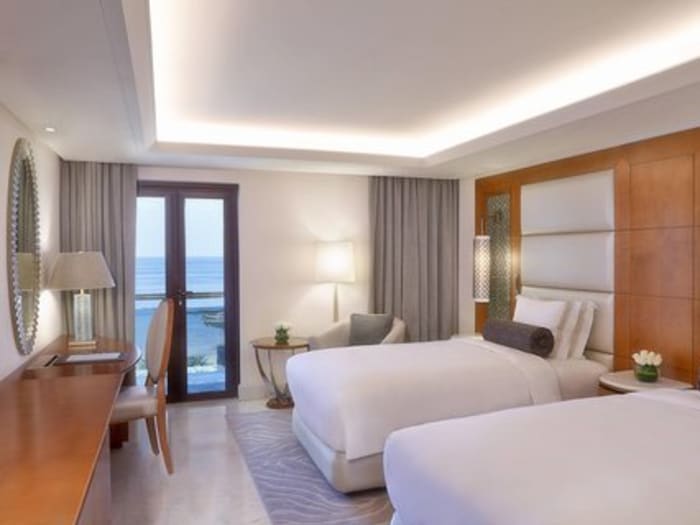
In a hotel of this calibre, a room should not merely be comfortable; it should extend the sense of place. At Al Bustan Palace, that challenge appears to have been understood with nuance. Rooms and suites continue the language of the wider property: legible elegance, Omani references present without excess, and careful attention to light, proportion and the relationship with the outdoors. The result is not demonstrative luxury, but a settled comfort designed to support both a restful stay and a more active visit to Muscat.
What stands out first is the way private spaces seek to maintain a dialogue with the landscape. Depending on their orientation, rooms may look towards the gardens, the surrounding relief or the sea, and that visual connection matters greatly to the overall experience. In Muscat, the light shifts quickly throughout the day; it can be clear and mineral in the morning, then warmer and more golden towards evening. In a well-conceived room, those changes become part of the stay. They remind the guest that this is not an interchangeable resort, but a very particular site between the Arabian Sea and the mountains.
Interior planning generally favours a sense of order and flow. Materials, tones and decorative details evoke local aesthetics while remaining entirely in keeping with the expectations of an international clientele. The emphasis is on serenity rather than effect. Sleeping areas, bathrooms and storage all contribute to that impression of ease, which is essential in a major resort hotel. After a day spent on the beach, at the spa or exploring the city, returning to one’s room should feel simple, soothing and immediate.
Suites, meanwhile, answer a different logic: that of longer stays, greater privacy and a degree of autonomy. They are particularly well suited to travellers wishing to entertain, work occasionally, travel with family or simply enjoy more space. In the context of Al Bustan Palace, that generosity has a particular meaning. It allows guests to enjoy the site without constantly inhabiting the public areas, and to recover a sense of retreat after the more social moments of a stay.
It is also worth noting that, in a Ritz-Carlton address, the room experience depends as much on service as on décor. The quality of upkeep, the attentive preparation of spaces, the discretion of the staff and the ability to personalise certain details all matter enormously. This is often where the difference lies between a beautiful hotel and a truly accomplished place to stay. At Al Bustan Palace, rooms and suites make their fullest sense when understood as calm refuges within a larger estate: places where one sleeps well, certainly, but also where one takes the measure of the landscape, the climate and Muscat’s particular rhythm.
Dining
In a high-end seaside address, dining is not simply a collection of restaurants; it shapes the way a stay unfolds from one moment to the next. At Al Bustan Palace, food and drink belong to that rhythm. Breakfast, lunches taken in brighter light, more composed dinners after the heat of the day: each mealtime accompanies a different facet of the place. What matters here, beyond specific venue names, is the hotel’s ability to bring setting, service and cuisine into a coherent atmosphere.
The Omani context naturally plays an important role. Staying in Muscat encourages attention to regional flavours, spices, seafood and certain forms of conviviality associated with the Arabian Peninsula. In an international property such as this one, the interest often lies in the balance between cosmopolitan breadth and local anchoring. Travellers expect an offer wide enough to suit varied appetites while still hoping to encounter, throughout the stay, touches more directly connected to the destination. When handled well, that balance avoids two common pitfalls: bland standardisation or, conversely, an artificial staging of tradition.
The main restaurant generally occupies a strategic place in the guest experience. It is often where the execution of a major hotel is most clearly revealed: consistency at breakfast, precision of service, and the ability to handle different rhythms according to time of day and guest profile. In a resort such as Al Bustan Palace, where couples, families and business travellers extending a trip may all be present, that versatility is essential. The practical advice to reserve a table upon arrival makes perfect sense here, especially during the most sought-after periods, when the hotel functions as a destination as much as accommodation.
Meals taken on a terrace or with views over the gardens and the sea naturally have a particular quality. In Muscat, the relationship between cuisine and climate is very tangible. Between November and March, when temperatures are milder, outdoor spaces take on greater importance. They offer another reading of the hotel: more open, more sensory, more directly connected to the landscape. A dinner in such an atmosphere does not require theatrical effects to be memorable; often, good light, assured service and clear cooking are enough.
Finally, gastronomy in a hotel like Al Bustan Palace is also about the art of hosting. The quality of a stay is often measured in details: a thoughtful welcome in the restaurant, a relevant recommendation, discreet adaptation to guest preferences, an ability to make every meal feel effortless even in a highly refined setting. It is this fluidity that turns hotel dining into a true house experience. Here, the table accompanies a journey to Muscat without ever overshadowing it: it is one of the stay’s guiding threads, faithful to the spirit of the place, between Omani elegance and international comfort.
Spa & wellbeing
In Muscat, wellbeing takes on a particular dimension. The climate, the light, the proximity of the sea and the constant presence of the mountains invite not so much performance as rebalancing. In that context, the spa of a grand hotel such as Al Bustan Palace is not a secondary facility; it becomes one of the stay’s centres of gravity. Guests come to shed the pace of travel, to recover a sense of slowness, but also to extend the feeling of shelter already suggested by the estate as a whole.
The value of a spa in such an address lies first in its ability to create transition. Between hours in the sun, excursions into the city, meals and time on the beach, it offers a more inward, quieter space where the body can reclaim its place. In an environment as visually powerful as Al Bustan Palace, that inwardness matters. It allows the stay to be lived not only through admiration of the setting, but also through a finer attention to one’s own rhythm. A well-chosen treatment, a period of rest, a few lengths in a pool or a calm moment in dedicated wellness areas can be enough to alter the perception of the entire trip.
Wellbeing in a contemporary luxury hotel often depends on personalisation. Without assuming specific protocols, one may reasonably expect an attentive approach here, capable of adapting recommendations to the time available, the traveller’s fatigue, the season or the desired outcome: recovery, deep relaxation, preparation for an active day or simply a comfortable pause. That flexibility is especially valuable in a resort welcoming very different profiles, from couples on a romantic break to families on holiday and travellers combining work with leisure.
The relationship with the outdoors also remains essential. Even in wellness spaces, one is still in Oman, in a destination where sea and light shape the experience. In this context, the finest luxury often lies in how moments are arranged: an active morning followed by a treatment, a restorative session after the beach, or a quiet pause at day’s end as the heat recedes. The spa then becomes less an isolated programme than part of a broader way of living centred on balance.
For many travellers, these quieter hours are the ones that leave the most lasting memories. Not because they are spectacular, but because they give the stay its depth. At Al Bustan Palace, the wellbeing experience finds its coherence in this alliance of natural setting, peaceful atmosphere and attentive service. It answers perfectly what one seeks in Muscat from an address of this level: not only comfort, but a quality of presence to oneself, to the landscape and to time.
Concierge & services
In luxury hospitality, services are not judged merely by their list; they are measured by their ability to make a stay fluid, legible and personal. At Al Bustan Palace, this dimension is central. Belonging to Ritz-Carlton creates high expectations in terms of welcome, availability and execution. Yet what matters most to the traveller is less the abstract promise than the concrete translation of that service culture: a well-managed arrival, requests handled without friction, advice suited to the nature of the stay, and that precious impression that everything feels easy without ever becoming impersonal.
The concierge is particularly important here, especially for visitors discovering Muscat or Oman for the first time. In a destination where distances, timings, climate and local customs can shape the organisation of each day, intelligent guidance makes a real difference. That may mean arranging transport, recommending the right time for a visit, suggesting an outing suited to a family, securing a restaurant table or proposing a more contemplative programme for those who mainly wish to enjoy the estate. The best concierge does not overload the experience; it clarifies it.
In a resort of this scale, everyday services matter just as much as exceptional requests. The quality of housekeeping, punctuality, luggage handling, attention to children, and the ability to respond to dietary preferences or different rhythms all contribute directly to the success of a stay. These are often invisible when they work well, yet immediately noticeable when they do not. True luxury frequently lies in that absence of friction.
Al Bustan Palace also lends itself to several kinds of travel, and the services must match that diversity. A couple will not expect the same as a family, nor as a traveller extending a business trip. Some will seek above all calm, the private beach and the spa; others will want to alternate relaxation with discovery of Muscat. The strength of a great hotel is its ability to accommodate these different uses without losing its identity. Service then becomes a discreet form of staging, capable of adjusting the intensity of a stay without ever making it feel rigid.
Booking through an attentive intermediary makes particular sense here. In an address where seasonality matters, where certain tables may be in demand, and where the success of a stay often depends on a few well-made decisions in advance, support before arrival has real value. It helps define the right tempo, anticipate expectations and turn a fine reservation into a genuinely coherent stay. At Al Bustan Palace, services are not an add-on; they are the invisible framework that allows the place, the landscape and Omani hospitality to reveal themselves fully.
The Muscat way of life
Staying at Al Bustan Palace also means discovering a particular idea of Muscat. Oman’s capital does not reveal itself like some other Gulf cities through accumulation or overt display. Its charm lies more in the balance of its lines, its relationship with the mountains, its light and a certain restraint that runs through both its urban fabric and its daily rhythm. For travellers accustomed to more theatrical cities, Muscat may at first seem quieter. That is precisely what makes it compelling, and what the hotel allows one to approach under excellent conditions.
The city is understood in fragments. A coastal road, an administrative district of pale buildings, a livelier market, a seafront walk, a viewpoint towards the mountains: the experience is not that of a single centre but of a succession of scenes. In this elongated geography, having a peaceful refuge such as Al Bustan Palace makes all the difference. One can go out for a few hours and then return to the gardens, the private beach and the calm of the estate. This alternation between discovery and retreat suits the spirit of Muscat, which is not a city to be consumed in haste.
The local way of life also depends on a particular relationship with time. Days are structured around heat, light and the most favourable moments for going out, walking or lingering on a terrace. Between November and March, the city reveals one of its most agreeable versions: the air grows milder, outdoor life becomes central again, and one makes fuller use of promenades, al fresco meals and views over the Arabian Sea. In that context, the hotel acts as a natural extension of the destination. Its lush gardens, peaceful atmosphere and opening onto the shore prolong what is most appealing about Muscat.
For couples, the city offers a setting well suited to a contemplative stay, where the point is not to multiply activities but to choose the right moments. For families, it has the advantage of a gentler rhythm than many regional capitals, with the possibility of alternating culture, seaside time and rest. In both cases, Al Bustan Palace provides a particularly fitting base, thanks to its protected environment and its ability to accommodate different uses without losing its calm.
Ultimately, the Muscat way of life rests on a kind of quiet precision. It is less about doing a great deal than about doing the right things: choosing the right season, the right time of day, the right balance between city and resort. That is exactly what this address makes possible. It opens onto an Oman that is elegant, hospitable and deeply shaped by landscape, where luxury does not impose itself through noise, but through the quality of setting, service and recovered time.
Book with MyConciergeHotel
Booking Al Bustan Palace through MyConciergeHotel is not simply a matter of securing a room in a major Muscat hotel. It means preparing the stay under better conditions, with a more precise understanding of the property and of what it can genuinely offer according to your travel profile. In a place where setting matters as much as rhythm, where season strongly shapes the experience, and where a few simple decisions can transform the quality of a stay, guidance before arrival has real value.
The first question is not only room category, but the intended use of the trip. Are you primarily looking to enjoy the private beach and lush gardens in a restorative mode? Do you prefer a more exploratory stay, alternating time at the resort with discovery of Muscat? Are you travelling as a couple, with family, or as an extension to a business journey? Each of these situations calls for slightly different choices, whether in terms of preferred positioning, the pace of the programme or the reservations worth securing from the outset.
MyConciergeHotel helps refine exactly these points. In a hotel such as Al Bustan Palace, it is useful to anticipate the most sought-after periods, particularly during the months when the climate is at its most agreeable, generally from November to March. It is also the right moment to consider the place of dining within the stay, especially if you wish to dine in the main restaurant under the best conditions. The advice to reserve promptly is not incidental: in destination hotels, the smoothness of a trip often depends on such details being settled in time.
The value of an accompanied booking also lies in the overall coherence of the stay. A grand hotel may offer a great deal; the challenge is to organise that richness without becoming scattered. Should more time be devoted to the spa? Should city outings be planned at certain hours rather than others? Is it better to reserve a shorter stay with an impeccable rhythm, or several nights in order to enjoy fully the site between mountains and the Arabian Sea? The role of an editorial concierge is to help ask the right questions before departure.
For the discerning traveller, this preparation makes all the difference. It avoids default choices, reduces logistical friction and allows one to enter the experience with a clear sense of purpose. At Al Bustan Palace, that often means finding the right balance between contemplation, comfort, service and discovery of Muscat. Booking through MyConciergeHotel therefore means choosing a more precise and more personal approach to luxury hospitality: fewer vague promises, greater attention to context, timing and the actual quality of the stay.