History & Identity
The Jumeirah Muscat Bay is part of a new generation of coastal addresses that prioritise grounding over ostentation. It offers a contemporary interpretation of Oman, woven together by hospitality, landscape, space, light, and tranquility.
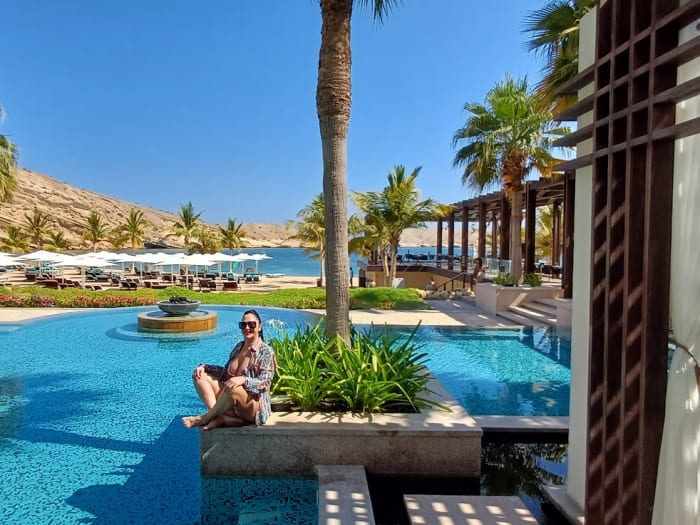
In Muscat, nestled between mineral mountains, an urban corniche, and the Gulf of Oman, this approach takes on a distinctive character. The hotel is set within a sheltered bay, embodying a tone of seaside retreat that is more contemplative than showy.
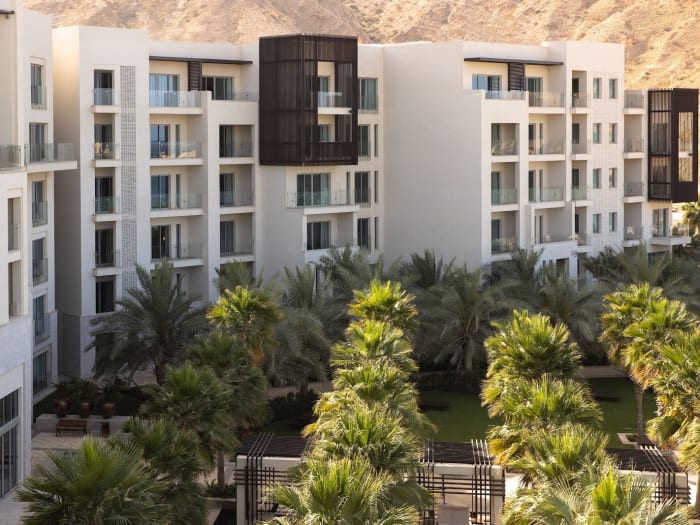
The identity of the establishment is fundamentally tied to its relationship with the land. The design, inspired by Omani culture, is less about decoration and more about creating an atmosphere. Simple lines, a mineral palette, wood, and shades of sand and deep blue structure the spaces, with natural light and transitions between indoors and outdoors playing a central role.
In a country where traditional architecture harmonises with heat, reflection, and topography, this sensitivity makes perfect sense. It places the hotel in continuity with its environment.
Belonging to the Jumeirah brand adds another dimension. The brand is synonymous with demanding service and a discreet staging of comfort. Here, this translates into a soothing atmosphere and an organisation designed for relaxing stays, whether for couples or families.
Luxury here is not about the accumulation of symbols. It lies in the opportunity to slow down, to feel cared for, and to enjoy a comprehensible setting.
Many seaside hotels promise escape, but few create a genuine sense of retreat without isolation. Muscat Bay strikes this balance. Guests come for the sea, the open views, and a form of visual silence, all while remaining within the orbit of Muscat.
This aligns with a certain idea of Oman: an elegance without ostentation, a culture of hospitality, and a pace more measured than in other Gulf capitals.
The history of the place is less about an ancient building and more about a location attentive to context, materials, rest, and landscape. The Jumeirah Muscat Bay speaks to those who prefer a hotel that breathes rather than one that impresses. For the traveller, everything is experienced through the senses: waking up to the sea, embracing a sobriety inspired by the land, and allowing Oman to exist around them.
The Establishment
In Muscat, Jumeirah Muscat Bay establishes its identity through architecture that is unmistakably Omani from the moment of arrival. The lobby exemplifies this with a design that prioritises local roots.
Here, the architecture does not seek to impress; rather, it creates an atmosphere characterised by lines and volumes that evoke a subtle elegance. The eye flows naturally, guided by a composition designed to allow the spaces to breathe.
The lobby plays a central role in this impression. It brings together the codes of Omani architecture and extends them into a calm, understated presentation. The overall effect creates a coherent introduction, where the place asserts its character without rigidity.
This architectural presence is complemented by stunning views that enhance the experience from the very first moments. These vistas engage with the interior spaces and reinforce the sense of openness. The relationship between architecture and panorama lends the establishment a composed appearance, attentive to its surroundings.
Thus, the address finds its balance in a confidently local expression, embodied by a lobby that encapsulates its spirit. It serves as a discreet reminder that, in hospitality, architecture often sets the initial tone.
Rooms & Suites
In a seaside hotel like the Jumeirah Muscat Bay, the room extends the landscape. The rooms and suites are designed for relaxation, continuing the soothing atmosphere of the establishment.
One can expect interiors where views, light, and materials play a central role. The sea views are among the highlights of this address, transforming the experience of a room.
In the morning, the presence of water accompanies the awakening. During the day, it punctuates moments of pause, leisurely reading, and returns from swimming. In the evening, it gently ushers in a sense of calm.
The design, inspired by Omani culture, finds a natural expression here. In the rooms, this inspiration manifests through natural tones, understated textures, and measured details. Luxury thus lies in the balance between contemporary comfort and discreet local references.
Service also enhances the in-room experience. The hotel offers daily housekeeping as well as turndown service. These thoughtful touches create a rhythm and a sense of continuous care.
A well-maintained room, prepared for the return from dinner or an evening stroll, alters the perception of the stay. It is not merely about efficiency, but about hotel tact.
For couples, the room becomes the heart of the stay. For families, it must remain simple to navigate and fluid in its organisation. The hotel caters to both couples and families.
Ultimately, the rooms and suites at Jumeirah Muscat Bay prioritise a quality of habitation. A space where one sleeps well, truly rests, and where the sea remains present even in silence.
Dining
At Jumeirah Muscat Bay, gastronomy plays a vital role in interpreting the place. In this seaside address in Muscat, it punctuates the day, connecting the hotel to its surroundings and giving a concrete form to hospitality.
The first pleasure lies in the setting. Dining with a view of the sea takes on a special resonance here. In this bay, the light evolves gently. Breakfast opens up to the horizon, lunch calls for a certain lightness in tune with the warmth and outdoor activities, while dinner often reveals the quality of an establishment through its ambiance and rhythm.
In the Omani context, the dining experience can also offer a sensitive approach to local culture. Attention to regional flavours, spices, and seafood finds its natural place here. The essence is not to theatricalise the experience but to subtly reveal a geography of taste.
For couples, dining plays an evident emotional role. A terrace, a well-placed table, the discreet sound of the sea, and attentive service are enough to create lasting memories. For families, the challenge is different; flexibility, simple timings, and options that cater to various daily rhythms are essential.
The quality of service makes a significant difference. A great establishment is recognised as much by what it serves as by how it accompanies the meal. The tone, precision, and sense of appropriateness are as important as the dish itself. At a Jumeirah address, a certain fluidity is expected. Available teams and consistent execution give each meal its rightful place in the day.
At Jumeirah Muscat Bay, dining is envisioned as an extension of the seaside stay. The focus is less on impact and more on the harmony between cuisine, setting, and rhythm. Breakfast by the sea, lunch after the beach, dinner in a calm atmosphere—these sequences often define the experience of the place for a long time.
Spa & Wellness
Jumeirah Muscat Bay invites guests to indulge in a retreat focused on the relaxation of both body and mind. Its primary asset lies in its setting. The sea, the light, the tranquillity of the bay, and a soothing atmosphere encourage a slower pace of life.
Here, wellness extends beyond the confines of a spa. It begins with the way the environment allows for deep breathing and a renewed sense of self-awareness.
The seaside plays a fundamental role. In Muscat, the presence of water alters the rhythm of daily life, encouraging gentle awakenings, leisurely walks, swimming, and moments of pause facing the horizon.
Rest takes on a simple form here. The surroundings facilitate relaxation without excessive staging.
In such a context, the spaces dedicated to relaxation naturally extend the overall tone of the hotel. Guests can expect precise gestures, calm areas, and a seamless connection between care and landscape.
The design, inspired by Omani culture, enhances this dimension. A sober and mineral aesthetic promotes repose. Natural materials, soft colours, air, and light all contribute to the experience.
This approach caters to both couples and families. Some find a private haven for two, while others seek a more balanced rhythm between beach time, exploration of Muscat, and moments of tranquillity.
At Jumeirah Muscat Bay, wellness is rooted in a simple idea. The view of the sea, the architecture inspired by the country, the sense of shelter, and the fluidity of the stay all contribute to a reduction in intensity. This is what gives the stay its restorative character.
Concierge & Services
In the realm of luxury hospitality, services are not an add-on; they form the invisible framework of the stay. Jumeirah Muscat Bay offers a 24-hour concierge, a 24-hour reception, daily room service, turndown service, luggage storage, laundry services, wake-up calls, and multilingual staff. Together, they create a precise promise: that of a seamless, comprehensible, and continuously supported stay.
The 24-hour concierge is one of the most significant markers for an international clientele. In Muscat, it facilitates practical needs as well as exploration desires: transfers, sightseeing advice, activity bookings, and adjusting schedules for late or early flights. In a destination that some travellers are discovering for the first time, this presence is reassuring. It avoids unnecessary friction and transforms the hotel into a reliable base. Here, luxury is not just about being served; it’s about not having to worry about the mechanics of the stay.
The continuously open reception plays a complementary role. It ensures a serene arrival, regardless of the hour, and provides immediate responses to everyday requests. In long-haul travel, this detail matters more than is often acknowledged. A welcoming presence at any hour directly contributes to the perceived quality of the establishment. This is especially true in a hotel suited for both couples and families.
Daily room service and turndown service represent another form of attentiveness: one that operates quietly. They ensure the continuity of comfort, align the room with the rhythm of the day, and give the stay a sense of constant care. Laundry services, luggage storage, and wake-up calls belong to this same category of discreet yet crucial services. They simplify extended stays, complex layovers, early departures, or late returns, allowing for lighter travel.
The presence of multilingual staff is also worth highlighting. In an international setting, this skill is not merely a convenience; it shapes the quality of relationships, the precision of exchanges, and the hotel’s ability to understand its guests' expectations. Good service is not only efficient; it is comprehensible, nuanced, and capable of adjusting its tone.
At Jumeirah Muscat Bay, these services take on a particular value as they uphold a promise of calm. The more organised the experience, the more the traveller can focus on what they have come to seek: the sea, relaxation, the discovery of Muscat, or shared moments. For a couple, this means a stay without unnecessary rough edges. For a family, it translates to streamlined logistics, prompt handling of requests, and greater freedom of movement.
The quality of a prestigious establishment is often measured less by the visibility of its services than by their discretion. When well thought out, they never impose themselves; they simply make everything easier. This is what is expected from Jumeirah Muscat Bay: structured hospitality that is light enough to allow for a full experience of the place.
The art of living in Muscat
Staying at Jumeirah Muscat Bay also means entering a particular idea of Muscat. Oman’s capital does not reveal itself like a city built for spectacle. It is discovered in layers, through an alternation of sea, relief, administrative quarters, corniches, souks, mosques and roads that run beside landscapes so pared back they seem drawn by light alone. For many travellers, that is precisely the appeal. Muscat does not dazzle in a single gesture; it establishes a slower, more attentive relationship in which one learns to read the nuances of a city open to the Gulf of Oman and backed by mountains.
In that context, a seafront hotel takes on particular meaning. It allows one to understand the city through its most constant element: the coastline. In Muscat, the sea is not merely a holiday backdrop. It shapes the imagination of the place, its climate, its light, and part of its maritime and commercial history. From a bay, one perceives more clearly the balance between openness and shelter, horizon and relief. Jumeirah Muscat Bay seems to offer precisely that privileged reading: a more sensory Muscat, less urban at first glance, yet deeply faithful to the spirit of the city.
Local art de vivre also lies in a certain restraint. Oman cultivates a discreet elegance in which welcome matters more than display. One feels it in the manner of receiving, in the relationship to time, in the importance of calm conversation, tea, shaded spaces and transitions between indoors and outdoors. A hotel whose design draws on Omani culture can become an excellent mediator of that sensibility. It does not replace the city; it offers a first translation of it, accessible and comfortable, before one goes further.
From the hotel, guests can imagine days composed with flexibility: a slow morning by the sea, then an outing to some of Muscat’s key sights; a return in the afternoon to the beach or the calm of the room; dinner taken without haste, still carrying the sensation of salt and light. That alternation is what makes the destination so appealing. Muscat does not ask to be consumed at speed. It lends itself better to a stay with pauses, where the landscape is allowed to matter as much as the visits themselves.
For couples, the city offers ideal material for a shared journey: promenades, marine views, legible architecture and a peaceful atmosphere. For families, it has the advantage of being transporting without being overwhelming. One finds a rare balance between cultural discovery, seaside horizon and a feeling of quiet security. Jumeirah Muscat Bay, by its positioning, seems well suited to that plurality of expectations.
Book with MyConciergeHotel
Booking Jumeirah Muscat Bay through MyConciergeHotel means approaching the property in the right way: as a stay shaped around the actual rhythm of travel rather than a simple room search. A hotel like this is not chosen only for its five-star status or its place within a major international brand. It is chosen because it answers a specific intention: to spend time by the sea, to find in Muscat a balance between discovery and retreat, and to travel as a couple or family in a setting that is calm, legible and well served.
The value of editorial and concierge guidance lies precisely in clarifying that intention. Depending on the length of stay, season, arrival time, travel party and expectations, the same address can be experienced in very different ways. Some guests will want to use the room as a refuge, with a light programme centred on the beach, rest and meals on site. Others will wish to combine the hotel with a broader exploration of Muscat and its surroundings, using the bay as a place to return to. Others still may be travelling with children and need a stay that is easy to organise without sacrificing quality of setting. Booking well means accounting for those nuances.
MyConciergeHotel allows the reservation to be placed within that logic of precision. The point is not merely to secure a room, but to choose the right tempo. In a destination like Muscat, that may mean allowing enough time to genuinely enjoy the marine setting, avoiding an overfilled programme that would undermine the very appeal of the bay, or conversely structuring days so that sightseeing and rest alternate without feeling fragmented. A good booking often begins with a good reading of the place.
Jumeirah Muscat Bay is particularly well suited to that approach because it works through subtle balances: proximity to the city and a sense of retreat, suitability for both couples and families, local design and international service standards, a seaside stay and openness to the destination. Those are precisely the balances that human advice can refine.