History & urban silhouette
In Dubai, some hotels are defined first by their address, others by their architecture. Jumeirah Emirates Towers Hotel belongs unmistakably to both. Set within one of the city’s most recognisable complexes, it is part of the generation of properties that accompanied Dubai’s rise as an international metropolis: a business capital, an air hub and a destination in its own right. More than a place to stay, the hotel is woven into a vertical cityscape that has become emblematic of modern Dubai, along Sheikh Zayed Road, where the emirate’s urban ambition is written in glass and steel.
The very name Emirates Towers speaks to that identity. It refers to a pair of skyscrapers instantly associated with the contemporary skyline. In this setting, the hotel does not pursue heritage in the European sense; its legacy is one of deliberate modernity, of clean lines, controlled volumes and fluid circulation. It tells a different story of refinement: not one of mouldings and centuries, but of hospitality conceived for a 21st-century commercial capital.
That perspective is essential to understanding the experience on offer. Elegance here comes from the relationship between efficiency and presence. Business travellers find an address in tune with the tempo of the city, while leisure guests encounter a side of Dubai that feels more structured, more urban and more grounded in its role as a global crossroads. The building supports that narrative without unnecessary theatricality. Public spaces, service and overall organisation favour clarity, comfort and a discreet sophistication aligned with the Jumeirah name.
Part of the appeal of Jumeirah Emirates Towers Hotel lies in its ability to accommodate different rhythms of travel. It can be chosen for meetings, an extended stopover, a few days of discovery or a stay that blends work and leisure. That versatility is not an abstract promise; it stems directly from the hotel’s design and location. In a city where everything moves quickly and distances can feel greater than they appear on a map, staying somewhere built around connectivity, access and service tangibly improves the journey.
It is also worth noting what this address represents in Dubai’s collective image. Surrounded by landmark towers, the hotel contributes to a vision of the city shaped by momentum, height and projection into the future. Yet the experience is not impersonal. A round-the-clock concierge, continuous hotel service and attention to detail soften the scale of the architecture. It is precisely in that balance between urban power and attentive hospitality that the hotel’s identity resides. Jumeirah Emirates Towers Hotel is not simply another five-star address in a city that has many; it expresses, with unusual clarity, a certain idea of Dubai: cosmopolitan, efficient, contemporary and always in motion.
The establishment and its location
Staying at the Jumeirah Emirates Towers Hotel means choosing a very accessible Dubai: the city’s nerve centre, with its major thoroughfares, corporate headquarters, and the iconic towers that form one of the most recognised skylines in the city. The hotel is situated in the heart of the business district, a positioning that is significant for both professional travellers and those wishing to explore a more contemporary side of the emirate. Here, the city presents itself not as a beachside backdrop or a desert interlude, but as an active, connected, and international metropolis.
This location offers an obvious practical advantage. From the hotel, accessing numerous points of interest is made easy, whether for business meetings, major shopping centres, dining establishments, or neighbourhoods to explore. In Dubai, where the organisation of one’s stay often hinges on the fluidity of travel, this centrality holds real value. It allows for a structured day without excessive transport times, facilitating a seamless transition from a work agenda to a discovery programme.
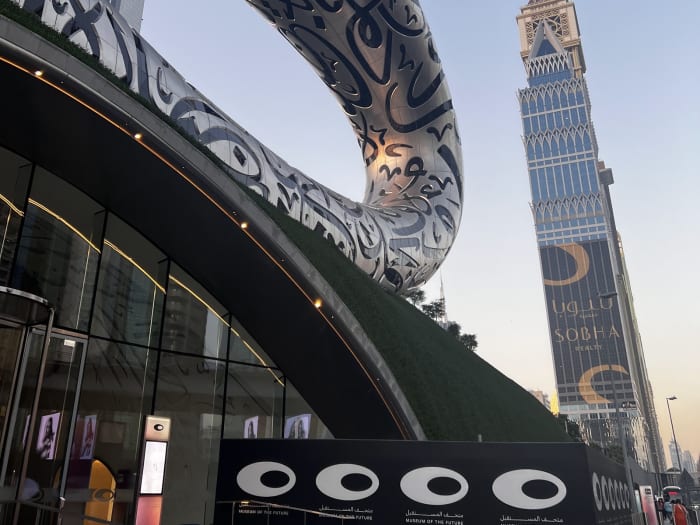
The immediate surroundings also contribute to the experience. Surrounded by iconic towers, the establishment is set within a landscape of glass, steel, and expansive urban vistas. This vertical density creates a unique atmosphere, almost cinematic at certain times of the day when light reflects off the façades, reshaping the contours of the neighbourhood. For a visitor discovering Dubai for the first time, this environment provides an immediate interpretation of the modern city; for a regular visitor, it offers the comfort of a central and coherent landmark.
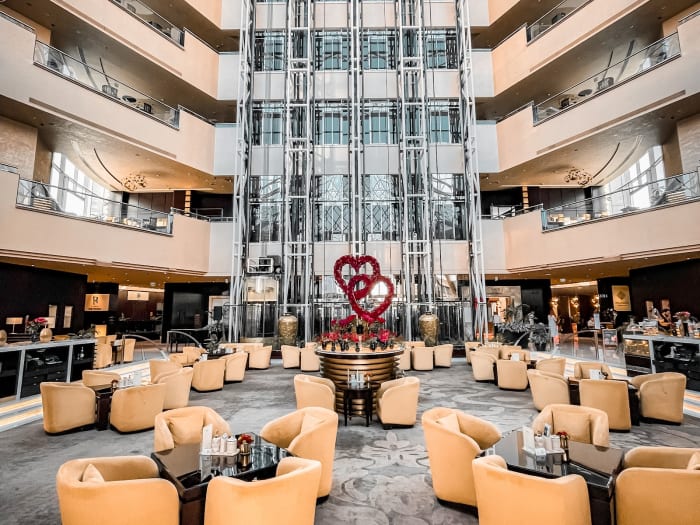
Inside, the hotel extends this impression of contemporary mastery. The spaces are designed to accommodate varied rhythms: late arrivals, early departures, meetings, breaks between outings, and returns after a day of sightseeing. The elegance of the design, noted among the highlights of the establishment, is expressed less through ostentation and more through a certain clarity of lines and a sense of order. It is urban luxury, suited to a hotel that welcomes couples on a getaway, families, and business travellers alike.
What particularly distinguishes this address is its ability to provide a grounding. In a city often perceived as spectacular, sometimes even overwhelming in its scale, the Jumeirah Emirates Towers Hotel offers a stable reference point. It is easy to return to, to organise one’s days simply, and to find continuous service thanks to the 24-hour reception and concierge. This consistency is invaluable, especially during a first visit to Dubai.
Finally, the location allows for a nuanced travel experience. It caters to those who come to work, of course, but also to those who wish to alternate between the energy of the city centre and other facets of Dubai. From this hotel, it is possible to approach the city through its contrasts: towers and grand boulevards, more recent cultural experiences, shopping, gastronomy, and then return to a place that remains directly connected to the urban pulse. In this respect, the Jumeirah Emirates Towers Hotel is not just well located; it is intentionally situated in a neighbourhood that tells something essential about the city itself.
Rooms and suites
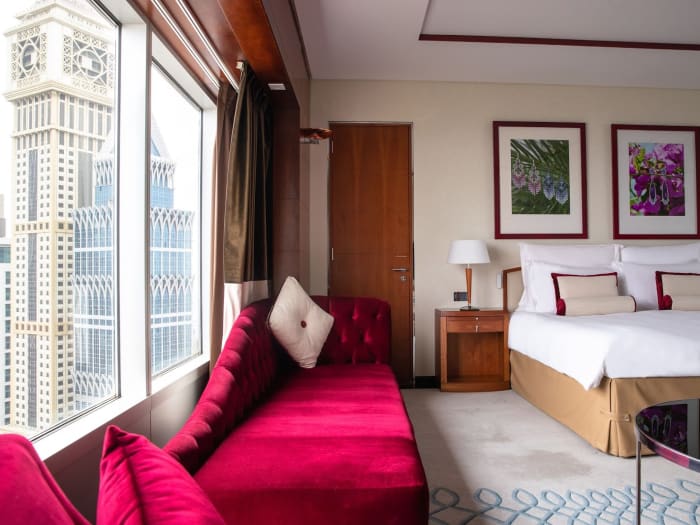
At a hotel such as Jumeirah Emirates Towers Hotel, the room is not conceived as a mere pause between outings; it forms an integral part of the urban experience. The property’s position in the heart of a dense and energetic business district gives rooms and suites a particular role: to provide a place of retreat, calm and comfort within a city often lived at speed. That promise of breathing space matters whether the stay is for business, a long weekend or a trip combining meetings and discovery.
The style expected here is that of contemporary luxury, consistent with the architecture and overall identity of the hotel. Guests come for clean lines, an elegant atmosphere and an interior layout designed to be as pleasant as it is efficient. Rooms in a major business-and-leisure hotel must respond to multiple uses: sleeping well despite jet lag, working comfortably, getting ready quickly before a meeting, or simply taking time to observe the city from above. In that context, the quality of a room is measured as much by immediate comfort as by the intelligence of its design.
Views naturally play an important part. In surroundings defined by Dubai’s landmark towers, the relationship with the cityscape becomes part of the stay’s identity. Depending on orientation and room category, one can expect a strong connection to the urban panorama of height, perspective and light. In Dubai, the room often becomes a privileged vantage point: in the morning, when the city wakes in bright clarity, and in the evening, when illuminated façades and flowing traffic create another kind of relief.
Suites, meanwhile, generally answer a desire for additional space and a clearer separation of functions. They suit those staying several nights, travellers wishing to receive guests in greater comfort, or families seeking a more flexible arrangement. At an address of this calibre, they are expected to maintain continuity of style with the rooms while offering a stronger sense of temporary residence. It is not merely a matter of size; it is a different way of inhabiting the hotel.
The in-room experience is also shaped by service. Daily housekeeping, turndown, a 24-hour reception and the attention of a multilingual team all contribute to the sense of ease that distinguishes well-run addresses. In an international transit city such as Dubai, few things are more valuable than a hotel able to accommodate unusual schedules and changing needs without ever feeling mechanical.
Ultimately, the rooms and suites at Jumeirah Emirates Towers Hotel follow a clear logic: to offer a contemporary refuge within a setting of intense urban energy. They do not seek decorative effect for its own sake. Their role is subtler and more lasting: to help the traveller regain a sense of balance, slow down when needed and enjoy a level of comfort aligned with a five-star address. In a city where the outside world constantly claims the eye and the attention, the ability to create a calm interior remains one of the truest luxuries.
Dining and the rhythm of the stay
In a major urban hotel, dining is never only about cuisine; it helps structure the entire stay. At Jumeirah Emirates Towers Hotel, it should be understood as a sequence of moments, services and atmospheres that accompany very different kinds of day. An early breakfast before a meeting, an efficient lunch between appointments, a more leisurely dinner after sightseeing, a late-evening drink: each of these moments contributes to the overall quality of the experience.
Dubai’s context heightens that dimension. The city is one of the most cosmopolitan in the region, and its international hotels have learnt to speak to guests with widely differing habits and expectations. One therefore expects from a property of this kind an offering that combines clarity, generous opening hours and attention to detail. Even without listing specific venues, what matters is the implicit promise of dining worthy of a five-star hotel: attentive service, a carefully considered setting, consistent execution and the ability to move from a formal register to a more relaxed mood depending on the time of day.
Breakfast occupies a particular place in this type of establishment. It sets the tone of the stay and often reveals the quality of the hotel’s organisation. In a property frequented by both business travellers and leisure guests, it must respond to opposite rhythms: speed for some, unhurried time for others. The real luxury here lies less in abundance than in ease: service that understands the guest’s pace, a pleasant room and an atmosphere calm enough to begin the day with clarity.
The rest of the day calls for different uses. A hotel in the heart of the business district must be able to offer suitable options for informal meetings, short breaks and late returns. Dining then becomes a natural extension of the broader service culture. It should reassure through consistency and appeal through its setting, without relying on excessive theatre. That restraint particularly suits an international clientele seeking reliability as much as pleasure.
In Dubai, dining at the hotel can also be a way of extending the experience of the city without being overtaken by its pace. After the visual intensity of towers, shopping destinations and major roads, returning to an environment that feels composed, elegant and comfortable is deeply welcome. The meal becomes a moment of rebalancing. For couples, it offers an easy way to create time together; for solo travellers, a setting where attentive service offsets the anonymity of large cities; for families, a practical solution in refined surroundings.
In short, dining at Jumeirah Emirates Towers Hotel is best understood as one of the quiet pillars of the stay. It does not need spectacle to be memorable. Its role is more fundamental: to support the different tempos of travel, provide reassuring landmarks at any hour and express hospitality through well-executed daily rituals. In a contemporary luxury hotel, it is often precisely that kind of precision that makes the difference.
Concierge & services
The true standard of a hotel is often measured less by what it displays than by how it supports the guest. In that respect, Jumeirah Emirates Towers Hotel aligns with the expectations of a major international address: availability, continuity and practical intelligence. In a city such as Dubai, where stays frequently combine long-haul flights, meetings, multiple reservations and carefully planned transport, the quality of service is not an optional comfort; it directly shapes the ease of the journey.
The presence of a 24-hour concierge and a round-the-clock front desk provides an essential foundation. It reflects the reality of late arrivals, very early departures and last-minute changes of plan, all common in a destination connected to the world at every hour. For the traveller, this creates a discreet sense of reassurance: knowing that at any time a team can guide, confirm, assist or simply make things easier. In high-level hospitality, that constant availability builds trust and improves the experience far beyond the initial welcome.
Daily housekeeping, turndown service, luggage storage, laundry and wake-up calls all belong to the same logic. Considered separately, these may seem standard in a five-star hotel; taken together, however, they form a very concrete promise: a stay without unnecessary friction, where logistical details are absorbed by the hotel so that the guest gains time, comfort and freedom. This is especially valuable in Dubai, where one may move within a few hours from a formal meeting to an evening out, from sightseeing to an airport departure.
A multilingual team adds another important dimension. In a city welcoming an exceptionally varied international clientele, the ability to understand needs quickly, avoid misunderstandings and adapt the tone of service matters enormously. Contemporary luxury also rests on this relational intelligence: being precise without rigidity, warm without intrusion, efficient without ever seeming hurried.
For business travellers, this quality of service often translates into better control of time. For couples and families, it creates a calmer stay in which practical requests are handled with minimal effort. The concierge then becomes a true command centre for the trip: arranging transfers, assisting with reservations, advising on pace and helping guests navigate a city whose scale can be surprising. Even when visitors have planned their programme in advance, being able to rely on a dependable local point of contact changes the feel of the stay.
What ultimately gives such an address its value is the coherence between setting and service. Contemporary, elegant design is not enough if the support behind it falls short. At Jumeirah Emirates Towers Hotel, the interest lies precisely in that balance: a clear urban aesthetic sustained by services designed to make the city simpler, more accessible and more enjoyable to experience. In an environment as dynamic as central Dubai, the ability to absorb the complexity of travel is one of the most tangible luxuries.
Dubai living from this address
Choosing Jumeirah Emirates Towers Hotel also means choosing a particular way into Dubai. Not through the postcard image of beaches alone, nor through the desert imagination, but through the active heart of the city, where business, architecture, mobility and cosmopolitan life intersect. This perspective is especially compelling for travellers who wish to understand Dubai beyond cliché. From this address, the city appears as an organism in motion, structured by major roads, towers, flows and its ability to accommodate very different uses within the same urban fabric.
This way of living Dubai is first and foremost about tempo. The city is rarely discovered in a linear fashion; it unfolds in sequences. A morning devoted to a meeting or a visit, a pause in a comfortable hotel, an afternoon between shopping, contemporary architecture or another district, then a dinner that allows the pace to soften. Jumeirah Emirates Towers Hotel lends itself well to that alternation. Its central location and urban identity make it a relevant base for those who want to experience the city without losing time in unnecessary transfers.
There is also a particular way of looking at Dubai from here. From the business district, the city reveals its most deliberate and constructed dimension. The landmark towers surrounding the hotel are not merely scenery; they speak of ambition, of a staged modernity and of an international outlook. For the visitor, this gives the stay a specific tone, more architectural and more metropolitan. One understands better why Dubai fascinates as much as it provokes reflection: it presents itself as a city of contrasts, where contemporary efficiency coexists with deeply rooted regional codes of hospitality.
From this address, it is possible to shape a highly personal stay. Some will prioritise the professional dimension and appreciate being able to reach appointments easily while enjoying refined surroundings. Others will see it as a strategic point of departure for exploring the major markers of modern Dubai. Couples can create a programme of skyline views, dinners and restorative pauses, while families benefit from a stable base from which to organise varied days. That adaptability is one of the hotel’s most persuasive qualities.
Living well in Dubai also involves managing climatic and visual contrasts. The city can be intense, bright and fast-moving. Returning to a hotel with elegant design, continuous service and an ordered atmosphere helps rebalance that intensity. This is where the address comes fully into its own: it does not merely host, it sets the rhythm. It offers a breathing space between the sequences of travel, a place where one can both prepare what comes next and enjoy the simple comfort of a well-run environment.
For travellers wishing to discover a contemporary, connected and fully urban Dubai, Jumeirah Emirates Towers Hotel is therefore far more than a practical address. It offers a coherent reading of the city, faithful to its energy yet calm enough to appreciate its nuances. It is a way of staying that privileges clarity, mobility and quality of service, without giving up the pleasure of a grand hotel.
Book with MyConciergeHotel
Booking Jumeirah Emirates Towers Hotel with MyConciergeHotel means approaching the property as a stay to be shaped, rather than as a simple rate comparison. In a city such as Dubai, where the experience depends as much on the choice of district as on practical organisation, guidance before arrival matters greatly. A hotel in the heart of the business district, suited to both professional trips and leisure stays, deserves to be selected according to the real rhythm of the journey: length of stay, arrival times, transfer needs, balance between appointments and free time, and expectations in terms of comfort and service.
That is precisely where assisted booking makes a difference. Beyond the room itself, the aim is to think through the entire journey. For a short stay, it may be wise to optimise travel time and arrange essential logistics in advance. For a longer stop, the challenge is more likely to be creating a smooth programme that alternates effectively between obligations and discovery. In both cases, good preparation allows guests to make full use of the hotel’s central location and its ability to serve as a stable base in a city that is constantly in motion.
One of the most useful recommendations for this address is to anticipate arrival. Booking an airport transfer in advance, as already suggested in the Concierge tip, is especially sensible in Dubai. After a long-haul flight, in a destination whose urban scale can feel impressive, being met and taken directly to the hotel immediately changes the tone of the stay. The journey begins under the sign of continuity rather than logistical effort. It may seem a small detail, but it is one that genuinely matters.
Booking through MyConciergeHotel also places the stay within a more editorial, more selective approach. Jumeirah Emirates Towers Hotel does not speak to every traveller in exactly the same way: some will come for flawless efficiency, others for immersion in contemporary Dubai, and others still for a balance between city life, comfort and service. Understanding that nuance helps guests make the right choice and avoid mismatched expectations. A major urban hotel is always best enjoyed when it corresponds closely to the way one wishes to inhabit the city.
For couples, the appeal often lies in combining centrality, skyline views and quality of service. For business travellers, the priority may be ease, team availability and the coherence of the location. For families, the focus is likely to be on securing a comfortable base that is straightforward to use and well connected to the rest of the city. In every case, the objective is not merely to book a room, but to prepare a stay in which each element supports the next.
In short, choosing this address with MyConciergeHotel means favouring a certain precision: the right hotel, in the right district, with the right degree of anticipation. In Dubai, that precision often turns a good stay into a genuinely seamless one. And for a property such as Jumeirah Emirates Towers Hotel, whose strength lies in the combination of location, contemporary design and continuous service, that approach makes perfect sense.