History & inspiration
In Bali, luxury is never only about comfort. It is shaped by a subtler relationship between landscape, everyday spirituality, craftsmanship and a particular sense of rhythm. Jumeirah Bali fits into this reading of the island through an approach that values atmosphere as much as architecture. More than a straightforward beachfront resort, the property draws on Balinese inspiration in its lines, volumes and in the way the stay is organised around serenity. This matters: in Bali, the most convincing hotels understand that the setting is never merely a postcard backdrop, but a language.
The identity of the place rests on a dialogue between Jumeirah’s contemporary hospitality and a local imaginary of stone, vegetation, water and open horizons. Without attempting to replicate an ancient palace or slipping into folklore, the hotel appears to borrow from Balinese architecture its sense of composition: marked entrances, circulation conceived as a progression, and the importance of thresholds, courtyards and visual pauses. This kind of architectural writing creates a particular feeling, that of a stay revealed in sequences rather than at a single glance.
Luxury here is also expressed through restraint. Where some overly demonstrative resorts crowd the space with decorative signals, Jumeirah Bali seems to favour a calmer aesthetic in which materials, tropical light and the presence of greenery do most of the work. This relative sobriety suits Bali well, an island where the intensity of the landscape often makes excess unnecessary. The sense of escape comes less from spectacle than from continuity between the natural environment, the architecture and the tempo of service.
Its affiliation with Jumeirah brings the framework expected by an international clientele accustomed to high standards: a strong sense of welcome, smooth organisation, and attention to comfort and discretion. This combination of a recognised hospitality signature and a clearly expressed local inspiration is one of the property’s strengths. It allows for an experience that feels dependable without becoming interchangeable.
For French travellers, the hotel may be understood as a gateway to a certain idea of Bali: not the island of constant movement, crowded itineraries or addresses to tick off, but one of retreat, calm and contemplation. Guests come here to recover a form of balance between the energy of long-haul travel and the need to slow down. In that sense, Jumeirah Bali does not merely provide accommodation; it stages a readiness for the island itself, for its light, its morning and evening rituals, and for that distinctly Balinese relationship between beauty of setting and quality of presence.
The property
Set on Bali’s coastline, Jumeirah Bali immediately offers what many travellers seek on the island: a sense of openness to the landscape, a direct relationship with sea air, and a feeling of remove from the surrounding bustle. The tropical setting plays a central role. It is not merely pleasant scenery, but a genuine sensory framework: gentle warmth in the early morning, dense vegetation, shifting light throughout the day, the sound of wind, and the constant presence of the horizon. The hotel appears designed to let these natural elements shape the experience.
Arrival usually sets the tone. In properties of this level, first impressions depend on how one moves from outside to inside, from the road to the estate, from motion to calm. Jumeirah Bali seems to stage that transition carefully, favouring space, perspective and a discreet sense of ceremony. Once settled in, it becomes clear that the place speaks to guests seeking not constant activity but a form of breathing room. Couples, families wanting an orderly setting, and international travellers in search of rest after a busier itinerary can all find a rhythm that suits them.
The design inspired by Balinese architecture gives the estate a distinctive coherence. This inspiration is expressed less through overt decoration than through a way of inhabiting the site: the importance of horizontal lines, materials that respond to light, and outdoor spaces conceived as natural extensions of the interiors. In a tropical climate, that continuity is essential. It allows guests to experience Bali not from a room closed in on itself, but in constant dialogue with the outdoors.
The peaceful atmosphere focused on wellbeing is the property’s other defining trait. Here, wellbeing refers not only to the spa or treatments, but to an overall quality of experience: smooth circulation, attentive yet unobtrusive service, the possibility of withdrawing, reading, swimming, lingering over lunch, or simply watching the sky change colour. It is often this kind of luxury, hard to quantify but immediately perceptible, that distinguishes places where one genuinely rests.
Its coastal location also allows for different styles of stay. Some guests will choose to remain almost entirely within the resort, enjoying the pool, restaurants, relaxation areas and concierge service. Others will alternate between downtime and island discoveries, with outings to beaches, temples or villages. In both cases, the hotel works as a serene base, a fixed point from which Bali becomes easier to read.
What is striking, finally, is the way the property preserves a sense of intimacy despite the scale expected of a major international resort. When architecture is well judged, it absorbs the presence of others without creating a feeling of crowding. That is precisely what seasoned travellers look for: not absolute isolation, which is rarely realistic, but the sense of a space sufficiently controlled for each guest to inhabit it on their own terms. Jumeirah Bali appears to meet that expectation with precision.
Rooms, villas and the art of rest
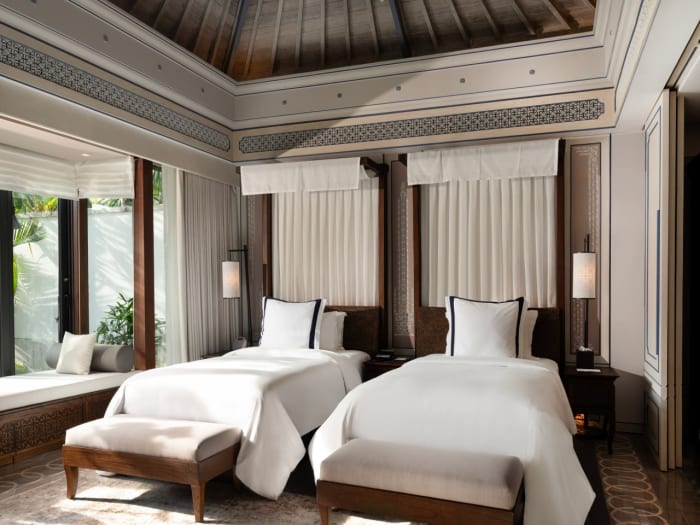
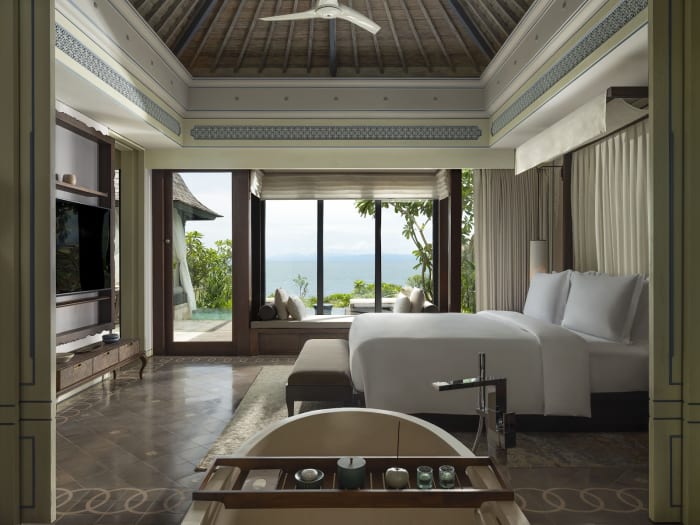
In a Balinese resort of this calibre, accommodation is never merely practical; it forms the core of the experience. At Jumeirah Bali, one expects spaces designed to extend the calm of the estate, with particular attention paid to circulation, light and the relationship between indoors and outdoors. The design inspired by Balinese architecture comes fully into its own here. It is not simply an aesthetic vocabulary, but a way of thinking about rest: generous volumes, thresholds that soften transitions, openings framing greenery or sky, and a sense of withdrawal conducive to unwinding.
Travellers familiar with major leisure hotels know that the quality of a room is often measured by details less visible than the décor itself. Silence first, or at least a place’s ability to filter the world. Then the legibility of the space: knowing immediately where to set down one’s belongings, where to read, where to get ready, where to retreat for a few moments. Finally, the overall coherence between furniture, materials, temperature, lighting and service. In a property such as Jumeirah Bali, these elements should converge towards one idea: making the room a refuge rather than a simple stop between activities.
The tropical context also calls for a specific kind of hospitality. One expects spaces able to welcome light without excess, preserve coolness, and allow for a life partly oriented towards the outdoors. It is this controlled porosity that often gives stays in Bali their charm. A terrace, an open sitting area, a bathroom conceived as a place of relaxation as much as function: such features turn time spent in the room into a genuine part of the stay. Even for guests who spend much of the day outside, it matters to return to a space that feels neither neutral nor standardised.
For couples, the room readily becomes a cocoon, a place of slowness where breakfast is taken, where one rests during the hottest hours, where the evening is extended. For families, the question is different: one expects fluidity, comfort, easy-to-live-in spaces and service able to support daily needs without rigidity. A well-run international resort knows how to answer these varied uses without feeling like a uniform product. Much of its success lies there.
Daily housekeeping, turndown service and the general attention paid to upkeep also contribute to this quality of rest. In fine hotels, comfort depends not only on what one sees on arrival, but on the way the room supports the stay day after day. Returning in late afternoon to a space restored to order, finding a carefully prepared atmosphere, sensing that the practical side works without visible effort: these are signs of hotel mastery that matter greatly.
In Bali perhaps more than elsewhere, ideal accommodation is that which allows one to slow down without ever becoming dull. One should be able to sleep deeply, read for hours, take time over tea or coffee, and watch tropical rain as readily as the return of sunshine. Jumeirah Bali appears to belong to this tradition of inhabited rest, where the room is not simply a luxurious backdrop, but a space designed to tune the traveller back to a calmer rhythm.
Dining, between horizon and tropical rhythm
On a successful seaside stay, dining plays a greater role than one might think. It structures the day, accompanies changes in light, and contributes to the sense of disconnection guests are seeking. At Jumeirah Bali, one may reasonably expect a dining offering shaped around different moments: an unhurried breakfast, a light lunch between swims, and a more settled dinner when the heat recedes and the landscape changes tone. In a tropical setting, the pleasure of the table lies as much in the pace it allows as in what is served.
The first luxury here is perhaps the morning itself. In major resorts, breakfast is not merely a service but a ritual of beginning. Guests look for freshness, variety, a certain precision in execution, and above all an environment that encourages lingering. In Bali, where morning light is especially gentle, starting the day facing greenery or sea air immediately alters the quality of the stay. This slow interval, before excursions or the stronger sun, forms an integral part of the experience.
The rest of the day calls for cuisine suited to the climate. Travellers generally appreciate menus that are clear, balanced and able to alternate between international inspiration and local touches. In a hotel of this level, one expects less a display than a sense of rightness: well-handled produce, controlled cooking, attentive service, and menus able to answer both a simple lunch and a more elaborate dinner. The aim is to allow each guest to compose their own culinary rhythm, without heaviness or monotony.
The setting obviously matters a great deal. A resort restaurant is never separate from its environment. At Jumeirah Bali, the appeal lies precisely in this relationship between dining and landscape: the feeling of lunching within a tropical pause, taking a drink as the light softens, or dining in a more hushed atmosphere after a day spent outdoors. The best hotels know how to create these sequences without making them theatrical. Everything should feel natural, almost self-evident.
Service also makes the difference. A team attentive enough to support international habits while retaining a form of local warmth turns a correct meal into a genuine moment of hospitality. Special requests, dietary preferences, shifting schedules linked to jet lag or excursions: in a well-run resort, all this should be absorbed with ease. It is often this fluidity that makes guests want to return to the same table several times during a stay.
Finally, dining in a place like this is not limited to restaurants. It also includes more intimate moments: a meal taken in the privacy of one’s accommodation, a light bite after the pool, tea or coffee enjoyed away from the heat, or a dinner chosen simply to extend the evening without leaving the estate. This ability to move between convivial and private experiences is part of contemporary comfort. At Jumeirah Bali, dining seems best understood as an art of accompanying the stay with discretion, consistency and a sense of the right moment.
Spa & wellbeing
Wellbeing sits at the heart of Jumeirah Bali’s positioning, but it deserves to be understood in a broad sense. In the best tropical resorts, the spa is not simply an added facility on a list of amenities; it extends an overall atmosphere shaped by silence, slowness and attention to the body after travel. In Bali, this dimension resonates particularly strongly. The island has long carried an image of retreat, re-centring and practices oriented towards balance. A hotel claiming a peaceful atmosphere must therefore place its wellbeing offering within that continuity, without overstatement.
The first treatment is often the setting itself. Sleeping more, walking slowly, swimming, taking in the morning light, and keeping digital demands at a distance: all of this already contributes to a form of reset. The spa then deepens that process. Guests seek less performance than quality of listening, precision of touch and the ability to adapt the moment to the traveller’s actual needs. After a long flight, a day of excursions or simply months of sustained pace, a well-conducted treatment can reorder the stay.
In a property of this level, one generally expects a menu built around massages, facials and relaxation rituals, with particular attention paid to welcome, preparation and the time allowed to return to calm afterwards. The difference between a competent spa and a very good one often lies in what surrounds the treatment itself: the quality of transition before the appointment, the serenity of the spaces, the discretion of the staff, the absence of haste. Luxury here consists in restoring density to time.
The Balinese context also invites a more global understanding of wellbeing. Some travellers will seek a simple moment of relaxation; others may wish to incorporate more regular practices into the stay, such as morning routines, breathing, stretching or centring sessions. Even without a formal programme, a hotel whose atmosphere is well judged can encourage this availability. Sometimes a coherent environment is enough for the body finally to accept slowing down.
The appeal of a resort such as Jumeirah Bali lies precisely in the relationship between the spa and the rest of the estate. A treatment is not an isolated activity, but one sequence among others in a day designed to soothe: an unhurried breakfast, time to read, a swim, a wellbeing appointment, a light nap, dinner without rush. This continuity is essential. It avoids the artificial effect of places where the spa promises serenity without anything around it making that promise plausible.
For many guests, the most lasting memory of a stay in Bali is not a crowded programme but a recovered sensation: a body less tense, a clearer mind, a relationship to time made habitable again. It is in this sense that wellbeing at Jumeirah Bali finds its full meaning. More than a collection of treatments, it is a way of inhabiting the stay with greater softness, presence and continuity.
Concierge & services
In luxury hospitality, services matter not only because they exist, but because they disappear behind the experience. Jumeirah Bali offers the essentials expected of a major international property: 24-hour concierge, 24-hour front desk, daily housekeeping, turndown service, luggage storage, laundry, wake-up service and multilingual staff. Taken separately, these may seem standard. In reality, the quality of their execution determines much of the comfort guests actually feel.
The concierge, first of all, plays a decisive role in a destination such as Bali. The island inspires as much desire as it does practical questions: arranging transfers, choosing timings to avoid crowds, making recommendations suited to a traveller’s profile, handling reservations, special requests and last-minute adjustments. A good concierge does not simply multiply suggestions; it filters, prioritises and simplifies. For a couple, this may mean shaping a day that balances relaxation and discovery. For a family, it may mean making movements easier. For a guest on a mixed stay, it may mean reconciling rest and obligations without unnecessary friction.
A front desk available at all hours is another important marker, especially in a long-haul destination where late arrivals and early departures are common. After an overnight flight or a change of plan, being received with efficiency and calm immediately alters one’s perception of the stay. The best hotels understand that these transitional moments are often those in which travellers are most vulnerable to fatigue. The quality of the welcome is therefore measured not only by courtesy, but by the ability to absorb that fatigue with simplicity.
Daily housekeeping and turndown service belong to that discreet practical order which distinguishes a beautiful hotel from one that is genuinely well run. They ensure continuity of comfort, particularly valuable in a tropical climate, where guests move more frequently between indoors and outdoors. Returning to a room perfectly restored, finding an atmosphere prepared for the night, noticing that the stay proceeds without visible disorder: these are signs of a well-managed house.
Laundry and luggage storage answer more practical needs, but they are no less essential. In Bali, where stays often form part of a wider itinerary, such services bring valuable flexibility. They allow guests to travel lighter, depart in good order, or enjoy their final hours on site without being encumbered. It is often these details that give a journey its memorable ease.
Finally, the presence of multilingual staff contributes to the overall relational quality. In an international hotel, precise understanding of requests, habits and sometimes cultural nuances is a genuine luxury. It avoids misunderstandings, facilitates adjustments, and creates that rare but decisive feeling of being accompanied rather than merely served. At Jumeirah Bali, services therefore seem best read as an invisible architecture: everything that allows the stay to unfold naturally, smoothly and without unnecessary expenditure of energy on the guest’s part.
The Balinese art of living
To stay in Bali is to accept that a journey may be shaped by more than the logic of sightseeing alone. The island invites a particular form of attention: to everyday gestures, to the beauty of offerings glimpsed at the side of a path, to the very concrete relationship between spirituality and ordinary life, and to the way nature and habitation coexist. Jumeirah Bali, through its peaceful atmosphere and coastal setting, seems especially suited to this slower reading of the destination. One does not come here merely to see Bali, but to become available to what it gives off.
The Balinese art of living begins with a relationship to time. Days are structured by light, heat, journeys that are sometimes slower than elsewhere, and by the importance given to intermediate moments: morning before the bustle, afternoon in the shade, the fall of evening. For travellers accustomed to tightly programmed stays, this temporality can be instructive. It invites one to loosen the itinerary, to leave room for the unexpected, and sometimes to prefer an hour of calm before the landscape to one more activity. A hotel such as Jumeirah Bali comes fully into its own when it makes precisely that breathing space possible.
The Balinese coast offers another face of the island, more open, sometimes more mineral, always shaped by the presence of the ocean. People come for the light, the air, the end of day, but also for that sense of space which balances the cultural intensity of the inland areas. From a well-positioned resort, it becomes possible to alternate between immersion and retreat: discovering a temple, a beach or a lively district, then returning to the calm of the estate. This alternation is often the key to a successful stay in Bali. Too many excursions exhaust; too much withdrawal impoverishes. One must find the right measure.
The island also lends itself to discoveries that are more sensory than strictly touristic. Observing materials, craftsmanship, the silhouettes of gates and shrines, listening to evening sounds, tasting local cuisine or food inspired by the tropical terroir, understanding the place of ritual in public space: these are experiences that do not necessarily require an ambitious programme, but rather genuine availability. The luxury of a grand hotel then lies in providing a stable point of anchorage from which such perceptions become clearer.
For French travellers, Bali often retains a powerful imaginative charge. One projects onto it rest, exoticism, sometimes a form of renewal. The reality is more complex, denser, and that is all to the good. The island rewards patient gazes, those willing not to grasp everything at once. In this context, choosing a hotel with a controlled atmosphere allows one to keep a comfortable distance from the intensity outside. Jumeirah Bali seems to offer that mediation: enough refinement to protect, enough openness to let the island in.
Ultimately, the art of living in Bali is neither a decorative concept nor an abstract promise. It is a way of inhabiting the day with greater awareness, gentleness and curiosity. A successful stay is measured not only by the number of sites seen, but by the quality of presence recovered. That is precisely what this kind of address can make possible when it understands luxury not as an end in itself, but as a favourable condition for experience.
Book with MyConciergeHotel
Booking Jumeirah Bali through MyConciergeHotel means choosing an editorial and assisted approach to travel rather than a simple transaction. For a property of this nature, the booking channel matters more than one might think. A major international resort can suit very different expectations: a honeymoon, a restorative couple’s stay, a family holiday, a seaside stop within a wider Indonesian itinerary, or a recovery pause after a more active travel sequence. The right booking is therefore the one that takes the purpose of the stay into account, not merely a rate or a displayed room category.
The value of MyConciergeHotel lies precisely in this ability to place the property in context. Jumeirah Bali is not reducible to a generic promise of tropical luxury. Its appeal rests on its peaceful atmosphere, its design inspired by Balinese architecture, its coastal setting, and the quality of service associated with the Jumeirah name. The question is whether that positioning matches the way you travel. Some guests will seek above all calm and wellbeing; others will want to combine the resort with carefully chosen island discoveries; others again will need particularly smooth logistics. A well-supported booking aligns those expectations with the right rhythm of stay.
Booking through MyConciergeHotel also means benefiting from a curatorial perspective. In a market saturated with images and interchangeable promises, the challenge is not to multiply options but to read places more accurately. Our approach is to highlight what makes an address distinctive, without unnecessary emphasis: here, a tropical setting conducive to relaxation, an atmosphere focused on wellbeing, a clearly Balinese aesthetic, and solid hotel services. This editorial reading helps guests decide with greater precision.
Support becomes especially valuable when organising the details that turn a good stay into a seamless one: arrival and departure times, specific requests, travel preferences, coordination with other stages of a journey, and the need for assistance before departure or on site. In a long-haul destination such as Bali, these parameters have a direct impact on comfort. Being well advised beforehand often means avoiding errors of rhythm once there.
Finally, booking through us means choosing a more qualitative relationship with travel. We believe a luxury hotel should be recommended for sound reasons, clearly expressed, rather than through empty language. Jumeirah Bali will particularly suit travellers seeking a serene seaside experience, structured by service and open to a calmer reading of Bali. If that is what you are looking for, the property deserves careful consideration.
Our role is to help confirm that fit, prepare the stay with precision, and ensure that the experience begins before arrival. In luxury travel, this quality of preparation is not incidental; it forms part of the journey itself. It is in that spirit that MyConciergeHotel supports bookings at Jumeirah Bali, with rigour, clarity and attention to detail.