Desa Potato Head Bali: a Seminyak hotel conceived as a creative village
In Seminyak, on Bali’s lively south-west coast, Desa Potato Head is not simply a beach hotel. It is conceived more as a coherent compound, almost a contemporary village, where accommodation, dining, cultural life and environmental thinking belong to the same narrative. The idea of a “desa”, or village, is the key to the place: the experience extends beyond a room with a view to a particular way of inhabiting Bali, shaped by openness to nature, expressive design and a seaside rhythm.
Its architecture, often cited as one of the property’s defining features, draws on Balinese references without slipping into postcard cliché. Spaces remain open, filled with air and light, and circulation between living areas, gardens, terraces and restaurants feels fluid. This permeability between indoors and outdoors immediately sets the tone: rather than the clear separation of a conventional resort, there is a sense of continuity across a domain oriented towards climate, greenery and the sea.
That identity also explains why Desa Potato Head Bali appears so frequently in searches related to Seminyak. Travellers are drawn as much by the hotel as by its social energy, culinary scene and beachfront setting. Those looking for a Potato Head Seminyak hotel or a Desa Potato Head hotel are usually seeking this exact combination: a five-star property without the stiffness sometimes associated with luxury, where one can move from suite to lunch, from sunset to evening drinks, without ever losing the aesthetic thread of the place.
The atmosphere deserves to be defined carefully. It is neither purely contemplative nor overtly party-driven. Desa Potato Head manages a rare balance between ease and intensity: couples, solo travellers, friends and families all find their place in a setting that feels lively without becoming overwhelming. The proximity of the beach and the presence of the well-known beach club bring movement to the wider estate, yet the hotel still retains quieter pockets suited to retreat.
Listed in The World’s 50 Best Hotels 2025, the property now stands among the internationally noted addresses valued not only for service levels, but for the coherence of their vision. What distinguishes Desa Potato Head is not an accumulation of luxury markers, but a distinctly contemporary approach to hospitality in Bali: less demonstrative, more sensory, and more engaged. For travellers seeking a Desa Potato Head Bali hotel that offers more than a standard beach stay, it remains one of Seminyak’s most singular addresses.
Potato Head Seminyak Hotel: the setting, the beach and the spirit of the place
Choosing Desa Potato Head is first and foremost a matter of location. In Seminyak, the property occupies one of Bali’s most sought-after settings for travellers wishing to combine beach access, dining, local life and ease of movement. The shoreline is central to the experience here: the sea is not a distant backdrop, but a constant presence shaping the day, from early morning light to the golden late afternoons for which this stretch of coast is known.
Its immediate proximity to the beach goes a long way towards explaining the property’s reputation. Many travellers instinctively associate the address with Potato Head Beach Club or Potato Head Beach Club Bali, such is the strength of the relationship between the hotel and the waterfront. Yet to reduce Desa Potato Head to its beachfront profile alone would be to miss its nuance. The site does not merely provide convenient access to sand and sunsets; it frames a particular way of living the coast, through a continuous dialogue between architecture, landscape and use.
Seminyak itself remains one of Bali’s most cosmopolitan districts. Visitors come for its energy, boutiques, restaurants, cafés, villas and that distinctive blend of tropical ease and visual polish. Within that context, Desa Potato Head occupies a singular place. It is integrated enough into Seminyak’s life to allow guests to feel the district’s pulse, yet self-contained enough to offer a complete world to those who prefer to remain on site for much of their stay.
Its relationship with nature is equally important. Open spaces, largely connected to the outdoors, encourage a very Balinese experience of climate: one lives with the light, the air, the vegetation and the sounds of sea and garden. This gives the stay a different texture from that of a sealed urban hotel. Transitions are gentle here: a corridor becomes a terrace, a terrace opens to a garden, a dining space extends towards the horizon.
For travellers wondering where Desa Potato Head is, the most accurate answer may be less geographical than sensory: it stands at the meeting point between vibrant Seminyak and a more elemental Bali. That is what makes it particularly appealing to those who want a beach stay without cutting themselves off from the wider island. One finds the social intensity of the south coast, but also the possibility to slow down, watch the sea, dine on site and move through the estate without rupture.
This setting suits different kinds of travellers. Couples find a backdrop well suited to evenings by the ocean; families appreciate the ease of a lively estate where everything feels within reach; solo travellers can settle in without ever feeling isolated. In a destination where location often determines the mood of a stay, Desa Potato Head turns its address into a genuine seaside way of life.
Potato Head Suites: rooms, suites and the art of staying
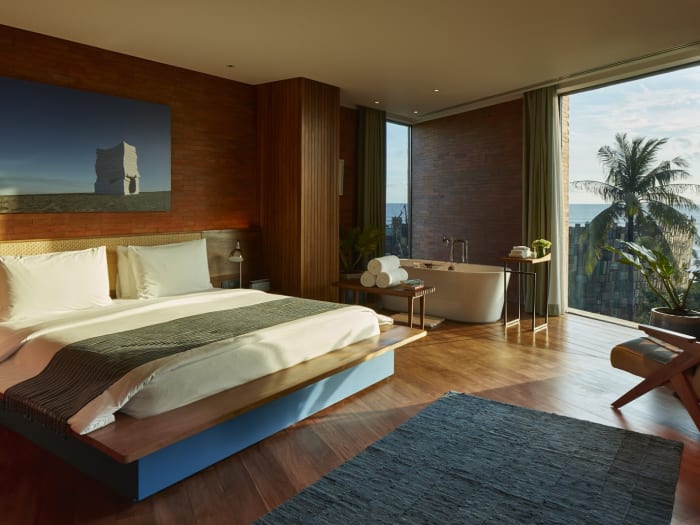
In a property so strongly defined by architecture and setting, rooms and suites play a decisive role: they must extend the spirit of the estate without freezing it into décor. At Desa Potato Head, accommodation follows that broader logic. The sleeping spaces do not aim for ostentation; instead they privilege fluidity, comfort and a connection with the Balinese setting. For travellers specifically searching for Potato Head Suites, the appeal lies precisely in this continuity between design, materiality and way of life.
The property’s aesthetic language rests on a contemporary reading of the tropics. One can expect volumes shaped to let light circulate, openings that make the most of views or greenery, and an atmosphere in which materials, textures and tones respond to the local climate. Luxury here does not come through decorative excess, but through the quality of space: a room that breathes, a suite that feels easy to inhabit, a layout that makes the stay intuitive.
This approach suits Bali particularly well, where life is often lived more outdoors than within four walls. Accommodation at Desa Potato Head appears designed to accompany that movement: returning from the beach, showering after the sun, reading quietly, preparing for dinner, waking with the morning light. The stay takes on an organic, almost domestic rhythm, yet one supported by five-star hotel standards. It is also one of the clearest answers to a question often asked about the property’s rating: Desa Potato Head is indeed a five-star hotel, and that category is expressed here through the coherence of the experience as much as through service.
For couples, the suites provide an especially apt setting, allowing a sense of intimacy within a lively estate. For families, the appeal lies in the flexibility of a hotel where rest and shared time in common spaces can alternate easily. Solo travellers, meanwhile, find an elegant base, calm enough to recover from Seminyak’s movement without ever feeling detached from the place’s energy.
What tends to remain in the memory at an address like this is not simply the size of a room or a list of amenities, but the way it accompanies the hours of the day. A good suite in Bali is one that receives the warmth, filters the light, preserves quiet and offers refuge without severing the link to the outdoors. The Potato Head Suites fit that idea of accommodation as a natural extension of landscape and local way of life.
For those browsing Desa Potato Head Bali photos or Desa Potato Head Bali reviews before booking, this is often the impression that emerges: a place where aesthetics are not applied superficially, but genuinely lived. The rooms and suites are central to that identity. They do not compete with the spectacle of the beach or the energy of the beach club; rather, they provide the necessary counterpoint, a space of retreat, coolness and personal rhythm within an estate devoted to experience.
Potato Head Bali menu: six venues through which to read Bali at the table
Dining is central to the identity of Desa Potato Head. More than an expected service in a hotel of this category, it is one of the place’s key languages. With six known venues across the estate — Dome Restaurant, Ijen Restaurant, Tanaman Restaurant, Kaum Restaurant, Dome Bar and the Beach Club — the property offers a culinary scene varied enough to shape several days of a stay on its own. For travellers searching for an idea of the Potato Head Bali menu or Desa Potato Head Bali menu, it is best understood not as a single menu, but as an ecosystem of tables and moments.
The guiding thread is clear: attention to local produce. In a destination such as Bali, this matters when taken seriously, because it connects the plate directly to territory, seasonality, craft and the tastes of the archipelago. At Desa Potato Head, that logic appears to run through the wider offer, whether in modern cooking, a table more rooted in regional traditions, seafood-led dining or a more informal meal by the water.
Dome Restaurant sits within a modern culinary register, in a setting fully aligned with the property’s aesthetic universe. Guests come for an experience that extends the Desa Potato Head spirit: design, atmosphere and food are in dialogue, without stiffness. Ijen Restaurant, Tanaman Restaurant and Kaum Restaurant broaden the range, each bringing its own tone to the stay. Without overloading the experience with explanation, this diversity prevents meals from repeating the same gestures from one sitting to the next.
The Beach Club naturally occupies a category of its own. Its reputation extends far beyond hotel guests, which is one reason the term Potato Head Beach Club appears so frequently in Bali-related searches. Yet for residents of Desa Potato Head, its appeal is not only its renown. It is the ease with which it fits into daily life: lunch by the sea, a late-afternoon drink, a natural transition between swimming, music, horizon and social life. The beach club is not an external add-on; it forms part of the stay’s wider rhythm.
Dome Bar completes the picture with a more liquid, more nocturnal dimension, ideal for extending the day without leaving the property’s world. In an address of this kind, the quality of a bar lies as much in its atmosphere as in its list. In Bali, where evening hours matter as much as morning ones, that dimension is never secondary.
For the traveller, this culinary breadth has a simple consequence: one can stay several nights at Desa Potato Head without encountering the monotony that sometimes affects large resorts. Each venue offers a different reading of Bali, its produce and its energy. Dining becomes a way of inhabiting the place, not merely eating within it. That is also what distinguishes a destination address from a simply well-located hotel: the ability to make each meal a coherent chapter of the journey.
Sustainability, design and a sense of place
If one had to isolate a single trait that truly distinguishes Desa Potato Head within Bali’s hotel landscape, it would likely be its tangible commitment to sustainability. Many properties now use that vocabulary; few make it a visible axis of their identity. Here, environmental thinking does not appear as an added layer of messaging, but as part of the overall project, on equal footing with architecture, dining and guest experience.
That commitment is first legible in the way the estate relates to its immediate surroundings. Open spaces connected to nature, the circulation of air, the role given to greenery and natural light are not merely aesthetic choices. They reflect an understanding of the tropical climate and a desire to root hospitality in a more porous logic, less energy-intensive in principle and more attentive to local conditions. In Bali, where a hotel can easily become an artificial bubble cut off from its setting, this approach changes the perception of a stay considerably.
Design belongs to that same awareness. Architecture inspired by Balinese culture does not attempt to reproduce a frozen past; it interprets it. This matters, because it avoids two common pitfalls: decorative folklore on one side, rootless internationalism on the other. Desa Potato Head appears to prefer a third path, in which local references nourish a contemporary language. The result is neither museum-like nor anonymous. It gives the property a highly recognisable presence, clearly tied to Bali without collapsing into cliché.
This coherence between design and sustainability also helps explain the property’s reputation. If one asks why Potato Head Bali is so well known, the answer lies not only in its beach or its beach club. The place has come to embody a certain idea of contemporary travel: a luxury measured not solely by rarity or display, but by the quality of the relationship between site, architecture, use and responsibility. In Bali’s highly competitive market, that vision gives the property a distinct voice.
For the traveller, this dimension becomes concrete. It shapes the atmosphere, which feels more breathable; the materiality, often more tactile; the way one moves through the estate; even the perception of comfort itself, which relies less on abundance than on rightness. One does not come here only to be looked after, but to stay in a place with a position, a way of doing things and a perceptible ethic.
That may well explain the loyalty the address inspires in some guests. In a hotel world saturated with images, the places that endure are often those that carry a clear idea. Desa Potato Head carries one: that a seaside hotel can be desirable, lively and socially magnetic while still assuming responsibility towards its environment. This balance between pleasure and awareness gives the stay a particular depth, rare in destinations where natural beauty is sometimes consumed without reflection.
Concierge, services and the rhythm of a stay at Desa Potato Head hotel
In a five-star hotel, the most important services are not always the most spectacular. They often lie in the quality of rhythm they make possible: arriving at any hour without friction, returning to a properly refreshed room, storing luggage, receiving a swift response, feeling that a team is present without becoming intrusive. At Desa Potato Head, this discreet dimension of service supports the overall experience and gives it its ease.
The presence of a 24-hour front desk and round-the-clock concierge first answers a very practical reality of travel in Bali: variable flight schedules, late transfers, early departures and last-minute wishes. In an island destination where journey times can be unpredictable, such continuity of service is far from incidental. It allows guests to approach the stay with greater flexibility, whether for a late arrival, a logistical need or a recommendation on the ground.
Daily housekeeping, turndown service, luggage storage, laundry and wake-up calls belong to the classic grammar of high-end hospitality, yet their value lies in the way they support a beach stay. In Seminyak, days can be long and mobile: beach time, meals, outings, rest and possible excursions. Returning to a refreshed space, finding personal belongings in order, being able to have clothes laundered or leave luggage before a late flight all materially improve the comfort of travel.
Multilingual staff also play an important role in a property with an international clientele. In an address as lively as Desa Potato Head, where hotel guests, restaurant visitors and beach club regulars coexist, clarity of communication contributes greatly to a sense of ease. Luxury here is measured in this too: not wasting time on unnecessary friction, being able to ask simply, being understood quickly and receiving a solution without theatre.
This style of service suits the variety of guests the property attracts. Couples can rely on flexible organisation to shape days between intimacy and social life. Families appreciate logistical support that simplifies travel with children. Solo travellers, meanwhile, find in the concierge and 24-hour reception an efficient and reassuring framework, especially valuable when travelling lightly but wishing to remain free in their movements.
Ultimately, service at Desa Potato Head does not seek to distract from the place; it accompanies it. This is not heavy ceremony, but a human infrastructure that makes everything easier. In a property where architecture, dining and beach life already occupy such a strong place, that discretion is a virtue. It allows the stay to retain its naturalness while still offering the assurances expected of a hotel at this level. It is often this blend of apparent looseness and real control that marks the most pleasurable addresses to inhabit.
Booking Desa Potato Head Bali: for which traveller, and when
Booking Desa Potato Head Bali is less about choosing a simple place to stay in Seminyak than adopting a particular way of living Bali. The property is especially well suited to travellers who want a stay in which beach life, design, dining and social energy answer one another without requiring every day to be organised elsewhere. It is a hotel for those who appreciate complete places, capable of offering both an anchor and a horizon.
Couples will find a particularly apt setting for time away together, thanks to the proximity of the sea, the quality of the shared spaces and the ability to alternate between intimate moments and livelier sequences. A lingering breakfast, a day drifting towards the beach, dinner on site, a sunset drink: the property lends itself naturally to this kind of rhythm. Families, meanwhile, often appreciate the legibility of the estate and the variety of atmospheres, which make it possible to shape a flexible stay without multiplying transfers. Solo travellers benefit from an environment that feels alive rather than static, where one can be alone without feeling isolated.
Seasonality matters, of course. The busiest period generally runs from June to September, when Bali attracts large numbers of international visitors. At that time, Seminyak is especially animated and the most sought-after places fill quickly. To enjoy Desa Potato Head fully under those conditions, it is wise to plan ahead, particularly if one hopes to organise certain experiences, reserve a specific table or secure the most in-demand moments of the stay. The property remains appealing outside peak season too, with a softer reading of Bali, more breathable, in which the relationship between estate, beach and neighbourhood can be felt differently.
Travellers reading Desa Potato Head Bali reviews before booking are often trying to understand whether the place suits their style of travel. The right question is not simply whether the hotel is well known, but whether one specifically wants this combination: a strongly defined five-star beach hotel connected to a noted beach club, several restaurants and a genuine social scene, while still preserving quieter pockets. If complete seclusion is the goal, other parts of Bali may be better suited. If, on the contrary, one wants an address with character, rooted in Seminyak and conceived as a destination in itself, Desa Potato Head is among the most coherent choices.
Booking wisely also means thinking about the stay as a whole. A few nights are enough to grasp the spirit of the place, but a slightly longer stay allows time to appreciate its nuances: trying different venues, enjoying the beach at different hours, alternating outings with time on site, allowing the estate’s rhythm to reveal itself. That is often how the property is best understood — not as a mere stop, but as a temporary way of life, intensely Balinese and distinctly contemporary.
For a discerning traveller, the real success of a reservation lies in the fit between place and expectation. On that point, Desa Potato Head is highly legible: one comes here for an open, stylish, sustainable and lively experience of Bali. When that promise matches the way you travel, the address makes complete sense.