History & heritage
In Almaty, the former capital of Kazakhstan and a major cultural crossroads in Central Asia, The Ritz-Carlton Almaty belongs less to the tradition of a historic grand hotel than to that of contemporary urban luxury. Its appeal does not rest on an aristocratic past or the conversion of a palace, but on the way a major international hotel name engages with a city shaped by altitude, commerce and culture. The property is part of The Ritz-Carlton, a brand associated with a particular idea of service, discretion and carefully calibrated comfort. In Almaty, that affiliation takes on a specific meaning: it offers a cosmopolitan reading of the destination while allowing local references to surface in the décor and atmosphere.
Almaty has a distinctive character within the region. The city developed between broad avenues, cultural institutions, business districts and an ever-present mountain horizon. It is this tension between urban modernity and immediate access to nature that gives the hotel its tone. The Ritz-Carlton Almaty does not attempt to reproduce interchangeable luxury; instead, it draws on a highly specific setting, that of an energetic metropolis watched over by the foothills of the Tian Shan. The mountain views, one of the property’s defining features, are not merely decorative: they shape the experience of staying here, constantly reminding guests that they are in a city oriented towards the peaks.
The hotel’s heritage is therefore expressed as a synthesis. On one side are the codes of the Ritz-Carlton name: structured hospitality, attention to detail, and public spaces designed for an international clientele of business travellers, couples and seasoned hotel guests. On the other are local cultural touches in the décor, which prevent the whole from slipping into placeless neutrality. These may appear through patterns, materials, artisanal references or a palette inspired by the region; what matters is that they root the hotel in its setting without resorting to heavy-handed folklore.
What makes the property interesting from a heritage perspective is ultimately its ability to reflect a particular phase in luxury hospitality in Central Asia: one in which contemporary hotels connect international standards with local identity. For the traveller, this results in an experience that is clear, comfortable and composed, yet never entirely detached from the destination. The Ritz-Carlton Almaty emerges as a privileged vantage point over a city in motion, where refinement is measured less by ostentation than by quality of execution, smooth service and the feeling of being exactly where one ought to be to understand present-day Almaty.
The Establishment
One of the immediate strengths of The Ritz-Carlton Almaty lies in its location within a vibrant district of the city. For the traveller, this offers a dual advantage: staying connected to the contemporary rhythm of Almaty while enjoying a calm and controlled atmosphere. This address is equally suited for a business stay or a romantic getaway.
From the communal spaces, the hotel asserts this identity. The panoramic views of the mountains, visible from several public areas, create an almost theatrical relationship with the landscape. In Almaty, the topography shapes the perception of the city, its climate, its light, and its rhythm. Observing these from a lounge, a restaurant, or a circulation space alters the experience of inhabiting the place. The hotel thus becomes an observatory, capable of conveying the unique geography of the destination without leaving the comfort of its interiors.
The decorative language also plays a significant role. Elements of local culture are woven into the decor. The local anchoring is expressed through a subtle narrative. Materials, textures, patterns, tones, and nods to the visual or artisanal heritage are all present. At The Ritz-Carlton Almaty, this approach tempers the international rigor of the brand with a more contextual touch. The result is not exoticism, but a form of accuracy.
The overall atmosphere prioritises modern refinement and serenity. This is particularly important in a dynamic city like Almaty. The hotel naturally facilitates the transitions between a busy day and a more contemplative evening. The spaces cater to various uses: professional conversations, reading time, informal meetings, or relaxation at the end of the day. This versatility is among the hallmarks of well-designed urban hotels.
Finally, the establishment captivates with its clarity. One quickly understands what it offers: a high-end international address, open to the city yet shielded from its hustle and bustle, with a pronounced sense of visual comfort. For those discovering Almaty, it serves as a reassuring and elegant base. For those already familiar with the city, it is a refuge that aligns with the expectations of a discerning stay. The Ritz-Carlton Almaty provides access to a structured urban experience, where the interior architecture, views, and quality of service create a harmonious whole.
Rooms and Suites
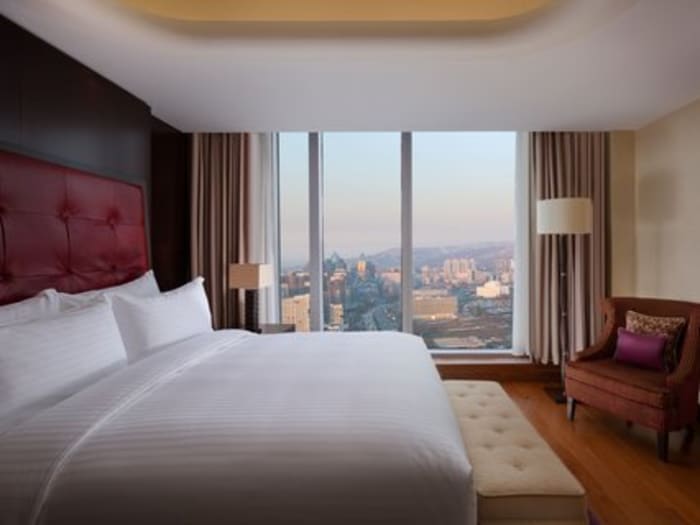
At The Ritz-Carlton Almaty, the room transcends mere rest; it becomes the focal point of the stay. The view of the mountains is a key element, providing depth and a sense of retreat from the urban density. Waking up to the rugged landscape, following the light, or witnessing the peaks at dusk lends a contemplative dimension to the experience.
Comfort is achieved through seamless execution. Generous bedding, effortless circulation, suitable storage, bathrooms designed for well-being, and discreet technology all contribute to this sense of ease. The nightly turndown service and daily maintenance reinforce this impression, ensuring the room remains pristine and ready to welcome the traveller back at any moment.
The decorative style extends a contemporary, readable, and international balance, punctuated by local touches. This approach avoids a standardised effect while preserving the understated nature of a restful space. A textile motif, a palette inspired by the landscape, or a material linked to regional craftsmanship is enough to ground the overall aesthetic.
The suites cater to those seeking more space or a more residential use of the hotel. In Almaty, alternating meetings, outings, and quiet moments is part of the rhythm of the stay. A lounge or a more spacious area can transform the day, providing a place to host, work, read, or simply extend a moment while gazing at the panorama.
What stands out is the overall coherence. The rooms and suites at The Ritz-Carlton Almaty are conceived as a luminous, comfortable, and orderly retreat, with the mountains ever-present. This relationship with the landscape anchors the overnight stay in an identifiable location. Comfort also stems from this feeling of being sheltered, above the tumult, while remaining connected to the city.
Dining
In a grand urban hotel, gastronomy often plays a subtler role than one might expect. It structures the day, creates landmarks, and contributes to the memory of the place. At The Ritz-Carlton Almaty, the communal spaces open to the mountains suggest moments where the landscape matters as much as the plate. In Almaty, this dialogue between the table and horizon takes on a particular significance.
Breakfast is envisioned here as a ritual. In this category of hotels, it embodies both rhythm and calm as well as abundance. Starting the day facing the mountains in a bright room lends a different tone to the stay. For business travellers, it serves as a moment of refocusing. For couples or leisure visitors, it often becomes a special time apart.
The culinary offerings are grounded in a logic of international readability and discreet anchoring. A Ritz-Carlton address typically caters to varied uses—business meals, more intimate dinners, light breaks, or room service. What matters, beyond the formats, is consistency. In luxury hospitality, a successful dining experience adapts to the client's tempo.
Local cultural touches present in the décor can also resonate at the table. Not necessarily through overt demonstration, but through sensitivity to the destination. This can manifest in certain products, regional inspirations, or an attention to context. In a city at the crossroads of nomadic traditions, Russian influences, Soviet legacies, and international openings, gastronomy finds a unique ground for expression.
Finally, the setting is crucial. In a hotel where the views are a distinctive element, enjoying a drink, dining, or extending a conversation takes on a different dimension. The landscape accompanies meals and softens the transitions between day and night, reminding us that Almaty is as much a mountain city as it is a metropolis. At The Ritz-Carlton Almaty, dining thus naturally extends the experience of the place.
Spa & Well-being
At The Ritz-Carlton Almaty, well-being is an integral part of the overall experience. In a bustling city, where business, travel, and the constant presence of mountains intertwine, it complements the rhythm of your journey.
The appeal of a hotel of this calibre lies in its ability to provide genuine moments of respite. This is true whether you are on a business trip, enjoying a romantic getaway, or exploring the city.
The tranquil atmosphere conducive to relaxation is as important as the facilities themselves. This ambiance extends to the acoustics, the fluidity of movement throughout the space, the sense of sanctuary offered by the rooms, and the connection to the surrounding landscape.
In Almaty, simply gazing at the mountains from the hotel can be enough to soothe the spirit. The horizon opens up, the pace slows down, and the city reveals a more sensitive dimension.
Within the Ritz-Carlton universe, well-being is reflected in a meticulous attention to overall comfort. It may manifest through treatments, relaxation areas, fitness facilities, or perfectly orchestrated rest.
In Almaty, this aspect takes on a special significance. The city remains closely linked to a powerful landscape, balancing urban surroundings with proximity to the rugged terrain.
Well-being is thus understood as a connection between the interior and the exterior. Guests can enjoy the comforts of a grand hotel while remaining connected to the mountains and the notion of altitude.
For the traveller, the experience is straightforward: slow down without sacrificing service, take care of oneself without leaving the hotel, and then return to an environment truly conducive to relaxation.
The Ritz-Carlton Almaty emerges as a destination where well-being is seamlessly integrated into the entirety of your stay. It is reflected in the atmosphere, the tempo, and the quality of attention given to comfort.
Concierge & Services
In luxury hospitality, the quality of a stay is often measured by the fluidity of services. The Ritz-Carlton Almaty provides clear indications of this.
The 24-hour concierge and reception cater to international rhythms. Late arrivals, early departures, and last-minute requests are seamlessly integrated.
In Almaty, this constant availability is equally important for business travellers and transient visitors, laying the groundwork for a serene stay.
Booking an airport transfer in advance makes perfect sense here. A grand hotel often begins before one arrives in the lobby.
The organisation of the journey, the clarity of communication, and the assurance of being expected all contribute significantly to the experience. The concierge anticipates needs as much as it responds to them.
Daily maintenance, turndown service, luggage storage, laundry, and wake-up calls form a coherent ensemble. Well-executed, these services transform the perception of the stay.
The room remains impeccable despite a busy agenda. Clothing is efficiently managed, and luggage does not weigh on arrival or departure schedules.
The presence of multilingual staff is also crucial in an international destination like Almaty, facilitating exchanges and refining recommendations.
The concierge's role extends beyond booking a vehicle or confirming a table. It assists in organising a day, suggesting an itinerary, and adjusting a programme.
The services at The Ritz-Carlton Almaty align with a precise definition of contemporary luxury: making things simple without rendering them impersonal.
The Almaty way of life
Staying at The Ritz-Carlton Almaty also means choosing a particular way of entering the city. Almaty cannot be reduced either to its historical role as Kazakhstan’s former capital or to its status as a major economic centre. It is a city of transition and contrasts, where Soviet inheritances, contemporary aspirations, Central Asian influences and international openness coexist within a landscape dominated by the mountains. For travellers, this complexity is precisely what makes the destination compelling. Yet it helps to have a base capable of revealing its main lines without adding confusion. That is exactly what a well-located address in a lively district can provide.
From the hotel, Almaty reveals itself as a city moving at several speeds. There is the professional tempo of meetings, offices and organised movement. There is also a softer dimension made up of walks, cafés, cultural institutions and moments when one looks up and the presence of the mountains immediately resets one’s sense of scale. This coexistence of urban intensity and the pull of the landscape is one of Almaty’s most attractive traits. It sets the city apart from other more monolithic regional capitals. Here, the urban experience is always crossed by an awareness of relief.
Thanks to its views and calm atmosphere, the hotel allows this duality to be experienced in particularly comfortable fashion. One may spend the day exploring the city and return to an environment that restores order to one’s impressions. This is a form of luxury often underestimated: that of a place which helps one read the destination rather than merely framing it. The local cultural elements present in the décor also contribute to this mediation. They remind guests that this is not an abstract grand hotel, but an address that acknowledges its place in Almaty.
The local way of life is also shaped by seasonality. Without entering into precise meteorological detail, it is clear that light, temperature and the visibility of the mountains strongly influence the perception of a stay. Some travellers will seek a city bright and open to the peaks; others may prefer the more hushed atmosphere of cooler periods, when the hotel becomes an even more perceptible refuge. In every case, the relationship between refined interiors and a dramatic exterior remains central.
For a French or European visitor, Almaty can be a stimulating discovery precisely because it resists overly simple categories. Neither strictly European nor entirely eastern in the conventional imagination, the city imposes its own grammar. The Ritz-Carlton Almaty offers an ideal framework from which to approach it with composure: international enough to reassure, rooted enough not to dilute the experience. That is likely where its real value lies. More than simply a luxury hotel, it functions as an elegant interface between the traveller and a subtle, energetic city profoundly shaped by its mountain horizon.
Book with MyConciergeHotel
Booking The Ritz-Carlton Almaty through MyConciergeHotel means choosing an editorial and assisted approach to a stay that deserves to be prepared with precision. A property of this kind cannot be reduced to a rate or a room category: it must be understood through its location, atmosphere, quality of views, the type of traveller it suits best and the rhythm of city life to which it gives access. Our role is precisely to place the hotel within its real context so that the booking matches a concrete expectation rather than a generic promise of luxury.
In the case of The Ritz-Carlton Almaty, several elements should be considered when reserving. The first is the relationship to the landscape. Mountain views, from both rooms and public areas, are an integral part of the experience. If that dimension matters to you, it is worth making it part of your preferences from the outset. The second element is the nature of the trip. This address works equally well for business travel and for a stay for two, but the way one inhabits it will not be exactly the same depending on whether one prioritises efficiency, rest, privacy or swift access to different parts of the city.
Booking with MyConciergeHotel also makes it possible to anticipate the practical aspects that make a difference once on site. Airport transfers, for example, are best arranged in advance to ensure a smooth arrival, particularly welcome after an international flight. Likewise, it can be useful to note arrival time, any specific needs linked to the stay, or the importance attached to certain comfort criteria. In a hotel where service plays a central role, the quality of preparation often shapes the perceived quality of the welcome.
Our approach favours clarity. We do not seek to oversell a property; we seek to describe it accurately. The Ritz-Carlton Almaty will appeal to travellers who appreciate contemporary urban grand hotels, structuring views, a calm atmosphere and the reliability of a major international brand. It may be less suited to those in search of a highly experimental boutique hotel or a historically immersive heritage stay. This precision is not a reservation; it is the condition of an honest recommendation.
Finally, booking through MyConciergeHotel means benefiting from a perspective that considers the stay as a whole. We think of the hotel as a living base, a vantage point and a travel tool. In Almaty, that means choosing an address able to combine comfort, panorama, service and access to the city. The Ritz-Carlton Almaty answers that equation with coherence. If you are looking for an upscale experience that is legible, serene and solidly executed in one of Central Asia’s major cities, it is a particularly relevant option to consider with attentive support in advance.