History & identity
Fairmont The Palm belongs to Dubai’s contemporary hospitality story rather than to a historic lineage in the European sense. Set on Palm Jumeirah, it emerged within the city’s broader coastal development, when Dubai reimagined its relationship with the sea through new residential and resort districts facing the Arabian Gulf. In that context, the hotel expresses a distinctly regional idea of luxury: generous proportions, structured service, a strong resort dimension and architectural references inspired by Arabian palaces.
Its identity rests on balance. On one side, there is the emblematic setting on one of Dubai’s most recognisable man-made landmarks; on the other, an aesthetic language that seeks atmosphere rather than spectacle. The result is neither a historical reconstruction nor a generic beach resort. Instead, the property offers a contemporary interpretation of Middle Eastern hospitality, shaped by spacious interiors, fluid transitions between indoor and outdoor areas, and a clear emphasis on arrival, views and the rhythm of a seaside stay.
The Fairmont name adds another layer. The brand is associated with polished service and a reassuring sense of structure: round-the-clock reception, concierge support, well-organised stays and an approach that suits both leisure travellers and business guests. At Fairmont The Palm, that framework takes on a resort character. The experience is less about formality than about ease, adapting to Dubai’s particular tempo: bright mornings, afternoons by the water, dinners in or beyond the hotel, then a return to a calmer setting away from the city centre’s intensity.
The hotel also reflects the evolution of Palm Jumeirah itself. Once seen primarily as an engineering symbol, the island has matured into a genuine destination with its own routines, vantage points and codes. Fairmont The Palm contributes to that shift by offering a residential style of luxury hospitality: a place to settle into as much as to use as a base for exploring. It particularly suits travellers who want to experience Dubai without giving up direct access to the sea.
In that sense, the property says something meaningful about Dubai today. The city is no longer only about dramatic skylines and stopover glamour; it is also a destination where travellers seek time, space and continuity. Fairmont The Palm answers that expectation through a clear proposition: Arabian-inspired architecture, an island setting, maritime views and service designed for both restorative breaks and more structured stays.
The property
Staying at Fairmont The Palm means choosing a property defined first and foremost by its relationship with the landscape. On Palm Jumeirah, the hotel combines the escapist feel of an island resort with convenient access to Dubai’s major districts. That duality is central to its appeal. There is a sense of being set apart, facing the Arabian Gulf in a calmer environment than the city’s business areas and main arteries, while remaining connected to the restaurants, shopping destinations, marinas and entertainment hubs that shape a Dubai stay.
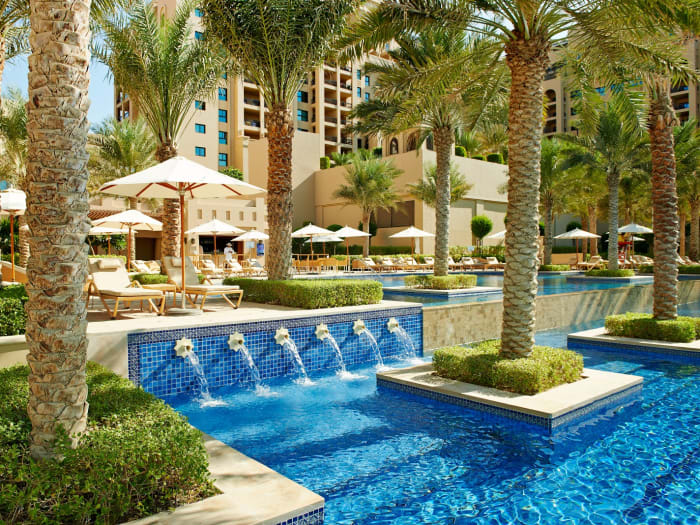
The Arabian palace-inspired architecture gives the property an immediately legible identity. Without relying on excess, it establishes a resort atmosphere built on balanced lines, generous spaces and visual warmth. The tones, materials and volumes are designed to work with Dubai’s light rather than against it. Public areas are arranged to keep views open and movement fluid, which is essential in a seaside hotel: guests should be able to move from lobby to terrace, from interior spaces to the pools, without any abrupt shift in mood.
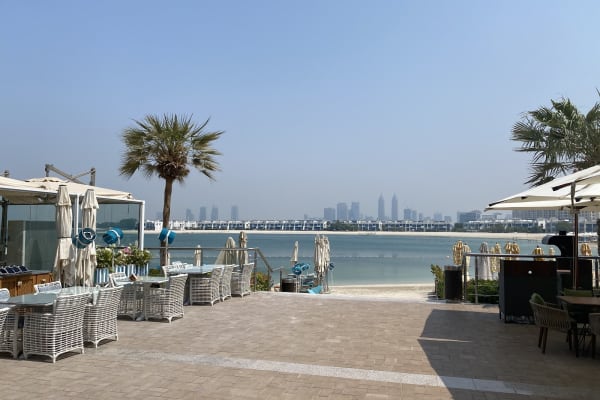
Views over the Arabian Gulf are among the property’s defining privileges. In Dubai, water is often a backdrop; here, it becomes a constant presence. The changing light alters the experience throughout the day, from the brightness of morning to the softer tones of late afternoon. This relationship with the shoreline naturally shapes the way the hotel is enjoyed. Guests come to alternate active moments with slower ones, to make use of the pools, to linger on terraces, or simply to reconnect with a calmer horizon than the vertical skyline of central Dubai.
The hotel is suited to both couples and families, and that is more than a positioning statement. The resort layout on Palm Jumeirah allows those different rhythms to coexist. Couples will appreciate the restorative setting and the ease of structuring days around the beach, dining and wellness. Families benefit from the clarity of the facilities, the presence of several pools and the convenience of a stay in which many needs can be met on site. In Dubai, where trips often blend relaxation, shopping, outings and urban exploration, that versatility matters.
Ultimately, Fairmont The Palm reflects a distinctly Dubai approach to luxury: not distance, but fluidity. The property offers a reassuring, generous seaside setting in which each element seems designed to simplify the experience. With its round-the-clock service, leisure facilities, Palm Jumeirah location and calm atmosphere, it works equally well for a winter long weekend or a longer Gulf stay.
Rooms and suites
In a resort hotel such as Fairmont The Palm, the room is more than a place to sleep: it becomes an extension of the seaside stay. Guests expect space, a genuine sense of retreat, light suited to Dubai’s climate and, above all, continuity with the wider atmosphere of the property. Here, rooms and suites follow that logic. They are designed as calm counterpoints to the city’s energy, with a decorative language that echoes the Arabian-inspired architecture without becoming overly thematic.
Comfort begins with well-executed essentials: quality bedding, clear layouts, daily housekeeping, turndown service and a discreetly organised sense of space. These may be expected in a five-star hotel, yet they matter particularly in Dubai, where days are often long and shaped by movement, activities, heat and the contrast between air-conditioned interiors and bright outdoor settings. Returning to a well-kept, temperate room designed for rest is a meaningful part of the experience.
Views naturally play a major role. Depending on category and orientation, the appeal may lie in the Arabian Gulf, in the geometry of Palm Jumeirah, or simply in the openness that comes with a waterfront setting. Even if guests spend most of their time elsewhere, that visual relationship with the landscape gives the stay coherence in a way many urban hotels cannot. The outdoors never feels far away, and there is a constant sense of inhabiting a coastal destination.
Suites answer a different style of travel. They suit longer stays, families seeking greater ease, or guests who simply prefer a more residential experience. In a resort setting, additional space changes the perception of time: it allows for a more comfortable pause after a morning by the water, easier family routines, or a proper moment of calm before dinner. That flexibility is one of the strengths of larger Palm Jumeirah properties.
What ultimately defines the accommodation at Fairmont The Palm is its ability to support several styles of stay without losing clarity. Couples on a short restorative break will find a serene retreat; families will appreciate the functionality; travellers combining business with leisure will benefit from a setting structured enough to move between both modes. The experience relies less on spectacle than on balance: comfort, light, access to the water and the possibility of slowing down without disconnecting entirely from Dubai.
Dining
In Dubai, hotel dining plays a particular role. It does not merely support a stay; it often structures its social rhythm, from leisurely breakfasts to more composed evening meals. At a property such as Fairmont The Palm, this dimension is essential, because the resort must respond to very different expectations: simple meals between swims, lingering lunches, dinners for two, convivial family moments and more informal pauses throughout the day. The presence of several dining venues on site therefore contributes directly to the quality of the experience.
The value of such a hotel lies first in the range of uses it allows. In the morning, guests look for ease and generosity, with service that accommodates both early departures and slower holiday starts. At lunchtime, the seaside setting calls for clear, climate-appropriate food that works well near the pools or on terraces. In the evening, the tone should shift: softer light, more measured service and an atmosphere suited to a dinner that extends the day without forcing it. That kind of progression is one of the hallmarks of a well-run resort.
On Palm Jumeirah, dining also has a practical dimension. Many travellers appreciate not having to leave the hotel every time they want a good meal, especially after a day divided between the beach, activities and movement across the city. Being able to alternate between several moods within the same property brings real comfort. It allows the stay to be adjusted according to the moment: a quick and easy meal one day, a more dressed-up evening the next, a family lunch without logistical effort, then a quieter dinner in a more intimate setting.
The dining experience in a hotel like Fairmont The Palm is not measured only by culinary sophistication. It is also reflected in the service’s ability to understand guests’ rhythms. In Dubai, where stays often combine excursions, shopping, business meetings and downtime, restaurants need to remain flexible. What matters is availability, consistency and a strong command of the essentials: quality execution, a pleasant setting and attentive service without unnecessary formality.
Ultimately, dining here contributes to the broader idea of a complete resort. Even for guests planning to explore Dubai’s wider culinary scene, it is reassuring to know that the hotel can carry a meaningful part of the stay. Breakfast becomes an anchor, lunch a natural pause, dinner a way to close the seaside day before returning to the room.
Spa & wellness
In Dubai, wellness is not merely an optional add-on to a stay. In a destination where climate, light and urban rhythm can be intense, it becomes an essential part of the hotel experience. Fairmont The Palm approaches it in that spirit: not as a separate luxury, but as a way of balancing the day. The presence of several pools, the seaside setting and the property’s calm atmosphere already create favourable conditions for restoration. The spa extends that logic by offering a more structured space for slowing down.
In a large resort, wellness often begins before any treatment. It is visible in the ability to settle by the water, to choose between different poolside rhythms, to find quieter corners as the day progresses, or to step aside after time spent in the city. This gradation matters particularly on Palm Jumeirah, where a highly active morning can easily give way to a more silent late afternoon. The spa and relaxation facilities answer that need for transition.
Travellers choosing Fairmont The Palm often want a stay that combines energy with release. Dubai invites contrast: striking architecture, shopping, restaurants, outings and family or water-based activities. In that context, returning to the hotel should help restore balance. A treatment, time in a relaxation area, a swim or simply an hour in the shade becomes more than an amenity; it gives the stay its breathing space.
For couples, this dimension naturally supports the resort experience. Time spent at the spa or by the pools reinforces the sense of escape associated with the Palm. For families, it takes another form: while children enjoy the facilities suited to them, adults can reclaim more personal moments of calm. That coexistence of uses is one of the strengths of destination resorts, provided the organisation remains fluid and the service can guide guests according to their needs.
More broadly, wellness at Fairmont The Palm reflects a simple but valuable idea: luxury as something that makes a stay more liveable. It is not only about accumulating facilities, but about creating the conditions for genuine rest. The sea, the pools, the relaxation spaces and the overall quality of service all contribute to that impression.
Concierge & services
In a five-star hotel in Dubai, the quality of a stay is often decided by the details of execution. Fairmont The Palm demonstrates this through a service offering designed to make the experience simple, continuous and reassuring. The 24-hour front desk and 24-hour concierge are central to that promise. In an international destination where arrivals may happen very early or very late, where plans change quickly and where guest expectations vary widely, constant availability is more than a standard: it is a genuine source of comfort.
The concierge role is particularly important on Palm Jumeirah. Staying on the island offers a distinct seaside setting, but it also requires thoughtful organisation of transport and activities. Whether arranging a table in the city, planning an outing, optimising a family programme or coordinating arrival and departure times, human support makes a real difference. The best concierge teams do more than respond; they help shape the rhythm of the stay, reduce friction and adapt the experience to Dubai’s practical realities.
The hotel’s known daily services reinforce that sense of continuity. Daily housekeeping, turndown service, luggage storage, laundry and wake-up service create a highly functional framework, especially useful in a destination where guests often alternate between beachwear, city clothes and evening attire. The quality of a major hotel is also measured by its ability to absorb the discreet logistics of travel so that guests experience only ease.
That fluidity matters all the more because Fairmont The Palm welcomes travellers with very different needs. Couples often want a stay without friction, where everything feels easy to arrange. Families need a clear environment and teams able to respond quickly to practical requests. Business travellers, even when extending a trip with leisure time, expect reliability, punctuality and constant availability. A hotel that can serve all three patterns without rigidity shows real expertise.
Choosing Fairmont The Palm therefore also means choosing a certain idea of hotel service: operational luxury rather than display. In a city where high-end options are plentiful, that reliability matters greatly. It allows guests to enjoy the Palm, the pools, the restaurants and the wider city without constantly managing the mechanics of the trip.
The Dubai way of life
Staying at Fairmont The Palm offers a particular way into Dubai, one that goes beyond the city’s familiar imagery of architectural records and spectacle. From Palm Jumeirah, Dubai is experienced in a more nuanced rhythm. One begins to understand how the emirate combines several identities at once: international metropolis, seaside destination, business hub, expanding dining scene and sought-after winter sun retreat for travellers from Europe, the Gulf, Asia and beyond. The value of a hotel such as this lies in providing a base from which those different facets become legible.
The first luxury here is time. Dubai lends itself to a distinctly contemporary style of travel built on alternation between intensity and retreat. A morning can be devoted to the sea, followed by lunch, shopping or urban exploration elsewhere in the city, before returning to the Palm for the calm of the shoreline. That flexibility is central to Dubai’s way of life. It also explains why so many travellers choose a Palm resort over a purely urban hotel: they want access to the city without giving up a maritime horizon.
Seasonality matters. From November to April, when the climate is milder, Dubai is arguably at its most agreeable. Terraces become central again, outdoor days lengthen and open-air activities take on a different quality. Fairmont The Palm benefits fully from that seasonal rhythm. The stay then organises itself around simple but distinctly Dubai habits: a bright breakfast, swimming during the day, time outdoors, dinner in or beyond the hotel, and a late return to a cool, quiet room.
Dubai’s way of life also rests on a culture of service and ease. The city was built to welcome, orient and connect, and that is reflected in its hotels, infrastructure and highly customisable stays. From Fairmont The Palm, guests can choose an almost self-contained resort rhythm or fill their itinerary with outings. Both are valid, and that freedom is part of what makes the destination work.
Palm Jumeirah itself forms part of this local culture of stay. More than a backdrop, it represents a way of inhabiting Dubai that is oriented towards water, views and organised relaxation. To stay here is to adopt, for a few days, a mode of life in which the sea becomes central again, even within an ultra-contemporary metropolis.
Book with MyConciergeHotel
Booking Fairmont The Palm through MyConciergeHotel means approaching the property not as a simple room reservation, but as an experience to be shaped with care. In Dubai, that distinction matters. A successful stay depends not only on the hotel itself, but also on timing, length of stay, room choice, activity rhythm and the balance between resort time and city exploration. Editorial guidance and concierge support can turn a standard booking into a coherent trip.
For this address, several factors deserve thought in advance. The travel period comes first: from November to April, milder weather makes full use of the pools, terraces and outdoor life possible. Then there is the nature of the stay itself: a couple’s escape, a family holiday, a beach extension after business, or a short break within a wider UAE itinerary. The priorities differ accordingly. Some travellers will value views and calm above all else; others will need greater logistical ease and a more carefully structured programme.
This is where a service such as MyConciergeHotel becomes especially relevant. Beyond booking, the aim is to anticipate how the hotel will actually be used. Should more time be set aside on property to enjoy the pools and seaside atmosphere? Is it wise to arrange activities in advance, as the Concierge tip suggests, in order to avoid queues and preserve the flow of the stay? Which room category best suits a couple seeking privacy, or a family wanting more space? These apparently simple questions can materially change the quality of the experience.
Booking with guidance also helps guests make the most of the Palm Jumeirah location. The island offers a highly desirable setting, but it also requires a thoughtful approach to transport and daily planning. Good organisation avoids turning the stay into a sequence of unnecessary journeys. Instead, it allows for balanced days: a morning at the hotel, a targeted outing in the city, a return for late-afternoon light, then dinner in or out depending on mood.
Finally, booking through MyConciergeHotel means benefiting from an editorial perspective that places Fairmont The Palm within Dubai’s wider luxury landscape. Not all high-end hotels answer the same needs. Some privilege urban immersion, others the beach, others dining or nightlife. Fairmont The Palm stands out for its balance between seaside resort comfort, international service and access to the city.