History & Heritage
The Fairmont Taghazout Bay belongs to a recent generation of high-end establishments that have accompanied the transformation of Taghazout, an old fishing village that has become one of the most observed anchor points along the Moroccan Atlantic coast. Here, the interest does not lie in an aristocratic past or a grand hotel legend from the early 20th century, but in another form of heritage: that of a coastline long sought after for its light, mineral relief, ocean-facing beaches, and a culture of slow living that still distinguishes the region. The hotel is situated within this unique geography, between the marine horizon, a temperate climate, and a lifestyle that embraces the outdoors.
The arrival of an international brand like Fairmont in Taghazout Bay speaks volumes about the evolution of the area. The destination has gained visibility among travellers drawn to the Atlantic, long sandy walks, water sports, and a more tranquil atmosphere than that of denser seaside resorts. In this context, the establishment adopts a contemporary language, without attempting to artificially reproduce a historical decor. Its identity is more about balancing international comfort, openness to the landscape, and a modern interpretation of seaside hospitality.
What matters here is how the building and communal spaces extend the idea of a stay by the ocean. The modern architecture, noted as one of the distinctive features of the address, is not merely an aesthetic choice: it allows for the organisation of volumes around light, views, and airflow. The lines are designed to give prominence to the Atlantic panorama and to that sense of space that is integral to the experience. In a region where the climate remains pleasant in both spring and autumn, this fluid relationship between interior and exterior makes perfect sense.
The heritage of the place can also be read through Taghazout itself. The village and its surroundings embody a unique Moroccan coastal culture, characterised by simplicity, fishing, surfing, and discreet sociability. A hotel of this calibre does not replace this identity; it frames, interprets, and makes it more accessible to an international clientele in search of comfort. The Fairmont Taghazout Bay is precisely situated in this successful tension between a destination still attached to its character and an establishment designed for discerning stays.
For the traveller, this recent history has a clear advantage: one does not come here seeking a frozen decor, but a contemporary vision of seaside luxury. The narrative of the stay is constructed less around monumental heritage than around the quality of the site, a distinctly Atlantic serenity, and a promise of retreat. It is a hotel that accompanies the rise of a destination without taking away its breath. In this sense, its heritage is already present: to help define a new way of inhabiting Taghazout, between international elegance and Moroccan coastal roots.
The Establishment
The primary luxury of the Fairmont Taghazout Bay lies in its location. In Taghazout, along a coastline open to the Atlantic, the hotel benefits from a seaside setting that structures the stay. The view of the ocean punctuates the days, accompanies awakenings, and softens moments of pause. For travellers who choose the coast over the city, this direct relationship with the landscape makes all the difference.
The address allows for easy access to the surrounding beaches. Taghazout retains a human scale, appreciated by those who enjoy walking, observing, and slowing down. The hotel aligns with this logic, featuring the codes of a contemporary five-star establishment: well-maintained spaces, fluid circulation, and communal areas designed for comfort.
The modern architecture contributes to the identity of the place. The contemporary style is expressed through clean lines, open volumes, and a focus on natural light. In a destination where the climate invites outdoor living for much of the year, this design makes perfect sense. The communal spaces extend the idea of a seaside refuge. Guests come here to unwind, read, gaze at the ocean, and find a slower rhythm.
This quality is felt in the transitions, from the lobby to the terraces, from relaxation areas to leisure spaces. The Fairmont Taghazout Bay seeks a balance between its seaside location and the enhancement of the landscape. The peaceful atmosphere rests on this precision.
The profile of travellers who feel at ease here is broad. Couples find a setting conducive to disconnection. Families appreciate the accessibility of the destination and the time spent outdoors. Wellness enthusiasts see a calming backdrop, with pools, relaxation areas, and proximity to the coastline. Regulars of large international brands find familiar service standards in a more open and mineral Moroccan context.
The establishment is appealing for the accuracy of its positioning. It offers a contemporary interpretation of high-end seaside stays in Taghazout: a place oriented towards the Atlantic, designed for relaxation, and open to its surroundings.
Rooms and Suites
In a seaside hotel of this category, the room serves multiple functions. It acts as a refuge after the beach, a vantage point, and a silent resting space. At the Fairmont Taghazout Bay, the accommodations follow this logic, with a focus on light, comfort, and a sense of space.
The view of the Atlantic Ocean is a central element of the stay. In Taghazout, the room is not limited to its furnishings. It also maintains a direct connection with the landscape. Generous openings, terraces, and spaces oriented towards the light contribute to this relationship with the outside. Although not all categories offer the same view, the hotel’s identity remains tied to this proximity to the Atlantic.
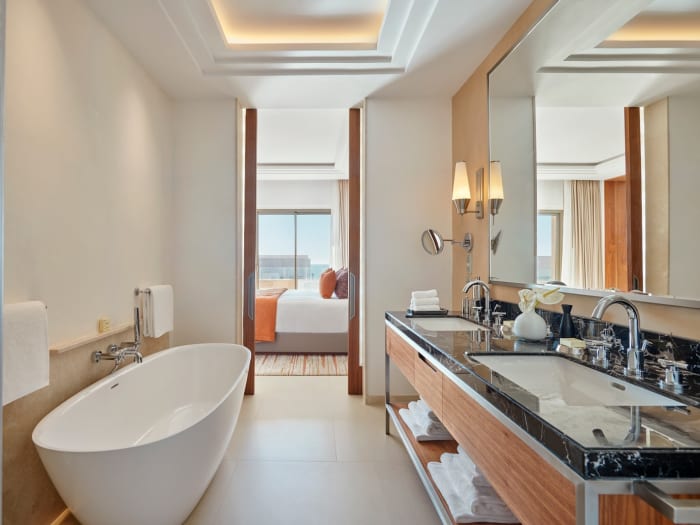
The decor of an establishment with modern architecture favours clear lines, soothing materials, and a palette in harmony with the coastline. Here, comfort is defined by the quality of the bedding, the ergonomics of the spaces, and the fluidity between the bedroom and the bathroom. The nightly turndown service and daily maintenance enhance this impression of continuous attention.
The suites cater to a different rhythm of stay. Guests tend to spend more time there, sometimes hosting, and may also work intermittently. They are suitable for long weekends, family trips, and stays where more intimacy is sought.
By the ocean, a successful room is judged by its ability to soothe. After the beach, the pool, walks, or treatments, returning to the private space should create an immediate sense of retreat. At the Fairmont Taghazout Bay, the room extends the peaceful atmosphere of the communal spaces. It offers a tension-free comfort, more focused on breathing than on effect.
When choosing a category, it is best to consider actual usage. Those who primarily live outdoors will prioritise the quality of the bed and access to facilities. Couples will look more at the openness to the landscape. Families will pay attention to practicality and the fluidity of daily life. The address thus combines international standards with a seaside anchoring.
Dining
The gastronomy of a seaside resort is not judged solely by the plate. It also establishes a rhythm for the stay. At the Fairmont Taghazout Bay, the dining experience naturally extends the landscape. Meals are enjoyed with the light of the Atlantic as a backdrop. Breaks stretch throughout the day.
In the morning, breakfast occupies a central place. It opens the stay to the outdoors, to the view, and to the available time. In Taghazout, where the ocean is immediately imposing, this first meal becomes a moment of observation as much as of indulgence. Guests seek freshness, variety, and the freedom to set their own pace. For some, it will be a coffee facing the sea. For others, a proper sit-down meal before heading to the pool or beach.
The rest of the day calls for a cuisine capable of adapting to various needs. Travellers appreciate flexible lunches, light snacks, and more leisurely dinners. In a hotel of this standing, one expects precise execution, attentive service, and discreet presentation. The proximity to the coastline invites a marine interpretation of the menu. The Moroccan identity of the place is equally important. Spices, seasonal products, generous flavours, and the art of hospitality contribute to the experience.
What distinguishes good resort dining is its ability to accompany different moments of the stay. After an active morning, one desires something simple and well-prepared. At the end of the day, the atmosphere becomes more important. The light dims, the wind or the sea can be heard in the distance, and the service allows for space. For couples, dinner becomes a ritual. For families, the flexibility of service is as important as the menu. In all cases, dining should contribute to this sense of ease.
The appeal of the Fairmont Taghazout Bay also lies in the coherence between the dining experience and the rest of the stay. Modern architecture, communal spaces designed for relaxation, and an Atlantic environment call for elegant yet relaxed dining. One can transition from an informal moment to a more structured dinner without a tonal break. The luxury here lies in this fluidity.
To fully enjoy the gastronomic aspect of the stay, it is wise to book the most sought-after times. Sunset and the early evening services are often the most pleasant. In a destination where light is part of the spectacle, the dining experience is never secondary. It contributes to the memory of the journey, with precision and without ostentation.
Spa & Well-being
Well-being is not merely an additional service at the Fairmont Taghazout Bay; it is integral to the very essence of the place. The description emphasises comfort, relaxation, and the tranquil atmosphere of the establishment. The pools and wellness areas shape the overall experience. In Taghazout, where the ocean, air, and light invite relaxation, the spa enhances the stay.
The primary effect of a successful wellness space by the sea lies in its ability to slow down the body. After the wind, sun, walking, or swimming, one seeks not just a treatment but a transition. Passing through the spa, a wet area, or enjoying a moment of rest transforms the energy from outside into lasting recovery. In a hotel designed for relaxation, the spa becomes a grounding point. It is a place to refocus rather than to distract oneself.
An establishment of this calibre meets several expectations. Couples seek a moment together, either at the beginning or end of their stay. Solo travellers appreciate the introspective nature of the treatment. Families integrate these restful moments into a more active day. In all cases, the quality of well-being is measured by the coherence between the treatment, the space, and the rhythm of the place.
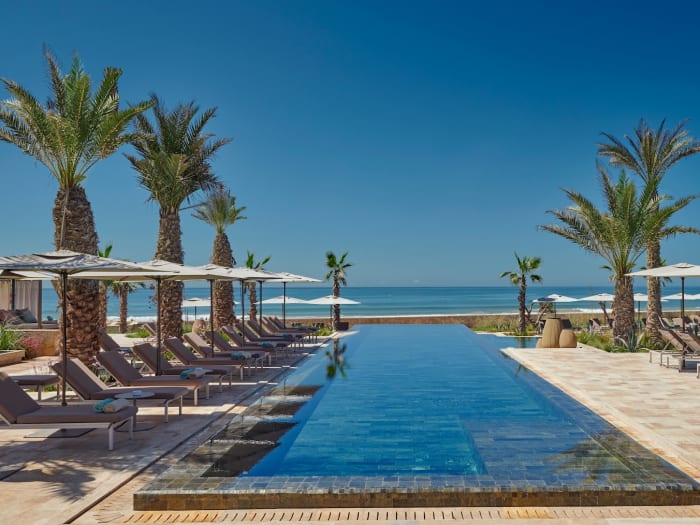
The pools play an important role here. In a seaside resort, they do not replace the sea but offer an alternative way to engage with it. More sheltered and quieter, they extend the relationship with water without the fluctuations of the coastline. They are ideal for times when one wishes to float, read, gaze at the sky, or simply let time pass. Coupled with well-designed resting areas, they contribute to a contemporary luxury: the luxury of having nothing urgent to do.
Booking treatments upon arrival remains a pertinent piece of advice. In hotels where well-being is a cornerstone of the experience, the most sought-after slots fill up quickly. This is often the case in the late afternoon, after returning from the beach. Planning ahead allows guests to secure their preferred times and to navigate their stay with greater ease.
What one remembers from a good spa by the Atlantic is the quality of relaxation achieved. At the Fairmont Taghazout Bay, everything converges towards this idea. A soothing setting, spaces designed to slow down, facilities that extend the gentleness of the climate, and a service capable of supporting travellers in search of a true breath of fresh air.
Concierge & Services
In a five-star hotel, perceived quality does not solely rely on architecture, views, or visible amenities. It often hinges on the precision of daily services. When considered individually, these services may seem expected; however, in a seaside setting where guests seek fluidity, they become essential. The concierge, in particular, plays a pivotal role in a destination like Taghazout. Not all travellers arrive with the same intentions. Some desire a nearly sedentary stay, marked by the pool, spa, and meals. Others wish to explore nearby beaches, arrange transportation, understand the best times to venture out, or simply benefit from discreet assistance in managing daily affairs. A good concierge does not merely respond; it adapts. It knows when to suggest, when to simplify, and when to allow space. This relational intelligence transforms a good stay into a truly curated experience. The constant presence of reception and concierge services is especially appreciated in a resort where rhythms can vary. Late arrivals, early departures, last-minute desires, and logistical needs related to the beach or transport all form part of the real-life experience of a stay. Contemporary luxury often lies in not feeling the weight of this organisation. When the welcome operates continuously, the traveller gains freedom. They do not have to adjust their time to the hotel's constraints; rather, the hotel absorbs those constraints for them. Room services contribute to this same sensation of frictionless comfort. Daily maintenance ensures the consistency of the environment, which is particularly important when alternating between indoor and outdoor spaces multiple times a day. The more discreet turn-down service belongs to another time frame: that of the evening, the return to the room, the transition from an active day to night. In fine establishments, these gestures are never purely mechanical; they help foster a sense of continuous care. Laundry and luggage storage cater to very concrete needs, often underestimated until they become crucial. For an extended stay, a family trip, an arrival before the room is ready, or a late departure, these services genuinely enhance the experience. They allow guests to fully enjoy the facilities without logistical interruptions to their enjoyment. The wake-up service remains relevant in hotels where one might wish to organise a morning excursion, a transfer, or simply a serene departure. Finally, the presence of multilingual staff is more than an international standard; it is a condition of well-understood hospitality. In a destination that welcomes a diverse clientele, the quality of interaction is as important as efficiency. Being understood quickly, being able to articulate a request precisely, and feeling that one can rely on a team accustomed to various traveller profiles all contribute to building trust. At Fairmont Taghazout Bay, the services seem designed to support a simple yet demanding idea of luxury: to make the stay lighter. It is not the demonstration that matters, but the anticipation, availability, and consistency. In such a conducive setting for relaxation, this quality of execution makes all the difference.
The Taghazout way of life
Staying at Fairmont Taghazout Bay also means encountering a particular Atlantic way of life that belongs to Taghazout. The destination is not merely a seaside resort; it still retains something of a village turned towards the sea, with a direct relationship to the elements, a very particular light and a rhythm that naturally encourages one to slow down. It is this combination that appeals to so many travellers: the feeling of being in a place now clearly on the map, yet not entirely stripped of its original simplicity.
Taghazout is associated first and foremost with the ocean. The sea shapes the day, movement and desire. Even for those who do not practise any board sport, the coastline offers a different way of inhabiting time. One walks more, looks further and grants oneself pauses without needing to justify them. The Atlantic landscape, more open and at times more rugged than other shorelines, invites a form of inner availability. That is doubtless why the destination attracts both active travellers and those who simply come in search of air and calm.
The appeal of the hotel lies precisely in allowing access to Taghazout without giving up comfort. From a structured address, one can taste local softness and then return to a more enveloping setting. That alternation is one of the pleasures of the stay. In the morning, one heads towards nearby beaches or enjoys the still-gentle light. During the day, one returns to the relaxation areas, the pool and the terraces. Towards late afternoon, as the light changes, the bay takes on an almost contemplative quality. The stay then adopts a slower, quieter tone.
The local way of life also rests on a certain simplicity of pleasures. Not everything needs to be programmed here. A walk, a moment facing the ocean, a lingering lunch, reading in the shade, the end of the day on a terrace: these elementary gestures often form the best memories. In a travel world sometimes saturated with itineraries and experiences to tick off, Taghazout is a reminder that a destination can matter as much for its atmosphere as for its activities.
Climate plays a major role in this perception. The existing description rightly notes that summer draws many visitors, while spring and autumn are also particularly pleasant. For many travellers, these shoulder seasons are ideal: the light remains beautiful, temperatures are mild and outdoor spaces can be enjoyed more freely. In a hotel conceived around relaxation and openness to the landscape, that climatic quality becomes a genuine reason to travel.
For couples, Taghazout offers a setting conducive to switching off, without the urban intensity of a major tourist city. For families, the destination combines beach time, hotel comfort and a relatively simple rhythm. For solo travellers, it can become a particularly restorative interlude, one in which a more direct relationship with time is recovered. Fairmont Taghazout Bay then serves as an anchor point: a place from which one discovers not only a coastline, but a way of being on holiday.
Ultimately, the Taghazout way of life rests on a few things, but they matter. Space, air, light, sea and the possibility of slowing down without becoming bored. A well-located, well-conceived hotel allows them to be fully appreciated. That is when the stay acquires its real value: when it offers not only comfort, but helps one enter the tempo of a place.
Book with MyConciergeHotel
Booking Fairmont Taghazout Bay through MyConciergeHotel means approaching the stay through selection and guidance rather than through a purely transactional process. An address such as this is rarely chosen at random. Travellers interested in it are looking for a hotel able to combine Atlantic views, a seaside setting, contemporary comfort and a genuine sense of relaxation. The question, however, is how to book the right category, at the right time, with a clear understanding of what will make the stay successful. That is precisely where editorial and concierge guidance becomes meaningful.
The first issue is positioning the trip properly. In Taghazout, the season has a strong influence on the experience, not only in terms of occupancy, but also in terms of rhythm. Summer naturally attracts more visitors, while spring and autumn appeal to those who prefer a softer atmosphere and freer use of outdoor spaces. Depending on whether one is travelling as a couple, as a family or with wellness in mind, expectations will differ. Booking intelligently therefore means taking account of seasonality as well as one’s own style of stay.
The second key point concerns the choice of room or suite. In a hotel where the relationship to the landscape is central, orientation, view and the way one intends to inhabit the private space become decisive. Some travellers will spend most of their time outdoors and simply prioritise a comfortable category. Others will want to make the room a true vantage point over the ocean, or a cocoon for a long restorative weekend. Families, meanwhile, are likely to think first in terms of practicality and flow. Personalised guidance helps turn these diffuse preferences into a concrete decision.
Booking through MyConciergeHotel also means anticipating the elements that genuinely structure the on-site experience. The spa, for example, is often worth organising on arrival, or even in advance if wellness is expected to be central to the stay. The most sought-after dining times, particularly in the evening, are also best considered early. Finally, requests linked to transfers, late arrivals, early departures or particular stay preferences are handled all the better when clearly expressed at the time of booking.
Beyond organisation, there is a question of fit. Not every luxury hotel suits every traveller, and not every season reveals a place in the same way. MyConciergeHotel allows the booking to be framed more qualitatively: understanding the style of the address, its real atmosphere and its suitability for a given travel plan. In the case of Fairmont Taghazout Bay, that means knowing whether one is primarily seeking a restorative oceanfront stay, a comfortable family interlude, or a contemporary seaside retreat from which to explore the surroundings.
The value of such a booking also lies in the peace of mind it creates. In the best stays, many things have been decided in advance with enough precision for everything on site to feel simple. It is that prepared simplicity which makes the difference. Choosing Fairmont Taghazout Bay through MyConciergeHotel is therefore less about “booking a room” than about composing a coherent stay, adapted to one’s rhythm, expectations and preferred way of experiencing Taghazout. In a destination chosen precisely for its slower pace, that quality of anticipation is already a form of luxury.