History & Heritage
In Rome, an address is never merely a point on a map. It engages in a relationship with the layers of the city, its ruins, its palaces, and its vistas. Palazzo Manfredi embodies this principle. The hotel is set in a historic context, just a stone's throw from the Colosseum. This proximity to one of Europe’s most significant monuments immediately sets the tone for the stay. Here, the experience is rooted in an authentic connection with imperial Rome, both visible and tangible.
The name Palazzo Manfredi evokes a tradition of Italian palatial elegance, characterised by urban sophistication, measured volumes, and discreet hospitality. The establishment cultivates a contemporary interpretation of this Roman heritage. It offers a small-scale luxury that is more intimate than ostentatious, where history serves as the backdrop. In a city where many addresses rely on the surrounding monumental grandeur, Palazzo Manfredi prioritises a more personal relationship with its environment.
The hotel’s membership in Small Luxury Hotels of the World further highlights its position within the Roman landscape. It embodies the idea of a human-sized home, attentive to the uniqueness of its location, the quality of its welcome, and the precision of the experience. It is not a large, anonymous transit hotel, but a thoughtfully designed address for those who wish to inhabit Rome, even briefly, with a deeper connection. The heritage here is less a theme than a rhythm; that of ancient stones glimpsed through a window, streets leading to the forums, and evenings when the light glides over ochre facades and ancient ruins.
Finally, the legacy of Palazzo Manfredi lies in this Italian ability to harmonise history with usage. The setting is ancient, the atmosphere refined, the design elegant, yet nothing feels stagnant. The contemporary traveller finds the expected comfort of a five-star establishment, while the city remains fully present. The value of this address lies in the rare sensation of staying not just beside Rome, but within one of its most iconic landscapes.
The Establishment
What strikes you first at Palazzo Manfredi is the precision of its positioning. The hotel does not seek to compete with the spectacle of Rome; rather, it intelligently integrates into it.
Just a stone's throw from the Colosseum, it boasts a location that is powerful not only due to its proximity to the monument but also because of the perspective it offers. You find yourself in the heart of a recognisable area, bustling with visitors and steeped in history. Yet, the establishment cultivates a more subdued, almost residential atmosphere at times, allowing for a sense of calm after the intensity of Roman days.
The historical setting is one of its most evident traits. However, it would be reductive to view it merely as a location argument. Palazzo Manfredi also asserts its identity through design. A refined aesthetic prevails, crafted to engage with the context without resorting to literal citation. In a city where decorative emphasis is never far away, this address favours a measured sophistication. The lines, materials, lighting, and flow of spaces create a contemporary ambience that respects the gravity of the location.
Certain parts of the hotel offer views of the Colosseum. This aspect profoundly alters the perception of one’s stay. Seeing such a universal monument from a hospitality space creates a unique relationship with time. In the morning, the city appears suspended. During the day, the presence of the Colosseum serves as a reminder of the neighbourhood's uniqueness. In the evening, as the crowds settle, the perspective takes on an almost theatrical dimension. This visual relationship with ancient Rome structures the experience, giving the establishment an immediately memorable identity.
As a member of Small Luxury Hotels of the World, Palazzo Manfredi belongs to a category of addresses where one expects coherence over monumental grandeur. This is reflected in the intimate atmosphere often noted by travellers. The common areas do not aim to impress with size; instead, they establish a sense of controlled comfort, attentive service, and personalised stays. This aspect is particularly valuable in Rome, where one can quickly transition from a dense crowd to a need for retreat.
In practice, the establishment is well-suited for both discovery stays and shorter, professional, or mixed trips. Its location allows for easy organisation of walking tours. It maintains a central and easily navigable base. For couples, the address is cherished for its views and intimacy. For business travellers, it offers an elegant, calm, and well-situated base. Palazzo Manfredi is not just a well-placed hotel; it is a destination that transforms its location into an art of hospitality.
Rooms and Suites
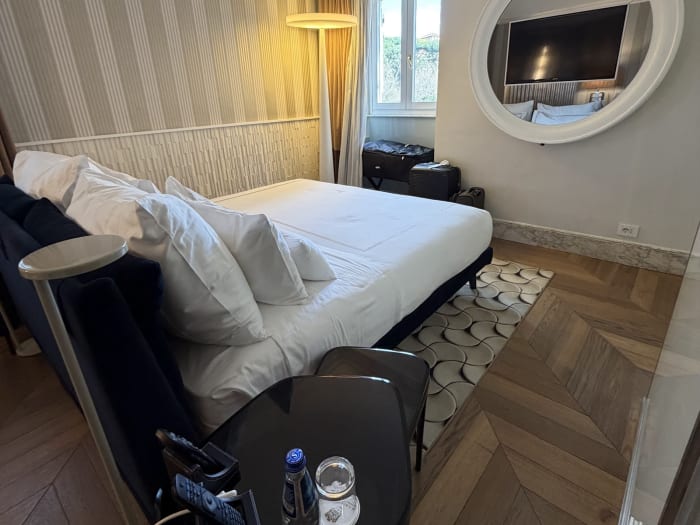
At Palazzo Manfredi, the rooms and suites extend the traveller's relationship with Rome. They are designed with elegance, an intimate atmosphere, and meticulous attention to detail.
In the Roman context, they seek a balance between character and tranquillity. After the city's intensity, returning to the hotel offers a form of respite.
The interiors favour materials, tones, and lighting conducive to retreat. Comfort derives from overall coherence rather than ostentation.
Some rooms or areas of the establishment benefit from views of the Colosseum. When present, this perspective adds another dimension to the stay.
The monument then becomes a part of daily life. Opening the curtains, taking a pause, or watching the city light up takes on a special significance.
Even without a direct view, the rooms enjoy immediate proximity to one of Rome's symbolic centres. This presence is felt from the moment you enter the establishment.
The intimate scale of the house fosters a personalised experience. The reception and 24-hour concierge service extend this continuity between private space and quality hospitality.
For couples, these accommodations accompany a slower-paced Rome, marked by returns to the hotel. For business travellers, they provide order and calm in a central environment.
The Dining Experience
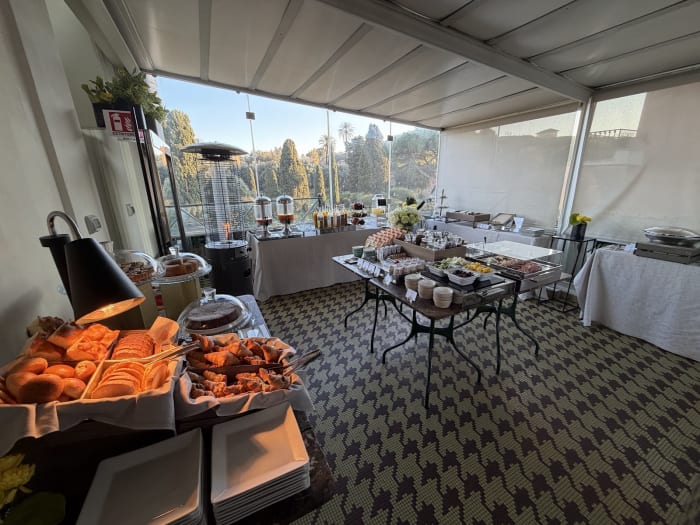
In Rome, dining is never just an ancillary service. It is an integral part of the city’s experience, rhythm, sociability, and memory. At Palazzo Manfredi, it is advisable to book in advance, especially during peak periods. The dining experience is fully woven into the fabric of the stay, attracting not only residents but also visitors, thanks to its location and views of the Colosseum.
The privilege of dining in this neighbourhood lies in its dialogue with the monumental landscape. Eating or enjoying a drink in close proximity to the Colosseum adds a unique tone to the moment. However, the appeal is not solely in the view; it also lies in how the hotel transforms this situation into a moment of hospitality. The historical setting, elegant design, and intimate atmosphere create an environment where service and the pace of the meal are as significant as the food itself.
The dining experience caters to travellers seeking more than just a convenient meal. It offers a place to extend the day, celebrate an arrival, organise a romantic dinner, or indulge in a contemplative moment facing one of Rome’s most evocative panoramas. In the morning, breakfast takes on a special dimension. Starting the day in a well-appointed setting, already in the heart of Rome, alters the tone of the stay. In the evening, the monument's proximity lends a different intensity to dinner, as the light fades and the ancient stones gain prominence.
The allure of dining at Palazzo Manfredi also lies in its balance. The view complements the quality of the welcome without overshadowing it.
For both guests and passing visitors, dining becomes a way to experience Rome differently. Not in the rush to see monuments, but in the time spent over a meal, a coffee, an aperitif, or a contemplative dinner.
Concierge & Services
In urban luxury hospitality, services are not merely a list of amenities. They determine the actual fluidity of the stay. Palazzo Manfredi understands this well. With 24-hour concierge service, continuous reception, daily room service, turndown service, luggage storage, laundry, wake-up calls, and a multilingual team, guests receive constant, discreet, and precise support, which is particularly valuable in Rome.
The concierge plays a central role here. In a capital where cultural, heritage, and gastronomic offerings are immense, knowing how to orient a stay makes all the difference. A good concierge does not merely book a transfer or a table; they help prioritise the city. They can suggest the best time to explore a neighbourhood, organise a day of sightseeing, recommend an afternoon stroll, or facilitate last-minute requests. Near the Colosseum, this expertise takes on particular significance. The area is home to both must-see attractions and heavy foot traffic. Being able to rely on a team available at all hours simplifies the experience.
The 24-hour reception caters to the realities of contemporary travel. Late arrivals, early departures, changes in plans, and unforeseen needs are part of life in an international hotel. In a more intimate setting, this continuous availability is reassuring and often accompanied by a more personal touch. Here, we find one of the advantages of establishments affiliated with Small Luxury Hotels of the World. A human scale allows service to be attentive without becoming intrusive.
Daily room service and turndown service contribute to this silent quality of stay. Returning to a tidied room, finding an atmosphere prepared for the night, having one’s belongings attended to by the laundry service, and storing luggage before or after the stay are all details that practically lighten the days. In Rome, where one walks a lot and schedules fill up quickly, this invisible logistics holds real value.
Finally, the presence of multilingual staff underscores that contemporary luxury also hinges on clear communication. Being understood immediately, being able to make a precise request, receiving nuanced recommendations—these are forms of comfort as important as a beautiful interior. Palazzo Manfredi thus offers services designed to make the city more accessible, fluid, and enjoyable.
The Roman art of living
To stay at Palazzo Manfredi is to choose a particular way of living Rome. Not by skimming across it, but by accepting its distinctive rhythm, made up of monumental dazzlement and simpler moments. The hotel’s location, just steps from the Colosseum, immediately places the traveller within an essential, almost archetypal Rome. Yet the value of such a starting point is precisely that it allows for more than the accumulation of sights. From this address, days can be organised on foot, with easy returns for rest, departures at a different hour, and the chance to observe how the neighbourhood changes between morning, afternoon and dusk. That is where a genuine urban art of living begins.
Rome rewards those who know how to create pauses. It is often treated as a city to be consumed intensively, like a catalogue of masterpieces. In reality, it reveals itself more fully when one alternates highlights with intervals. A coffee taken without haste, a walk through nearby streets, a return to the hotel to refresh before dinner, a moment of contemplation facing the Colosseum: these sequences matter as much as the major sites. Palazzo Manfredi, with its calm and intimate atmosphere, seems especially suited to this more nuanced reading of the city. It offers refuge without severing the connection to reality, a form of retreat that never becomes disconnection.
For couples, Rome naturally lends itself to a more emotional experience, yet the address avoids contrived romance. What appeals here is rather the truth of the place: the closeness of ancient stone, the light on façades, the possibility of seeing a universal monument from parts of the hotel, then returning to a refined interior and attentive hospitality. For business travellers, the city takes on another dimension. Between appointments, a few hours are enough to reconnect with history, walk to a major site, or simply dine in a setting that immediately reminds you where you are. The hotel then acts as a bridge between efficiency and pleasure.
The Roman art of living also implies a particular relationship with evening. As the heat drops and the streets change tone, the city becomes slower, more conversational. It is the hour of aperitivi, lingering dinners and walks back through the city. In this context, having an address that is central yet peaceful is a genuine privilege. One can enjoy Rome’s energy without constantly absorbing its intensity.
Ultimately, Palazzo Manfredi appears to offer less a mere sightseeing base than a privileged vantage point on Roman life. It allows guests to approach the Italian capital not as a static backdrop, but as a city to inhabit for a few days with style, attention and restraint. And that is often how the most lasting memories are made.
Book via MyConciergeHotel
Booking Palazzo Manfredi through MyConciergeHotel means approaching this Roman address with the right level of preparation. In an intimate hotel, well-located and sought after for its immediate proximity to the Colosseum, anticipation is key. During high season, it is advisable to book in advance to secure your stay. This recommendation is all the more pertinent for travellers wishing to fully immerse themselves in the experience, whether for a weekend for two, a longer cultural getaway, or a business trip.
The benefit of a supported reservation lies not only in availability but also in the ability to align the stay with the right expectations. In a hotel where certain rooms boast views of the Colosseum, where the intimate atmosphere is part of the venue's identity, and where dining deserves to be booked ahead of time, every detail of preparation can enhance the experience. MyConciergeHotel’s role is to clarify priorities, signal peak times, recommend reserving the restaurant in advance, and assist in constructing a coherent programme around the hotel’s location.
For a couple, this may mean prioritising a stay configuration oriented towards the view, dinner, and the slower pace of a contemplative Rome. For a business trip, the focus will be on optimising schedules, late arrivals, early departures, and services that streamline logistics. For a first-time discovery of Rome, this support allows for a better understanding of this address: an elegant five-star hotel and a very particular anchor point in one of the city’s most iconic areas.
Booking via MyConciergeHotel also provides an editorial perspective on the place. One does not choose Palazzo Manfredi solely for its proximity to the Colosseum, but because it offers a specific way of inhabiting Rome: more intimate, more attentive, and more focused on the quality of time spent than on the multiplication of services.
In practice, it is wise to anticipate the most sought-after periods, clarify expectations at the time of booking, and consider organising dining alongside the room. It is often this preparation in advance that allows, once on site, to fully enjoy what the hotel offers that is most rare: the feeling of being in Rome within one of its most famous settings, without sacrificing calm, comfort, or the precision of service.