History & heritage
Kempinski Residences and Suites Doha belongs less to the tradition of the classic hotel than to a more contemporary idea of hospitality: a place designed for living in the city with the comfort and support of a major international address. In Doha, where urban development accelerated dramatically around the turn of the 21st century, this kind of hotel residence answers a very specific need: extended business stays, international mobility, families in transition, and travellers who want the reassurance of a private home without giving up five-star services. The property is part of Kempinski, one of Europe’s long-established luxury hospitality names, whose identity rests not on display but on service, discretion and polish.
In Doha, that positioning makes particular sense. The Qatari capital is not only a stopover destination; it is often experienced over time, through business assignments, family stays, winter escapes or temporary relocations. The residences-and-suites format fits a city defined by high-rise districts, a structured business life, rapidly evolving neighbourhoods and a waterfront that remains a constant visual reference. Kempinski Residences and Suites Doha translates this urban reality into a form of hospitality that feels stable, orderly and practical, where the idea of a private interior is extended by the attentions of a grand hotel.
Kempinski’s heritage is visible here in the balance between international standards and local relevance. This is not a historic palace in the European sense, nor a heritage address shaped by aristocratic history; its identity is grounded instead in clean design, quality of execution and consistency of service. In a destination such as Doha, where contemporary architecture plays a central role in the city’s image, modernity is not incidental: it is the natural setting for a style of stay that privileges space, light, views and ease of use.
That positioning also defines the property’s overall tone. Guests come here to regain control over the everyday: to work, host, rest, organise their movements and enjoy the city without unnecessary friction. Longer stays in particular change one’s relationship with a hotel. A property is judged not only by the impact of its lobby or the effect of first impressions, but by its ability to support the real rhythms of life. This is exactly where Kempinski Residences and Suites Doha finds its coherence: in the promise of a liveable luxury, less demonstrative than enduring, where excellence lies in the consistency of service and the feeling of being properly settled from the outset.
On the scale of Doha, the address forms part of a broader story: that of a city which, over just a few decades, has become a major Gulf capital open to exchange, large-scale events and international movement. Kempinski Residences and Suites Doha reflects its calmer side: contemporary urban hospitality designed for those who want more than a room — a base.
The Establishment
What strikes you first at the Kempinski Residences and Suites Doha is the way the establishment embraces the verticality and energy of Doha, while also creating a genuine sense of intimacy.
In this part of the city, the towers form a sharp, almost graphic landscape. Glass, straight lines, and sea views define the urban experience. The address benefits from this modernity, retaining clarity, vistas, and centrality, while also providing a setting where one can slow down.
The proximity to the Doha Corniche greatly structures the stay. This expansive waterfront promenade establishes an immediate connection between the city and the Gulf. From the hotel, this major thoroughfare is easily accessible. The waterfront, with its curves, gardens, bay views, and architectural silhouettes, lends a unique rhythm to the days.
The central location is another asset. For business travellers, it facilitates movement between meetings, business districts, and institutional venues. For those here to explore, it offers a logical starting point for the coastline, museums, shopping districts, and urban strolls.
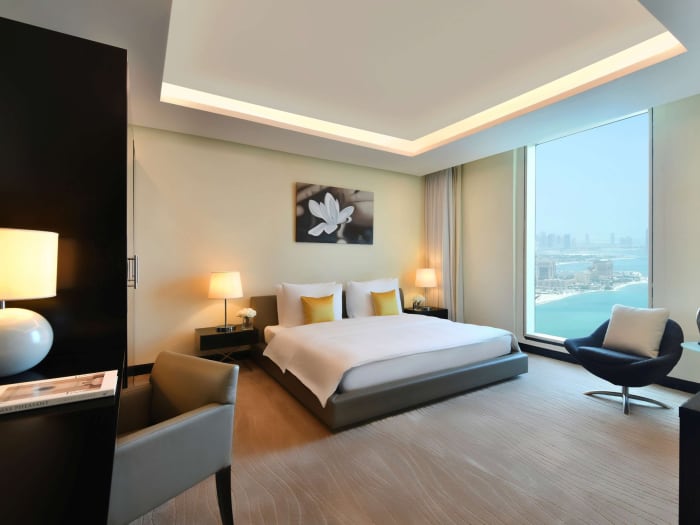
Inside, the aesthetic language remains contemporary. The modern design and current amenities suggest a sober, functional staging focused on usability. The overall emphasis is on the quality of spaces, the clarity of circulation, and natural light.
The Kempinski Residences and Suites Doha is ideal for those wishing to experience Doha with a degree of autonomy. The residences allow guests to settle in, establish routines, and tailor their days to their needs. This flexibility suits both professional missions and family holidays, as well as extended stays.
Residences, Suites, and the Art of Extended Stays
At the Kempinski Residences and Suites Doha, the experience is built around a format designed for long stays. Residences and suites offer more than just accommodation.
In a city like Doha, this distinction matters. The stay takes the form of a temporary installation within a space adapted for daily use.
Here, there is room, comfort, and a seamless flow between work and relaxation. At the end of the day, one finds a place to truly settle.
The residences meet this expectation through their emphasis on autonomy. Focus is placed on space and functionality.
For families, this allows for the preservation of distinct rhythms. For business travellers, it provides a more flexible working environment.
Contemporary design enhances this sense of clarity. The furniture, volumes, and spatial organisation create a readable and calming environment.
In Doha, the quality of an interior is also measured by its ability to provide a smooth transition between the city and relaxation. A well-designed residence filters out the hustle and bustle and welcomes light with precision.
The view of the Persian Gulf is among the most sought-after attractions, adding a unique depth to the stay.
Seeing the water, tracking the variations of light on the bay, and observing the horizon from a private space alters one’s perception of the location. Doha reveals itself as a city open to the sea.
Daily service, with regular maintenance and the attentions of high-end hospitality, complements this enduring comfort. The formula combines the independence of a residence with the continuity of service.
For an extended stay, this balance is often crucial, allowing for a stable quality of life without logistical fatigue.
Dining at the pace of the stay
In a property such as Kempinski Residences and Suites Doha, dining is understood differently from that of a grand resort or a leisure-focused palace hotel. Here, the aim is not necessarily to multiply theatrical signatures, but to support stays that are often longer, more structured and closer to an elevated everyday life. Dining must therefore respond to several rhythms: an efficient breakfast before a day of meetings, a meal taken without rigid timing, a discreet refreshment between appointments, a quieter dinner when one chooses to remain on site, or the comfort of in-room dining that extends the privacy of the residence.
That flexibility is essential in Doha, where days may be shaped by the climate, by professional obligations or by a very specific family routine. In that context, luxury lies not only in the sophistication of a menu, but in a property’s ability to offer fluid, well-executed solutions adapted to real needs. A residence-led address must know how to nourish without burdening, to propose without imposing, and to maintain a consistent level of quality while allowing each guest to set their own pace.
The hotel’s contemporary setting suggests an approach to dining in keeping with the whole: clear, elegant and international in spirit. In Doha, the culinary scene reflects the diversity of residents and visitors, with a strong presence of global cuisines and a marked attention to service standards. In a property of this category, one therefore expects an offer capable of suiting both business travel and family stays, with that refined neutrality that allows guests to feel immediately at ease.
For longer stays, breakfast becomes especially important. It turns into a daily ritual, almost domestic in nature, that sets the tone for the day. In a hotel residence, guests value the possibility of alternating between a calm moment on site and more independent days. Likewise, room service or discreet dining options take on real significance: they preserve privacy, allow late work without inconvenience, or simply make it possible to enjoy the view and quiet of one’s private space.
Dining here therefore contributes to an overall sense of comfort rather than to display. It supports the stay through consistency, which is often more valuable than a single dramatic effect. In a city such as Doha, where one can easily go out for dinner, explore different districts or vary the atmosphere, the property’s role is above all to provide a reliable, pleasant and well-run fallback. That idea of continuity matters most: knowing that one can rely on dining adapted to one’s schedule, expectations and the nature of the trip. At Kempinski Residences and Suites Doha, the culinary dimension fits the wider logic of the address: functional, urban and enduring luxury, designed for those who live their stay as much as they pass through it.
Wellbeing, breathing space and inner rhythm
Even when a property is not defined primarily by a destination spa, wellbeing remains central to the experience of a five-star stay in Doha. The climate, the intensity of the light, urban movement and the often demanding pace of business travel make spaces and services that allow one to slow down especially valuable. At Kempinski Residences and Suites Doha, wellbeing should be understood in a broad sense: not only as a set of possible facilities, but as an overall quality of stay shaped by calm, space, continuity of service and the ability to regain control of one’s time.
The first luxury here is perhaps breathing space itself. The residences, through their relative scale and domestic logic, offer an alternative to the more constrained standard room. Being able to stretch out, work without encroaching on the area of rest, organise the day at one’s own pace, and look out over the sea or city from a private setting all contribute to tangible wellbeing. In a vertical metropolis such as Doha, where the outside world can be spectacular yet demanding, the interior must act as a counterpoint. It becomes a place of recovery, recalibration and sometimes decompression after a dense day.
Daily service contributes strongly to that feeling. Regular housekeeping, turndown service and the constant presence of staff reduce the mental load of travel. These are simple gestures in appearance, but decisive over several days. Comfort lies not only in the quality of materials or the design of furniture; it also resides in the way the property quietly takes charge of the invisible, everything that allows the stay to remain fluid. Wellbeing, in this sense, is not an add-on: it is a silent organisation that protects guests’ time and energy.
Doha is particularly well suited to more balanced routines during the cooler months. One can imagine active mornings, more contemplative evenings, and returns to the hotel conceived as genuine pauses. The proximity of the Corniche reinforces this dimension. Walking by the water, observing the bay, then returning to the calm of one’s residence creates an alternation between movement and retreat that forms a distinctly urban but very real kind of wellbeing. It suits solo travellers as much as families, who need a setting capable of absorbing different rhythms between adults and children.
In a property such as this, wellbeing is therefore less about staging than about balance. It arises from the right relationship between location, space, view, service and autonomy. It is a foundational form of wellbeing, particularly suited to longer stays because it relies not on the exceptional but on consistency. Guests feel supported without being managed, served without being interrupted, settled without losing their sense of freedom. For many international travellers, that is exactly what makes the difference between a good hotel and an address they choose to return to.
Concierge & Services
At the Kempinski Residences and Suites Doha, a 24-hour concierge and continuously open reception assist travellers at any time.
In Doha, where late arrivals, early departures, and tight schedules are common, this availability brings genuine fluidity.
The concierge also facilitates connections with the city, guiding, recommending, and organising according to each guest's rhythm and needs.
A family does not seek the same advice as a business executive on the move. A long stay is not managed in the same way as a two-night stopover.
Daily services include housekeeping, turndown service, laundry, luggage storage, and wake-up calls.
These services simplify the stay, making it more stable and comfortable. For an extended stay, these details take on particular importance.
Laundry becomes a true comfort element. Daily cleaning helps maintain an orderly space. Luggage storage eases transitions.
The wake-up service is useful for very early departures or days with tight schedules.
The multilingual staff reflects Doha's international reality, fostering clear communication and precise support.
For business travellers, the establishment offers an environment conducive to time management. For families, it simplifies the logistics of the stay.
Here, the service prioritises discreet efficiency, designed to allow guests to fully enjoy their stay.
The Art of Living in Doha
Staying at the Kempinski Residences and Suites Doha means embracing a particular way of life in Doha, whether for a few days or several weeks. The city does not always reveal itself immediately; it unfolds through contrasts: between sea and desert, between mercantile tradition and contemporary skyline, between institutional rhythm and the more subdued sociability of its interiors. A centrally located establishment, close to the corniche, allows one to engage with this subtle geography without feeling out of place. Here, one discovers a capital that is neither solely defined by its spectacular modernity nor merely a regional hub, but rather a unique art of living characterised by movement, climate, light, and distinct temporalities.
The best season to appreciate it remains winter, or more broadly, the milder months. Doha takes on a different face during this time. Strolls become more enjoyable, and evening outings extend into the night. The corniche fully regains its role as an urban breathing space. During this period, the significance of the coastline in daily life becomes clearer. The sea is not a distant backdrop; it structures the city, tempers its horizon, and provides a constant counterpoint to the built density. From a residence with a view, this relationship becomes even more palpable, as one follows the light, the variations in the sky, and the reflections on the water.
Doha also lends itself to exploration in sequences. Mornings can be dedicated to professional obligations or cultural visits. Afternoons often call for air-conditioned venues, moments of respite, and quieter appointments. In the evening, the city regains a different energy. This organisation of time, closely tied to the climate, profoundly influences the travel experience. An address like the Kempinski Residences and Suites Doha complements this rhythm well, providing a private space to retreat to between urban excursions. One can alternate, balance, and create their own equilibrium.
For families, Doha offers a reassuring and structured experience, with ample spaces, relatively clear circulation, and a strong service culture. For business travellers, it provides undeniable efficiency, coupled with quality infrastructure that facilitates both short stays and extended missions. In both cases, the city benefits from being approached from a stable anchor point that combines comfort, location, and views.
Thus, the art of living in Doha is neither that of a museum city nor that of a classic seaside destination. It embodies a balance between intensity and retreat, between urban ambition and the pursuit of interior comfort. From the Kempinski Residences and Suites Doha, this balance is clearly evident. Here, one experiences a Gulf capital in its most contemporary form: international, architectural, forward-looking, yet also attentive to the quality of private spaces and the notion of sustainable stays. It is a city that is better understood when one takes the time to settle in.
Book with MyConciergeHotel
Booking Kempinski Residences and Suites Doha through MyConciergeHotel means approaching the property with the right framework. An address of this kind is not chosen solely on the basis of rate or room category; it is booked according to use. The essential question is not simply “where to stay in Doha?” but “how do you want to experience Doha?”. For a longer stay, for a business trip that requires space, for a family holiday where autonomy matters as much as service, or for an upscale stopover in a central setting, the relevance of a hotel residence is measured by details that only a concierge-led approach truly takes into account.
Our role is precisely to qualify the stay in advance. A view over the Gulf, for example, can transform the experience and is often worth requesting from the outset. Likewise, the length of stay, number of travellers, presence of children, need for separate living areas, arrival and departure times, and the professional or mixed nature of the trip all influence the most suitable category. In a property such as this, the aim is not merely to secure a beautiful room, but to ensure a configuration that matches the actual rhythm of the stay.
Booking through MyConciergeHotel also means placing the hotel within its wider context. Doha is not a uniform destination. Depending on whether one prioritises the Corniche, business appointments, cultural outings or simply ease of movement, the value of a central location takes on different nuances. We help arbitrate those priorities and confirm whether the residences-and-suites format truly suits your expectations. For some travellers, it will represent a decisive level of comfort; for others, it will simply provide welcome flexibility over a few nights. In every case, our support is designed to avoid generic bookings and favour a stay shaped with precision.
That precision also applies to services. A 24-hour concierge, daily housekeeping, efficient laundry and round-the-clock reception may seem self-evident on paper, yet they take on very concrete importance depending on the travel profile. We help identify what will genuinely matter once you are on site. This is particularly useful in a city such as Doha, where stays may combine obligations, jet lag, a specific climate and family needs.
Finally, booking with MyConciergeHotel means benefiting from both an editorial and a practical perspective. We do not aim to oversell the property; we aim to position it accurately. Kempinski Residences and Suites Doha will suit travellers seeking space, centrality, views and continuity of service in a contemporary setting. If that promise matches your way of travelling, then the property can become far more than a hotel: a genuine living base in Doha. It is that alignment, above all, that we seek to build with you.