History & heritage
In Shanghai, hotel heritage is not always measured in centuries, but in the way an address becomes part of the story of a city in constant transformation. Grand Kempinski Hotel Shanghai belongs to that category of properties that express a certain idea of international luxury in a metropolis where architecture, finance, commerce and the arts move in close conversation. This is not the story of a converted historic palace, but of a contemporary grand hotel set within one of Asia’s most recognisable urban landscapes, overlooking the Huangpu River and the Lujiazui district, which has become the emblem of vertical Shanghai.
Kempinski brings a distinct lineage to the address. The brand, long associated with European grand hospitality, has developed a language shaped by structured service, classical codes and a sense of occasion. In Shanghai, that tradition takes on a different tone: less about inherited patrimony than about efficiency, fluidity and clarity of use. The result is a hotel that does not attempt to imitate the local past, but instead offers a cosmopolitan setting in step with the contemporary city.
Shanghai has always been a city of crossings, negotiations and contrasts. Its imagination combines historic concessions, commercial boulevards, glass towers, quieter lanes, a shifting dining scene and intense business life. In this context, a five-star hotel plays an almost urban role: it becomes an anchor point, an observatory and, at times, a refuge. Grand Kempinski Hotel Shanghai fits that role, welcoming both business travellers bound for major commercial hubs and visitors drawn by the city’s energy, museums, waterfront walks and luxury shopping districts.
Its heritage is therefore also that of an era: the period in which Shanghai asserted its global stature and international hotels became places of convergence for local and international guests alike. This is reflected in an aesthetic that is generally restrained and elegant, designed to outlast passing trends. Generous volumes, commanding views, and a thoughtful relationship between public areas and services create a form of contemporary classicism.
To stay here is also to experience a particular Shanghai: not the city as museum, but the city as active, panoramic and connected. The hotel reinforces that reading through its direct relationship with the river and the skyline, two essential elements of local identity. The Huangpu is not merely a backdrop; it shapes the city’s mental geography. Lujiazui, meanwhile, represents Shanghai’s economic force and architectural ambition. That the hotel engages with both says much about its place within the city.
In that sense, Grand Kempinski Hotel Shanghai has a heritage defined less by chronology than by position: that of a grand Shanghai hotel at the heart of urban modernity, faithful to the standards of an international house yet deeply shaped by the landscape and tempo of the city around it.
The hotel
The first luxury of Grand Kempinski Hotel Shanghai is its location. To be in the heart of Shanghai is not merely to tick a central address on a map; it means staying at a point where many of the city’s major currents meet. The Huangpu River, the skyline of Lujiazui, business districts, transport routes and luxury shopping areas together create an environment that captures much of the Shanghai experience. For the traveller, the immediate consequence is ease: the city becomes more navigable, whether the stay is built around meetings, a city break or a longer visit.
The hotel stands out through a contemporary and controlled aesthetic. In a city that often favours spectacle, it opts for a more composed elegance, where lines, materials and light seek coherence rather than effect. The public spaces are designed to reassure as much as impress: this is the language of an international grand hotel able to absorb very different rhythms of stay, from the early arrival of a business guest to the late return of a couple after dinner in town. That versatility matters in Shanghai, where the pace of a day can shift quickly.
Its relationship with the panorama is central. Views over the Huangpu lend the stay a particular depth, because the river acts as both a visual and almost narrative marker. Depending on the hour, it reflects milky light, heavy skies, metallic glints or the city’s evening illuminations. Across from it, Lujiazui underlines Shanghai’s international dimension with its towers and vertical energy. This dialogue between water and urban density gives the hotel a distinctive presence: one feels both the scale of Shanghai and a certain remove, as though the room or lounge allows the city to be held at a distance without ever losing contact with it.
The property naturally suits business stays thanks to its practical access to commercial hubs, yet it is equally relevant for leisure travellers. Its proximity to luxury shopping, lively districts and major urban landmarks makes it possible to organise one’s days without spending undue time in transit. In a vast city, that is a tangible advantage.
Inside, the atmosphere relies on international comfort codes: round-the-clock welcome, clear circulation, and spaces conceived for relaxation as well as for the transition between appointments. One can easily imagine taking coffee while watching the city come to life, returning in late afternoon to pause before heading out again, or spending a quieter evening simply enjoying the setting. Grand Kempinski Hotel Shanghai works precisely because it accommodates these varied uses without stiffness.
More than a place to stay, the hotel acts as an urban platform. It offers a vantage point over Shanghai, but also a way of inhabiting the city temporarily with ease. For travellers seeking views, accessibility and established hospitality standards, it presents a lucid reading of Shanghai: modern, mobile and ambitious, yet always structured by a few defining lines, foremost among them the river and Lujiazui.
Rooms and suites
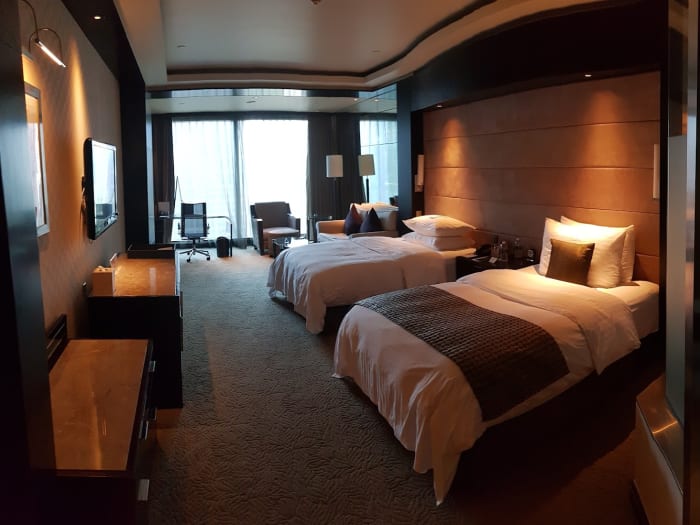
In a city as dense and fast-moving as Shanghai, a hotel room is never merely a place to pass through: it becomes a space of recalibration. At Grand Kempinski Hotel Shanghai, that role is especially clear, because the world outside is defined by movement, appointments, circulation and powerful urban perspectives. Rooms and suites are therefore tasked with creating a pause without severing the connection to the city. Luxury here often lies in that ability to provide calm, clarity and comfort while maintaining a direct relationship with the panorama.
The first impression usually rests on light and visual openness. Depending on orientation, accommodation may look out over the Huangpu River, the lines of Lujiazui or the wider fabric of Shanghai. This presence of the landscape gives the stay a particular dimension: one does not simply occupy a room, but temporarily inhabits a viewpoint. In the morning, the city seems to unfold in successive layers; in the evening, it changes texture, gaining reflections and depth. For many guests, that relationship with the urban scene becomes one of the stay’s most lasting memories.
The design generally follows the codes of an international grand hotel: comfortable proportions, functional furnishings, a restrained palette and amenities suited to both business and leisure stays. That elegant neutrality is a sensible choice in a setting where the view already plays a leading role. Rather than overloading the space, the hotel appears to seek balance between presentation and use. At this level, a room is expected to support work as comfortably as rest, to accommodate luggage for one night or several days, and to offer an ordered atmosphere at the end of the day.
The suites extend this logic with greater ease and more distinct zones for the different tempos of a stay. They naturally suit travellers who wish to receive guests, preserve a separate working area or simply enjoy a more expansive rhythm. In a destination where business itineraries can be intense, that distinction between rest and conversation areas makes real sense. For leisure guests, it also provides the comfort of a genuine urban pied-à-terre, particularly valuable on longer stays.
Turndown service and daily housekeeping contribute to the discreet continuity that defines good hotels. There is nothing ostentatious about these gestures, yet they matter greatly to the overall experience. Returning to a room restored to order after a day in the city or between appointments reinforces the sense of fluidity that seasoned metropolitan travellers value.
Ultimately, the rooms and suites at Grand Kempinski Hotel Shanghai answer a key expectation of contemporary high-end hospitality: to offer refuge without isolation. They provide the comfort needed to slow down, read, work, sleep or simply watch the city evolve beyond the windows. In a property so closely tied to its surroundings, the room is not an absolute retreat; it is a filter. It lets Shanghai in through light, lines and river views while preserving what a great urban stay demands above all: control of one’s rhythm, a sense of space and the possibility of recentring oneself.
Dining
In a grand Shanghai hotel, dining is never merely a convenience. It plays a full part in the way the address relates to the city. At Grand Kempinski Hotel Shanghai, the presence of several restaurants and convivial spaces responds to a simple local reality: travellers, whether on business or leisure, expect to shape their meals according to the hour, the mood and the context. Breakfast facing the river light, an efficient lunch between appointments, a more composed dinner, or a late drink with the skyline beyond — these are the moments that make up the real life of a hotel at this level.
The setting is decisive. In Shanghai, dining with a view is not just an added pleasure but a way of entering into dialogue with the city. The Huangpu, the towers of Lujiazui, shifting light and urban animation create a backdrop that transforms the table experience. Well-positioned hotel dining venues therefore become vantage points as much as places of service. One comes to eat, certainly, but also to mark a transition in the day, host a conversation, extend a meeting or simply watch the city.
In the spirit of a major international address, one can expect a varied offering able to accommodate different guests and different rhythms. That generally means cuisine suited to cosmopolitan expectations, options that work for both formal meals and more informal pauses, and service accustomed to precision without excessive ceremony. In a metropolis such as Shanghai, that flexibility is essential. Business travellers value punctuality and clarity; leisure guests may seek atmosphere, views and the possibility of turning a meal into a moment of discovery or relaxation.
Breakfast deserves particular mention, as it is often one of the defining moments of a stay in a large urban hotel. It is the time when one takes the measure of the day ahead, notes the weather, watches traffic on the river and sees the city gradually wake. In a property with such a setting, that ritual acquires an almost theatrical dimension. It is not simply a buffet or morning service, but an introduction to Shanghai itself.
In the evening, hotel dining takes on another function: offering a credible alternative to the city’s dispersal. After a dense day, many travellers want somewhere to dine without sacrificing quality or the feeling of still being connected to local energy. A hotel such as Grand Kempinski Hotel Shanghai can answer that expectation through its setting, service standards and variety of spaces.
Dining here thus becomes a natural extension of the stay. It does not claim to summarise Shanghai’s vast and compelling food scene, but it offers a comfortable, international and well-situated reading of it. For some, it will be a starting point before exploring the city; for others, an elegant refuge on return. In both cases, the culinary offering supports the hotel’s central promise: to experience Shanghai intensely without ever compromising comfort or coherence.
Spa & wellness
In a metropolis such as Shanghai, hotel wellness takes on a particular meaning. It is not simply a matter of adding a spa or a few leisure facilities to an upscale address; it is about creating a counterpoint to urban intensity. Grand Kempinski Hotel Shanghai, with its central position and appeal to both business and leisure guests, fits naturally into that logic. Its wellness spaces serve as transitional zones: places to slow down after a day of meetings, recover from a long flight, or simply carve out time between two city-bound sequences.
In this context, true luxury often lies in the ability to recover an inner rhythm. Shanghai is constantly stimulating: traffic, light, architecture, human density, professional demands and cultural distractions. An effective wellness space does not need to add to that. It should instead offer clarity, controlled gestures and an environment in which body and mind can disengage without effort. In an international grand hotel, this generally means a combination of relaxation facilities, treatments suited to travellers’ needs and a level of service discreet enough to let each guest follow their own pace.
A well-conceived spa is not merely décor but a use. One comes to ease the effects of jet lag, release tensions accumulated in transit or meetings, regain energy before an evening out, or extend a slower day. That flexibility is essential in a hotel welcoming varied profiles. A business traveller does not seek exactly the same thing as a couple on a city break, yet both are looking for something similar: a moment of recentring in a city that naturally pulls one outward.
The presence of wellness facilities also contributes to the overall balance of a stay. It allows the hotel to be experienced not only as a functional base, but as a place in which one can truly inhabit the day. Beginning the morning quietly, taking a pause in late afternoon, or choosing to devote a few hours to rest rather than another outing can change the quality of a journey. It is a reminder that a successful stay in Shanghai depends not only on the list of places visited, but on how intensity is managed.
Wellness is also expressed through quieter details: sleep quality, thermal comfort, attentive housekeeping, fluid service and the sense of being cared for without being interrupted. In a five-star hotel, these elements matter as much as visible facilities. Together they create a holistic experience of rest, especially valuable in a destination where days can be long and densely scheduled.
At Grand Kempinski Hotel Shanghai, wellness should therefore be understood as an essential component of the urban experience. It does not seek to isolate the traveller from Shanghai, but to help them move through it better. Between the river, the skyline, meetings and walks, the body needs a place to readjust. That is precisely what one expects from a contemporary grand hotel: not only to accommodate, but to provide the conditions for a stay that is sustainable, elegant and genuinely restorative.
Concierge & Services
In Shanghai, the quality of hotel services directly influences the smoothness of your stay. The Grand Kempinski Hotel Shanghai offers a 24-hour concierge service, a round-the-clock reception, daily room service, a turndown service, luggage storage, laundry services, wake-up calls, and a multilingual team. Together, these services create a seamless experience, where practical needs are consistently and discreetly attended to.
The 24-hour reception is particularly significant in an international destination. Shanghai welcomes arrivals at all hours, often following long-haul flights or connections. Knowing that the hotel can take over immediately transforms the perception of arrival. For early departures, schedule changes, or late returns, this continuity remains invaluable.
The 24-hour concierge plays a strategic role. In such a vast city, it becomes an essential navigation tool. Booking transfers, obtaining tailored recommendations, organising transportation, confirming addresses, or optimising schedules lightens the logistical burden of travel. In Shanghai, anticipation often remains the best form of comfort.
Room services contribute to a different level of quality, quieter yet equally essential. Daily maintenance ensures ongoing comfort. The turndown service marks the evening attention that distinguishes prestigious establishments. These gestures accompany the guest's day and serve as a reminder that high-end hospitality is often measured by what is done quietly.
Laundry services and luggage storage address the concrete realities of contemporary travel. An extended business stay, a layover between destinations, an arrival before check-in time, or a late departure give them immediate value. They allow guests to enjoy the city to the fullest without being burdened by logistics.
Finally, the presence of multilingual staff facilitates communication, ensuring precision and trust. Being understood quickly, making specific requests, receiving clear explanations, or contextualised recommendations transforms good service into genuinely useful service.
At the Grand Kempinski Hotel Shanghai, these services shape a masterful hospitality experience. A chain of attentions that secures the stay, supports various travel rhythms, and grants guests greater freedom.
The Shanghai way of life
To stay at Grand Kempinski Hotel Shanghai is to choose a particular way into Shanghai: through its most contemporary lines of force, without giving up the city’s complexity. With its views over the Huangpu and its direct relationship with Lujiazui, the hotel places the traveller immediately within a Shanghai of panoramas, business, mobility and architectural momentum. Yet the local way of life cannot be reduced to that image of urban power. It also lies in contrasts, in the way a day can move from a quiet coffee to a brightly lit avenue, from a business appointment to a riverside walk, from luxury shopping to a more intimate district.
One of the privileges of a well-located hotel is precisely that it allows for such alternation. From the heart of the city, one can compose a stay at several speeds. Some travellers will favour efficient Shanghai: business hubs, optimised movements and addresses where one lunches quickly before moving on. Others will seek a more sensory city: river views, late-day walks, reflections on façades, and the observation of crowds and urban rhythms. Grand Kempinski Hotel Shanghai makes these two readings compatible, which may be one of its most valuable qualities.
Shanghai’s way of life also rests on the coexistence of the global and the local. It is a world city, yet it retains a very particular way of organising space, habits and time. One senses both intense economic energy and a real attention to comfort, chosen consumption, sociability and the staging of everyday life. The luxury shopping close to the hotel forms part of this urban culture, in which shopping is not merely transactional but also linked to promenade, self-presentation and the pleasure of moving through carefully designed environments.
The river, meanwhile, reminds one that Shanghai is also a city of breathing space. Even when framed by dense architecture, the Huangpu opens perspective, introduces distance and offers an axis of contemplation. Many visitors discover the city through this tension between compression and openness. That is what makes the views from the hotel so eloquent: they do not simply show a famous scene, but reveal something of Shanghai’s underlying structure.
For French or European travellers, the experience can be particularly stimulating. One finds familiar markers of international luxury — service, comfort, clarity — while also encountering an urban energy on another scale. That meeting often produces a rare feeling: being both looked after and genuinely displaced. The grand hotel then acts as a mediator. It does not erase the city; it makes it more accessible, more inhabitable and more legible.
To experience Shanghai from Grand Kempinski is therefore to accept a city that does not reveal itself all at once, but in sequences. Sunrise over the river, a meeting in a business district, time among the shops, a pause back at the hotel, dinner with a view, then the skyline lighting up: the local art of living is made of these transitions. It is not fixed. It is mobile, contrasted and deeply contemporary — and this is precisely what the hotel allows one to grasp with unusual clarity.
Booking via MyConciergeHotel
Booking the Grand Kempinski Hotel Shanghai through MyConciergeHotel means approaching this address with a focus on the overall experience rather than merely on pricing. In Shanghai, location, travel pace, and practical arrangements significantly influence the experience. It is not just about selecting a room category, but understanding what the hotel truly offers: views of the Huangpu River, seamless access to business centres, proximity to luxury boutiques, and an environment suitable for both couples and business travellers.
This perspective on the stay is particularly beneficial for an international destination. A trip to Shanghai often raises practical questions: which orientation to favour for the view, how to organise the arrival from the airport, what type of room to choose for a short stay or a longer mission, and when to depart according to one’s priorities. A well-supported reservation transforms these questions into simple, coherent decisions.
Anticipating airport transfers illustrates this approach. Luxury often begins before arriving at the hotel, in the way the journey is prepared. In Shanghai, this preparation is even more crucial given the city's vastness and activity. Securing essential steps in advance allows guests to enter their stay with greater calm. This is particularly appreciated after a long-haul flight or when a professional agenda demands immediate efficiency.
Booking through MyConciergeHotel also provides an editorial perspective that places the hotel in its real context. The Grand Kempinski Hotel Shanghai finds its significance through its relationship with the river, Lujiazui, and the major functions of the metropolis. This contextualisation helps determine if the hotel aligns with your travel style. Are you looking for a base to explore Shanghai on foot and by car? A reliable setting for business meetings? A room with a panoramic view? A stay that combines shopping, comfort, and streamlined logistics?
The value of a specialised concierge lies in its ability to adjust. It allows for directing the reservation towards the right criteria: length of stay, purpose of travel, importance of the view, service needs, arrival and departure times, and daily comfort expectations. In a large international hotel, these nuances often make the difference between a satisfactory stay and a seamless one.
Finally, booking through MyConciergeHotel means opting for a more qualitative approach to luxury travel. It involves clarifying expectations, anticipating sensitive points, and highlighting what the address offers most pertinently. For the Grand Kempinski Hotel Shanghai, this primarily means an urban experience that is well-located, panoramic, structured by solid services, and designed to experience Shanghai intensely without sacrificing comfort.