History & heritage
In Vilnius, few addresses express so clearly the meeting point between an emerging North-Eastern European capital and the classic idea of the grand European hotel. Grand Hotel Kempinski Vilnius belongs to that tradition without relying on theatrical effect or empty display. Its identity rests on a simple principle: to provide, within a historic city centre rich in heritage, a refined retreat where service matters as much as location. The Kempinski affiliation, one of Europe’s longstanding luxury hotel names, sets the tone at once. Guests will recognise a distinctly continental approach to high-end hospitality: attentive reception, a hushed rhythm, discretion, and interiors that favour lasting elegance over passing fashion.
Vilnius has a singular urban history, shaped by Lithuanian, Polish, Jewish, Russian and Central European influences. In a city where historical layers remain legible in the street plan, façades and squares, staying in a hotel of this calibre is not only about comfort; it is also a way of inhabiting, however briefly, the symbolic heart of the capital. Grand Hotel Kempinski Vilnius is particularly suited to travellers who want to experience the city from its centre while keeping the codes of an international luxury establishment.
The heritage here is not only architectural or urban. It is also hotel-related. The property embraces the fundamentals expected of a contemporary five-star address: round-the-clock reception, concierge service, turndown, daily housekeeping, and attention to practical details as well as the overall experience. This continuity of service, often more important than decorative effect, is what distinguishes hotels built to last from mere places to sleep. The promise is not one of flamboyant extravagance; it lies instead in consistency, precision and the ability to make a stay feel seamless, whether for a cultural weekend, a business trip or a quiet escape for two.
It is also worth understanding the role such a hotel plays in a city like Vilnius. The Lithuanian capital, long considered a destination for the well-informed, now attracts travellers drawn to its Baroque heritage, cultural scene and gentler pace compared with other European capitals. A centrally located grand hotel becomes an anchor point: a place to return to after museums, walks through the Old Town or business meetings, with the sense of re-entering a controlled and reassuring environment. This function of urban refuge, almost a private salon within the city, is one that Grand Hotel Kempinski Vilnius appears to fulfil.
Its heritage, in short, is twofold. It stems from the brand that operates it, associated with a certain art of hospitality, and from the urban setting in which it stands: a historic capital on a human scale. The result is an address that does not overstate luxury, but places it within a European continuity shaped by personalised service, centrality and calm. For the traveller, this translates into a clear and reassuring experience: that of a contemporary grand hotel that understands the value of its location and turns proximity to Vilnius into one of its chief privileges.
The Establishment
The foremost asset of the Grand Hotel Kempinski Vilnius is its central location. In Vilnius, the ability to explore everything on foot instantly transforms the travel experience.
Key cultural and historical landmarks are easily accessible without cumbersome logistics. Days remain flexible, allowing for a blend of sightseeing, leisurely terrace breaks, meetings, and returns to the hotel.
This centrality lends a genuine fluidity to the stay, catering equally to leisure travellers and business profiles.
The establishment asserts a clear urban presence. Guests stay here to be in tune with the city's rhythm, with the option to retreat at will.
The proximity to heritage sites, cultural institutions, and vibrant neighbourhoods fosters a direct connection with Vilnius. Travellers can venture out without a rigid itinerary, only to quickly return to the hotel's tranquillity.
The overall atmosphere enhances this relationship with the city. The elegant and well-maintained common areas reflect a measured refinement that aligns with the Kempinski spirit.
The public spaces set the tone from the moment of arrival. They provide an ideal setting for informal meetings, a quiet reading session, an early departure, or a late return.
Elegance is also found in the flow of the space, the relative silence, the quality of the welcome, and the sense of order. Guests feel attended to without ever feeling observed.
The Grand Hotel Kempinski Vilnius caters to a variety of needs. Couples find a central and serene environment conducive to discovering the city together.
Business travellers benefit from a prestigious yet unpretentious address, suitable for stays where efficiency is as important as comfort. Families can also consider a well-organised urban getaway here.
The practical dimension deserves emphasis. With 24-hour reception, concierge services, luggage storage, multilingual staff, and daily maintenance, the stay is structured without friction.
In Vilnius, where one alternates between heritage, contemporary culture, and professional engagements within the same day, this organisation makes a significant difference.
The establishment is defined by its just position. It is a central, elegant, and calm address, capable of accompanying the traveller through their varied rhythms.
Rooms and Suites
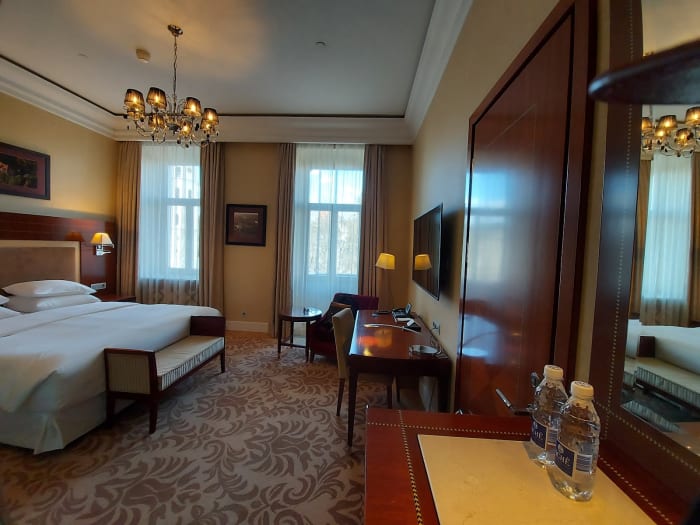
In a grand urban hotel, the room is never merely a place to rest. It serves as a second stage for the journey. It is where one prepares to venture out, catches a breath between city explorations, and finds a form of inner silence in the evening.
At the Grand Hotel Kempinski Vilnius, this private space extends the promise of the public areas: elegance, comfort, precise service, and a sense of order.
What matters in such an establishment is less the spectacular effect than the coherence. A successful room in a five-star city hotel strikes a balance between refinement and functionality. The business traveller seeks a calm and comprehensible environment, while couples desire a subdued atmosphere. Families need a comfortable and practical setting.
This multiplicity of uses necessitates well-thought-out spaces, quality bedding, a bathroom designed as an extension of comfort, and impeccable maintenance.
Daily housekeeping ensures the continuity of comfort. The turndown service integrates the room into the classic rhythm of a grand hotel. The wake-up service, laundry, reception, and concierge available around the clock further enhance this feeling of discreet support.
In Vilnius, the value of a good room also lies in its ability to provide a counterpoint to the city. The historic centre invites walking, observation, and curiosity. Returning to a controlled, temperate, and calm space takes on particular significance. Here, luxury resides in the quality of the transition between the outside and inside.
The suites cater to an additional logic of space and representation. They are suitable for extended stays, celebratory trips, or guests wishing to entertain, work, or simply enjoy a more spacious environment.
Ultimately, the rooms and suites at the Grand Hotel Kempinski Vilnius form the silent heart of the experience. They convince through their accuracy. In a city as rich in heritage as Vilnius, this restraint is a virtue. It allows the city to play its role outside while providing a stable, elegant, and soothing environment within.
Dining
In an establishment like the Grand Hotel Kempinski Vilnius, gastronomy is not limited to dining. It punctuates the day and contributes to the hospitality experience.
Breakfast is often the first true moment of presence in the place. In a large city hotel, it sets the tone. Attentive service, a relaxed pace, and a setting suitable for both visits and meetings. In a house of this calibre, the dining experience is as important as the room or the concierge service.
The strength of a grand international hotel lies in its ability to cater to multiple uses without losing coherence. Couples on a getaway seek an elegant dinner, while business travellers appreciate discreet meetings, efficient lunches, or service tailored to a busy agenda. Casual visitors may simply want a coffee, a break, or a drink after several hours in the city. The dining experience naturally extends the public spaces.
In Vilnius, this dimension takes on particular significance. The culinary scene in the capital is evolving, influenced by regional traditions, Central European flavours, and contemporary openness. In this context, a well-located five-star hotel can serve as a reference point. One can explore the historic streets and then opt for the comfort of dining at the hotel. Here, luxury lies in the freedom to choose one’s own pace.
The quality of a hotel’s dining does not depend solely on the food served. It is built on the welcome, the memory of preferences, the precision of service, and the adaptation to time or dietary constraints. The Kempinski signature naturally expresses itself through personalised service. Successful dining is not necessarily ostentatious; it is reliable, enjoyable, and flexible enough to meet diverse expectations.
For many travellers, breakfast remains the most decisive moment. In a capital best explored on foot, starting the day in a serene setting alters the perception of the stay. It is also a moment for observation. One encounters leisure travellers, regulars, and professionals, each entering their day at their own pace. A grand hotel succeeds when it accommodates this diversity without breaking the impression of unity.
The dining experience at the Grand Hotel Kempinski Vilnius is an essential component of its art of hospitality. More than a strictly gastronomic destination, it appears as a structuring, elegant, and reassuring service. This is what one expects from a great urban address: the ability to rely on a setting, a tempo, and a quality of attention that naturally extends the stay.
Spa & Wellness
In a capital that one willingly explores on foot, wellness takes on a particular form. It provides moments of respite within a dense urban stay.
At the Grand Hotel Kempinski Vilnius, wellness is naturally integrated into the overall experience. In a contemporary grand hotel, rest is no longer confined to the room. It also encompasses spaces and rituals that allow one to slow down and recover after the city.
Vilnius particularly lends itself to this need for contrast. The historic centre, cultural visits, and walking create a pleasant yet tangible fatigue. Returning to a hotel designed for relaxation enhances the quality of the stay. Wellness thus becomes a very concrete comfort. An hour of calm, a treatment, or a moment away from the urban flow can suffice to deepen the journey.
In European luxury hotels, the most appropriate wellness spaces often share a certain restraint. They do not mimic dedicated large resorts. They offer an environment coherent with the city and the rhythm of the traveller. This requires a calming atmosphere, attentive service, and an experience tailored to the moment—be it recovery after a flight, a pause between appointments, preparation for an evening, or simply a desire for silence.
Personalised service takes on its full meaning here. In wellness, personalisation relies on listening, pacing, and discretion. The traveller expects less a discourse than a precise execution: a simple reservation, punctual welcome, and impeccably maintained environment. And the feeling of being understood without needing to articulate everything.
The spa also occupies a symbolic place in an urban hotel. It marks the boundary between the active city and regained time. Even without spending long hours there, knowing that a relaxation space is available contributes to the overall comfort. This is one of the reasons why such facilities are significant in the choice of a five-star address.
At the Grand Hotel Kempinski Vilnius, wellness thus extends a discreet luxury experience. It offers a more measured way to experience the city. After the stones, squares, museums, and appointments, it provides a return to oneself that transforms a stay.
Concierge & Services
The true luxury of a grand city hotel is often measured by what functions seamlessly. At the Grand Hotel Kempinski Vilnius, this includes a 24-hour concierge, a 24-hour reception, daily housekeeping, turndown service, luggage storage, laundry, wake-up calls, and multilingual staff.
Taken together, these services outline an establishment capable of supporting the stay at any hour, with consistency and without ostentation.
The concierge occupies a central role here. In Vilnius, it facilitates cultural programmes, reservations, transfers, neighbourhood recommendations, or the smoother organisation of a day.
Its value lies in its understanding of the stay, its sense of timing, and its ability to tailor suggestions to the traveller's profile. For a couple, this might take the form of a well-planned walking route. For a business traveller, discreet and efficient logistics. For a family, simple solutions that make the city more accessible.
The continuously open reception naturally complements this ensemble. Late arrivals, early departures, and changes in plans are part of the rhythm of European capitals.
Luggage storage then takes on its full significance. It allows guests to enjoy the city until the last moment or to lighten their load upon arrival.
The turndown service and daily housekeeping reflect another dimension of comfort: continuity. The experience does not end with a beautiful space; it extends into a room that is maintained and prepared throughout the day.
Laundry and wake-up services are particularly useful during business stays, extended trips, or multi-stop journeys. Their presence reflects a concrete understanding of the traveller's needs.
The multilingual staff also deserves mention. In an international capital like Vilnius, it facilitates precise communication and a more natural relationship with a clientele from diverse backgrounds.
Thus, the services at the Grand Hotel Kempinski Vilnius are not merely a list. They structure a flexible, attentive, and well-managed stay. In a central address, this quality of execution makes all the difference.
The art of living in Vilnius
Choosing Grand Hotel Kempinski Vilnius also means choosing a certain way of entering the Lithuanian capital. Vilnius does not reveal itself like a spectacular metropolis at first glance; it is discovered instead in layers, through details and atmospheres. Its charm lies in the scale of its centre, the density of its religious and civic heritage, its changing light, inner courtyards and sudden perspectives opening onto a square or bell tower. In that context, staying in the heart of the city is not merely a practical advantage: it is a way of reading the place. One understands Vilnius better when one can move through it freely, return several times during the day, and allow impressions to accumulate without transport constraints.
The local art of living rests partly on this gentle mobility. One walks a great deal, stops easily, and alternates between monuments, cafés, shops, museums and moments of simple observation. The city invites not so much tourist performance as a form of availability. That is one of the great pleasures of a stay here: accepting not to see everything in order to better feel the rhythm of the place. A central and calm hotel then becomes a valuable ally. It allows early starts, midday pauses, evening outings, or, conversely, a slower pace when weather or fatigue calls for restraint.
For couples, Vilnius offers a setting particularly suited to travelling together. Old streets, squares, Baroque façades and the human scale of the centre create a city made for conversation and walking. Grand Hotel Kempinski Vilnius naturally supports that experience through its location and its presumably hushed atmosphere. One can imagine days without a rigid programme, shaped by movement between heritage discoveries and moments of comfort at the hotel. Luxury here lies not in the accumulation of activities, but in the freedom to modulate one’s time.
Business travellers, too, find in Vilnius a rare sense of balance. The city remains legible, accessible and less dispersed than many other European capitals. This favours stays in which professional efficiency can genuinely be combined with quality of life. Between meetings, it is possible to enjoy a walk through the historic centre, a brief visit, or a coffee in an old-world setting. A hotel such as Grand Hotel Kempinski Vilnius, through its central position and service structure, fits fully within that logic.
The art of living in Vilnius is also defined by a certain restraint. The city does not seek to seduce through saturation; it convinces through coherence, history, light and tempo. It is a destination that rewards attention. One comes for the heritage, certainly, but also for that harder-to-define feeling of a capital that remains inhabitable, where travel can stay human, fluid and measured. A well-located grand hotel allows guests to capture that quality without undue effort.
In that sense, Grand Hotel Kempinski Vilnius is not only a place to sleep in comfort. It becomes a privileged observation point over the city and a way of experiencing Vilnius with greater accuracy. From this central base, the capital appears not as a list of sights to tick off, but as a collection of atmospheres to absorb. That is perhaps where the true luxury of the stay lies: in the ability to combine heritage, comfort and inward availability without ever feeling that the journey is being forced.
Book via MyConciergeHotel
Booking the Grand Hotel Kempinski Vilnius through MyConciergeHotel means preparing your stay with precision. For a five-star address in the heart of a historic capital, the pre-arrival support is just as important as the hotel itself. The experience begins before you arrive: selecting the right category, anticipating schedules, understanding the city's rhythm, and coordinating useful details. This is where an editorial concierge and booking service truly comes into its own.
The Grand Hotel Kempinski Vilnius caters to a variety of traveller profiles. This versatility should be considered when making a reservation. A couple does not expect the same experience as a business traveller or a family. Some prioritise centrality for exploring Vilnius on foot, while others place more importance on logistics, such as late arrivals, early departures, or a well-organised agenda. Smart booking involves defining your priorities from the outset: length of stay, season, desired pace, service needs, and specific requests.
MyConciergeHotel also allows you to integrate the hotel into a broader travel project. Vilnius is suitable for both short stays and as a stop on a Baltic or North-Eastern European itinerary. In either case, the Grand Hotel Kempinski Vilnius provides a central and operational anchor point. An early arrival, a delayed departure, luggage management, a cultural programme, or professional appointments are all best planned in advance.
Booking through us also means benefiting from an editorial perspective. The Grand Hotel Kempinski Vilnius is ideal for a stay in the centre of Vilnius, with the service standards of a major European brand. This contextualisation aids in making an informed choice. It helps to understand who the hotel is suited for, what it offers, and how to incorporate it into a coherent journey.
In the five-star segment, the difference often lies in the details. A clearly communicated request, a timely indicated preference, a prepared arrival, or an activity booked before peak times: nothing is trivial. These elements contribute to a smoother stay. Vilnius can be discovered spontaneously, but certain experiences are best anticipated, especially when time on site is limited.
By choosing MyConciergeHotel to book the Grand Hotel Kempinski Vilnius, you favour a more precise and serene approach to travel. The goal is not merely to confirm a room but to construct a stay tailored to your way of travelling. In a city where location is paramount, this preparation makes all the difference. It allows you to arrive in Vilnius with just one thing to do: enter the city at the right pace.