History & heritage
Mandarin Oriental, Doha belongs to a city whose hotel identity has been shaped at speed, at the crossroads of Gulf trade, contemporary urban planning and a deeply rooted culture of hospitality. Here, heritage is not expressed through the accumulated centuries of an old palace, but through a more recent way of defining urban luxury in the Middle East: highly codified service, architecture designed for the climate, fluid transitions between private spaces and social settings, and constant attention to the comfort of the international traveller. The address belongs to a house known for its sense of detail and for a style of hospitality that favours restraint over display. In Doha, that philosophy feels entirely at home.
The hotel is part of a new generation of high-end properties conceived not as isolated retreats, but as anchors within the life of the city. That changes the nature of the stay. One does not come only to sleep in polished surroundings; one comes to inhabit Doha elegantly, benefiting from an environment that keeps the bustle at a comfortable distance without ever severing the connection to it. Mandarin Oriental, Doha expresses this shift particularly well: a five-star hotel able to meet the expectations of business travellers, couples on a city break and leisure guests seeking a high level of service while remaining close to urban energy.
For many travellers, the Mandarin Oriental name suggests a certain idea of international refinement: addresses rooted in their destination, yet linked by a shared culture of welcome. In Doha, that continuity is visible in the care given to public spaces, the quality of the transitions between arrival, settling in and daily life, and the balance between modernity and local references. In a city where contemporary architecture often converses with motifs, materials and rhythms inspired by regional tradition, the hotel sits naturally within its setting.
It is also worth understanding the property on the scale of Doha itself. The Qatari capital has, over a few decades, developed a cultural, commercial and hotel scene of striking density. Grand hotels play a particular role here: they are at once temporary residences, meeting places and privileged vantage points from which to observe the city’s transformation. Mandarin Oriental, Doha belongs to that category of establishments that do not merely accompany urban change, but help define its standards.
For the French traveller, the appeal of this recent history is clear: one stays here in an address that does not attempt to imitate European grandeur, but fully embraces its own era and context. Luxury is less narrative than tangible. It is measured in the precision of service, in the efficiency of teams available at any hour, in the feeling of being expected without being watched. That operational maturity, more than any speech, is today the true heritage of a great urban hotel in Doha.
The Establishment
Staying at the Mandarin Oriental, Doha, means choosing an urban address in a vibrant neighbourhood, with easy access to the city's main attractions.
In Doha, the travel experience heavily relies on the interplay between movement, meetings, cultural visits, and relaxation time. Here, the location enhances fluidity.
The establishment caters to both business travellers and visitors eager to explore the city. This dual purpose is reflected in the organisation of the spaces.
Circulation is intuitive, arrivals are efficient, and communal areas are suitable for both informal meetings and genuine moments of relaxation.
In Doha, the quality of the volumes, materials, and air conditioning significantly contributes to well-being. Luxury here is as much about environmental control as it is about aesthetics.
The Mandarin Oriental, Doha is suitable for both short stays and longer retreats. For business trips, it offers a reliable base with services available around the clock.
For leisure stays, it allows easy access to the various facets of the capital. Business districts, shopping, cultural institutions, urban strolls, and gastronomic scenes remain within reach.
The atmosphere is refined without being rigid. The overall design prioritises functional luxury, with an elegance that enhances the stay.
The communal spaces and facilities blend modernity with tradition. Contemporary lines, technological comfort, and cultural references interact harmoniously.
Doha is experienced differently depending on the season. In winter, when the city attracts more visitors, a well-located hotel becomes increasingly strategic.
One enjoys the city more when movement is simple and returns are swift. The 24-hour reception and available concierge services further enhance this comfort.
Rooms and Suites
In an urban hotel of this calibre, the room is never just a transient space. It absorbs the rhythms of contemporary travel.
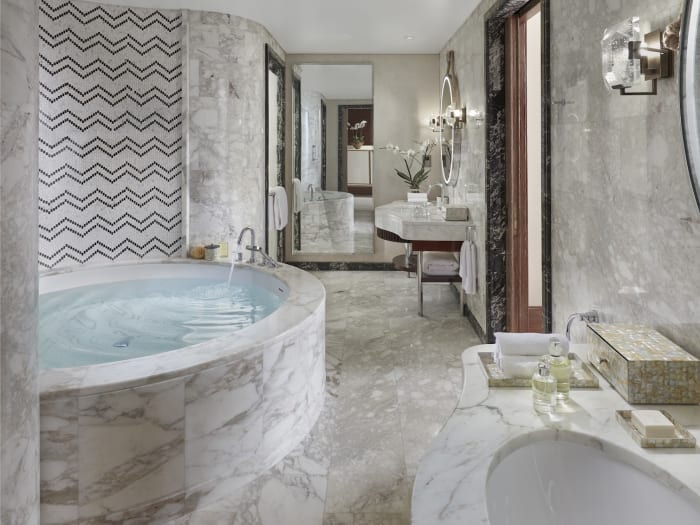
At the Mandarin Oriental, Doha, the rooms and suites extend the promise of the brand: precision, comfort, discretion, and a sense of order. Everything should feel intuitive from the very first moments.
This begins with the clarity of the space. A good luxury hotel room does not impress through accumulation. It immediately instils a sense of mastery.
The volumes allow for unconstrained movement. The storage solutions adapt to both short and extended stays. The lighting caters to every need, from a gradual awakening to a late return.
In Doha, where one transitions from bright external light to temperate interiors, the materials and tones are of great importance. The traveller expects a calming environment.
The suites cater to distinct needs. More space for entertaining. Greater privacy for families or couples. A more residential way to inhabit the city.
This added comfort is not solely about square metres. It also depends on the separation of functions. Sleeping, working, reading, or entertaining do not operate on the same tempo.
Comfort is also measured by less visible elements. Daily housekeeping, evening covers, and the responsiveness of the staff. Additional services include laundry, luggage storage, and wake-up calls.
In practice, the stay remains fluid even when it is busy. One can return late, depart early, have an outfit pressed, request logistical assistance, and then find a room perfectly restored.
For couples, the room becomes a cosy refuge in the heart of an energetic city. For business travellers, it extends the professional stay into a private setting.
For visitors in transit or on short stays, it immediately restores a sense of control over time. This is essential. A successful room provides the traveller with a form of inner continuity.
Dining
In a prominent urban establishment, gastronomy transcends mere dining. It shapes the stay, facilitates encounters, and contributes to the memory of the place. At the Mandarin Oriental, Doha, it is assessed across several dimensions. Breakfast, business lunches, afternoon tea, dinner, and room service are all as significant as the dishes themselves.
In Doha, the culinary scene mirrors the cosmopolitan character of the city. The clientele is local, regional, and international. A grand hotel must therefore speak multiple gastronomic languages while maintaining coherence. This requires precise execution, well-handled ingredients, and attentive service that aligns with the pace of the guest. The atmosphere must also adapt to the moments of the day. Mornings call for lightness, freshness, and efficiency. At noon, the table should facilitate hosting without heaviness. In the evening, it transforms into a space for relaxation or representation.
For French travellers, true luxury often lies in consistency. An excellent coffee served without delay, a table available at the desired time, staff who guide with precision, and reliable room service after a late arrival—these details matter more than an emphasis on culinary performance. In a city with tight schedules, this reliability becomes a comfort in itself.
The dining experience in a grand hotel in Doha also serves a social function. It is a place for meetings, reconnecting with loved ones, and extending conversations. Dining spaces must strike a balance between vibrancy and privacy. Leisure travellers appreciate an environment conducive to discovery and relaxation, while business travellers seek a setting where conversations flow clearly, supported by punctual and frictionless service.
Breakfast often proves revealing. It reflects freshness, organisation, the quality of the welcome, and the management of various rhythms. At the Mandarin Oriental, Doha, a serene and efficient morning experience is expected. It should cater equally to a day of meetings and a sightseeing itinerary. Gastronomy is not an isolated chapter; it connects private comfort, social life, and the art of hospitality.
Spa & Well-being
The Spa at Mandarin Oriental, Doha spans an impressive 3,030 square metres dedicated to tranquility and wellness. The design prioritises a clear layout of spaces and a serene atmosphere.
The journey unfolds around nine treatment rooms, a configuration that ensures a genuine sense of intimacy, even when the spa is bustling with activity.
The indoor pool extends this retreat with a more subdued than spectacular approach. It invites guests to slow down, swim a few laps, or simply let the pace of life ease.
The sauna enhances the experience with its dry, crisp heat, ideal for muscle relaxation. It is often here that the body truly shifts its tempo.
The appeal of the venue lies in its balance between spaciousness and restraint. With its generous volumes, The Spa at Mandarin Oriental, Doha maintains a rare impression of discretion.
Whether for a stay focused on recovery or a well-deserved pause between meetings, this address offers a coherent setting. There is nothing ostentatious here; only well-maintained spaces designed to distance the body and mind from the hustle and bustle.
Concierge & services
What enduringly distinguishes a grand hotel from a merely comfortable property is not only the quality of its architecture or facilities, but the continuity of its service. On this point, the Mandarin Oriental, Doha brief already provides solid indications: 24-hour concierge, 24-hour front desk, daily housekeeping, turndown service, luggage storage, laundry, wake-up service and multilingual staff. Considered separately, these elements may seem expected in a five-star hotel. Taken together, however, they form the backbone of a stay without friction.
A front desk open around the clock is first and foremost a promise of flexibility. In Doha, arrival times may be irregular because of international flights, and business schedules sometimes require very early departures or late returns. Knowing that a team can welcome, guide and resolve a request immediately at any hour fundamentally changes one’s relationship to travel. One feels less dependent on logistical constraints and freer to organise the day according to one’s own priorities. This constant availability is one of the most concrete markers of contemporary luxury.
The concierge, meanwhile, represents a form of applied intelligence within the stay. Its role is not limited to booking a restaurant or calling a car. In a fast-moving city such as Doha, a good concierge helps prioritise wishes, optimise journey times and adapt a programme to the weather, the traveller’s rhythm or the nature of the trip. For a couple, this may mean shaping a gentler day balanced between discovery and rest. For a business stay, it is more about reliability: transfers, recommendations, last-minute assistance and the management of the unexpected.
Daily housekeeping and evening turndown contribute to a discreet quality of presence. The guest does not need to keep asking; the hotel anticipates, restores order, prepares the night and maintains a constant level of comfort. Laundry extends this same logic of fluidity, particularly useful in warm climates, during stays of several days or for travellers moving between meetings and events. Luggage storage, often underestimated, becomes invaluable in the case of an early arrival before the room is ready or a late departure. As for wake-up calls, they retain their full relevance in a context of jet lag and important appointments.
Finally, the presence of multilingual staff deserves emphasis. In an international hotel, the quality of service also depends on the precision of understanding. To be welcomed, advised or assisted in a language one masters reduces misunderstandings and immediately improves relational comfort. At Mandarin Oriental, Doha, all these services combine into a simple yet demanding promise: to allow guests to devote their energy to what matters to them, while the hotel takes care of the rest with calm, method and discretion.
The art of living in Doha
A successful stay at Mandarin Oriental, Doha does not end with the hotel itself. It finds its full meaning when it becomes a way of entering the particular rhythm of the Qatari capital. Doha is neither a museum city nor a seaside destination to be experienced only in retreat. It is a metropolis in constant construction, where one moves with striking ease from one register to another: business, culture, architecture, shopping, air-conditioned promenades, cosmopolitan dining and moments of calm sheltered from the heat. To understand this art of living is to accept that the city is discovered in sequences, often brief but intense, punctuated by regular returns to the hotel to rest, cool down or prepare for the next part of the day.
The advantage of an address set in a lively district, with easy access to attractions, is precisely that it makes this way of discovering the city feel natural. One can compose one’s days without heaviness: a morning outing, lunch, a pause, a late-afternoon visit, a later dinner. In Doha, this alternation is part of the pleasure. The climate, the urban scale and social habits all encourage one to think of the day as a succession of interludes rather than a long uninterrupted continuum. A well-located hotel then becomes a true pivot, not merely a backdrop.
For travellers discovering the city, Doha’s appeal often lies in its contrasts. On the one hand, a highly visible modernity, carried by infrastructure, architectural lines and cultural ambition. On the other, a way of receiving and living together still deeply marked by the codes of Gulf hospitality: attention to the visitor, the importance of shared time and a taste for spaces where people gather. A major international hotel such as Mandarin Oriental, Doha allows these contrasts to be read without caricature. It offers a familiar framework through the quality of its service, while allowing the city to express its own singularity.
Couples will find here a particularly appealing winter city-break destination, where urban discoveries can alternate with moments of retreat. Business travellers, meanwhile, will appreciate the density of the city and the possibility of fitting a few cultural or gastronomic sequences into a tight schedule. As for seasoned luxury-hotel guests, they will see in Doha a highly contemporary laboratory of hospitality: a city where efficiency, climatic comfort, infrastructure quality and a sense of welcome combine in a very specific way.
The art of living in Doha also requires a certain openness of mind. One must accept not to seek here the same reference points as in Mediterranean Europe or in the continent’s historic capitals. Pleasure comes from elsewhere: from the clarity of spaces, the sense of order, the quality of services and the coexistence of urban energy with protected interiority. Within that equation, Mandarin Oriental, Doha plays a central role. It allows guests to approach the city with confidence, to appreciate its codes without undue effort and to find there, for the duration of a stay, a form of cultural as well as material comfort.
Book with MyConciergeHotel
Booking Mandarin Oriental, Doha through MyConciergeHotel means approaching the stay with a logic of precision rather than mere availability. In a destination such as Doha, where comfort depends as much on the choice of address as on the proper orchestration of details, support before arrival has real value. It is not simply a matter of confirming a room in a five-star hotel; it is about preparing the right conditions for the experience according to the purpose of the trip, the season, the desired rhythm and personal priorities. A business stay does not call for the same choices as a break for two, and a first visit to Doha is not arranged in the same way as a return to a city already known.
The value of an accompanied booking appears from the very first questions. Should one favour a highly structured stay or preserve flexibility? When should a spa treatment be planned, knowing that appointments may fill quickly? How should arrival, settling in, possible meetings and time for discovery be articulated? Which hotel services will prove most useful depending on flight times, length of stay or the need for smooth logistics? An adviser familiar with this kind of address helps ask these questions at the right moment, avoiding many approximations once on site.
MyConciergeHotel also brings an editorial reading of the stay. This matters particularly for a hotel such as Mandarin Oriental, Doha, whose appeal lies as much in its intrinsic quality as in the way it fits into the city. Booking intelligently means understanding that the lively district location, easy access to attractions, availability of a 24-hour concierge and suitability for both business and leisure stays form a coherent whole. The role of advice is precisely to turn that information into a concrete experience: a smoother programme, better-calibrated expectations and services called upon at the right time.
For demanding travellers, this mediation is far from incidental. In luxury hospitality, differences rarely lie in broad promises; they reveal themselves in the quality of preparation. Booking early during the busier winter season, anticipating wellness requests, noting a late arrival time, thinking ahead about laundry or luggage storage, planning for the needs of a hybrid work-and-leisure stay: all these elements noticeably improve the final feeling of the trip. Luxury often begins before departure, in the way the journey is conceived.
Choosing MyConciergeHotel for this address therefore means favouring a more editorial, attentive and personalised approach to booking. The aim is not to overdo things, but to calibrate them correctly. In a city such as Doha, where efficiency and comfort are closely linked, that accuracy makes all the difference. It allows guests to enjoy fully what Mandarin Oriental, Doha promises best: well-mastered international hospitality, a relevant urban setting and a stay conducted with calm, elegance and clarity.