History & heritage
Fairmont Le Château Montebello belongs to that rare category of hotels whose identity is legible in the very material of the building. Here, timber is not merely decorative: it is the founding principle of a property conceived as a grand Canadian retreat, impressive in scale yet deeply rooted in its natural setting. Its log-built architecture, now its defining signature, evokes the imagery of vast North American landscapes, elegant hunting lodges and forest hideaways designed for long stays shaped by the seasons. More than a hotel, the property belongs to a tradition of hospitality in which landscape, conviviality and a sense of shelter matter as much as comfort.
This heritage dimension is felt in the overall atmosphere. The hotel cultivates a direct relationship with a certain idea of Canada: generous, warm and free from unnecessary display. The volumes, textures, omnipresent wood and constant dialogue with the surrounding forest create a coherent narrative, apparent from the moment of arrival. Guests do not come here for an interchangeable form of luxury, but for an experience anchored in a specific territory and in an immediately recognisable architectural language. That is what gives the address its timeless strength. Even as habits evolve and contemporary expectations of comfort become more refined, the spirit of the place remains steady: to offer a sense of retreat, continuity and closeness to nature.
Its Fairmont affiliation adds another layer to this story. The brand is associated with hotels that often serve as landmarks within their destination, combining heritage, structured service and a certain social life. In Montebello, that logic takes on a more rustic and immersive tone. The elegance here is less urban than landscape-driven; it lies in the quality of the welcome, the ease of the public spaces and the way the hotel accommodates couples, families and travellers drawn by outdoor pursuits.
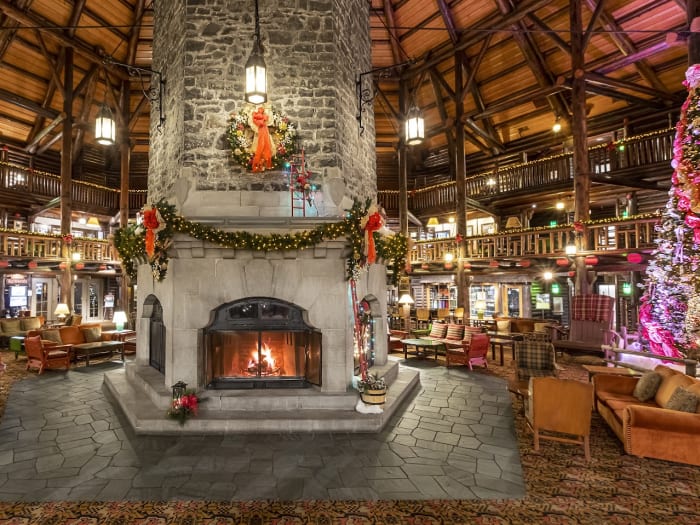
This heritage matters because it is still actively lived. The hotel does not simply preserve an iconic silhouette; it sustains a way of inhabiting the site. Guests find a refined lodge atmosphere in which simple moments gain unusual depth: returning after a day outdoors, crossing timber-lined lounges, settling by the fire or watching the light shift across the forest. This continuity between architectural legacy and contemporary use explains the loyalty the property inspires. It speaks both to travellers seeking a distinctly Canadian imagination and to those looking for a characterful hotel capable of offering something beyond standardised luxury.
In a hospitality landscape often shaped by passing trends, Le Château Montebello retains a clear singularity. Its heritage is neither static nor museum-like; it is expressed through a sensory experience that remains immediately perceptible, where the history of the place still informs the present. It is precisely this coherence, between architecture, environment and hospitality, that gives it lasting value.
The property
Staying at Fairmont Le Château Montebello means choosing a hotel whose first quality is immersion. Set in the heart of the forest, the property does not treat nature as a pleasant backdrop; it shapes the entire experience. From the moment of arrival, the dominant sensation is one of withdrawal from ordinary pace. Wooded views, the scale of the estate, the constant presence of greenery and direct access to the outdoors create an immediate sense of release. Luxury here lies first in space, relative quiet and the ability to move seamlessly between a cocooning interior and a generous natural environment.
This setting gives the place a distinctive tone. The hotel is neither a seaside resort, nor an urban grand hotel, nor simply a country inn. It occupies a particularly appealing middle ground: that of a large destination retreat capable of offering full facilities alongside a genuine sense of escape. The relationship with the forest is central, but not merely contemplative. Direct access to the surrounding nature encourages an active way of inhabiting the stay, whether through walks, seasonal pursuits or simply the pleasure of spending time outdoors. In summer, the light, trails and breadth of the landscape invite longer days. In winter, the atmosphere tightens around the idea of a cocoon, with that intensity unique to northern destinations where the indoors become all the more precious after time outside.
The log-built architecture plays an essential role in this dialogue with the site. It does not seek to dominate the landscape, but to converse with it. The material creates visual continuity between hotel and environment while giving the public spaces a very particular warmth. The result is less theatrical than organic: one feels welcomed by a building that seems to belong to its surroundings. This coherence contributes to the sense of rightness that defines the property. Many nature-led hotels promise immersion; here it is tangible in the very construction of the place.
The overall atmosphere, often described as warm and distinctly Canadian, rests on this balance between scale and conviviality. Despite its high-end status, the hotel avoids stiffness. Spaces are designed to be lived in easily, by couples on a break, families on holiday or travellers seeking a few quiet days. That flexibility is part of its appeal. One can shape a highly active stay here or, on the contrary, settle into a rhythm of complete slowing down.
Finally, the property’s commitment to sustainability adds further relevance. In an environment so closely tied to the landscape, responsibility cannot be an afterthought. Without turning the stay into a demonstration, this attention to impact and preservation reinforces the sense of a hotel aware of what constitutes its primary value: the quality of its natural setting. Le Château Montebello is compelling for a rare reason: its character, location and atmosphere all tell exactly the same story.
Rooms and suites
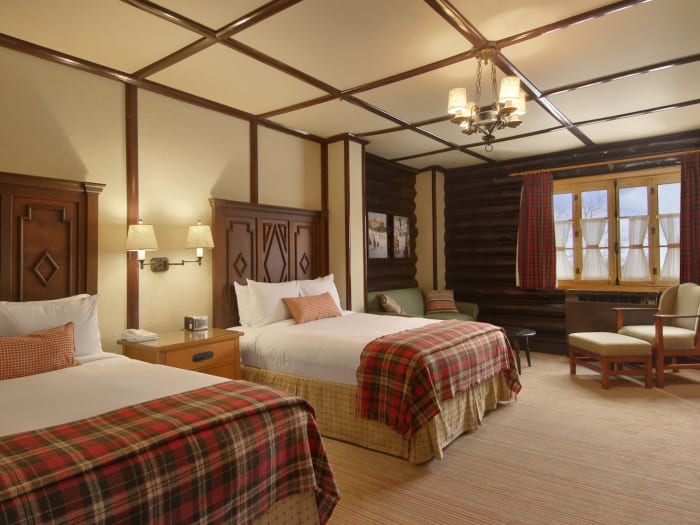
In a hotel so strongly defined by its architecture and setting, rooms and suites cannot be reduced to a list of amenities. What guests seek at Fairmont Le Château Montebello is continuity between the experience of the public spaces, the spirit of the place and the intimacy of their accommodation. The rooms therefore extend the idea of a comfortable retreat, where a Canadian aesthetic appears in a calmer, more personal form oriented towards rest. The decorative language remains consistent with the hotel’s overall identity: warm materials, a cocooning atmosphere, a sensory relationship with the landscape and the impression of a refuge away from noise.
That coherence matters because it avoids a common pitfall of character hotels whose rooms feel disconnected from the main narrative. Here, accommodation fully participates in the experience. After a day spent enjoying the surrounding nature, exploring seasonal activities or simply inhabiting the estate’s spaces, returning to one’s room feels natural and reassuring. Modern comfort is present, but it does not erase the spirit of the house. The balance sought is not that of anonymous minimalism; rather, it lies in offering functional, welcoming and legible spaces that prioritise a sense of wellbeing.
Depending on the category chosen, travellers may seek different shades of stay. For a short weekend, a well-conceived room is enough to enjoy the hotel’s overall atmosphere and environment. For a longer stay, a suite or more generous configuration allows guests to settle into their own rhythm more fully, especially for families or for those wishing to alternate between rest, outdoor pursuits and time spent indoors. In every case, the main appeal lies in the hotel’s ability to make one feel that one is inhabiting a singular place rather than a standardised room.
Service contributes greatly to this impression. Daily housekeeping, turndown service and a structured hotel operation help preserve that sense of ease which distinguishes well-run properties. Nothing ostentatious, simply a constant attention to keeping the stay effortless. This is particularly valuable in a destination where days can differ greatly according to season: an early departure for an activity, a slower return in late afternoon, a peaceful evening sheltered from cold or weather, a morning extended in a retreat-like mood.
The rooms and suites at Le Château Montebello make full sense in this context: they do not try to compete with the landscape, but to accompany it. They offer an interior counterpoint to the forest, the light, the changing weather and the rhythm of the estate. This relationship between indoors and outdoors lies at the heart of a successful stay. One sleeps here, of course, but one also rediscovers a form of inhabited calm, that difficult quality to achieve in high-end hospitality when décor overtakes use. Here, the essential lies in this sense of rightness: accommodation designed to prolong the experience of a grand Canadian lodge without ever turning it into caricature.
Dining
At a property such as Le Château Montebello, dining is not merely an additional service: it forms part of the art of staying well. After landscape and architecture, the table is one of the main ways in which the hotel expresses its identity. Without seeking theatrical effect, it extends the idea of generous hospitality suited to a place where guests come both to slow down and to make the most of the destination. The forest setting, warm atmosphere and culture of the grand Canadian lodge call for food that is legible, comforting and capable of accompanying days that vary greatly with the seasons.
The pleasure of dining in such a context lies first in the rhythm it establishes. In the morning, breakfast takes on particular importance: it opens the day, prepares guests for outdoor activities or, on the contrary, allows for a gentler morning devoted to contemplation and slowness. At midday, the hotel must answer varied uses, from lighter meals to convivial pauses and more structured moments. In the evening, dining often becomes more enveloping, almost ritualistic, especially when the outdoors encourages an early return and one seeks the warmth of an inhabited interior. In a property of this nature, the meal becomes an anchor point of the stay.
One of Fairmont’s strengths lies in its ability to serve multiple guest profiles without losing coherence. Couples on a break, families, leisure travellers and guests seeking a few restorative days do not all expect the same experience, yet all look for reliability and comfort in the culinary offering. Dining must therefore combine quality of execution, flexibility and a sense of place. In Montebello, that ideally means cuisine that dialogues with the environment, without heavy-handed folklore, and privileges conviviality as much as polish.
The setting plays an essential role here. In a hotel known for its log-built architecture and Canadian atmosphere, a meal is never entirely separate from its surroundings. The sense of warmth, the presence of natural materials, the relationship with the seasons and the possibility of extending the day in welcoming public spaces give dining a particular density. Even a late-afternoon drink or a snack after an outdoor activity can become a genuine travel moment because it is framed by such a carefully composed atmosphere.
For the traveller, that continuity may be the key point. Dining forms part of the wider experience. It does not seek to distract from the place, but to accompany it with accuracy. In a hotel world where some restaurants seem designed to exist independently of their address, Le Château Montebello suggests a more integrated approach. One eats here in continuity with the landscape, the climate and the rhythm of the estate. This discreet yet coherent way of doing things suits the spirit of the house: a form of luxury lived over time, where quality is measured as much by consistency and comfort as by the brilliance of a single moment.
Wellbeing & restoration
Even when a hotel is not defined first and foremost by a major destination spa, wellbeing can still occupy a central place. At Fairmont Le Château Montebello, it arises naturally from the setting, the rhythm and the overall atmosphere. Wellbeing here is not only a matter of treatments or dedicated facilities; it also stems from the relationship with the landscape, the sense of space, the possibility of slowing down and the very particular quality of refuge offered by the property. In a hotel set in the heart of the forest, the idea of restoration is not abstract. It is felt in the morning light, in the outdoor air, in the contrast between time spent outside and the return to indoor comfort.
This logic is especially relevant for contemporary travellers, who often expect more from a stay than a simple change of scene. Guests come here to rest, certainly, but also to recover a sense of balance. The place lends itself to this through its ability to offer several intensities of stay. Some will favour activity and physical exertion, others contemplation, while others still will alternate movement and recovery. The hotel supports these different patterns through its calming atmosphere and the organisation of a complete house, where one can easily shape the day without effort.
Wellbeing also takes on a strongly seasonal dimension. In summer, it is nourished by the openness of the landscape, the presence of the forest and time spent outdoors. The body adjusts to longer days, to a more expansive energy, to the pleasure of occupying space. In winter, the logic changes: comfort, warmth, longer pauses and attention to recovery become essential. This alternation is part of the property’s charm. It reminds guests that a great nature hotel does not offer a uniform experience, but a different way of inhabiting each season.
In this context, moments of relaxation acquire particular value, whether one takes time after an activity, creates a calm pause in the middle of the day or turns the stay into a gentle retreat. Service plays a discreet yet real role here: an available front desk, attentive concierge team and smooth logistics help preserve that sense of simplicity which is one of the conditions of genuine rest. The luxury of wellbeing does not lie only in the sophistication of an offer; it often resides in the absence of friction.
Le Château Montebello therefore appeals to travellers seeking credible restoration, not excessively staged wellness. The place does not impose a single model of relaxation; it allows each guest to find their own pace. That may be its most contemporary quality. In a world saturated with wellness injunctions, this address reminds us that a restorative stay can arise from simple but well-judged elements: a preserved environment, protective architecture, reliable service and the rare feeling of being, for a few days, truly elsewhere.
Concierge & services
In a destination hotel, the quality of a stay depends as much on atmosphere as on the invisible mechanics of service. Fairmont Le Château Montebello illustrates this well: its rustic charm and deep connection to nature only truly work because they are supported by a solid hotel operation. The presence of a 24-hour front desk and round-the-clock concierge gives travellers that discreet sense of security which changes everything, especially in a property where days may begin early, extend outdoors or need to adapt to weather and the seasons. Luxury here is not only in the setting; it lies in the hotel’s ability to make things easy.
That ease is first expressed through essential gestures. Daily housekeeping preserves the feeling of a place always ready to be inhabited. Turndown service, more intimate in nature, accompanies the transition into evening and reinforces the sense of a stay cared for down to its details. Luggage storage facilitates early arrivals and late departures alike, particularly valuable when guests wish to make the most of the estate or fit in an activity before travelling onward. Laundry service also makes particular sense in a hotel linked to the outdoors: it allows for longer or more active stays without unnecessary constraint.
A wake-up service may seem minor, yet it points to a simple truth of well-run hospitality: attention is not measured only by spectacular offerings. In a destination where one may wish to leave early for an activity, make the most of a specific morning or organise the day precisely, this sort of service contributes to overall fluidity. The same applies to multilingual staff, essential in an international house welcoming varied guest profiles. The quality of a grand hotel is often visible in this ability to put people at ease without apparent effort.
The concierge naturally plays a central role. In an environment where seasonal activities may be in demand, where rhythms shift with the weather and where guests may hesitate between several ways of shaping their stay, human guidance becomes particularly valuable. Receiving tailored advice, organising one’s time, anticipating certain bookings or simply understanding the possibilities of the estate and its surroundings more clearly: all this helps turn a good stay into a well-composed experience. The recommendation to reserve some outdoor activities in advance is especially relevant here. An effective concierge does not merely respond; it helps orchestrate the stay.
It is this alliance between warmth of welcome and operational rigour that defines service at Le Château Montebello. The property retains a convivial atmosphere, never overly formal, yet that apparent ease rests on real structure. For the traveller, the result is clear: one enjoys a characterful place without giving up the reliability expected of a grand hotel. In such an immersive setting, quality of service becomes almost a condition of letting go. It allows guests to focus on what matters most: the landscape, recovered time and the pleasure of a stay conducted without friction.
The Montebello way of life
Montebello lends itself to a form of travel grounded in space, nature and recovered time. Fairmont Le Château Montebello is one of its clearest expressions, yet the appeal of the stay also lies in what the destination suggests beyond the hotel itself. The way of life here is not urban; it is organised around seasons, landscapes and a more direct relationship with the elements. Visitors come less to tick off a series of sights than to inhabit an atmosphere, adopt a different rhythm and rediscover a chosen simplicity. That is what makes Montebello especially appealing to travellers seeking a distinct break without giving up the comfort of a grand hotel.
The forest setting immediately imposes a different scale of perception. Days are shaped more naturally by light, weather and the desire either to go out or to remain sheltered. In summer, the destination encourages outward living: walks, outdoor pursuits, long evenings and the pleasure of inhabiting the landscape. In winter, it becomes a territory of contrasts, where the outdoors invigorate and returning indoors becomes an essential part of the pleasure. This seasonal alternation is not merely scenic; it genuinely shapes the way the stay is lived. Montebello is best understood when one allows oneself to be guided by that tempo.
For couples, the destination offers a rare quality: romance without excessive staging. Its charm comes from the setting, the relative quiet, the warmth of interiors and the possibility of sharing simple moments that acquire unusual depth here. For families, the appeal lies in versatility. Nature provides an immediate field of experience, while the hotel supplies the comfort and structure needed for everyone to find their place. Solo travellers, meanwhile, often find what major destinations struggle to offer: the feeling of being alone without ever feeling isolated.
The Montebello way of life also rests on a certain sobriety. One does not come here in search of an accumulation of events or an excess of addresses. Pleasure arises instead from the coherence between territory, hotel, seasonal activities and a calmer way of spending time. This sobriety does not exclude elegance; it redefines it. It reminds us that a successful stay does not necessarily depend on a dense programme, but on the quality of sensations, the rightness of the setting and the freedom left to the traveller.
From this perspective, Le Château Montebello acts as an ideal gateway. It provides access to the surrounding nature, offers a comfortable anchor point and translates the spirit of the place through its very architecture. To stay here is therefore to discover Montebello not as a destination to be consumed quickly, but as a landscape to inhabit. For many travellers, that is precisely what gives the experience its lasting value: the possibility of leaving with the feeling of having truly changed pace, even if only for a few days.
Book with MyConciergeHotel
Booking Fairmont Le Château Montebello through MyConciergeHotel means approaching the property in the right way: as a stay considered in advance, calibrated according to season, desired rhythm and the way you wish to experience the destination. In a hotel so closely tied to its natural setting, preparation matters more than it does in a purely urban address. The choice of dates strongly shapes the experience, as does planning certain outdoor activities ahead, particularly in high season. An editorial and concierge-led approach helps avoid a generic stay and instead build a more accurate, more rewarding escape.
The value of an assisted booking does not lie only in rate or availability. It lies in understanding the place. Le Château Montebello is not experienced in the same way by a couple, a family or a solo traveller; nor by someone seeking a disconnected weekend, a few active days centred on nature or a more contemplative retreat. Good advice beforehand makes it easier to choose the right length of stay, the right pace and, where relevant, the right room category. It also helps organise the key moments of the stay without overloading it, which is essential in a destination people choose precisely to regain mental space.
MyConciergeHotel brings particular value to this kind of property because the experience extends well beyond the room itself. One must think about arrival, activities, moments of pause, meals, possible logistical needs and the season. In summer, the focus may be placed on the outdoors and on reserving certain experiences in advance. In winter, the challenge is often to orchestrate a more cocooning stay, where the alternation between outdoor time and indoor comfort becomes central. In both cases, the objective remains the same: to turn a simple booking into a coherent stay.
This approach is all the more useful because the hotel attracts varied profiles. Some travellers are drawn above all by the forest setting; others by the log-built architecture and Canadian atmosphere; others still by the idea of a grand hotel capable of combining nature, structured service and logistical ease. Personalised guidance helps prioritise these expectations and make the right choices before departure. That is often what separates a pleasant experience from a truly successful stay.
Booking through MyConciergeHotel ultimately means choosing a qualitative reading of luxury hospitality. Not an accumulation of abstract promises, but careful attention to the fit between a place and a traveller. Fairmont Le Château Montebello has a strong, immediately recognisable personality. To enjoy it fully, it is better to enter into its rhythm than to impose one’s own upon it. That is exactly the role of a well-supported booking: to help turn this address into a tailored stay that remains faithful both to the spirit of the place and to your own expectations.