History & heritage
In Florence, some addresses do more than occupy a privileged location: they become part of the city’s own narrative. The St. Regis Florence belongs to that rare category of hotels whose experience begins before one has even crossed the threshold. Set in a historic riverside setting on the Arno, the property reflects a Florentine tradition of urban palazzi, ordered façades and interiors where splendour is inseparable from culture. Here, luxury does not rely on novelty, but on continuity: a certain art of hospitality shaped by Renaissance heritage and by the cosmopolitan elegance long associated with the city’s grand houses.
Its relationship with history is first felt in the atmosphere. There is that distinctive quality found in great Italian hotels housed in period buildings: generous volumes, an easy flow between formal rooms and more intimate spaces, and a constant dialogue between heritage décor and contemporary comfort. Florence has long welcomed travellers, collectors, art lovers and diplomats; a hotel of this standing cannot simply be a place to sleep. It must offer a sense of permanence, almost that of a ceremonial residence, where guests feel both received and expected.
The St. Regis name also carries an international service tradition shaped by precision, discretion and attention to detail. In Florence, that culture of hospitality takes on a particular tone. It is coloured by a local sense of staging, by a more tactile relationship to materials, light, views and the history of place. The result is neither a museum nor a design hotel imposed upon an old shell, but an address that fully embraces its historic dimension while meeting the expectations of the contemporary traveller.
What is most striking, ultimately, is the way the hotel conveys a deeply Florentine idea of refinement. In this city, elegance is not expressed through excess. It lies in balance, in quality of execution, in the exactness of detail. A well-proportioned salon, a perspective over the river, a calm arrival, a turndown carried out without fuss: these are the gestures that extend a tradition of excellence rather than merely imitate it. The St. Regis Florence therefore belongs both to the long history of grand residences turned places of hospitality, and to the subtler history of a city where the art of living has always been inseparable from art itself.
The property
A stay at The St. Regis Florence means choosing an address that immediately reveals the city’s emotional geography. The river, the bridges, the pale stone façades, the perspectives that open and tighten through the streets: all of Florence is within walking distance, yet without the feeling of being trapped in the constant flow of the busiest areas. Views over the Arno are among the hotel’s greatest privileges. They lend the stay an almost theatrical quality, because the river is not merely scenery; it is a line of breath, a way of structuring the city and giving it light.
Its location in the heart of Florence is a practical advantage for travellers wishing to do everything on foot. Museums, churches, palaces, shopping streets and more discreet addresses are all easily reached. Days can be arranged with real flexibility: setting out early to visit a museum before the crowds, returning to the hotel for a pause at midday, heading out again in the late afternoon towards boutiques or the riverbanks, then coming back to the hotel’s hushed calm at dusk. That fluidity is invaluable in a city where cultural intensity can quickly become demanding.
The hotel itself works on this balance between display and refuge. The public spaces, in an elegant register, immediately establish a sense of composure. Nothing feels improvised, yet nothing is rigid. Business travellers will appreciate a clear, well-ordered setting suited to discreet meetings or a tightly planned stay; couples, by contrast, are likely to sense a form of urban romance shaped by the views, the materials and the slower rhythm made possible by a well-run grand hotel. That versatility is telling: it says much about an address able to welcome different kinds of stay without losing its identity.
The historic setting deepens this impression. In Florence, beauty is never merely decorative; it shapes the way one inhabits a place, moves through it and rests within it. The St. Regis Florence makes intelligent use of that fact. One does not simply sleep near the monuments here; one stays in an address that extends the city itself, taking up its codes of refinement, proportion and visual culture. For a first visit as much as for a return to Florence, it is a particularly persuasive base, offering both the intensity of the centre and the rarer feeling of genuine anchorage.
Rooms and suites
In a hotel of this calibre, the room is not merely a functional space between outings: it must become a counterpoint to the pace of the city. In Florence, where days quickly fill with masterpieces, queues, cobblestones and light, returning to one’s room takes on particular importance. The St. Regis Florence appears to understand this well, offering an environment that seeks less to dazzle than to establish lasting comfort. The blend of tradition and modernity, highlighted among the property’s defining traits, finds its most tangible expression here.
One expects flawless execution from such an address: carefully prepared bedding, precise daily housekeeping, evening turndown, easy circulation and an atmosphere calm enough for the room to fully play its role as a refuge. The butler service associated with the St. Regis signature adds a level of personalisation that matters greatly in a high-end stay. It is not simply an extra service, but a way of adapting the rhythm of the hotel to that of the guest, whether for a short cultural break, a romantic weekend or a demanding business trip.
Rooms and suites in a grand Florentine hotel also carry an aesthetic responsibility. Without falling into decorative excess, they should remind guests that they are in a city where art history is never far away. One therefore looks for a sense of proportion, carefully chosen materials, a palette that works with Tuscan light rather than against it, and details that evoke heritage without turning into pastiche. When the view opens onto the Arno or the surrounding urban fabric, the experience takes on another dimension still: the room ceases to be a mere interior and becomes a privileged vantage point over Florence.
For the most demanding travellers, a suite is naturally the ideal format. It allows for real breathing space between sitting room and bedroom, for discreet entertaining, or simply for inhabiting the city at a more measured pace. Yet even in a more classic category, what matters here is the sense of being in an address that understands the codes of the grand hotel without making them heavy-handed. Everyday comfort, the quality of housekeeping, the availability of a 24-hour front desk and the attention paid to detail all create a coherent experience. On arrival as at waking, after dinner as before an early departure, everything contributes to making the room a place of continuity, calm and composure — precisely what one expects from a well-located Florentine five-star hotel.
Dining
In Florence, hotel dining is rarely judged by showmanship. Seasoned travellers tend instead to look for a table capable of extending the spirit of the place: elegant without stiffness, attentive to produce, service and the rhythm of the meal. At a property such as The St. Regis Florence, dining forms a full part of the overall experience. It accompanies the various moments of a stay — breakfast before museums, a light lunch between visits, an informal meeting, a more settled dinner — and must therefore offer consistency, precision and a sense of atmosphere.
The first luxury here is often the setting itself. Having lunch or dinner in a refined environment, with the feeling of being sheltered from the bustle outside while remaining connected to the city, profoundly changes one’s perception of a Florentine stay. After several hours spent in the streets, galleries or boutiques, returning to an elegant dining room or a calm restaurant space allows the day to continue without rupture. That is also why advance booking is recommended: in grand houses, the table attracts not only residents but passing visitors as well, precisely because it offers this combination of comfort, service and location.
One may expect from such an address a clear, readable cuisine rooted in Italian taste and flexible enough to answer different expectations. Some travellers will want a quick meal executed perfectly; others will seek a more ceremonial dinner in which service plays an essential part. In both cases, what matters is rightness. A great hotel restaurant does not necessarily aim to compete with the city’s most experimental gastronomic scene; rather, it should offer a form of high-end reliability, where one knows that the welcome, the tempo and the attention to detail will be of a high standard.
Breakfast deserves special mention. In a city best discovered on foot, it often determines the quality of the day. A well-orchestrated morning service in a pleasant setting, with the feeling of beginning Florence in calm before the intensity of sightseeing, is one of the very tangible pleasures of a grand hotel. In the evening, dining may take on a more hushed, almost residential tone. Here again one finds the blend of tradition and modernity that defines the property: a certain idea of classical refinement adapted to contemporary habits. For guests who prefer privacy, in-room dining and butler support naturally extend the experience, allowing dinner or a light meal to be enjoyed in the comfort of one’s own space.
Spa & wellbeing
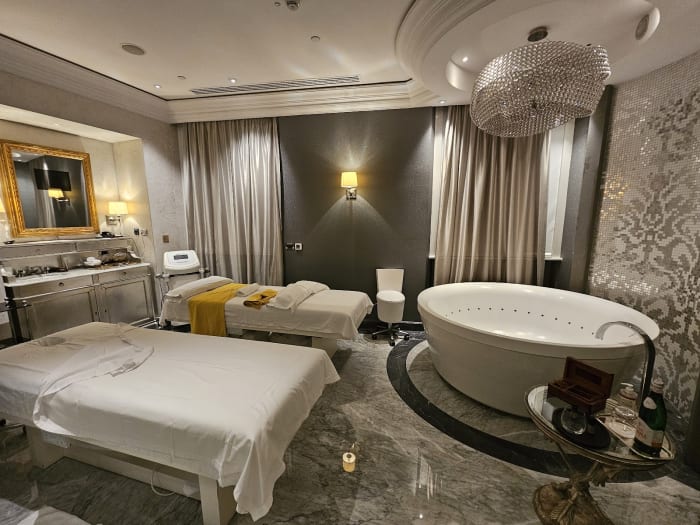
In a city such as Florence, wellbeing takes on a particular meaning. One does not come here merely to rest; one absorbs an unusual visual and cultural density, which can be as stimulating as it is demanding. That is why, in a grand hotel, moments of recovery matter as much as the visits themselves. Even when a property does not foreground oversized facilities, the quality of the wellbeing experience is measured by its ability to recreate silence, comfort and a sense of recentring. The St. Regis Florence, through its positioning and service culture, naturally lends itself to this understanding of wellbeing as the art of slowing down.
The first element is intimacy. In a historic setting in the heart of the city, luxury often lies in the ability to create pauses. Returning to the hotel after a day spent among museums, churches, squares and boutiques, finding an orderly environment, a room prepared with care, and attentive yet non-intrusive service already forms part of a restorative experience. Turndown service, staff availability, and the ability to organise one’s time flexibly through concierge and butler support all belong to a discreet form of wellbeing, less demonstrative than a large spa complex, yet often better suited to an urban stay.
In luxury hospitality, wellbeing has long ceased to be limited to treatments alone. It also concerns sleep quality, acoustic comfort, the ease with which one can arrange a quiet moment in the room, organise a gentle wake-up, or plan a pause between appointments. In that respect, The St. Regis Florence answers a very contemporary expectation: that of a hotel able to absorb the logistical complexity of travel so that the guest is left with the most pleasurable part of the stay. True rest often comes from that feeling of fluidity, of nothing requiring unnecessary effort.
For travellers who treat wellbeing as a ritual, the hotel also provides an excellent base from which to structure more balanced days: cultural mornings, a return for a pause, a slower late afternoon, dinner without further movement. This way of inhabiting Florence, alternating intensity and retreat, suits the spirit of a grand address on the Arno perfectly. The river, the light, the quality of service and the property’s overall composure create a setting conducive to sophisticated relaxation, never ostentatious. Here, wellbeing is not staged as performance; it is woven into the continuity of a well-conceived stay, where elegance also means knowing how to preserve moments of breath.
Concierge & services
In grand luxury hospitality, the quality of a stay often depends less on what is visible than on what is resolved quietly. The St. Regis Florence belongs to that school of service in which efficiency has no need to be theatrical. The presence of a 24-hour concierge and a round-the-clock front desk is first and foremost a guarantee of fluidity. Late arrival, early departure, a last-minute request, transfer arrangements, restaurant booking or simply guidance through the city: all of this should be handled with calm, precision and continuity. In a destination as busy as Florence, such constant availability is far from a minor detail.
Butler service gives the experience an additional tone. It places the stay within a logic of personalisation that goes beyond the mere administrative handling of requests. A grand hotel is recognised by its ability to anticipate patterns of use: preparing a room according to the guest’s rhythm, easing the settling-in process, coordinating in-room service, supporting the practical needs of a short or longer stay. When well delivered, this attention does not create dependence; it frees time and energy. That is especially valuable in a city where one wishes to devote the greater part of the day to discovery rather than logistics.
The quieter services matter just as much. Daily housekeeping, turndown, laundry, luggage storage and wake-up service may appear self-evident on paper, yet they make all the difference when executed rigorously. They allow a constant level of comfort to be maintained whatever the pace of the stay. For business travel, that means being able to move between meetings and outings without friction; for leisure, it guarantees a precious sense of lightness, especially when alternating between cultural visits, walks and dinners in town.
In Florence, the concierge also plays an almost curatorial role. In a city saturated with options, essential monuments and more confidential addresses, true luxury lies in being guided well. Knowing when to set out, how to organise a day on foot, where to pause, which shops to favour, how to avoid the busiest hours: such information transforms the experience. The St. Regis Florence, by virtue of its central position and service level, is particularly well suited to this kind of tailored support. The hotel becomes more than accommodation: it is a dependable base capable of orchestrating a stay with discretion. It is precisely this mediating quality between city and traveller that distinguishes great addresses from merely well-located hotels.
The Florentine art of living
Florence can never be reduced to a list of monuments. Certainly, one comes for the museums, churches, palaces and masterpieces that have shaped the European imagination. Yet what truly holds the traveller is a way of inhabiting beauty in everyday life. Light sliding across stone in the late afternoon, an artisan’s window, the relative quiet of a side street, the distinctive rhythm of a walk along the Arno: the Florentine art of living lies in this continuous relationship between culture, material and use. Staying at The St. Regis Florence allows one to enter that cadence almost effortlessly, thanks to its central location and a setting that extends the city’s own elegance.
The great advantage of an address in the heart of Florence is that it makes discovery by sequence possible. One may devote the morning to a museum, then cross the shopping districts, pause to observe a façade, a courtyard, an architectural detail, and return to the hotel before setting out again later. This way of dividing the day is essential in a dense city where pauses matter. It also allows one to move beyond a purely touristic logic and recover something more accurate: an experience of the city itself, rather than a mere succession of visits.
Boutiques and workshops are integral to this local culture. Florence has always maintained a close relationship between creation, craftsmanship and commerce. Travellers with an eye for fashion, leather, well-made objects or decorative arts will find exceptionally fertile ground here. Once again, the hotel’s proximity to shopping areas allows for a freer approach. One can wander without too rigid a programme, return to leave purchases, head out again for dinner or simply walk back towards the river. That logistical ease greatly changes the quality of a stay.
In the evening, Florence returns to another scale. Groups disperse, perspectives soften, and the city seems to become more local again. It is often then that one best measures the relevance of a hotel such as The St. Regis Florence. Its historic setting, views over the Arno, sense of service and refined atmosphere allow this quieter, more inhabited Florence to continue indoors. For couples, the experience readily takes on a romantic tone; for business travellers, it offers a rare sense of cultural depth; for everyone, it is a reminder that a great urban stay depends not only on what one sees, but on how one experiences it. Here, the art of living is not an abstract notion: it is a daily practice of proportion, beauty and time well spent.
Book with MyConciergeHotel
Choosing The St. Regis Florence through MyConciergeHotel means approaching the stay through a logic of guidance rather than simple booking. In a destination as sought-after as Florence, where high season brings significant demand and where the best tables and visiting slots fill quickly, the quality of preparation matters almost as much as the quality of the hotel itself. A fine address, however well located, reveals its full potential when it forms part of a coherently planned stay: the right rhythm, the right reservations, the right expectations, and a clear understanding of what one wishes to seek in the city.
The value of an expert intermediary lies first in this ability to provide perspective. Not all travellers experience Florence in the same way. Some prioritise museums and major cultural institutions; others are looking above all for a romantic weekend, a shopping-focused itinerary, or a stay combining business appointments with time for discovery. The St. Regis Florence suits these different uses thanks to its central location, views over the Arno, historic setting and level of service. Yet the stay still needs to be organised accordingly. Booking at the right moment, choosing the appropriate room category, anticipating meals and planning pauses: these are the adjustments that significantly shape the final experience.
MyConciergeHotel makes it possible to place the reservation within precisely that qualitative framework. It is not simply a matter of confirming a room, but of preparing the conditions for a fluid stay. For a couple, this may mean favouring a more contemplative experience, with more time at the hotel and returns during the day. For business travel, the priority may instead be to secure practical arrangements, simplify arrivals and departures, and rely on the hotel concierge for the rest. For a first stay in Florence, such guidance helps avoid the classic pitfall of an overfilled programme that leaves too little room for the city’s real pleasures.
Booking this address well in advance is particularly sensible during the busiest periods. The recommendation to reserve the hotel restaurant ahead of time also applies, more broadly, to the stay as a whole. Florence rewards travellers who prepare, especially when they choose a grand hotel in the heart of the city. With MyConciergeHotel, booking therefore becomes the first gesture of a better-composed journey: clearer, calmer and more faithful to what The St. Regis Florence promises — a high-level Florentine experience grounded in elegance, location and service quality rather than empty display.