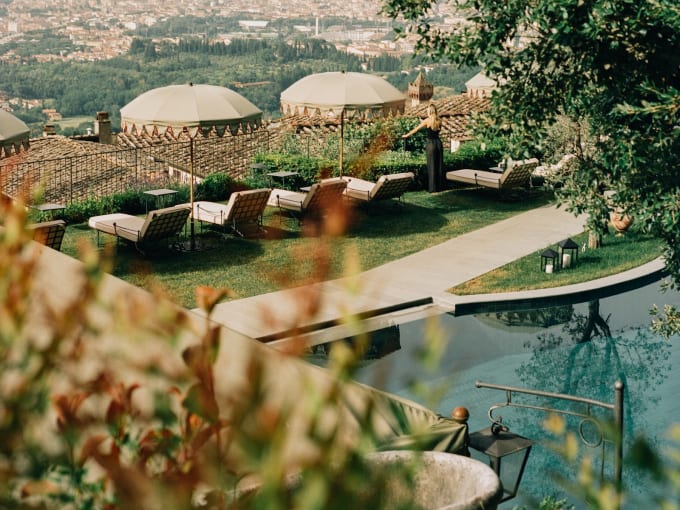
Florence may have a limited number of hotels, but it boasts an abundance of strong signatures. This is precisely what makes the selection so demanding. In this city, luxury is never just about the address. It is reflected in the relationship with heritage, in the mastery of space, in the right view, and in the way of inhabiting the Renaissance without freezing it in time. Between the Arno, the hills of Fiesole, and the palaces of the historic centre, Florence's high-end offerings create a rare landscape. Here, one encounters renowned establishments, more intimate retreats, and hotels that embrace a contemporary interpretation of the city. In Florence, choosing a hotel often equates to choosing your pace. It is the difference between staying in an urban palace, a panoramic villa, or a neighbourhood address designed for exploring the city on foot.
To establish our perspective, we do not seek to create hype. We observe concrete criteria. Location matters, of course, but it is not enough. We also consider the coherence between the building and the experience offered. An old palace does not promise the same experience as a villa perched on the heights. We take into account the brand's reputation, the expected level of service, operational consistency, and a hotel's ability to provide a comprehensible Florentine experience. Institutional distinctions also weigh in the analysis, when they exist. It is also essential to note that a grand hotel in Florence must know how to manage tourist density without losing its calm. What our advisors most often observe is this ability to create a sense of breathing space in a heavily visited city.
The Florentine panorama is more varied than it appears. Four Seasons Hotel Firenze and The St. Regis Florence embody two very different visions of international luxury. Hotel Lungarno plays the card of the Arno and an elegance rooted in the city. Belmond Villa San Michele, situated on the heights, caters to a different expectation. Here, one seeks more space, views, and distance. Il Salviatino, Florence, Italy, follows this same logic of panoramic retreat. In contrast, Palazzo Vecchietti and Hotel Calimala appeal to those who want Florence within immediate reach. 25hours Piazza San Paolino brings a more design-driven energy. Hotel Regency, more classic, retains a loyal clientele. Finally, Collegio alla Querce and Castelfalfi broaden the perspective. The former reinterprets a historic site, while the latter opens up to the nearby Tuscan countryside.
For 2025 and 2026, several trends are solidifying in Florence. The first concerns space. Travellers are seeking more gardens, terraces, and unobstructed views. This expectation naturally benefits villas and large peripheral properties. The second relates to the relationship with heritage. Clients want history, but not a museum-like decor. The most convincing hotels are those that restore without freezing. Another notable evolution is the rise of a more fluid luxury. It prioritises intimacy, simplicity of movement, and less ceremonial hospitality. In this vein, addresses like 25hours Piazza San Paolino or Hotel Calimala cater to a clientele seeking style without heavy protocol. My advice for a first stay is simple. First, define your relationship with the city. Dense centre, Arno riverbank, or hills. The right choice begins there.
At MyConciergeHotel, we advocate a precise idea of luxury. It owes much to a culture of detail, measure, and clarity. French luxury, applied to Florence, is not about overplaying the show. It is about getting it right. A smooth welcome, a well-proportioned room, a meaningful view, a service that anticipates without overwhelming. Florence lends itself particularly well to this, as the city imposes a certain aesthetic discipline. The best hotels understand that they are engaging with a very strong architectural memory. They must therefore find the right distance. Four Seasons Hotel Florence and Four Seasons Hotel Firenze, according to the encountered nomenclature, illustrate this requirement for context. Hotel Lungarno, on the other hand, reminds us that a location by the water can become a complete hotel language. These coherences are what we prioritise in our assessment.
One must also know how to read a ranking without seeking a vain absolute. The first is not the only valid choice. The eighth is not a secondary role. Each hotel caters to a specific use, sensitivity, and way of inhabiting Florence. Some travellers want a grand name that is immediately recognisable. Others prefer a more discreet address, but very well located. Some prioritise gardens and silence. Others want to step out on foot, return late, and keep the city at the threshold of their room. This is why we avoid hollow formulas. A hotel can be remarkable for a cultural weekend, and less suited for a relaxing stay. Conversely, a peripheral villa may be ideal for slowing down, but less practical for hopping between museums. Our role as concierges is to illuminate these nuances, not to erase them.
Here is our assessment of the best luxury hotels in Florence. Eight addresses stand out, each with a clear proposition. The challenge is not only to sleep well. It is to choose the right backdrop to experience Florence at your own pace.