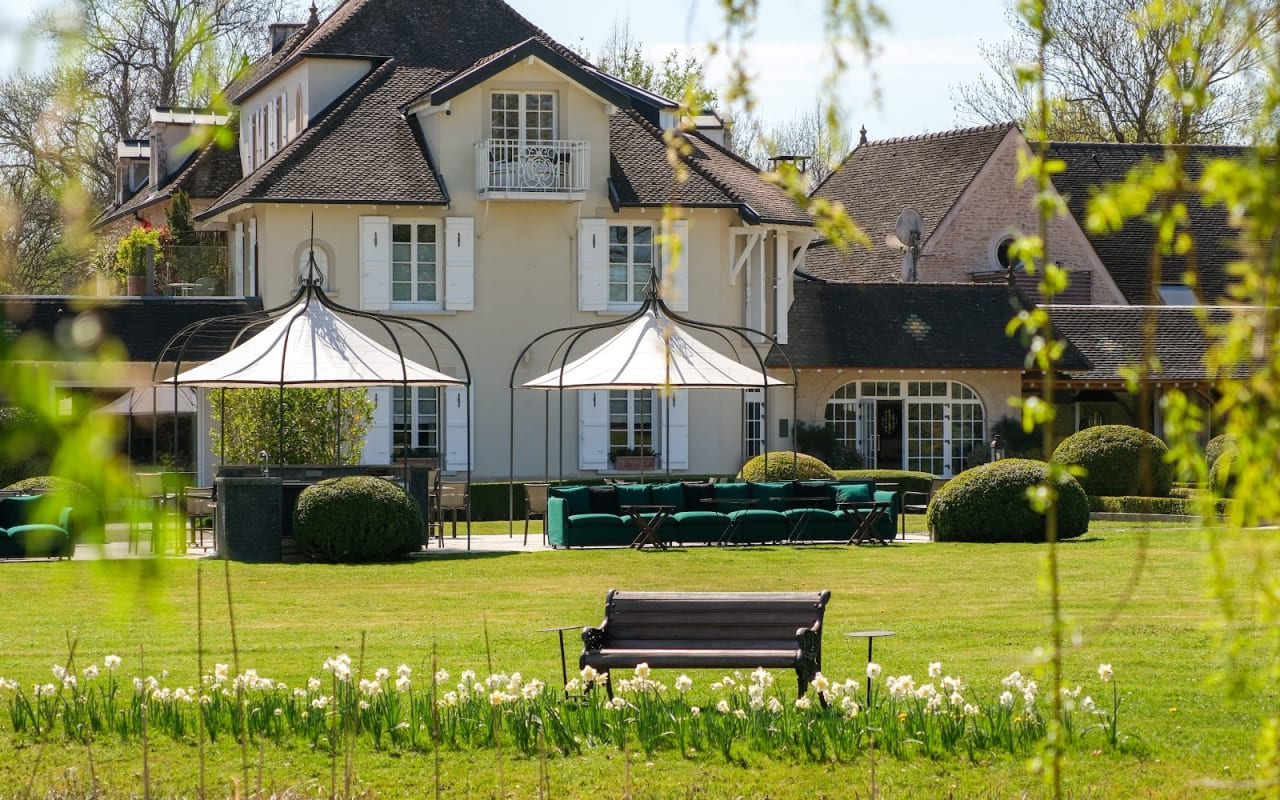


Our selection criteria
We rank Burgundy country hotels by rural anchoring, landscape quality, dining, wellbeing, and overall coherence.
Why Burgundy suits countryside stays
Burgundy suits country stays because its vineyards, villages, abbeys and rural estates still shape a highly legible landscape for refined hospitality.
Dining and wines
In Burgundy, a countryside hotel is also measured by its table, its cellar, and its understanding of the terroir.
Questions about this section
Why does gastronomy matter so much when choosing a Burgundy countryside hotel?
Because in Burgundy, dining often shapes the entire stay as much as scenery or wine.
Spa, Silence, and Slow Rhythm: The Discreet Luxury of the Countryside
In the Burgundy countryside, well-being transcends a mere treatment menu. It is primarily measured by the appropriateness of the setting. A spa is more convincing when it extends the landscape, silence, and local rhythm. This is precisely our focus here. We are not seeking excess; we are looking for a coherent experience where the pool, light, garden, and view contribute to the stay. Notably, in Burgundy, spa luxury often remains understated. It manifests through space, the absence of noise, and a genuine sense of retreat.
At Château Sainte Sabine, this coherence is reflected in the surroundings. The hotel occupies a castle set within a park, in a rural environment that naturally imposes a slower tempo. Well-being takes on its full meaning when it is linked to this feeling of chosen isolation. Our advisors note that this type of establishment works particularly well for travellers looking to disconnect without a packed agenda. Here, the value of the spa comes as much from the overall atmosphere as from the facilities themselves. Guests seek a breath of fresh air. The garden, open vistas, and distance from urban centres play a crucial role. My advice: this is a place to favour if you associate well-being primarily with tranquillity.
At Abbaye de la Bussière, the relationship with well-being is different. It is almost contemplative. The site, housed in a former abbey, creates a rare quality of silence. This context alters the perception of the spa. Treatments, the pool, or relaxation areas are no longer mere technical interludes. They become natural extensions of a historically rich place, surrounded by water and greenery. This is an important point in our editorial perspective. In the countryside, a spa can quickly feel out of place. Here, the ancient setting and park add depth to the experience. What our advisors often highlight is the venue's ability to immediately slow down the stay. Well-being begins even before the first treatment. It starts upon arrival, during the walk around the estate, and in the unique calm of the site.
Domaine de Rymska adopts a different approach to relaxation. This establishment speaks more of lived nature, inhabited countryside, and a more grounded luxury. In this context, well-being elements must remain in harmony with the identity of the estate. This is what makes the experience interesting. The spa does not need to overshadow everything else. It should accompany a broader rural immersion, characterised by space, silence, and open views. For many travellers, this is now the right definition of well-being in the countryside. One alternates between the room, fresh air, dining, and quiet time. The pool or treatments then take their rightful place. They do not dominate the stay; they balance it. It is worth noting: this approach particularly appeals to those seeking high comfort without losing touch with the agricultural landscape.
Ultimately, the best Burgundy addresses in this regard share a common trait. They understand that the spa is not an autonomous selling point. It must engage with the architecture, the park, the view, and the available density of silence. This is why these hotels capture our attention. Each offers a different interpretation of rural well-being. Château Sainte Sabine emphasises retreat and the softness of the park. Abbaye de la Bussière prioritises the depth of the location and heritage serenity. Domaine de Rymska advocates a more organic version, rooted in lived countryside. My concierge advice: choose less based on the size of the spa and more on your way of slowing down. In Burgundy, this detail often makes all the difference.
Questions about this section
Is a spa essential for a slow Burgundy countryside escape?
No; a spa helps, but calm, space, setting, and dining often matter more.
Why Rural Burgundy Works So Well for Couples
In pairs, rural Burgundy has a simple advantage. It offers an immediately comprehensible backdrop. The vineyards shape the landscape. The villages maintain an intimate scale. The back roads invite a leisurely pace without effort. For a couple's stay, this clarity is significant. It avoids the bustle of more ostentatious destinations. It leaves room for essential gestures. A breakfast facing the rows of vines. A walk between stone walls and enclosures. A dinner that stretches without a set agenda. What our advisors often observe is quite concrete. Couples seek less accumulation of activities. They desire a coherent, calm, indulgent, and easy-to-navigate setting. Burgundy precisely meets this expectation.
Another strength of the region lies in its rhythm. Here, the wine's timing naturally structures the day. One sets off late in the morning towards a village. One returns for a pause in the garden. A table is reserved for the evening. Between these moments, there is no obligation to fill the agenda. This breathing space is particularly suited to short getaways. Two nights are often enough to change pace. The stay then gains emotional depth. It does not rely on the exceptional; it rests on continuity. A lovely room, genuine silence, late afternoon light, and a serious table often create more memories than a packed itinerary. My advice is simple. In Burgundy, it is better to choose a place that encourages you to stay put. This is often where a couple's journey becomes most authentic.
However, not all countryside hotels tell the same romantic story. For a couple primarily seeking intimacy, smaller establishments are often the most relevant. They foster a more fluid relationship with the place. The service quickly recognises habits. Common areas remain peaceful. The rooms gain character. This profile suits anniversaries, short stays, and travellers who value discretion. Other couples prefer a larger property, with a park, spa, or multiple experiences on-site. This format works better when the stay must alternate between relaxation, treatments, and meals without needing to drive again. It also reassures travellers who want everything in one location. Finally, some addresses appeal primarily due to their wine heritage. They resonate with enthusiasts of cellars, tastings, and vineyard landscapes. In this case, romance is less about absolute isolation. It is about the shared pleasure of a well-defined territory.
The success of a couple's stay thus depends less on an abstract definition of romance than on a good alignment between the place and the timing of the trip. A room open to nature can suffice if the environment remains quiet and the dining meets high standards. A large historic house can be ideal if it maintains simple circulation and a genuine sense of space. It is also worth noting that Burgundy accommodates all seasons for couples. Spring brings gardens and the first terraces. Summer enhances outdoor dining and late returns via small roads. Autumn, with the grape harvest and the colours of the vines, remains highly sought after. Winter, finally, suits couples seeking retreat, fireside warmth, and long tables. This versatility explains much.
If rural Burgundy works so well for couples, it is because it never forces the effect. It offers a form of calm luxury, founded on authenticity. The landscape has depth without theatricality. Gastronomy gives meaning to the evenings. The most convincing hotels know how to open the room to a real outside. A garden, vineyards, a courtyard, a valley. For a couple, this relationship with the place is decisive. It creates a sense of inevitability. In our view, the best romantic addresses in the region are those that combine four qualities. A clear rural setting. A room designed for extended stays. A serious table or access to local gastronomy. And an atmosphere flexible enough to allow everyone to experience the stay at their own pace. It is this mastered simplicity that brings guests back.
Questions about this section
Is Burgundy countryside a good choice for a romantic weekend?
Yes, Burgundy works very well for couples seeking wine, villages, character hotels, and slower pacing.
2025-2026 trends
In 2025-2026, Burgundy’s countryside hotels are defined by space, discretion, local gastronomy, wine experiences and a slower pace.
Our Final Thoughts on This Top 3 in Burgundy
At the conclusion of this top 3, our perspective is straightforward. These three hotels do not portray the same Burgundy. This is precisely their appeal. They cover three very distinct uses. The choice depends less on the level of comfort than on the purpose of the stay. Are you seeking wine, fine dining, relaxation, or a well-paced weekend for two? In Burgundy, this nuance changes everything. One address may be perfect for a wine immersion. Another may be better suited for a slow-paced retreat. A third stands out for a stay focused on cuisine and service. It is worth remembering. One should choose a Burgundy countryside hotel as one would select an itinerary. According to the season, the rhythm, and the dominant desire of the moment.
If your priority is wine, it is the address most directly linked to the vineyard that should be favoured. Our advisors observe that this type of hotel works best when the vineyard landscape begins right at the doorstep. The stay then takes on immediate coherence. Guests come to radiate between estates, villages, cellars, and tables. This is also the right choice for a first weekend in Burgundy. The setting speaks for itself. Distances remain reasonable. Days can be easily structured without heavy logistics. For a couple, this option has another advantage. It allows for alternating tastings, walks, and dinners without losing the thread of the stay. My advice: book this address if you want a Burgundy that is clear, embodied, and centred on the culture of wine.
If you are primarily seeking relaxation, consider the hotel that best embraces the countryside as a space for retreat. Here, luxury is not about accumulation. It lies in silence, the breathing of the place, and the feeling of being truly elsewhere. This profile particularly suits urban travellers. They want to slow down without completely isolating themselves. This is often the best choice for a two or three-night stay. One enjoys the slow rhythm more. There is room for the spa, reading, the garden, or simply the long duration of meals. For a couple's weekend, this category works very well. It avoids an overly dense schedule. It puts the place back at the centre. This is the most accurate recommendation if your definition of a successful stay hinges on decompression.
Lastly, there is the hotel that stands out for its dining and a sense of completeness. This is often the one we recommend to travellers seeking a more structured experience. The meal is not a mere complement; it becomes one of the motifs of the journey. In Burgundy, this criterion carries significant weight. The region is experienced as much at the table as in the vineyards. A large country house with strong dining attracts a specific audience. Gourmet couples, celebration weekend enthusiasts, or travellers who prefer to stay put once they arrive. This profile is also very relevant outside of harvest time. When the weather invites less long walks, the quality of indoor hospitality becomes crucial. What our advisors often highlight is balance. A good table extends the day. It gives the stay its clearest memory.
Our practical recommendation is therefore clear. For wine, choose the address most rooted in the vineyard. For relaxation, favour the one that makes calm its true language. For dining, remember the house where the stay naturally revolves around dinner. And for a couple's weekend, two paths stand out. The first goes through the vineyards and villages. It suits couples who enjoy going out, tasting, and visiting. The second focuses on retreat and slow time. It speaks more to couples who want to reconnect without an agenda. In both cases, rural Burgundy delivers on its promise. It offers space, a culture of taste, and an elegance that does not need to overdo it. This is exactly what one expects from a great country hotel.
