History & positioning
Royal Maxim Palace Kempinski Cairo belongs to a contemporary chapter of luxury hospitality in the Egyptian capital. Rather than drawing on centuries of aristocratic history or an address rooted in the old city, it expresses a different idea of refinement: a grand hotel conceived for Cairo’s eastward expansion, within the more ordered and spacious setting of New Cairo.
Its affiliation with Kempinski provides a clear frame of reference. The brand is associated with a European approach to service, where discretion, smooth attention and carefully composed public spaces matter as much as visual grandeur. Here, that culture translates into an elegant, measured sense of occasion rather than excess.
In Cairo’s hotel landscape, the property occupies a distinctive position. It does not compete with the historic Nile-side hotels on the basis of urban memory or iconic views. Instead, it offers something else: a composed, contemporary retreat with practical access to business districts, major roads and newer residential hubs. For many travellers, that slight remove from the intensity of central Cairo is precisely the point.
Its positioning rests on a balance that is not always easy to achieve: formal enough for meetings, events and high-level stays, yet comfortable and calm enough for a couple’s break or a restorative city stay. That versatility is reflected in the way the hotel’s spaces are organised, from the lobby to the restaurants, from the wellness areas to the rooms.
Rather than forcing a heritage narrative, Royal Maxim Palace Kempinski Cairo embraces an elegant modernity. It speaks to present-day Cairo and its newer centres of gravity: a city that works, hosts, expands and reinvents itself. For the guest, this means an experience that is less about nostalgia than about context, calm, service and ease—qualities of particular value in a metropolis as vast and layered as Cairo.
The establishment in New Cairo
Staying at the Royal Maxim Palace Kempinski Cairo means choosing a more modern, planned, and breathable version of Cairo. New Cairo follows a clear urban logic, with wide thoroughfares, residential complexes, corporate headquarters, campuses, and shopping centres creating a more spacious environment. The hotel takes full advantage of this context, catering to those who wish to access business hubs without constantly enduring the intensity of central traffic, all while maintaining a high level of comfort.
The architecture transcends mere aesthetics; it evokes a genuine sense of arrival. The hotel asserts itself with a distinctive visual language that remains classic enough to be timeless. The grand volumes, interior perspectives, and attention to materials instil a serene solemnity. One enters, finds oneself, awaits a meeting, or extends a dinner. The address becomes a stable reference point throughout the stay.
The lobby and communal spaces occupy a central position, immediately setting the tone. The quality of the welcome, flow management, acoustic comfort, and clarity of services structure the experience. At the Royal Maxim Palace Kempinski Cairo, everything seems designed for a diverse clientele, from business trips to more leisurely stays. The atmosphere remains one of calm luxury, conducive to both a busy day and a moment of retreat.
The appeal of New Cairo becomes particularly evident upon returning from excursions or meetings. While other districts extend their hustle and bustle late into the night, this part of the capital offers a more contained, almost residential feel. This does not imply isolation; the hotel remains connected to the practical needs of the stay. It simply provides a distance that becomes a comfort in itself. For a first-time visitor to Cairo, this choice can be reassuring. For a regular guest, it may offer a more efficient way to experience the city.
The establishment is defined not only by its standing but also by the quality of its location. It offers a perspective on Cairo based on the balance between accessibility and retreat, representation and functionality, urbanity and breathing space. It is a destination suited to those who view the hotel as a true base for their stay.
Rooms and Suites
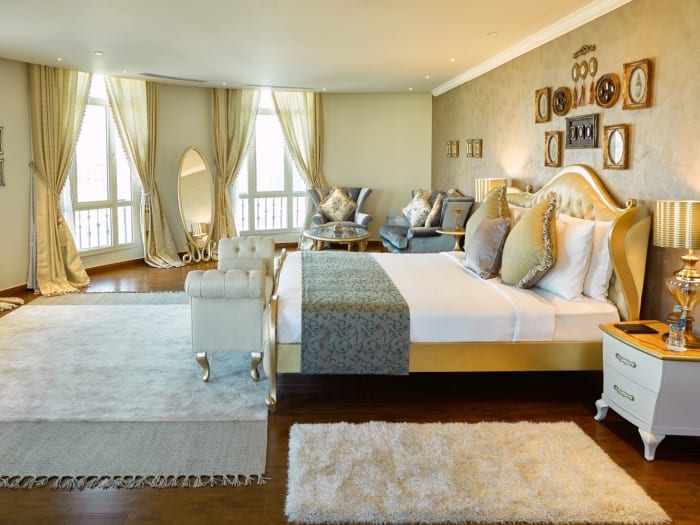
In a hotel of this calibre, the room extends beyond mere rest. It embodies the promise of the place, alleviates the fatigue of travel, and provides a credible workspace. At the Royal Maxim Palace Kempinski Cairo, the rooms and suites adhere to this principle of structured comfort. Guests can expect balanced volumes, a classic-contemporary décor, and thoughtfully designed internal circulation.
In Cairo, luxury often hinges on tangible elements. Careful soundproofing, quality bedding, ample storage, and bathrooms tailored to the rhythm of one’s stay make a significant difference. The daily housekeeping service and turn-down service enhance this seamless experience, making the return to one’s room after dinner or a day of meetings all the more soothing.
The suites cater to various needs. Some are suitable for extended stays, while others are designed for guests who entertain, work, or desire more space. In a large hotel in New Cairo, their appeal lies in the ability to separate different aspects of one’s stay. Sleeping, working, preparing, or hosting no longer blend into a single room. This is particularly appreciated by business travellers and couples staying for several nights.
The aesthetic is not one of radical minimalism. In a contemporary palace affiliated with a major international chain, the décor seeks a balance between classic codes, international comfort, and discreet local references. Fabrics, woodwork, lighting, and colour palettes contribute to this coherence. When executed well, the room becomes a stable environment conducive to re-centering.
The quality of service remains paramount. The concierge, 24-hour reception, wake-up service, and laundry facilities complete the experience. Comfort is not merely material; it is also organisational. For the international traveller, this flexibility is invaluable. The ability to adapt one’s pace and manage practical needs without friction transforms the nature of the stay.
Thus, the rooms and suites at the Royal Maxim Palace Kempinski Cairo are envisioned as spaces for deceleration. They reflect the hotel’s positioning with understated elegance. Sophistication without ostentation, genuine functionality, and the capacity to momentarily forget the intensity of the capital.
Dining
Dining is one of the essential signatures of a grand hotel, especially when it is conceived as a destination in its own right.
At the Royal Maxim Palace Kempinski Cairo, the on-site restaurants allow the culinary experience to be woven into the stay. They accompany various moments of the day.
The dining experience must cater to business breakfasts, lunch meetings, and more ceremonial dinners. It should also be suitable for coffee breaks, snacks, or late meals.
The primary challenge is consistency. In luxury hospitality, one expects regularity in execution, service, and atmosphere.
A successful hotel restaurant does not merely aim to be pleasant on the night of arrival; it must remain relevant throughout the days.
The Royal Maxim Palace Kempinski Cairo meets this demand with an offering tailored to an international clientele. It aligns with high standards and a certain fluidity of service.
Breakfast deserves particular attention. In large hotels, it often reveals the true quality of the establishment.
It tests the organisation, the rhythm of the staff, the freshness of the products, and the ability to serve diverse profiles. Busy travellers, couples, families, and clients in meetings all converge here.
When well orchestrated, breakfast sets the tone for the day. It reinforces the impression of a place that masters its fundamentals.
Dinners contribute significantly to the character of the hotel. The appeal lies as much in the plate as in the overall presentation.
Lighting, service rhythm, seating comfort, and acoustics all matter. A refined restaurant is primarily a place where one wishes to linger.
The hotel also offers a coherent dining solution in New Cairo. Dining on-site, in a well-appointed setting, provides genuine comfort after a busy day.
For business travellers, this simplifies organisation. For couples, it preserves a retreat-like atmosphere. For short stays, it alleviates logistical burdens.
Ultimately, dining adds texture to the stay. One remembers a calm breakfast, a leisurely dinner, and attentive service.
At the Royal Maxim Palace Kempinski Cairo, dining fully contributes to the overall experience.
Spa & Wellness
In a city as vast and energetic as Cairo, wellness facilities become an essential component of a balanced stay. At the Royal Maxim Palace Kempinski Cairo, the spa plays a significant role in the experience. It acts as a counterpoint to the urban density, busy days, and the sometimes unpredictable pace of travel.
The spa in a hotel of this category serves multiple functions. It allows for immediate recovery after travel, meetings, or commuting. It also offers a slower pace. Well-being is as much about the treatments as it is about the venue’s ability to change one’s rhythm. Light, temperature, materials, hospitality, and transitions between spaces all contribute.
At the Royal Maxim Palace Kempinski Cairo, the spa integrates seamlessly into the stay. One can spend an hour there between obligations or dedicate an entire afternoon. This flexibility suits business travellers, couples, and short-stay visitors alike.
It is wise to book treatments in advance. The most sought-after slots often fill up towards the end of the day. Anticipating allows for securing the desired time and organising the stay with greater fluidity. A massage after arrival, a ritual before dinner, or a wellness interlude before departure all have different effects depending on the chosen moment.
Beyond treatments, the wellness facilities embody a certain idea of contemporary hospitality. They demonstrate that the hotel also takes care of the physical and mental state of the traveller. In a context that combines work, jet lag, different climates, and constant demands, this attention becomes a tangible marker of quality. A well-designed spa offers the opportunity to regain one’s own rhythm.
At the Royal Maxim Palace Kempinski Cairo, wellness appears as a natural extension of the establishment. In this quieter New Cairo compared to the historic centre, the spa prolongs a logic of retreat, comfort, and mastery of time. For some, it may be an occasional luxury; for others, a functional necessity. In either case, it contributes to the balance of the stay.
Concierge & Services
Hotel luxury is often measured less by what is visible than by what operates quietly behind the scenes. At the Royal Maxim Palace Kempinski Cairo, the 24-hour concierge, 24-hour reception, daily housekeeping, turn-down service, luggage storage, laundry, wake-up service, and multilingual staff constitute this quality of discreet support. When executed well, these services form the invisible infrastructure of a seamless stay.
The concierge is at the heart of this mechanism. In Cairo, where travel times, schedules, reservations, and local customs can complicate organisation, having a contact who can anticipate, recommend, and coordinate changes the experience. A good concierge helps prioritise the stay’s needs. Leaving earlier for an appointment, timing a treatment just right, or coordinating an on-site dinner with a late arrival: these adjustments reduce travel friction.
The constant reception plays an equally important role, especially for an international clientele subject to irregular hours. Night arrivals, early departures, last-minute requests, and the need for administrative or logistical assistance: a welcoming presence available at all times ensures reassuring continuity. In a large hotel, this permanence must remain stable and adapt to each guest's tone.
Daily housekeeping and turn-down service contribute to another dimension of service: domestic comfort. Returning to a tidied room, finding personal effects arranged with care, and noticing that details have been anticipated all create a sense of rest that goes beyond mere cleanliness.
Practical services such as laundry, luggage storage, and wake-up calls take on particular importance during short or intensive stays. They save time, allow for lighter travel, and maintain a precise rhythm. Meanwhile, the multilingual staff facilitates nuance, avoids misunderstandings, and makes exchanges more natural.
Ultimately, the service quality at the Royal Maxim Palace Kempinski Cairo lies in its ability to simplify the stay without rendering it impersonal. Personalised service reflects this pursuit of balance: being present at the right moment, with the appropriate level of attention. For the traveller, contemporary luxury often hinges on this: not having to think of everything, without ever feeling burdened by the service.
The New Cairo way of life
To understand Royal Maxim Palace Kempinski Cairo, one must also understand what New Cairo represents in the contemporary imagination of the Egyptian capital. This is far from the postcard imagery of Islamic Cairo, the Belle Époque façades of downtown or the hotel mythology associated with the Nile. New Cairo belongs to another geography: that of urban expansion, newer residential districts, campuses, offices and more open living environments.
For the traveller, this changes the texture of the stay. The experience is not built on immediate monumentality, but on a more rational form of urban comfort. It particularly suits those who like to alternate intensity and retreat: spending part of the day on meetings, major sights or denser explorations of the city, then returning to an environment that does not automatically prolong that agitation.
New Cairo also reveals a less frequently discussed aspect of the city: its future. This area speaks of a capital that is expanding, reorganising itself and developing new centres of gravity. For business travel, that has obvious practical value. For leisure stays, it offers a complementary reading of Cairo—less heritage-driven, but highly revealing of ongoing change.
The hotel fits naturally into that atmosphere. Its elegant architecture, on-site dining, wellness facilities and personalised service respond to guests who value the quality of their surroundings as much as proximity to points of interest. The way of life on offer is not one of display, but of control over the rhythm of the stay.
In that sense, local lifestyle is not only about district but about tempo. Cairo fascinates through density, history, contrast and human energy. New Cairo introduces breathing space, and the hotel translates that into a form of luxury that is practical, elegant and well judged.
Booking with MyConciergeHotel
Booking Royal Maxim Palace Kempinski Cairo through MyConciergeHotel means approaching the hotel not simply as a room to secure, but as an experience to shape. That distinction matters in a property of this level. In a grand five-star hotel, the quality of the stay depends not only on the room category, but also on arrival timing, use of services, the place given to wellness, on-site dining and any professional requirements.
The value of concierge-style support begins before departure. New Cairo follows different practical rhythms from historic central Cairo, so it helps to think ahead about the coherence of the programme. For a business stay, that may mean planning a smooth arrival, anticipating laundry needs, structuring breakfast around meetings and reserving a treatment at the end of the day. For a couple’s stay, the priority may be preserving the hotel as a retreat.
MyConciergeHotel can also help clarify priorities. Not every traveller experiences a palace-style hotel in the same way. Some seek calm above all, others functionality, others the dining offer or the flexibility of service. By asking the right questions in advance, it becomes easier to shape the stay accordingly.
There is also value in contextual advice. Royal Maxim Palace Kempinski Cairo is not simply a high-end hotel in Cairo; it is a particularly relevant option for travellers who want access to business hubs, a calmer environment and a full range of services. Good advice is not always about recommending the most dramatic hotel, but the one whose positioning best suits the intended trip.
In a destination as rich and sometimes demanding as Cairo, that quality of anticipation makes a real difference. It allows guests to arrive with a stay that has already been thoughtfully considered—without rigidity, but with purpose.