History & heritage
Raffles Shenzhen belongs to a broader story than that of a simple city hotel: that of an international house whose name has long suggested a particular idea of hospitality, shaped by precision, calm and attention to detail. In Shenzhen, that signature takes on a distinct meaning. The city, often associated with innovation, speed and the energy of major economic centres, provides an intriguing setting for an address that instead values the slower rhythm of service done properly. The contrast is not a contradiction; it becomes a form of balance. On one side, a contemporary, vertical, fast-moving metropolis looking firmly towards the future. On the other, a hotel that aims to create pause, continuity and a style of welcome that does not depend on passing trends.
In this context, the Raffles heritage is not expressed as historical décor applied to a recent address, but as a culture of hospitality translated into a 21st-century Asian city. The brand’s language can be sensed in the restraint of the interiors, in the emphasis on genuine comfort rather than display, and in the desire to make a stay feel seamless, whether it is shaped by business, a couple’s break or family travel. The intention is not to recreate the past, but to extend a tradition of discreet elegance wherever it remains meaningful: in the quality of circulation, in the availability of the staff, and in the feeling of being expected without being watched.
Shenzhen itself adds a particular depth to this reading. A young city by the standards of Chinese history, it has developed over a few decades into an economic and urban laboratory. To stay at an address such as Raffles Shenzhen is therefore also to experience a form of luxury suited to a city that does not rely on inherited monumentality, but on the modernity of its skyline, the intensity of its exchanges and the sophistication of its habits. The hotel becomes a point of anchorage: a place where one finds stable reference points in the midst of an environment defined by constant movement.
What ultimately stands out is less a history told through dates than a heritage felt through experience. It appears in the coherence between the name, the setting and the service; in the way the shared spaces create a hushed atmosphere in the heart of an active city; and in the property’s ability to speak equally to business travellers and to guests seeking a few days of comfort and distance. For a MyConciergeHotel reader, this is essential: Raffles Shenzhen does not promise nostalgic reconstruction, but a contemporary interpretation of grand hotel style, conceived for a metropolis that symbolises urban Asia today.
The Establishment
Being at the heart of Shenzhen is not merely a phrase here; it is a fundamental aspect of the experience. Raffles Shenzhen is ideal for those who wish to engage with the city through its daily rhythms. Its location in a vibrant neighbourhood facilitates the transition from a professional agenda to more personal time. A meeting, a stroll, a dinner, and then a late return without hassle. This centrality is significant in a sprawling metropolis, where travel can quickly reshape a day.
The establishment plays with the tension between urban intensity and retreat. Outside, Shenzhen asserts its energy as a contemporary metropolis. Inside, the tone shifts. The communal spaces seem designed to soften the noise of the world. This approach allows the central location to be an advantage without the accompanying fatigue.
For business travellers, the benefits are immediate: proximity, efficiency, and simplified access to various points in the city. Families find a convenient starting point here. Couples appreciate the ease of returning to the hotel between outings. In a large urban centre, luxury often lies in this fluidity. Not wasting time. Not having to choose between comfort and location. The ability to improvise without complicating arrangements.
Raffles Shenzhen thus functions as a controlled transition between the city and oneself. It offers a continuity of service and a sense of order. The hotel does not detach from Shenzhen; it allows one to enjoy it with greater clarity. From a reliable base, the city becomes more accessible and pleasant to explore. This is invaluable for international travellers, who also seek the ability to guide, simplify, and recommend.
The establishment is equally valued for its location and its ability to leverage it. It transforms this centrality into a livable experience. For a Raffles address, this is a defining quality: providing a refuge without straying far from the city.
Rooms and suites
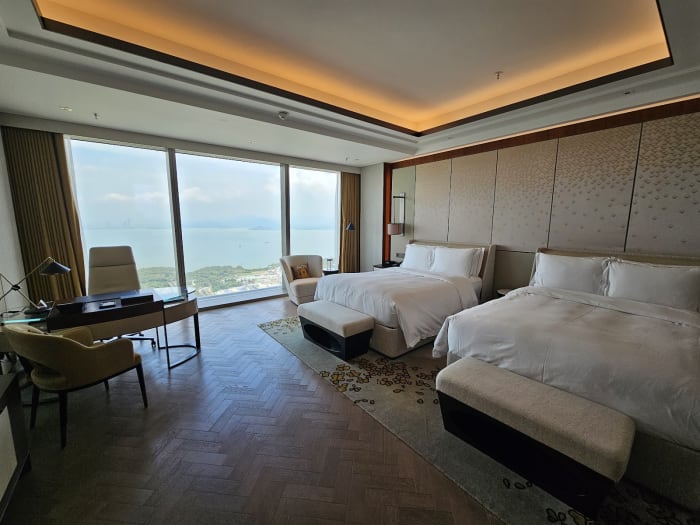
In a city hotel of this level, the room is not simply a place to sleep: it must absorb jet lag, extend calm after a dense day, allow proper working conditions and offer, in a few gestures, an immediate sense of comfort. That is the balance one expects at Raffles Shenzhen. While no detailed inventory of categories or sizes is provided here, the property’s overall promise can still be read clearly: accommodation designed for varied stays, from highly structured business travel to more flexible family breaks.
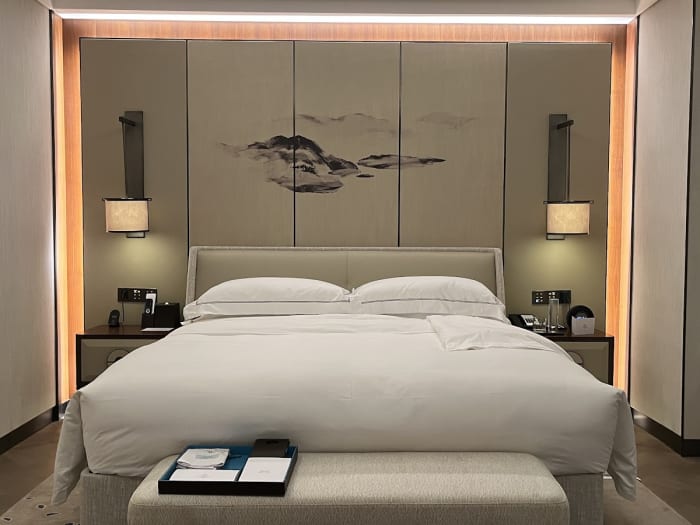
When well interpreted, the Raffles style generally favours a legible elegance without excess. One therefore imagines rooms where sophistication comes through perceived quality rather than effect. Materials, textures, acoustics, light and ergonomics matter more than decorative display. In a city such as Shenzhen, this approach is especially relevant. After the intensity of transfers, meetings or urban exploration, true luxury often lies in returning to an orderly, quiet space where everything seems in its place. A good hotel room does not impose its personality; it supports yours.
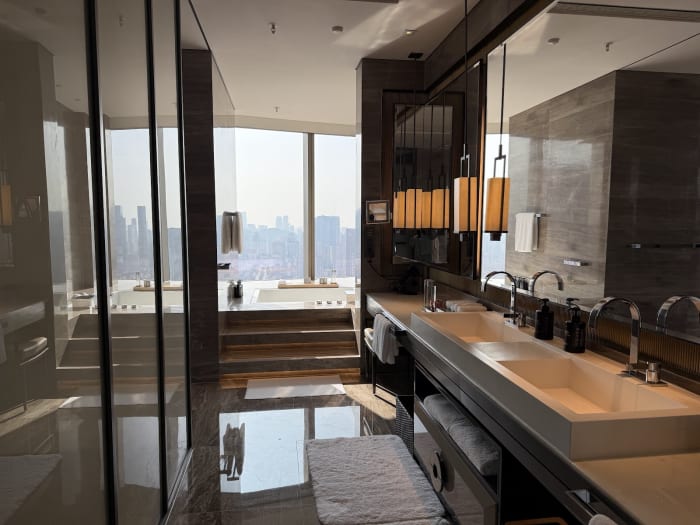
For business travellers, certain elements become essential even when they are not itemised one by one: simple circulation, well-considered storage, a credible desk or working area, seamless connectivity, excellent bedding and a bathroom conceived as a place of recovery as much as utility. For couples, the emphasis shifts towards atmosphere, privacy and the room’s ability to create a cocoon within the city. For families, functionality takes precedence: ease of settling in, a sense of space, attentive service and a domestic rhythm flexible enough to avoid rigidity.
Suites, in an address such as this, usually play an additional role. They do not merely represent a higher category, but another way of inhabiting the hotel: more breathing room, a clearer separation between rest and activity, and sometimes a better capacity for receiving or extending a stay. In a business metropolis, that distinction matters. It allows certain guests to turn a simple stopover into a temporary base of life, with all the psychological comfort that implies.
The turndown service and daily housekeeping mentioned among the known amenities also contribute to this quality of experience. They are reminders that a grand hotel room is not defined only by its initial design; it is built through repeated care, consistency and the feeling that the space discreetly readjusts itself throughout the day. That is where the level of a property is truly measured. At Raffles Shenzhen, one comes in search of that continuity: a room or suite that is not merely attractive or well located, but genuinely liveable from the first morning to the late return.
Dining
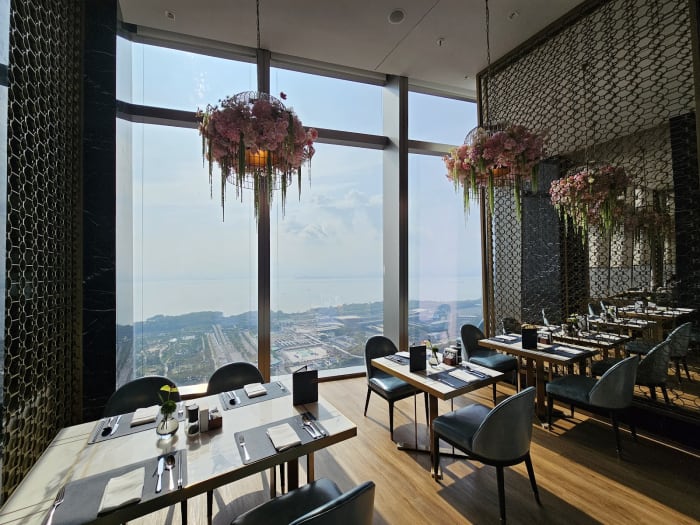
Dining in a grand city hotel is never merely a collection of restaurants. It forms an essential part of the property’s internal rhythm and of its ability to support different uses throughout the day. At Raffles Shenzhen, even without detailing every venue or culinary concept, one can reasonably expect an offering designed to answer the diversity of modern stays: an efficient breakfast for early departures, informal meetings, more settled meals, transitional moments between obligations, and dinners where one seeks not animation for its own sake but a sense of rightness.
In a city such as Shenzhen, where the culinary scene is tied to economic vitality and international circulation, a hotel of this level benefits from cultivating clarity. Business travellers need reliability, swift service when required, a setting conducive to conversation and food that does not tire. Leisure guests, by contrast, expect more than convenience: they want dining to contribute to the stay itself, to provide pause, perspective, atmosphere and sometimes a first reading of the city. The challenge is to reconcile those expectations without falling into standardisation.
The Raffles style generally suggests an approach in which the elegance of the setting matters as much as what arrives on the plate. That does not mean turning every meal into theatre, but taking care of the whole: welcome, pace of service, comfort of seating, acoustics, light, quality of produce and precision of gesture. In a central hotel, dining also plays the role of refuge. One returns because one knows what will be found there: a consistent level, genuine attention and a way of making things simple without making them ordinary. That consistency is especially valuable on short stays, when every moment needs to feel fluid.
Breakfast deserves particular mention, because it often sets the tone of an address. In a property aimed at both business travellers and families, it must manage a complex exercise: organised without rigidity, generous without excess, international without losing all identity. It is often here that a hotel’s maturity becomes visible. The same logic applies to in-room dining, indispensable in a contemporary grand hotel, especially for late arrivals, jet lag or days when one prefers to preserve privacy.
More broadly, dining at Raffles Shenzhen can be understood as an extension of the overall service culture. It does not need grand claims in order to convince; above all, it should offer an experience coherent with the rest of the hotel. For the MyConciergeHotel reader, that means food and beverage capable of accompanying both a tightly scheduled work stay and a more contemplative urban weekend, with the same search for balance between refinement, comfort and controlled simplicity.
Spa & wellbeing
In a metropolis as active as Shenzhen, wellbeing in a hotel is more than a pleasant extra: it becomes a matter of rhythm. One does not expect a five-star property merely to offer leisure facilities, but to organise a genuine transition between the intensity outside and a deeper state of rest. Even without a full description of the installations, Raffles Shenzhen naturally invites that reading. An address of this level, in the heart of a dense urban environment, should provide spaces and practices that help guests slow down, recover and regain a sense of availability.
When present in a contemporary grand hotel, the spa is no longer simply a place for treatments; it is an extension of the room, another register of comfort. One looks there as much for technical quality as for atmosphere: silence, controlled light, measured welcome and the feeling of suspended time. For business travellers, this aspect is often decisive. Between flights, meetings, jet lag and constant demands, the possibility of taking a treatment, a quiet moment or a recovery ritual changes the perception of a stay. For couples, wellbeing becomes a shared retreat. For families, it contributes to the overall balance of the hotel, even if not everyone uses it in the same way.
Beyond the spa in the strict sense, wellbeing is also visible in the architecture of service. A reception available at all hours, 24-hour concierge service, turndown and rigorous daily housekeeping all help reduce the traveller’s mental load. Rest does not depend only on a massage or a pool; it also grows from the feeling that nothing unnecessary has to be managed. In the best urban hotels, wellbeing is first a quality of operation.
It is also important to consider temporality. A well-conceived grand hotel allows each guest to compose a personal rhythm: starting early, extending the morning, returning between appointments, withdrawing before dinner, recovering after a day in the city. That flexibility is especially valuable in Shenzhen, where days can be very full and shifts in pace quite marked. Raffles Shenzhen appears intended for travellers who seek not only a central address, but a setting capable of supporting both body and attention.
For the MyConciergeHotel reader, the property’s wellbeing promise therefore lies as much in the possible quality of its facilities as in the coherence of the whole. Contemporary luxury is not measured solely by the presence of a spa, but by the way the entire hotel contributes to a more breathable experience. Here, that logic seems essential: to make the urban stay not an ordeal elegantly packaged, but a genuinely restorative interlude.
Concierge & Services
The true measure of a great hotel often reveals itself in its ability to make a stay effortless. At Raffles Shenzhen, this is achieved through a 24-hour concierge service, a 24-hour reception, daily room service, turn-down service, luggage storage, laundry, wake-up calls, and a multilingual staff.
Taken together, these services create a precise promise: that of a seamless hotel experience at any hour for travellers with diverse needs.
The concierge remains one of the most intriguing markers of high-end hospitality. It orchestrates the stay, prioritises needs, offers solutions, and anticipates potential stress points. In a city like Shenzhen, this role takes on particular significance.
For an international visitor, the metropolis can seem vast, fast-paced, and technical. Being able to rely on a team available at all times transforms the quality of the experience. Booking transport, directing to a neighbourhood, recommending a time, facilitating an early arrival or a late departure, managing an unexpected need.
The continuously open reception adheres to the same logic. In a destination connected to major international flows, arrival and departure times do not always follow a simple rhythm. A welcome assured day and night provides a constant point of reference. This continuity is especially important for business travellers.
The more discreet services also build loyalty. Turn-down service, daily maintenance, laundry, and luggage storage lighten the logistical load. They maintain the room in constant comfort and allow guests to experience the hotel effortlessly.
The multilingual staff plays a crucial role in an international setting. They foster a clear and calming relationship.
For families, these services ensure welcome flexibility. For couples, they preserve the fluidity and intimacy of the stay. For professionals, they guarantee a reliable environment. At Raffles Shenzhen, service is less about ostentation and more about consistency, availability, and practical intelligence.
The Shenzhen way of life
Staying at Raffles Shenzhen also means agreeing to look at Shenzhen as more than a business city. The metropolis is often reduced to its growth, its towers and its role in contemporary Chinese economics. That reading is not wrong, but it is incomplete. For the traveller who remains a few days, Shenzhen reveals another quality: a very particular way of combining speed and comfort, innovation and daily life, urban ambition and the search for fluid habits. It is precisely in that context that a central grand hotel makes full sense.
The local way of life is not grounded here in historical monumentality, as it may be in other major destinations, but in lived modernity. One notices districts in transformation, public spaces designed to support mobility, a service culture linked to the city’s internationalisation, and a distinctly contemporary relationship with time. Shenzhen is a city where people work intensely, but also seek to optimise moments of pause, meals, movement and leisure. For a visitor, this creates a singular urban experience: everything seems oriented towards efficiency, yet that efficiency can itself become a form of comfort.
From an address such as Raffles Shenzhen, that reality can be read with greater subtlety. One may step out to feel the energy of the district, understand the density of movement, observe how the city tells its story through shopping centres, towers, meeting places and infrastructure. Then return to the hotel to recover another temporality. That back-and-forth is essential. It allows one not to endure the city, but to appreciate it in sequences, with enough distance to perceive its nuances. This is often how attachment to a contemporary metropolis is formed: not through accumulation, but through alternation.
For business travellers, this way of life translates into the possibility of extending a professional trip into something more personal. For couples, Shenzhen may become a field of architectural and urban exploration rather than a romantic destination in the conventional sense. For families, the city offers a compelling introduction to contemporary China, its infrastructure and its new ways of living. In every case, the hotel acts as a mediator. It helps make that modernity liveable, intelligible and enjoyable.
This is perhaps the most subtle appeal of Raffles Shenzhen. It does not try to make the city disappear, but to make it more legible. It supports a way of travelling that does not sharply separate hotel comfort from urban experience. On the contrary, it allows the two to speak to one another. For a MyConciergeHotel reader, the property may therefore represent far more than an elegant base: a measured gateway to one of the most emblematic cities of contemporary Asia.
Book with MyConciergeHotel
Booking Raffles Shenzhen through MyConciergeHotel means approaching the property through selection rather than mere availability. In a city such as Shenzhen, where the high-end hotel market follows a sustained economic rhythm, choosing a hotel is not simply a matter of category or location. It is about finding the right balance between centrality, service quality, legibility of the spaces and suitability to the true purpose of the trip. That is precisely where editorial guidance and concierge support become meaningful.
Raffles Shenzhen suits several profiles, though not in the same way. A business traveller will primarily seek a dependable, efficient base capable of absorbing scheduling constraints and shifting hours. A family will value ease of movement, the quality of daily service and the hotel’s ability to simplify organisation. A couple, meanwhile, may see it as an elegant urban address for a short stay, where the comfort of returning matters as much as the outings themselves. Booking intelligently therefore means matching the right room category, the right length of stay and the right travel rhythm to those concrete expectations.
The value of booking through MyConciergeHotel also lies in preparation. In an international destination, details matter: arrival time, the need for a late welcome, a preference for a quieter stay, transfer arrangements, or specific requests linked to family travel or a business trip. These parameters, often more than the headline rate alone, determine the real quality of the experience. A successful stay begins before check-in, at the moment one anticipates what will make arrival simple and time on site more fluid.
It is also wise to take seasonality and the local calendar into account, as the existing description suggests. In a major business and events city, rates may vary according to periods of high activity. Booking ahead therefore remains sound advice, not only to access better conditions, but also to benefit from a wider choice of rooms or suites. That anticipation helps avoid being limited by what remains and allows a more coherent stay to be built.
Ultimately, choosing Raffles Shenzhen through MyConciergeHotel means favouring a qualitative reading of the hotel: understanding what it truly offers, whom it suits, and under which conditions it will perform at its best. For an urban address of this kind, the difference rarely lies in general promises. It lies in the precise fit between hotel, city and traveller. That is the fit we aim to make possible.