History & heritage
In Dubai, a city shaped by rapid transformation and declarative architecture, some hotels choose not to disappear into the constant flow of novelty. Raffles Dubai belongs to that category of addresses that establish a presence rather than merely a backdrop. The Raffles name, long associated with a particular idea of grand hospitality, is translated here into a very different setting from its historic properties: not colonial classicism or heritage resort life, but a Gulf metropolis where luxury is often expressed through scale, service fluency and a carefully managed balance between privacy and theatre.
The hotel’s identity begins with that meeting point between an international brand with strong symbolic capital and a city that has made hospitality both a cultural and economic language. In Dubai, a high-end hotel is not simply a place to sleep; it is an urban landmark, a meeting place and, at times, a climate-controlled refuge within an intense rhythm. Raffles Dubai fits naturally into that logic, with an architectural and spatial vocabulary that favours poise, clarity and a form of contemporary gravitas. The result is neither ostentatious in the easy sense nor strictly minimalist: it is a composed luxury, where architecture, volume and service work together to create a feeling of controlled calm.
The Raffles legacy is also visible in its approach to welcome. The name suggests a style of hospitality built on attentiveness, continuity and discretion rather than display. In a city such as Dubai, where stays often combine business obligations, extended stopovers and leisure time, that philosophy takes on particular relevance. The hotel must function as an efficient base for meetings while retaining the warmth and flexibility expected from a destination address. It is precisely in that balance that the property finds its coherence.
Rather than claiming old-world history in a European heritage sense, Raffles Dubai embraces a contemporary form of legacy: that of international grand hospitality established in a young global city already rich in its own codes. Its story is one of a more mature Dubai, where travellers no longer seek visual exception alone, but a reliable, well-conceived setting capable of giving shape to a stay. That maturity can be felt in the way the hotel brings together brand prestige, operational efficiency and a residential atmosphere.
For European travellers in particular, the address can be read as a point of convergence between two expectations that are not always easy to reconcile: the desire for an immediately recognisable hotel, with the standards of a major house, and the wish for an urban immersion that does not feel disconnected from the city. Raffles Dubai does not tell a story of nostalgia; it tells one of settled modernity. That is perhaps what gives it lasting character in a hotel landscape where many properties aim to impress, but fewer remain in the memory.
The property
The first impression at Raffles Dubai is of a hotel that fully embraces its urban setting. The experience here is not built on seclusion, but on the ability to provide a strong anchor in a lively district, with easy access to the city’s main attractions. For many travellers, that is a decisive advantage: being able to move around Dubai with ease, to reach business areas, shopping destinations or points of interest, without giving up the sense of retreat that begins the moment one returns to the hotel. That dual reading, very much in keeping with Dubai itself, is part of the property’s appeal.
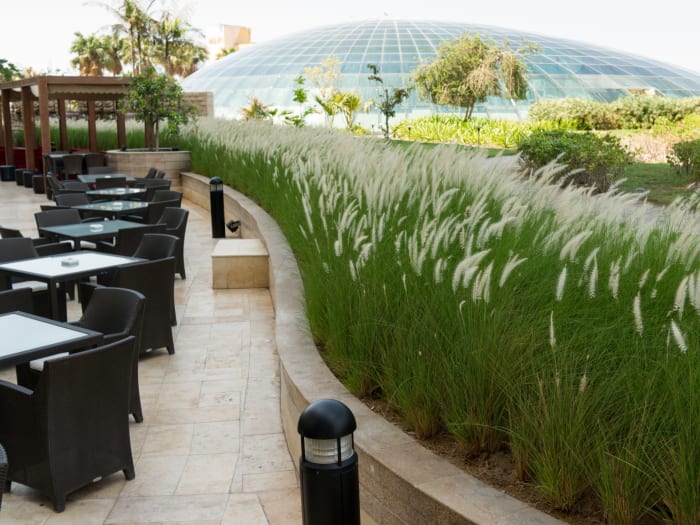
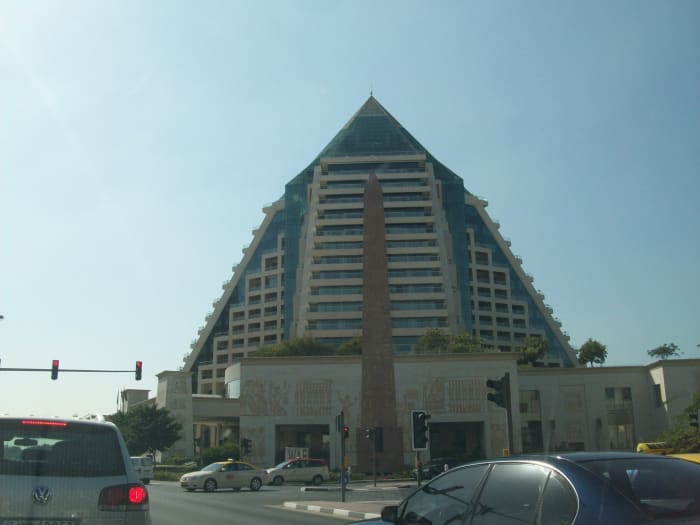
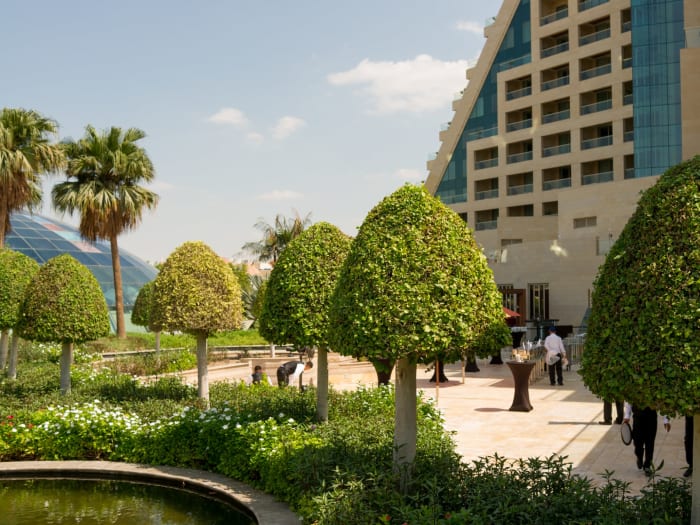
The hotel stands out through an architectural presence that is immediately recognisable, designed to mark the skyline without sacrificing interior legibility. Dubai’s major hotels often excel at creating a sense of arrival; the more difficult task is ensuring that this impression carries through daily use. Here, the public spaces are conceived to support different rhythms of stay: the swift passage of a business traveller between meetings, the slower pause of a couple returning from a day in the city, or the practical organisation of a family stay. The lobby, circulation areas and reception spaces therefore play a central role: they set the tone, structure the experience and create a feeling of ease.
What is equally notable is the way the property balances scale and comfort. In many high-end urban hotels, generous volumes can impress without necessarily reassuring. Raffles Dubai seeks a more measured equilibrium. Where there is monumentality, it is offset by attentive service, human clarity and the sense of being expected. This matters in a destination where stays are often short and dense, and where travellers value a hotel that simplifies daily life rather than complicating it.
Its position within a lively environment also contributes to the address’s character. One does not come here to withdraw from the world, but to inhabit Dubai with a certain ease of reading. From the hotel, the city can be approached in layers: commercial modernity, efficient infrastructure, cultural contrasts, climate, light and tempo. This proximity to urban life gives the stay a more active tone than a beach resort would, and that is precisely what many visitors seek, whether travelling for business or discovery.
Finally, the property answers a very contemporary expectation of luxury: adaptability. Raffles Dubai is not tied to a single guest profile or one reason for travel. It can suit a structured business stay, an elegant stopover within a wider itinerary, or several days devoted to the city itself. That versatility is far from incidental. In a destination such as Dubai, where hotel use is inherently varied, it is often the clearest sign of a well-conceived address: a place able to function at once as landmark, refuge and platform.
Rooms and suites
In an urban hotel of this level, the room must do more than provide comfort; it must restore a sense of balance after the intensity outside. In Dubai, that matters greatly. Between transfers, omnipresent air-conditioning, the desert’s shifting light and the often demanding pace of the day, travellers expect their private space to be functional, restorative and generous enough not to feel like a mere stopover room. Raffles Dubai answers that expectation through an approach that privileges scale, clarity and a genuine sense of privacy.
The decorative language follows the hotel’s wider identity: contemporary luxury with a degree of controlled theatricality, but without unnecessary excess. In both rooms and suites, what matters most is the feeling of space and the way the layout supports the actual uses of a stay. Guests seek not only the comfort of a good night’s sleep, but also the possibility of working, getting ready for dinner, pausing quietly during the day or simply slowing down. That versatility is especially valuable in a city where journeys often combine several purposes.
The suites naturally extend this logic, with greater separation between functions and rhythms. They suit travellers looking for a more residential setting, longer stays, or those for whom the hotel temporarily becomes a place of representation as much as a place of rest. Yet even in the more classic categories, the spirit remains that of accommodation designed to be lived in throughout the day, not used only at night. It is a subtle but important distinction between a well-equipped room and one that feels truly hospitable.
The experience also depends on the service surrounding that private space. Daily housekeeping, turndown service and attentive handling of particular requests all contribute to the seamless continuity expected from a major hotel. There is nothing showy about it; rather, a series of precise gestures that make the stay easier. Business travellers will appreciate the regularity and discretion, while couples and families will value the more diffuse feeling of being looked after without being interrupted.
Ultimately, the rooms and suites at Raffles Dubai contribute to a very contemporary idea of hotel luxury: creating a legible pause within a city of contrasts. One does not necessarily come here in search of exuberance, but of complete comfort, where space, relative quiet, careful upkeep and overall coherence create the conditions for a successful stay. In a destination as energetic as Dubai, that ability to produce calm is not incidental; it is often what separates the hotels one forgets from those to which one returns.
Dining
In Dubai, hotel dining occupies a particular place. It does not serve resident guests alone; it forms part of the city’s social life, attracts a local clientele and often shapes a significant part of a property’s identity. In that context, the dining offer at Raffles Dubai should be understood as a natural extension of its positioning: a high-end urban hotel able to support varied uses, from a working breakfast to a more leisurely dinner, including the informal pauses that punctuate a day in the Gulf.
What matters here is not the multiplication of headline effects, but the creation of dining settings suited to different moments of a stay. In the morning, the primary expectation is precision of service, a sufficiently broad offer to accommodate international habits, and an environment that allows both quiet conversation and preparation for a busy day. In a city of early departures, business appointments and planned excursions, a good breakfast is never incidental: it sets the tone. Grand hotels understand this, and guests often seek as much consistency as pleasure.
At lunch or dinner, the equation changes. Travellers may wish to remain within the hotel to preserve time, or on the contrary to make dining a central part of the stay. An address such as Raffles Dubai must be able to answer both logics. That implies spaces where one can dine efficiently without sacrificing setting, but also more enveloping atmospheres for dinner for two, a business meeting or an evening without a fixed programme. The success of a dining offer in such a hotel often lies in this ability to adjust: neither overly ceremonial nor overly ordinary.
Service plays a decisive role. In high-level international hotels, the quality of a meal depends as much on pace, attentiveness and accurate reading of expectations as on what is on the plate. A multilingual team accustomed to diverse guests contributes to that sense of ease. True luxury in this field lies less in impressing than in making the experience simple, pleasant and coherent, whether one is taking coffee between meetings or lingering over dinner.
Dining in Dubai always says something about the city itself: its cosmopolitanism, its appetite for encounters and its ability to let influences coexist. Without claiming to summarise that richness, Raffles Dubai offers a clear hotel translation of it. What one finds is the idea of dining conceived as a complete service, integrated into the stay, capable of supporting both the efficiency of a business trip and the slower pleasure of leisure travel. For the guest, that is an essential form of comfort: knowing that the hotel can sustain the day with accuracy, from the first coffee to the final drink.
Spa and wellbeing
In a city such as Dubai, hotel wellbeing is not merely an amenity; it answers a very concrete need. The climate, transfers, jet lag for many visitors and the general intensity of a stay all create a genuine requirement for recovery. This is why spa and relaxation spaces occupy such an important place in the experience of a major urban hotel. At Raffles Dubai, that dimension makes particular sense: it is not simply a comfortable interlude, but a counterpoint to the city’s pace.
In this kind of property, the spa functions as an echo chamber for the rest of the hotel. One finds the same expectations of discretion, control and continuity of service. Guests come for treatments, certainly, but also for a change of tempo. A few hours can be enough to rebalance a stay: a massage after a long-haul flight, a restorative pause before dinner, a quiet interval between two highly active sequences. The luxury of urban wellbeing often lies precisely there, in the ability to give time back to the body.
The best spas in international hotels also know how to address very different guest profiles. Business travellers see them as an efficient recovery tool; couples as a shared moment; longer-stay visitors as a ritual that structures the day. Raffles Dubai, by virtue of its positioning, naturally lends itself to this plurality of uses. What matters is not excess, but the quality of the environment: calm, impeccable upkeep, precise welcome and the sense that every step has been designed to simplify the experience rather than make it more ceremonial than necessary.
Wellbeing, moreover, is not limited to treatments. In a grand hotel, it extends to everything that contributes to the balance of a stay: the possibility of genuinely resting, attentive room care, team availability and ease of organisation. A spa is only fully successful when it forms part of that continuity. Guests should not feel they are moving from a functional hotel into an artificial enclave; they should find, in the relaxation space, the same quality of presence and coherence as elsewhere in the property.
In Dubai, where so many experiences are designed to accelerate the eye and multiply stimuli, an address capable of creating genuine deceleration has particular value. Wellbeing at Raffles Dubai can therefore be understood as a luxury of rebalancing. One comes here less to collect promises than to recover a form of inner availability. And that is often what one ultimately expects from a grand hotel: not merely to host the journey, but to give it room to breathe.
Concierge and services
The true level of a grand hotel is rarely measured by décor alone. It reveals itself above all in the quality of the services that support a stay without ever making it feel burdensome. In this respect, Raffles Dubai belongs to a demanding tradition of international hospitality, in which the concierge, reception and wider team play an essential mediating role between traveller and city. In a destination as mobile as Dubai, that function is especially valuable: the hotel does not merely receive guests, it helps organise, orient and simplify.
The presence of a 24-hour concierge and round-the-clock front desk first responds to the reality of local and international rhythms. Late arrivals, very early departures, programme changes and last-minute requests are part of everyday life. A well-run property must be able to absorb those variations calmly. It is often in such moments, more than in grand theatrical gestures, that the quality of a house becomes clear. Travellers remember not a speech, but a solution found quickly, a consistent welcome regardless of the hour, or the feeling that nothing ever had to be forced.
Daily housekeeping, turndown service, luggage storage, laundry and wake-up service form the discreet infrastructure of comfort. Taken separately, each may seem simple. Together, they create the invisible continuity that allows a stay to unfold smoothly. For a business traveller, efficient laundry or a punctual wake-up call may matter as much as a beautiful public space. For a family or a couple in transit, baggage handling and flexibility at reception immediately alter the quality of the experience.
A multilingual team adds an essential dimension in a city as international as Dubai. Understanding expectations, adjusting tone and knowing how to guide without rigidity are matters of cultural as much as linguistic competence. In the best hotels, service is not merely efficient; it is accurate. It knows when to intervene, when to step back and how to adapt the relationship to the nature of the stay. This situational intelligence, difficult to quantify, is nonetheless one of the most reliable markers of hotel luxury.
Finally, concierge service in an address such as Raffles Dubai matters not only for reservations or practical requests. It contributes to reading the city. Recommending an itinerary, helping to structure a day, taking account of heat, traffic or scheduling constraints: these are the gestures that transform a standard stay into a more fluid experience. In a metropolis where the offer is abundant and sometimes overwhelming, the ability to filter, prioritise and personalise is a genuine comfort. Service here is not an add-on; it is one of the reasons to choose the hotel.
The Dubai art of living
Staying at Raffles Dubai also means adopting, for a few days, a particular reading of the city. Dubai is sometimes reduced to quick clichés: gigantism, shopping, architectural records, demonstrative luxury. All of that exists, certainly, but it does not fully describe what the city has become. Dubai is better understood as a place of circulation and composition, where populations from across the world intersect, where highly contemporary uses of urban space coexist, and where a culture of hospitality has adapted to a singular climate. A well-situated hotel makes it possible to enter that complexity without undue effort.
From an urban address such as this, the city reveals itself in sequences. There is the Dubai of business and appointments: fast, structured and deeply international. There is the Dubai of leisure, shaped by malls, restaurants, social venues and experiences designed for a cosmopolitan public. There is also, in the background, a subtler relationship to time: one dictated by heat, by the most favourable hours for moving around, and by the contrast between air-conditioned interiors and the bright exterior. To understand that rhythm is already to inhabit the city more intelligently.
Dubai’s art of living lies largely in this management of contrasts. One moves from a highly animated environment to near-instant calm. Social moments alternate with more private retreats. Days are composed between efficiency, comfort and the search for experience. For the traveller, this requires a certain tact: not trying to see everything too quickly, accepting that the city is also read through its hotels, cafés and interior viewpoints. Raffles Dubai, by virtue of its positioning, supports that way of travelling particularly well. It provides a base from which the intensity of the stay can be calibrated.
It is also worth recalling that Dubai is a city of services, and that this service culture deeply shapes the visitor’s experience. Transfers, reservations and everyday logistics are often smoother than one might expect. Yet this depends on having a strong point of support. A grand hotel then acts as a translator: it helps turn a potentially overwhelming city into a destination that feels legible, workable, almost familiar. That is a very contemporary form of elegance, linked less to display than to the quality of orchestration.
Ultimately, the Dubai art of living does not consist merely in consuming places, but in finding the right rhythm between energy and retreat. An address such as Raffles Dubai makes that modulation possible. One can experience the city actively, benefit from its accessibility, and then return to an ordered, attentive and protective setting. For many travellers, it is this alternation that makes a stay successful: the feeling of having approached Dubai without being lost in it, and of having found in the hotel not simply accommodation, but a way of inhabiting the city.
Book with MyConciergeHotel
Choosing Raffles Dubai through MyConciergeHotel means favouring an editorial, guided approach to travel rather than a purely transactional booking. In a destination such as Dubai, where the high-end hotel offer is extensive and not always easy to rank, that mediation is meaningful. Luxury hotels do not all answer the same expectations, and an urban address such as Raffles Dubai is not chosen for the same reasons as a beach resort or a property focused almost exclusively on business. The value of concierge insight lies precisely in matching the right place to the right use.
This hotel will particularly suit travellers seeking a major international house, well integrated into the city and adapted to both business and leisure stays. It can function as an efficient base for several days of meetings, as an elegant stopover within a wider Middle Eastern itinerary, or as a starting point for discovering Dubai without moving too far from key areas of interest. Booking with guidance makes it possible to refine the practical parameters of the stay: ideal duration, daily rhythm, service needs, arrival and departure organisation, or priorities in terms of comfort.
MyConciergeHotel also adds value in practical preparation. In a city where flight schedules may be irregular, where the season strongly influences the use of the day, and where expectations differ according to whether one is travelling as a couple, with family or for business, details matter. Relevant advice on the best timing for a stay, on how to structure the first hours after arrival, or on the benefit of reserving certain services in advance can materially improve the experience. Luxury often begins there: in accurate anticipation.
Booking Raffles Dubai in this way also means choosing a qualitative reading of the hotel. Beyond categories and amenities, what matters is the way the address corresponds to a style of travel. Here, the property is recommended to those who appreciate complete city hotels, with real presence, continuous service and the ability to simplify a stay. It is less an address of total withdrawal than a hotel of rhythm and comfort, conceived for those who want to experience Dubai while retaining a stable, carefully run base.
Finally, MyConciergeHotel’s guidance helps place the booking within a broader logic: that of a successful stay as a whole. The hotel is only one element, albeit a central one, and it interacts with flights, transfers, dining reservations, rest time and the desire to explore. By entrusting this address to a demanding editorial selection, the traveller gains clarity. And in a destination as dense as Dubai, that clarity is often worth as much as comfort itself.