History & Heritage
Staying at the Raffles Europejski Warsaw means choosing a location that engages in a dialogue with the history of Warsaw. The name Europejski has long been a part of the urban landscape.
In this part of the city, the buildings carry the memory of disruptions, reconstructions, and rebirths that define the capital. The hotel is part of this continuity.
The appeal of this address lies in its balance between heritage and reinterpretation. Guests do not come for a museum-like reconstruction, but for a contemporary interpretation of a grand European hotel.
Classic elegance is expressed in the volumes, the flow of spaces, and the relationship with the public realm, while modern comfort is seamlessly integrated.
In Warsaw, the question of heritage is never trivial. The city experienced massive destruction in the 20th century, followed by a reconstruction that shaped its current identity.
In this context, establishments that occupy a central place in the urban fabric take on a particular significance. The Raffles Europejski Warsaw is part of this memorial geography.
This historical depth is also reflected in the experience of the stay. The refinement remains understated, far from ostentatious luxury.
Travellers attuned to the character of a place will appreciate this sense of authenticity. It is as if the hotel belongs to the city as much as it welcomes its guests.
Whether for a cultural weekend, a business stopover, or a more contemplative stay, this heritage dimension alters the way one experiences the hotel. It invites guests to slow down and view the city from a different perspective.
The uniqueness of the establishment lies in its ability to offer the comfort of a grand five-star hotel while retaining a palpable historical depth. In Warsaw, this idea takes on a particular resonance.
The Establishment
The primary asset of Raffles Europejski Warsaw is its location, nestled in the heart of Warsaw, where the official city meets the historical and cultural realms.
This centrality shapes the stay. From the hotel, it becomes natural to explore the capital on foot, visiting a museum, then heading to a theatre or concert.
This proximity to cultural and historical sites lends a rare coherence to the experience, particularly valuable for first-time visitors to Warsaw.
The immediate surroundings allow one to read the city in layers. First, the monumentality of certain perspectives, followed by the more intimate scale of the streets.
Institutions, cafés, bookstores, and sought-after dining establishments unfold in succession. The closeness to museums, theatres, and restaurants is among the privileges of this address.
One can organise their days without constantly relying on a vehicle, profoundly altering the rhythm of travel.
Warsaw reveals itself through transitions and contrasts, between national memory, contemporary creation, and daily life.
The hotel serves as an elegant counterpoint to this urban intensity. After several hours of exploration, one returns to an ordered and calm environment.
The codes of a grand international hotel are tempered by a warm atmosphere, devoid of ostentation. The décor combines classic elegance with modern comfort.
Visitors are neither immersed in a frozen decor nor confronted with a cold modernity. The overall design favours continuity, featuring understated lines and spaces thoughtfully designed for relaxation.
In a city like Warsaw, this quality of composition is significant. As an administrative capital, intellectual centre, and active artistic scene, the city combines multiple registers.
A well-located hotel must offer more than just a place to stay. It should provide an environment capable of absorbing the variations of the visit.
Raffles Europejski Warsaw meets this expectation. It can serve as a romantic getaway, an efficient base for business travel, or a refuge for a culturally rich itinerary.
The hotel also values the importance of pause. Even with a busy schedule, it allows for a form of breathing space.
Returning in the mid-afternoon, spending time in communal areas, or enjoying a moment before dinner takes on special significance here. It is not merely a matter of luxury, but of tempo.
This address suits travellers who wish to experience Warsaw without feeling scattered. From this central base, everyone can curate a highly personal stay.
History and heritage, cultural institutions, architectural strolls, business meetings, local or international gastronomy: everything remains easily accessible.
The hotel supports this freedom without imposing a singular narrative. It provides access to the city while offering the necessary distance to appreciate it fully.
Rooms and Suites
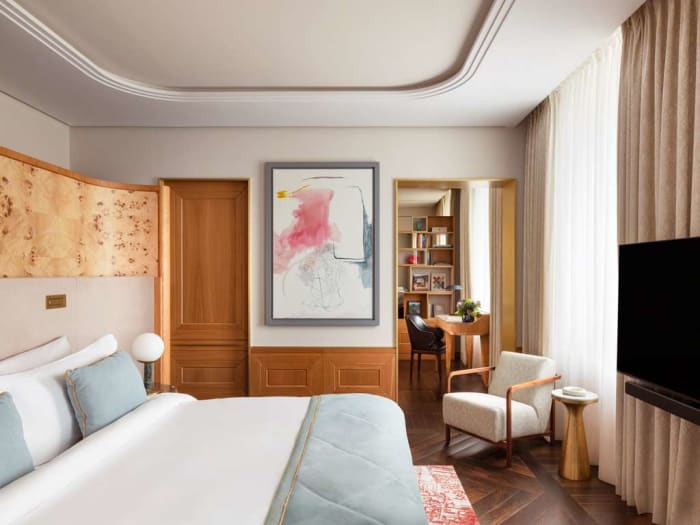
In a grand urban hotel, the room is never merely a place for sleep. It accompanies the rhythm of travel. One retreats there, sometimes works, and prepares to go out. It also offers a form of silence after the bustle of the city. At Raffles Europejski Warsaw, this function takes on particular significance. Classic elegance and modern comfort create a soothing, readable, and refined setting.
The rooms seem designed as true interiors. Subtlety matters. A successful interior does not strive to impress at every moment. It naturally accommodates various uses. In Warsaw, days alternate between meetings, visits, travel, and cultural evenings. This obviousness becomes precious. Modern comfort brings fluidity, with good ergonomics, suitable amenities, and an atmosphere conducive to both rest and concentration. Business travellers find the clarity they need, couples enjoy a more intimate envelope, and city-break enthusiasts have a stable and elegant anchor point.
The suites extend this logic. They add space, separation, and a more residential quality to the stay. They cater to various needs, whether for discreet entertaining, working under better conditions, or simply enjoying a more spacious time in the heart of the capital. This is one of the pleasures of grand historic hotels. One feels as though they inhabit the city differently, with more perspective, calm, and a more personal relationship with time.
Service also plays a central role in the room experience. Daily housekeeping and turn-down service are among the markers of a hotel attentive to detail. These gestures remain discreet but change the perception of the stay. Returning in the evening to a prepared room, finding impeccable order, and sensing the space adjusted for the night. Hotel luxury often rests on anticipation rather than spectacle. This quality of care is particularly appreciated in an urban hotel.
In Warsaw, a beautiful room also has genuine practical value. The city invites exploration, understanding, and walking. One moves from sites of memory to cultural institutions, from grand perspectives to livelier neighbourhoods. In this context, having a genuinely restful space is far from trivial. It enables one to maintain the pace without excessive fatigue. A good hotel does not compete with the city; it makes it more liveable. The rooms and suites directly contribute to this mission.
Choosing this address is not merely about sleeping in an elegant setting. It is about benefiting from an environment that aligns with the identity of the place. A successful room extends the hotel while remaining neutral enough to accommodate varied uses. This alliance of character and comfort, presence and discretion, often makes the difference in the memory of the stay. At Raffles Europejski Warsaw, the rooms and suites embody this tradition of the grand European hotel.
Dining
At Raffles Europejski Warsaw, dining unfolds across several atmospheres, from bright lunches to more intimate evening settings.
The Europejski Grill takes centre stage, where Polish and Mediterranean inspirations converge in a clear and accessible culinary narrative. At lunchtime, the grilled octopus salad sets the tone, while the tomato served with gazpacho and watermelon highlights freshness. Caviar blinis introduce a more classic note.
The Long Bar continues this culinary journey with a venue designed to match the city's rhythm. Guests come for a precise drink in a setting that embraces elegance without stiffness. The Warsaw Sling is the signature cocktail here.
For a sweeter interlude, Lourse Warszawa excels in the art of the tearoom. This establishment is renowned for its cakes and pastries, considered among the most desirable in the city. It is equally suited for an afternoon treat or a pause between meetings.
More discreetly, the Humidor caters to aficionados of single malts, cognacs, and armagnacs. This intimate cigar lounge prioritises slow conversation and characterful pairings.
Finally, hub.praga introduces a more contemporary voice. Chef Witek Iwański presents a dish that never leaves the menu, yet is never quite the same, offering a refined way to experience both loyalty and surprise.
Spa & wellness
The existing Concierge tip recommends booking a spa treatment after sightseeing; it is a simple suggestion, yet a revealing one in terms of how a stay here should be approached. Warsaw is a city that demands attention. One walks a great deal, moves constantly from one register to another — history, politics, culture, architecture, contemporary life — and that density can be as stimulating as it is tiring. In that context, the wellness area is not a decorative extra: it becomes a useful component of the experience, almost a method for inhabiting the city more successfully.
In a great urban hotel, the spa plays a very particular role. Unlike resort properties, where wellness may constitute the day’s main activity, here it functions as an art of transition. One comes to recover after a long walk, to release the body after a flight or a day of meetings, to create a pause before dinner or before an evening at the theatre. That intermediate function is essential. It allows a full programme to become a balanced stay, reintroducing calm where the city imposes intensity.
The luxury of urban wellness often lies in that precision of timing. A well-chosen treatment in the late afternoon can alter one’s whole perception of the evening. A visit to the spa the day after a late arrival helps restore rhythm. For a couple, it is also a way of creating shared time that is neither a visit nor a meal. For a business traveller, it may be the only true decompression space between work sequences. The advice to book ahead is therefore pertinent: in the best hotels, these moments are all the more appreciated when they are integrated harmoniously into the programme of the stay.
Beyond the treatments themselves, the spa environment contributes to the property’s overall quality. It extends the idea of a hotel capable not only of welcoming, but also of regulating the rhythm of travel. That capacity is especially valuable in Warsaw, where one may be tempted to do too much in too little time. Wellness then serves as a reminder that a successful stay is measured not only by the number of places visited, but by the quality of presence one manages to preserve. A hotel offering a genuine space for recovery allows one to see better, feel better and ultimately remember better.
The spa can also be read as a discreet expression of service. Here again, the point is not to multiply promises, but to provide a setting in which the body regains a form of neutrality after the demands of travel. Temperature, silence, light, the slowness of gestures: everything that belongs to quality hotel wellness rests on this command of detail. In a property where attention to guests is already expressed through 24-hour concierge service, round-the-clock reception and turndown service, the spa area naturally forms part of the same logic of care.
For travellers approaching Warsaw as a cultural destination, the spa may even become an itinerary tool. A morning of visits, lunch in town, a return to the hotel for a treatment or restorative pause, then an evening out: this rhythm gives the stay a highly agreeable sense of breathing space. It allows one to enjoy the capital fully without yielding to accumulated fatigue. In that sense, wellness is not a concession to rest, but a more intelligent way of travelling. At Raffles Europejski Warsaw, it supports the idea of an urban luxury that is measured, attentive and genuinely liveable.
Concierge & Services
The quality of a grand hotel is often measured less by what it displays than by what it makes possible. In this regard, Raffles Europejski Warsaw boasts a service base tailored to a demanding international clientele. The presence of a 24-hour concierge and a 24-hour reception is essential in a capital where late arrivals, early departures, and changes in plans are part of daily life. At any hour, the hotel remains accessible, ready to assist.
This continuity is particularly significant in Warsaw. The city lends itself to both highly structured stays and more spontaneous days. A good concierge knows how to serve both approaches. They can organise a cultural itinerary within a limited timeframe, recommend a nearby restaurant, facilitate a transfer, or suggest a neighbourhood to explore depending on the time.
Raffles Europejski Warsaw also offers daily room service, turn-down service, luggage storage, laundry service, wake-up calls, and multilingual staff. Taken together, these elements make the stay more fluid. The luggage storage allows one to enjoy a final morning in the city. The laundry service proves useful during a prolonged stay or business trip. The wake-up call service remains relevant before a train, flight, or meeting.
The multilingual staff deserves special mention. In a destination that attracts a diverse international clientele, the quality of communication is as important as the efficiency of the response. Being able to articulate a request precisely and adjust a logistical detail without friction directly contributes to comfort.
The concierge takes on particular value in a city rich in cultural institutions. Booking a spa treatment, obtaining local advice, organising the timing between visits and meals, or optimising a day according to the weather and schedules can change the quality of the stay. For a couple, this might mean a better-planned evening. For a business traveller, simplified logistics. For a culture enthusiast, a more harmonious access to the city.
At Raffles Europejski Warsaw, this promise of service aligns with the overall concept of the place: a central, elegant, and attentive hotel designed for travellers who expect precision rather than spectacle. In a capital like Warsaw, where days can be dense, this discreet mastery makes a difference.
The art of living in Warsaw
Choosing Raffles Europejski Warsaw also means choosing a certain way of discovering Warsaw. The Polish capital does not always reveal itself immediately; it asks for an attentive gaze, sensitive to contrasts and continuities. It is a city where history is everywhere present without preventing modernity, where places of memory coexist with an active cultural life, where grand official vistas open onto more intimate sequences. For the traveller, the point is not merely to tick off sights, but to understand what connects these different layers. A central hotel, close to museums, theatres and restaurants, offers precisely the ideal conditions for that finer reading.
A stay may begin with the major historic landmarks and then gradually open onto a more nuanced experience of the city. Warsaw is well discovered on foot, allowing transitions to do their work. Between two institutions, one notices a façade, a square, a café, a bookshop, the rhythm of a neighbourhood. This is often how attachment to a capital is formed: not through the accumulation of monuments, but through the quality of the passages between them. From the hotel, this approach becomes natural. One may leave in the morning with a precise plan and accept, along the way, to alter it according to a mood, a light, or a recommendation from the concierge.
Winter and summer do not offer the same city, and that is one of Warsaw’s interests. The colder season highlights interiority: museums, concert halls, theatres, cafés, Christmas markets when the period allows. Summer, by contrast, favours longer walks, terraces, cultural events and a more open relationship to urban space. A well-positioned hotel makes it possible to benefit from these variations without undue effort. One adjusts one’s rhythm, composes the days differently, yet always retains the same anchor point. That stability is precious in a destination where climate and light significantly alter the experience.
The art of living in Warsaw also rests on a certain restraint. The city does not always seek to charm at once; it reveals itself to those who take time. That reserve may appeal to travellers who prefer capitals of depth to destinations that are overly polished. One finds here intellectual intensity, historical awareness, but also genuine contemporary energy. Lovers of music, architecture, visual arts or urban life will see it as rich territory for exploration, provided they accept a gradual discovery. The hotel, through its position and style, supports this approach well: it does not impose folklore, it gives access to a real city.
For couples, Warsaw can offer a more subtle escape than expected, made of walks, pauses in fine cultural institutions, carefully chosen dinners and returns to a calm hotel. For business travellers, it offers real efficiency, tempered by a cultural offering dense enough to enrich free time. For those familiar with Europe’s capitals, it represents a stimulating alternative, less saturated than some larger cities, yet just as rewarding for anyone who likes places that reveal themselves over time.
Ultimately, the art of living in Warsaw may consist in accepting this double temporality: that of long history and that of a city very much alive. Raffles Europejski Warsaw allows one to enter that rhythm with ease. It offers the comfort needed for rest, the centrality useful for exploration, and the discreet elegance suited to destinations whose richness cannot be reduced to appearances. It is an address for curious travellers, seeking less immediate effect than the rightness of a well-composed urban experience.
Booking via MyConciergeHotel
Booking Raffles Europejski Warsaw through MyConciergeHotel means approaching this stay with a mindset of precision. In Warsaw, booking goes beyond merely selecting a room.
It allows for the composition of a coherent stay, tailored to the duration of the trip, the season, and individual priorities. Whether for cultural discovery, a romantic getaway, business travel, or a mixed trip.
The editorial and concierge support also repositions the hotel within its context. An address in the heart of Warsaw does not meet the same expectations depending on the itinerary.
MyConciergeHotel's role is to help interpret this alignment. At Raffles Europejski Warsaw, centrality, proximity to cultural and historical sites, and the comfort of a grand five-star hotel are among its strengths.
Intelligent booking also involves anticipating the moments that add depth to the stay. The spa can be a valuable addition to a weekend or short stay.
An early arrival, a busy day of visits, or an evening at the theatre are experienced differently when certain elements are planned in advance. The concierge, schedule management, or departure organisation then take on concrete value.
MyConciergeHotel caters to travellers who seek more than a transaction. They look for a suitable address, but also a perspective.
Understanding why this hotel suits their way of travelling. Knowing how to integrate it into a broader programme. Identifying services to reserve in advance.
In Warsaw, this approach is particularly beneficial. The city rewards being approached with a minimum of preparation while leaving room for the unexpected.
For a couple, booking via MyConciergeHotel can mean a smoother stay. For a business traveller, more efficient logistics. For a culture enthusiast, a strategic, elegant, and functional base.
In all cases, the goal remains the same: to transform a good booking into a well-thought-out stay.
Raffles Europejski Warsaw lends itself well to this process. Its identity rests on its integration into the city, the coherence of its atmosphere, and the robustness of its services.
Booking via MyConciergeHotel means choosing a more nuanced understanding of travel. And a simpler, better-orchestrated experience of Warsaw.