History & Heritage
Mandarin Oriental, Shenzhen belongs to a double lineage that immediately defines its position: that of a major Asian hotel house, known for highly refined hospitality, and that of Shenzhen itself, a young metropolis that has become one of contemporary China’s most dynamic urban laboratories. The interest here does not lie in inventing an aristocratic past or a heritage narrative, but in understanding how an international luxury address settles into a city shaped by innovation, movement and ambition. The result is less about display than about control: clean lines, calm rhythms, precise service, and that particular Mandarin Oriental ability to combine international sophistication with Asian references without slipping into cliché.
In a city often associated with speed, corporate headquarters, glass towers and entrepreneurial energy, the hotel offers a more inward reading of luxury. Its heritage is therefore largely intangible. It rests on a certain idea of welcome, on the importance of detail, on discreet staff presence, on the fluidity of service and on the feeling of being expected rather than merely checked in. This service culture, for which the group is widely known, feels especially relevant in Shenzhen: business travellers seek efficiency without stiffness, while couples and leisure guests value a setting that softens the intensity of the city.
The identity of the property is also built around a stated blend of modernity and Asian traditions. This is not a themed décor but a language of hospitality. Materials, proportions, light, and the attention given to shared spaces and transitions between public and private areas all contribute to that continuity. It reflects what the best contemporary Asian addresses often achieve: a sense of structured calm, almost ceremonial, yet never intimidating. Luxury is expressed through coherence rather than ornament.
The hotel also says something about Shenzhen itself. A frontier city, a global city, a city of work and invention, it calls for hotels able to accommodate very different rhythms: an intense business stay, an extended stopover, a weekend for two, or a few days devoted to discovering an urban China that remains less familiar to many European travellers. Mandarin Oriental, Shenzhen answers that plurality with a clear proposition: to offer a contemporary refuge, rooted in the codes of Asian luxury hospitality, yet designed for present-day needs. It is in this productive tension between outward momentum and inner serenity that its true heritage lies.
The Establishment
One of the key advantages of the Mandarin Oriental, Shenzhen lies in its strategic location. In a vast and polycentric city, choosing the right base can significantly enhance the experience of your stay. Here, the hotel allows guests to remain connected to business districts, major thoroughfares, and urban attractions, all while preserving a sense of retreat. This combination explains its appeal to a clientele that includes both business travellers and couples seeking a more subdued environment.
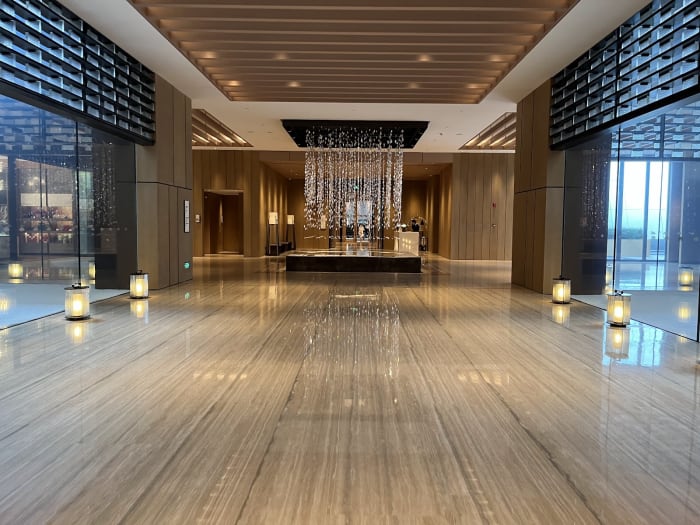
The establishment has been designed as a counterpoint to the external intensity. The communal spaces, crafted for relaxation, play a central role in this distancing. The focus is less on dramatic effects and more on breathing space. The flow of movement feels seamless, the volumes create pauses, and the overall atmosphere fosters both concentration and relaxation. For informal meetings, quiet hours of work, post-meeting unwinding, or moments of reading, these shared spaces extend the experience of the room and provide a rare rhythm in large metropolises.
The aesthetic language is rooted in a blend of modernity and Asian traditions. This is reflected in a measured elegance, devoid of decorative excess. The hotel does not seek to compete with the city in terms of architectural display; rather, it aims to establish a certain ambience. This restraint is particularly appreciated in Shenzhen, where the urban landscape can be quite assertive. Inside, everything seems organised to reduce visual noise and restore a form of sensory continuity: controlled lighting, soft materials, and furniture designed for both function and form.
This calm atmosphere, conducive to concentration, is one of the most distinctive features of the hotel. It makes the establishment particularly relevant for business stays, often subject to tight schedules, as well as for travellers wishing to explore Shenzhen without constantly being overwhelmed by its intensity. The hotel thus becomes a retreat, a place where one can find a slower pace. The address remains rooted in an active, international city that is looking towards the future.
Guests come here for this form of balance that is rarely easy to achieve: being at the heart of a major metropolis without bearing the full brunt of its tumult. This is what makes the Mandarin Oriental, Shenzhen a relevant address for a variety of uses. A couple will find a discreet and refined setting; a business traveller will enjoy smooth logistics and a conducive work environment; a curious visitor will have a comfortable starting point to explore Shenzhen beyond the clichés. The establishment does not seek to suspend the city; it offers a way to inhabit it with greater calm and chosen distance.
Rooms and Suites
In a hotel of this calibre, the room is not merely a place to rest. It must also facilitate recovery, preparation, and sometimes work.
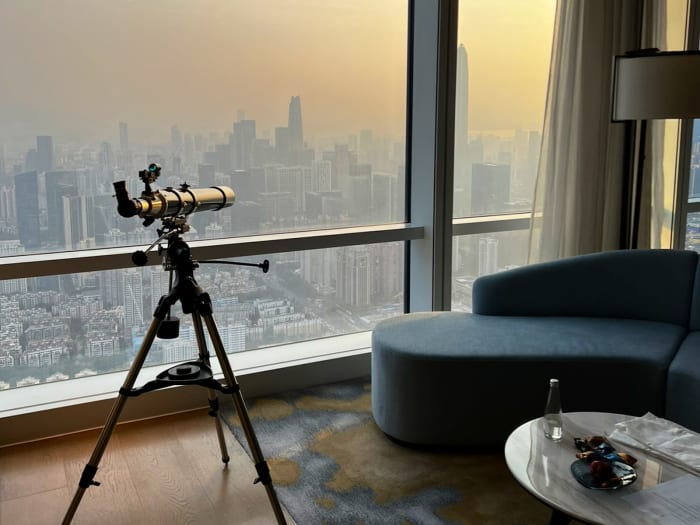
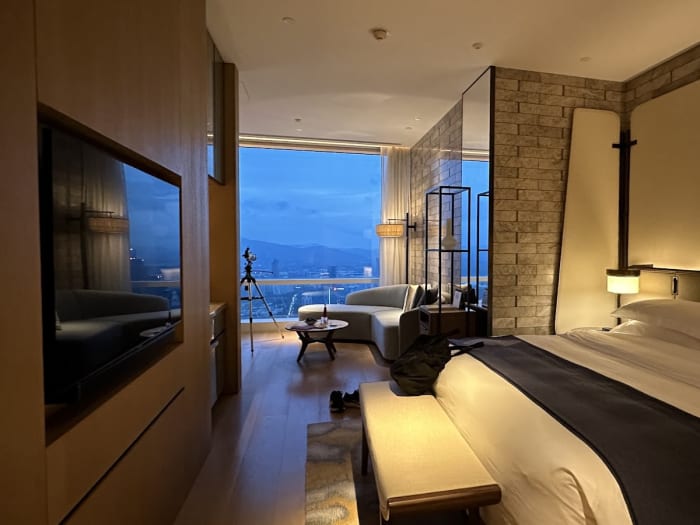
At the Mandarin Oriental, Shenzhen, this versatility seems to lie at the heart of the experience. The address offers rooms and suites tailored to a discerning clientele. Tangible comfort is as important as the quality of the atmosphere. Ergonomics matter just as much as aesthetics. The sensation of calm takes precedence over the accumulation of effects.
The style continues the theme of the communal spaces. Here, one finds a clear modernity tempered by discreet Asian references. Elegance is defined by proportion, material choices, spatial clarity, and mastery of light. Luxury does not solely rely on volume or bedding; it is about the overall arrangement, designed to reduce the traveller's fatigue.
For business travellers, this balance is crucial. A well-designed room allows for concentration without extending the office. The calm atmosphere then makes perfect sense. It implies a focus on sound insulation, visual comfort, sleep quality, and ease of use.
For couples, the reading is different yet complementary. There is a search for intimacy. A harmonious continuity between the bathroom, sleeping area, and relaxation zones is appreciated. A sober decor also allows the stay itself to take centre stage.
Daily service plays a significant role in this experience. Housekeeping, evening turndown, wake-up calls on request, and discreet assistance foster a sense of trust. The room remains a space that is always ready, never left to chance. This is particularly valuable in a city like Shenzhen, where days can be long and dense.
The suites extend this logic by offering more space and better separation of functions. They are suitable for informal meetings, longer stays, or the need to host discreetly. The essence remains coherence. At the Mandarin Oriental, Shenzhen, the room is part of a carefully and calmly designed whole.
Dining
Dining holds a special place in the experience of a grand Asian hotel, and the Mandarin Oriental, Shenzhen is no exception. At this level, the dining experience is integral to the identity of the stay. It extends the hospitality with the same precision, rhythm, and discretion as the rest of the establishment.
In Shenzhen, the hotel dining caters to multiple uses. In the morning, it supports both quick departures and leisurely awakenings. At lunchtime, it can host a business meeting or provide a break between commitments. In the evening, it marks a transition to a more leisurely time. This plurality requires a service that is clear, fluid, and attentive to preferences.
The interest also lies in how the gastronomy can reflect the blend of modernity and Asian traditions that characterises the address. Flavours, presentation, meal tempo, and setting then engage in dialogue with the hotel's overall spirit. An international clientele finds familiar comforts here, while more curious travellers may discover local or regional sensibilities expressed in a contemporary manner. The essence remains moderation, without ostentation.
For couples, the restaurant or dining lounges can be among the most enjoyable moments of their stay. Dining in a calm setting, enjoying a leisurely breakfast, or having a snack between outings: these sequences matter. For business travellers, a good hotel restaurant saves time, allows for elegant hosting, or provides a welcome consistency after a busy day.
Room service, combined with a rigorous daily housekeeping service, naturally complements this offering. It allows the room to become a true living space, rather than just a transit point. At the Mandarin Oriental, Shenzhen, dining aligns with schedules, moods, uses, and expectations, with the same attention to detail as the entire hotel experience.
Spa & Wellness
The advice already given in the short description — to book a treatment in advance — says a great deal about the place of the spa within the Mandarin Oriental, Shenzhen experience. In a property of this kind, wellness is not merely an added amenity on a facilities list; it often plays an essential balancing role, especially in a city as active as Shenzhen. The spa becomes less an optional indulgence than a means of re-centring. Guests come to interrupt the flow, recover a sense of breathing space, and restore continuity between body and mind after a day of travel, meetings or urban exploration.
Mandarin Oriental has built a significant part of its reputation on this culture of care, in which the precision of touch matters as much as the atmosphere surrounding it. Without inventing specific protocols here, one can reasonably expect an attentive, personalised and calm approach, faithful to the group’s standards. This generally means spaces designed to slow the pace, a carefully managed transition between the outside world and the treatment room, and a level of care that begins well before the treatment itself. In the best hotel spas, the experience depends as much on what frames the treatment as on the treatment proper: welcome, preparation time, quiet, comfort of facilities and a gradual return to ordinary rhythm.
For business travellers, the spa answers a very practical need. It helps them decompress without leaving the hotel, recover from a dense schedule, or create a moment of clarity before dinner or an important meeting. For couples, it may become one of the highlights of the stay precisely because it offers a shared pause in a setting that privileges serenity. In both cases, the hotel’s calm atmosphere reinforces the relevance of the wellness offer: the spa does not feel like a separate universe, but rather the most concentrated expression of a mindset already present throughout the property.
Wellness here should also be understood broadly. It includes sleep quality, the softness of shared spaces, the availability of service, and the feeling that everything is organised to reduce friction during the stay. A treatment booked at the right moment can therefore become the centre of an entire day: a morning of work, a pause at the spa, a quiet dinner; or a city outing, a return to the hotel, a late-afternoon massage and a calm evening. This ability to structure time is one of the true strengths of grand hotels.
Booking ahead remains sound advice, not as a marketing device, but because the most desirable slots are often those that best fit a harmonious schedule. At Mandarin Oriental, Shenzhen, the spa appears as a natural component of a stay designed to combine high standards, recovery and a contemporary art of living.
Concierge & Services
In luxury hospitality, services are valued for their ability to make the stay simpler, smoother, and more precise. The Mandarin Oriental, Shenzhen boasts a robust service foundation: 24-hour concierge, 24-hour reception, daily room service, evening turndown, luggage storage, laundry, wake-up service, and multilingual staff.
The 24-hour concierge plays a central role here. In an international city like Shenzhen, having a permanent point of contact changes the nature of the stay. It is not just about securing a reservation or obtaining practical information, but about relying on a reliable interface between the hotel and the city. For a business traveller, this might mean organising a transfer, adjusting a schedule, or assisting with a last-minute request. For a couple on holiday, it could involve recommending an itinerary, coordinating an outing, or discreetly managing a special request.
The continuously open reception complements this promise of availability. Late arrivals, early departures, programme changes, and ad-hoc requests: the hotel adapts to the realities of travel. Daily room service and evening turndown reflect a silent hospitality. Guests find their room tidied, prepared for the night, adjusted without ostentation.
Laundry, luggage storage, and wake-up services are more functional yet essential. A shirt ready on time, luggage taken care of between meetings, a precisely requested wake-up call: these details often determine the overall feeling of control. Finally, the multilingual staff contributes to this international fluidity, which is indispensable in a global metropolis.
The Shenzhen Way of Life
Staying at Mandarin Oriental, Shenzhen also means choosing to look at Shenzhen as more than a business city. Certainly, the metropolis is inseparable from its economic role, its rapid development and its image as a city turned towards the future. Yet it also has a distinctive way of life shaped by contrasts: speed and breathing space, urban density and calmer interludes, international outlook and regional grounding. A well-located hotel designed for relaxation makes it possible to enter that complexity with greater subtlety.
Shenzhen does not offer the obvious heritage narrative of some older Chinese cities. Its interest lies elsewhere: in its energy, its relationship to the contemporary, and its ability to combine innovation, design, visual culture, sophisticated consumption and constant mobility. For the traveller, this means a highly current urban experience, at times closer to reading a global metropolis than to following a historical postcard. The point is therefore not to search for monumental pasts at every corner, but to understand a way of living the city in the present tense.
In this context, Mandarin Oriental acts as a mediator. Its calm atmosphere and shared spaces designed for relaxation make it possible to alternate between immersion and retreat. One may devote part of the day to meetings, active districts, shopping environments and contemporary social spaces, then return to the hotel and recover a lower rhythm. For a couple, that alternation is valuable: it prevents the city from becoming pure intensity. For a business traveller, it helps turn a work trip into something more liveable.
The Shenzhen way of life also involves a certain efficiency. Distances, infrastructure, digital habits and the service culture found in high-end places all combine to create a very fluid urban experience when properly supported. That is why the quality of the concierge and multilingual staff matters so much here. It helps guests read the city, choose the right tempo and avoid dispersion. In a destination this contemporary, luxury often means filtering rather than multiplying.
Finally, Shenzhen may appeal most to those who enjoy cities in transformation, urban landscapes that speak of today’s Asia, and stays in which one observes as much as one visits. From a refined address, one better understands what makes the city distinctive: a modernity that is still being written. Mandarin Oriental, Shenzhen does not impose a narrative; it offers a setting from which each guest can compose their own, between work, discovery, rest and curiosity. That may be the most accurate form of local art of living: inhabiting, however briefly, a city of the future with the right markers of calm, comfort and discernment.
Book with MyConciergeHotel
Booking Mandarin Oriental, Shenzhen through MyConciergeHotel means choosing an editorial and service-led approach to travel rather than a simple transaction. An address such as this cannot be reduced to a room category or a rate displayed at a given moment. It needs to be understood in context: that of a major Asian metropolis, of a stay that may combine business and personal time, and of a desire for calm within a particularly dynamic urban environment. Our role is precisely to place the hotel back into that real-life use so that each traveller can make a more accurate choice.
This reading is especially useful in Shenzhen. The city can impress through its scale, speed and variety of rhythms. A good hotel there does not merely serve as a place to sleep; it structures the stay. Mandarin Oriental fulfils that function through its strategic location, its atmosphere suited to focus, its shared spaces designed for relaxation, and its ability to suit both couples and business travellers. Booking with MyConciergeHotel allows those qualities to be properly valued instead of reducing the experience to a standardised list of amenities.
Our approach favours clarity. We highlight what truly matters: the type of atmosphere, the service logic, the relevance of the location and the kind of stay for which the hotel is best suited. For this address, that means emphasising the balance between connection to the city and retreat, the expected quality of welcome, the value of planning certain moments in advance — especially at the spa — and the overall coherence of a house that speaks to demanding yet not necessarily demonstrative travellers.
Booking through us also means benefiting from a selection built for the long term. We do not seek to multiply vague promises; we prefer to identify properties that hold a clear line. Mandarin Oriental, Shenzhen belongs to that category of hotels whose value lies in consistency: consistency of service, atmosphere, comfort level and capacity to absorb the constraints of contemporary travel. For a business trip, a stay for two or a first discovery of Shenzhen, that coherence is often more decisive than any effect of novelty.
Finally, MyConciergeHotel is for travellers who expect more from a hotel platform than a booking engine. They seek a point of view, a hierarchy and an understanding of use. It is exactly in that spirit that we recommend Mandarin Oriental, Shenzhen: as an address of controlled urban luxury, suited to those who want to experience Shenzhen with measured intensity and return in the evening to a genuine sense of composure, calm and precision. If you are considering the destination, it is worth planning the stay as a whole: the rhythm of your days, work needs, moments of relaxation, spa reservations and service expectations. That is when the hotel reveals its full relevance.