History & heritage
The Raffles name holds a singular place in the Asian hotel imagination. In Singapore, it immediately suggests a certain idea of grand travel, ceremonial yet unforced service, and a way of hosting shaped over time. Raffles Sentosa Resort & Spa belongs to that heritage without attempting a museum-like recreation of it. Here, the spirit of the brand is expressed less through historical display than through continuity of style: attention to detail, discreet staff, a fondness for spaces that allow a stay to breathe, and an emphasis on the quality of the experience rather than on spectacle.
The address is set on Sentosa, the leisure and resort island just south of Singapore. The contrast is compelling. On one side, the city-state embodies density, efficiency, vertical architecture and the pace of a global metropolis. On the other, Sentosa offers a calmer reading of Singapore, shaped by greenery, promenades, shorelines and hotels conceived as retreats. In that context, the Raffles signature finds natural ground: a luxury of space and pause, more insular than urban, more contemplative than ostentatious.
What makes the property interesting is precisely this meeting of a heritage brand and a tropical setting. A stay here is not simply about sleeping in a prestigious hotel; it is about inhabiting, for a few days, a quieter version of Singapore. That appeals both to travellers already familiar with the destination and to those who wish to discover it from a less frenetic angle. The Raffles name brings a promise of coherence: one expects structured service, legible elegance, and hospitality able to anticipate without intruding.
In contemporary luxury, many hotels claim to be exceptional. Few manage to build a lasting identity. Raffles’ strength lies in belonging to a lineage that is instantly recognisable while allowing each address to engage with its setting. On Sentosa, that translates into a close relationship with the landscape, a retreat-like atmosphere, and an approach to the stay as a restorative interlude. Heritage here is therefore not a matter of historic décor, but of service culture and positioning: offering a high-end experience that privileges serenity, fluidity and the feeling of being expected.
For the traveller, this heritage dimension has a practical consequence: one books not only an address, but a way of being received. The prestige of the name matters only if it is reflected in daily gestures, from arrival to turndown, through concierge guidance and the overall rhythm of the stay. It is in this fidelity to a certain idea of classic hospitality, adapted to an island and contemporary setting, that Raffles Sentosa Resort & Spa finds its place.
The setting
Staying at Raffles Sentosa Resort & Spa means choosing an address where the setting is central to the experience. The hotel stands on Sentosa Island, in an environment shaped by tropical greenery and a sense of retreat that is rare on the scale of Singapore. There is something distinctive about this location: one remains close to the destination’s major landmarks while gaining the possibility of stepping away from them mentally. For many travellers, that dual movement is precisely the appeal. One may spend the day among the city’s emblematic districts, museums, shopping areas or business appointments, then return in the evening to a quieter, almost suspended atmosphere.
The landscape plays an essential role here. The greenery is not a mere backdrop but an active component of the stay’s sensation. It filters views, softens perspectives, absorbs some of the noise and immediately establishes a slower tempo. In a city known for its urban mastery and intensity, that breathing space has real value. It allows guests to experience Singapore differently, not in opposition to the city but as a complement to it. Sentosa becomes less a tourist enclave than a privileged vantage point from which to compose one’s own balance between activity and rest.
The property naturally suits travellers seeking tranquillity without complete isolation. Couples on a short escape, families wishing to alternate outings with downtime, business visitors extending a professional stay: all may find a different use for it. Proximity to Singapore’s attractions remains an obvious advantage, yet it does not overshadow the identity of the place. The hotel does not present itself as a mere logistical base; it asserts a genuine quality of atmosphere, with that very contemporary idea of luxury as a mental space as much as a material one.
Arrival on Sentosa already alters one’s perception of the journey. One leaves the dense urban grid for a more open, greener environment, where a transition is immediately felt. That brief distancing changes a great deal. It encourages a quicker settling into the stay, as if moving from a functional mode to a residential one. Raffles Sentosa Resort & Spa builds on that sensation with a setting conceived for calm: fluid circulation, a close relationship with the outdoors, and the overall impression of being in a refuge rather than merely a stopover hotel.
For the discerning traveller, true luxury often lies in the ability to offer several readings of a destination. Here, Singapore is not only a polished and efficient metropolis; it also becomes a territory of pause, greenery and wellbeing. The setting allows those two realities to coexist. That is what makes it a relevant address for those wishing to combine discovery and retreat, urban energy and rest, precision of service and gentleness of place.
Rooms, suites and the rhythm of the stay
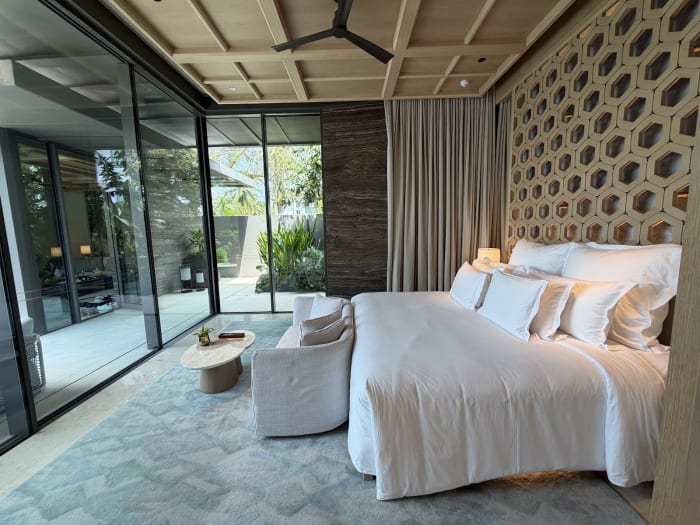
In a hotel of this category, the room is never merely a place to sleep. It is the true centre of gravity of the stay, the space in which the experience is recomposed between outings, appointments or moments of rest. At Raffles Sentosa Resort & Spa, one first expects that sense of retreat which distinguishes a fine address from a genuinely successful refuge. Sentosa’s green setting naturally contributes to this: it invites one to think of accommodation not as a simple extension of the city, but as a space of release, relative quiet and measured comfort.
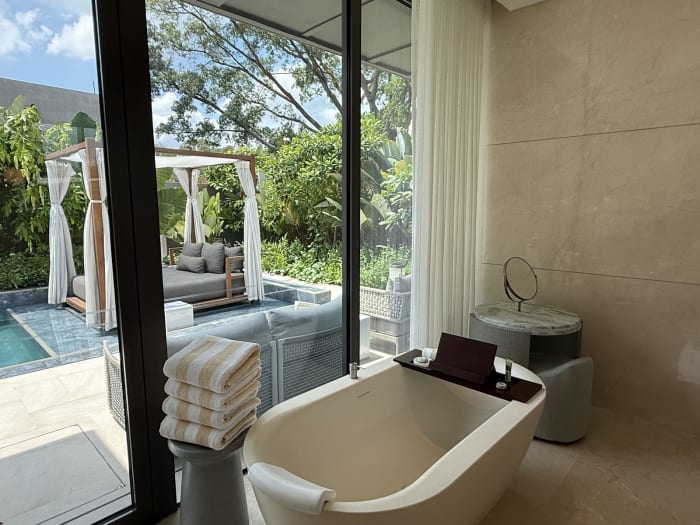
The Raffles universe suggests an approach to hospitality in which refinement is expressed through clarity. Rooms and suites are generally at their best when they offer intuitive circulation, pleasing materials, well-handled light and a calming relationship between indoors and outdoors. In a destination such as Singapore, where visual and climatic intensity can be strong, that compositional quality becomes especially important. The traveller seeks a place in which to settle, recover a gentler emotional temperature, read, work, prepare for dinner or simply slow down.
Daily housekeeping and turndown service fully contribute to this sense of continuity. In high-end hospitality, comfort depends not only on facilities but also on the way the room supports the different moments of the day. In the morning, it should allow for a frictionless awakening. During the day, it may become a private sitting room, a place of retreat between activities. In the evening, it regains a more enveloping dimension, almost domestic in the best sense of the term. This ability to change function without losing coherence is one of the markers of a successful stay.
For couples, the appeal of an address such as this often lies in the possibility of experiencing the room as a cocoon, in dialogue with the island’s peaceful atmosphere. For families, the value is measured differently: ease of organisation, a sense of space, and the ability to return and rest after an outing. In both cases, luxury lies less in ostentation than in the absence of friction. Everything that simplifies the stay matters: precise upkeep, carefully considered bedding, a calm atmosphere, and the feeling that one can truly inhabit the place rather than merely occupy it.
Today’s traveller also expects a degree of versatility. A grand hotel room should be able to host rest, the preparation of a day’s sightseeing, a discreet working session, or a pause after the spa. In a setting such as Sentosa, that versatility takes on a particular tone, more residential, almost resort-like. One does not come back merely to sleep between obligations; one returns to recover a truer rhythm. It is probably there that the property finds its best expression: in this way of making accommodation a space of recentering, faithful to the idea of a calm, precise and enduring luxury.
Dining
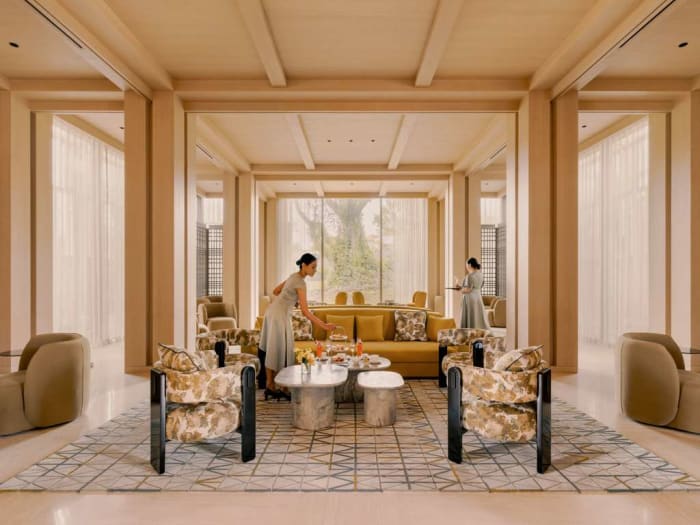
In Singapore, speaking of gastronomy is almost the same as speaking of the city itself. Few destinations in Asia have developed such a daily, curious and exacting relationship with food. In that context, a hotel within the Raffles collection cannot settle for merely functional dining. Even without theatricality, it must offer a culinary experience coherent with its positioning: attentive service, a carefully considered setting, the right rhythm, and the ability to support very different uses, from an unhurried breakfast to a more composed dinner.
At Raffles Sentosa Resort & Spa, the interest of dining lies first in the way it is woven into the wider stay. On an island such as Sentosa, food is not simply a convenience; it contributes to the sensation of retreat. One appreciates being able to begin the day in a calm environment, to take time over coffee or breakfast without haste, and later to return to a space suited to a light lunch or a dinner that extends the day’s sense of ease. In a high-end hotel, culinary success often depends on this invisible continuity: nothing feels forced, everything seems to sit in its proper place.
The Singaporean context also invites a certain openness. The city is one of the region’s great culinary crossroads, where Chinese, Malay, Indian and international influences meet. A hotel of this standing may choose to reflect that diversity directly or more allusively, but it always benefits from acknowledging the territory in which it stands. For the traveller, this means that dining in the hotel is not necessarily a parenthesis cut off from the destination; it may instead offer a quieter, more comfortable and more orchestrated reading of it.
The quality of service remains decisive. A fine hotel table is recognised by the precision of its gestures, the knowledge of the dining room, and the ability to adapt to the guest’s pace. Some seek a structured dinner; others prefer something simpler after a dense day. Families do not have the same expectations as couples on a short escape. The team’s role is to absorb that diversity without ever breaking the impression of harmony. In the Raffles universe, one expects precisely this kind of flexible professionalism, able to make the moment pleasurable without overplaying it.
Lastly, dining contributes to the emotional identity of the stay. One often remembers a hotel through a few very concrete scenes: breakfast in the morning light, tea or a drink taken in calm after an outing, a dinner that marks the transition between the day’s activity and the evening’s rest. On Sentosa, this dimension takes on a particular colour, slower, greener, more insular. Gastronomy naturally finds its place there, not as a display, but as an extension of a way of living founded on the quality of time.
Spa & wellbeing
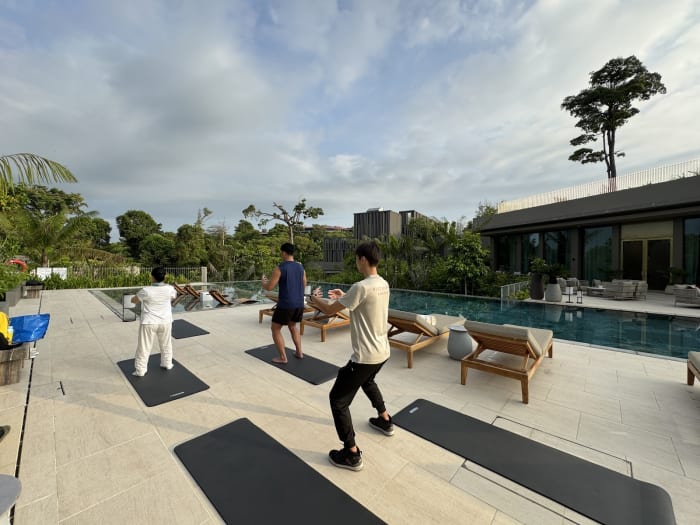
Wellbeing is not an optional extra at an address such as Raffles Sentosa Resort & Spa; it is one of its guiding threads. The very name of the property makes that clear, and Sentosa’s setting gives it further obviousness. In an environment surrounded by greenery and at a relative remove from urban intensity, the spa is not merely a list of treatments. It becomes a language of the stay, a way of inhabiting time differently. One comes not only for a pleasant interlude, but for a form of rebalancing after travel, heat, jet lag or the sustained rhythm of a trip to Singapore.
What makes a spa relevant in a grand hotel is its ability to enter into dialogue with the place. On Sentosa, that logic makes complete sense. The island already suggests a distancing, a transition between the city and a calmer experience. The spa extends that sensation by giving it structure. It offers a setting in which the body catches up with the mind, where attention turns from the outside world back towards oneself. For some travellers, this will mean a massage after arrival or before departure; for others, a more complete ritual integrated into the stay. In both cases, the aim is the same: to restore continuity to the journey.
Luxury here lies less in the complexity of protocols than in the quality of guidance. A good spa knows how to adapt its approach to the guest’s profile: a need for recovery, a search for deep relaxation, a wish to release tensions linked to flying, or simply the desire to enjoy a moment alone. This personalisation is especially important in high-end hospitality, where one expects teams to listen without imposing. The ideal experience is one that feels right, neither standardised nor demonstrative.
The appeal of hotel wellbeing also lies in the way it structures the rhythm of the stay. One may choose to begin the day with a moment of calm, to pause in mid-afternoon after exploring the city, or to end the day with a treatment that prepares the body for rest. In a destination as dynamic as Singapore, that possibility of modulation has real value. It prevents the trip from becoming a mere sequence of activities. It reintroduces quality of presence, a more measured relationship to time and to the body.
For couples, the spa may become a discreet shared space, a way of giving the stay a more intimate tone. For solo travellers, it often represents a particularly valuable moment of recentering. For families, it is a reminder that a resort hotel should also know how to offer time for oneself. In that sense, Raffles Sentosa Resort & Spa responds to a very contemporary expectation: that of a luxury which does not merely impress, but genuinely helps one feel better. At its best, one leaves not only rested, but realigned with the place, the journey and oneself.
Concierge & services
In high-end hospitality, services matter not only because they exist, but because of the way they are integrated into the stay. Raffles Sentosa Resort & Spa offers the essentials expected at this level: 24-hour concierge, 24-hour front desk, daily housekeeping, turndown service, luggage storage, laundry, wake-up service and multilingual staff. Taken separately, these belong to the segment’s standard toolkit. Taken together, and above all when well executed, they shape a seamless experience, which remains one of the most decisive criteria of contemporary luxury.
The concierge plays a central role here. In a destination such as Singapore, where the offer is dense, structured and varied, human guidance makes all the difference. It is not simply a matter of arranging transport or recommending an outing, but of helping the traveller compose a stay coherent with their rhythm, interests and available time. Some will wish to discover the city’s major icons; others will prefer a few carefully chosen experiences while preserving genuine downtime on Sentosa. A good concierge reads those nuances and proposes without overloading.
A round-the-clock reception brings discreet reassurance, particularly valuable for late arrivals, early departures or stays shaped by jet lag. In a major international destination, such permanent availability is not a detail. It contributes to the feeling of being expected at any hour, without a break in quality. In the same way, luggage storage and laundry form part of that invisible logistics which greatly simplify travel, especially when the stay is part of a wider Asian itinerary.
Daily housekeeping and turndown belong to another register, a more sensory one. They remind us that a luxury hotel does not merely sell space, but continuous attention. A well-kept room, prepared with precision according to the time of day, profoundly changes the perception of the stay. One finds there a sense of order, care and consistency that allows true relaxation. It is often in these details, more than in spectacular displays, that the real quality of a house is measured.
Lastly, the presence of multilingual staff responds to the international nature of Singapore’s clientele. It facilitates exchanges, reduces friction and makes the experience feel more natural, especially for travellers who expect clear and efficient communication. Together, these services compose a mature form of hospitality, designed to accompany rather than to impress. It is this well-calibrated discretion that makes the difference: the feeling that everything works, that one can ask without hesitation, and that the stay unfolds with a kind of obviousness. In the Raffles universe, such fluidity is not an extra; it is at the very heart of the promise.
Singapore living, Sentosa style
Choosing an address on Sentosa means adopting a particular way of experiencing Singapore. The city is often approached through its most visible contrasts: dramatic skyline, business districts, shopping centres, museums, iconic gardens, and a cultural and gastronomic scene of great density. All of that exists, of course, and forms part of its appeal. Yet there is another reading, gentler and more intermittent, which consists in alternating urban immersion with retreat. Raffles Sentosa Resort & Spa enables precisely that breathing space, offering an anchor point to which one may return in order to slow down without renouncing the destination.
Sentosa occupies a special place within Singapore’s ecosystem. The island gathers leisure attractions, beaches, green spaces and resort hotels, but it can also be experienced in a subtler, almost residential way. One appreciates the simple act of walking, of taking time, of letting light and vegetation reshape the day. For travellers accustomed to major Asian metropolises, that possibility of modulation is precious. It avoids the feeling of saturation and allows one to better appreciate Singaporean precision, no longer only as urban performance, but as a quality of organisation in the service of comfort.
From the hotel, the city may be approached according to several rhythms. Some will leave early to explore major cultural or architectural landmarks, then return in the late afternoon to recover the island’s calm. Others will prefer a more fragmented approach, made up of short outings, lunches in town and long pauses at the resort. This freedom of composition is one of the great privileges of a well-conceived stay. It helps avoid overly tight schedules and leaves room for spontaneity, for the mood of the moment, and for fatigue as well — a dimension often neglected in travel narratives, yet essential to the real quality of a stay.
Singaporean living, in its most interesting version, lies precisely in this balance between efficiency and pleasure. Everything is remarkably organised, yet the city also knows how to offer interludes of nature, design, gastronomy and contemplation. Sentosa accentuates that second dimension. It gives Singapore a depth of stay not always suspected on a first visit. One then discovers that it is possible to experience something other than a rapid city break: a genuine resort interlude punctuated by carefully chosen excursions.
In that context, Raffles Sentosa Resort & Spa acts as a mediator between two worlds. It allows guests to enjoy Singapore’s energy and attractions while preserving a quality of quiet, greenery and comfort that profoundly changes the perception of the journey. That is perhaps its most enduring appeal: offering not a simplified version of the destination, but a more balanced one, where luxury is measured by the ability to hold together movement and rest, curiosity and retreat, city and refuge.
Book with MyConciergeHotel
Booking Raffles Sentosa Resort & Spa through MyConciergeHotel means approaching the stay with a logic of guidance rather than mere transaction. A Raffles address on Sentosa often calls for fine judgement: the ideal length of stay, the balance between time at the resort and time discovering Singapore, the organisation of transfers, the moments worth reserving in advance, and the particular attention to give to the spa or on-site experiences. It is precisely these details, sometimes invisible at the moment of booking, that turn a fine address into a truly successful stay.
The value of an editorial and booking concierge lies first in placing the hotel within its real context. The traveller is not choosing only a category or a brand; they are choosing an atmosphere, a rhythm, a relationship to the destination. In the case of Raffles Sentosa Resort & Spa, the question is whether one is primarily seeking a peaceful retreat, an elegant base from which to explore Singapore, or a combination of both. Depending on the nature of the stay — a couple’s escape, a family trip, an extension after business travel — priorities will differ, and guidance helps refine those choices.
Booking with MyConciergeHotel also makes it easier to prepare the experience in advance. A stay on Sentosa often benefits from being thought through in terms of timing: arrival hour, first evening on site, a day devoted to the spa or relaxation, urban excursions distributed intelligently. The aim is not to over-plan, but to create a flexible framework that leaves room for comfort. In luxury hospitality, the true privilege is not the accumulation of options; it is the rightness of organisation. Knowing when to book, when to leave space, and when to favour the resort over an outside programme makes all the difference.
MyConciergeHotel also provides a qualitative reading of the address. Beyond facilities and brand promises, the point is to identify what makes the hotel relevant for a certain kind of traveller. Here, it is the serenity of the setting, the relative proximity to Singapore’s attractions, the Raffles signature and the wellbeing dimension that structure the stay. This editorial reading helps guests book with a clear understanding and with the right expectations. In luxury, satisfaction often arises from that fit between promise, actual need and lived experience.
Finally, booking through MyConciergeHotel means favouring a more human relationship to travel. Even in the age of platforms, some addresses deserve perspective, advice and context. Raffles Sentosa Resort & Spa is one of those hotels that make full sense when chosen for the right reasons: a need for calm, a desire for a more breathable Singapore, a search for structured service, a wish to integrate wellbeing into the stay. To book in this way is already to begin travelling better: with greater coherence, greater comfort and a clearer sense of what one is truly seeking.