History & Heritage
The Jumeirah Jabal Omar Makkah is a hallmark of contemporary hospitality in Mecca, welcoming an international flow of travellers and pilgrims.
Here, heritage is experienced through a direct connection with the holy city, its rhythm, and the centrality of the Sacred Mosque. The hotel is situated in a recently developed urban environment, designed to accommodate visitors from around the globe.
Belonging to the Jumeirah brand adds a distinct tone. The hotel prioritises service quality, seamless guest experiences, and an international elegance that remains attentive to the local context.
In Makkah, this promise takes on a unique significance. Stays are often linked to spiritual moments or long-planned family gatherings.
The hotel transcends being merely a transit point. It provides a space for rest, offers simple landmarks, and facilitates movement.
The heritage of the place is defined less by its age than by its function: to welcome with precision. In the context of Makkah, this hospitality requires a concrete attentiveness to the needs of travellers.
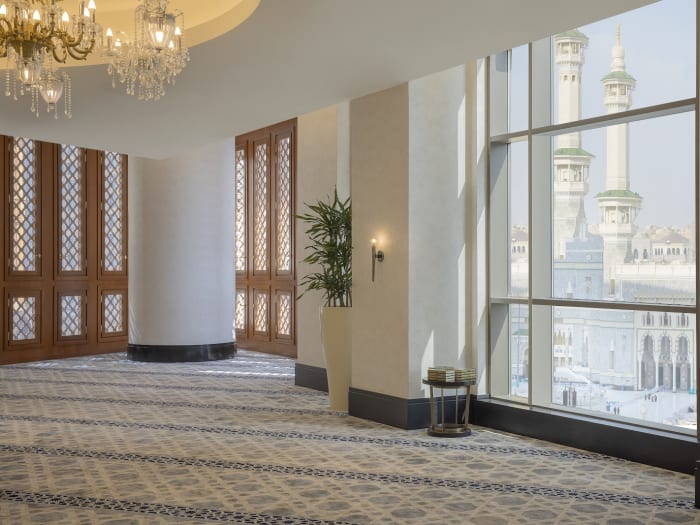
The elegant and soothing communal spaces accompany guests returning to the hotel after prayer times, family outings, or busy days. This understated decor, combined with modern comfort, creates a practical luxury.
The Jumeirah Jabal Omar Makkah belongs to a generation of establishments that blend international standards, attention to detail, and local cultural references. Its signature lies in providing a clear, comfortable stay that respects the spiritual context of the city.
For French-speaking travellers, it is a grand pilgrimage hotel in the noblest sense of the term. A 5-star establishment where luxury begins with proximity, quality of welcome, clarity of services, and conducive conditions for rest.
The Establishment
One of the primary advantages of the Jumeirah Jabal Omar Makkah is its proximity to the sacred mosque. In Makkah, this aspect shapes the experience of the stay. Easier access to prayer locations, reduced travel times, the ability to return and rest between significant moments, and then finding a calm environment after the intensity surrounding the Haram transforms the way one inhabits the city. For pilgrims, this closeness represents tangible comfort. For families, it simplifies organisation. For business travellers, it allows for a balance between obligations and easy access to the spiritual heart of Makkah.
The hotel’s layout adheres to this principle of fluidity. The elegant and soothing communal spaces facilitate movement without adding tension. In a destination where days can be packed, the quality of circulation, the clarity of spaces, and the sense of order are as important as the decor. A well-designed large hotel in Makkah must cater to a variety of profiles, from individual travellers to family groups, while maintaining an impression of control and serenity.
The establishment is also distinguished by its ability to cater to multiple uses. It is suitable for pilgrimage stays, families, and business travellers. This versatility requires comfortable communal spaces, services tailored to practical needs, and an organisation that does not compromise on either efficiency or the quality of hospitality. In an international context, this implies particular attention to reception, client orientation, and team availability.
The overall style favours understated elegance. It combines modern comfort with local traditions. This can manifest through materials, tones, patterns, or simply an atmosphere that avoids the uniformity of certain contemporary large complexes. In Makkah, this nuance matters. Travellers often seek a place that offers high standards without appearing interchangeable with an international business hotel.
Thus, the Jumeirah Jabal Omar Makkah emerges as an establishment designed for accuracy rather than display. Its appeal lies in the balance between location, user comfort, and a sense of hospitality. Its value is measured in the flow of the stay. Ease of access, the possibility to unwind, consistent service, and a reliable anchor point in a city with a unique rhythm.
Rooms and Suites
In a venue such as the Jumeirah Jabal Omar Makkah, the room plays a crucial role in the balance of the stay. In Makkah, days can start early and extend late. The need to return to an orderly, comfortable, and restful space becomes central. The experience is built on the fundamentals of a great five-star hotel: quality bedding, rigorous maintenance, a calm atmosphere, attentive services, and amenities designed to facilitate daily life.
The daily housekeeping and turn-down service indicate the attention given to comfort. These hospitality gestures are particularly significant in a pilgrimage destination. Returning to a tidied room, experiencing a sense of freshness, and benefiting from a regular service rhythm contribute to recovery. In a context of high traffic, this consistency is often more valuable than an accumulation of decorative effects.
The rooms and suites cater to various needs. Families require a clear and functional setting. Business travellers seek efficient installations. Pilgrims primarily expect a serene, close, and reliable base. A good hotel in Makkah must provide spaces capable of adapting to these rhythms without losing coherence. This involves well-thought-out furniture, sufficient storage, a comfortable bathroom, and an ambiance conducive to rest. Elegance is measured here by controlled simplicity rather than excess.
The idea of modern comfort combined with local traditions can also be reflected in the spirit of the rooms. Some visual or material references to the regional context, a soothing palette, and a certain restraint in style embed the experience in its location. For an international clientele, this accuracy matters. It gives the stay a local tone while retaining the expected markers of a major hotel brand.
Finally, the quality of a room in Makkah is judged by its ability to protect the time for rest. After the movements, the crowds, and the intensity of the city, the hotel must offer a clear interlude. This is where the Jumeirah Jabal Omar Makkah finds its relevance: contemporary comfort, discreet and well-executed, serving a stay that demands as much serenity as efficiency.
Dining
Dining occupies a central place in an establishment of this category in Makkah. It structures the stay as much as it accompanies it.
In a city governed by prayer, movement, and moments of reflection, meals must remain easily accessible. A large five-star hotel close to the sacred mosque must offer reliable, organised solutions tailored to an international clientele.
The first quality expected is clarity. Clear hours, efficient service, a comfortable setting, and meals without logistical complications. Families seek spaces that are easy to share. Pilgrims expect a rhythm compatible with their day. Business travellers prioritise service without wasting time.
Sophistication here relies less on effect than on accuracy. Doing things right, at the right moment, matters more than display.
The Jumeirah identity evokes attentive hospitality, a well-maintained environment, and an offering designed for a cosmopolitan clientele. In Makkah, this international dimension is essential. Guests come from diverse backgrounds, with varying dietary habits and lengths of stay.
In this context, a good hotel restaurant must combine diversity, consistency, and clarity. The dialogue between modernity and local traditions can also be expressed here. An establishment of this level generally seeks to articulate regional references with global expectations.
In Makkah, meals also serve a comforting function. After the external intensity, they become a moment of pause, family sharing, or calm.
In the realm of pilgrimage, culinary luxury takes on a particular form. It does not rest on rarity but on a fluid, dignified, and consistent experience. A well-maintained table, punctual service, a calm setting, and an offering adapted to varied needs. It is within this logic that the dining experience at the Jumeirah Jabal Omar Makkah is situated.
Concierge & Services
It is often in the services that the quality of a great hotel in Makkah is revealed. The Jumeirah Jabal Omar Makkah offers a 24-hour concierge, a 24-hour reception, daily room service, turn-down service, luggage storage, laundry service, wake-up calls, and multilingual staff. In the specific context of Mecca, these services take on particular importance. They outline a hotel designed to support demanding, sensitive, and often time-sensitive stays.
The presence of a reception and concierge available at all hours is essential in a city where arrivals, departures, and movements do not always follow usual schedules. Travellers may arrive late, depart very early, or require immediate assistance. In this context, continuous availability forms a foundation of trust. It smooths the stay and avoids unnecessary complications.
The multilingual staff also deserves mention. Makkah welcomes a profoundly international clientele. The quality of the experience often depends on the teams' ability to quickly understand requests, clearly orient guests, and create a climate of relational security. In a large pilgrimage hotel, this linguistic competence fully contributes to hospitality. Being understood, especially during an important moment of the journey, changes the perception of the stay.
The daily maintenance and comfort services also play a key role. Daily cleaning, turn-down service, and laundry meet very concrete needs, especially during multi-day stays or peak periods. They help maintain a stable level of comfort despite the fast pace of the destination. Luggage storage proves invaluable for managing staggered schedules or enjoying the last moments in the city without excessive constraints.
The wake-up call service illustrates the spirit of the establishment. In a destination where time holds particular value, this type of service contributes to a more serene experience.
Thus, the Jumeirah Jabal Omar Makkah advocates a vision of luxury based on availability, regularity, and understanding of real needs. Here, the concierge is not limited to exceptional requests. It supports the concrete flow of the stay. It is this quality of execution that makes the difference in a hotel of this nature.
The Art of Living in Makkah
Discussing the art of living in Makkah requires a particular approach. The city cannot be explored through the lens of a typical leisure destination. This is what makes it unique. Here, the experience revolves around a spiritual centre, collective temporalities, and an extraordinary human intensity. The relationship with the place transcends the mere idea of visitation. In this context, the Jumeirah Jabal Omar Makkah does not merely provide accommodation; it helps guests find the right rhythm. It offers a balance between the often bustling exterior and the thoughtfully designed interior, conducive to rest.
The local art of living primarily hinges on this alternation between movement and retreat. The surroundings of the sacred mosque concentrate a considerable energy, characterised by flows of people, encounters, contemplation, and organisation. Returning to an elegant and calming environment afterwards makes perfect sense. Luxury here is not about absolute isolation; it is about a successful transition between the holy city and the private space of the hotel. Creating moments of pause, returning to a well-maintained room, and enjoying consistent hospitality contribute to a comfort that aligns with the destination.
Makkah is also an international city in its daily experience. Languages, cultures, and backgrounds intersect continuously. This diversity influences the way one stays. It teaches a form of discreet coexistence, an attentiveness to others, and a relationship with time that is less linear than elsewhere. In a hotel tailored for pilgrims, families, and business travellers, this plurality is reflected in the various needs of guests. Some seek solitude, others practicality, and still others a stable environment to support a professional journey. The art of living in Makkah involves harmonising these dimensions.
It is also essential to highlight the importance of preparation. At certain times, particularly during Hajj, the city experiences exceptional crowds. Booking in advance, anticipating logistical needs, and choosing a well-located hotel are all part of the travel experience. Reserving several months ahead during peak periods is a sensible rule to ensure the quality of the stay.
Finally, the art of living in Makkah encompasses a certain sobriety of perspective. One does not come here to accumulate distractions but to inhabit a particular time. A successful hotel understands this reality. It does not seek to divert attention from the destination; it supports it. The Jumeirah Jabal Omar Makkah embodies this philosophy. It offers modern comfort, efficient services, and a welcoming atmosphere, allowing guests to experience Makkah with greater serenity and continuity.
Book via MyConciergeHotel
Booking the Jumeirah Jabal Omar Makkah through MyConciergeHotel means approaching your stay with a mindset of precision. In Makkah, the choice of hotel entails much more than just the comfort of a room. It influences the rhythm of your days, the ease of movement, the quality of rest, and the overall serenity of your journey. A five-star address close to the sacred mosque meets very specific expectations. Our editorial and concierge support helps to contextualise each establishment within its real purpose.
The Jumeirah Jabal Omar Makkah is ideal for travellers seeking a blend of proximity, international standards, and reliable organisation. Pilgrims will find a coherent base from which to structure their stay. Families will appreciate the clarity of a large establishment accustomed to welcoming diverse profiles. Business travellers can rely on continuous services and a location that simplifies their experience of the city. Discerning booking requires consideration of the timing of the trip, the length of stay, the expected level of crowding, and how the hotel fits into this overall picture.
One of the essential points to anticipate is the seasonality of demand. Pilgrimage periods, particularly during Hajj, attract a large number of visitors. During these times, advance booking becomes a practical necessity. The earlier you book, the more options you preserve, whether it concerns the choice of establishment, dates, or the overall organisation of your stay. This foresight is particularly important for a well-located address sought after for its easy access to the sacred mosque.
Choosing MyConciergeHotel also allows for a qualitative assessment of the offerings. Beyond categories and labels, what truly matters is how a hotel functions for a specific type of trip. Here, the key points are clear: proximity to the religious heart of Makkah, adaptation to pilgrimage stays, communal spaces designed for tranquility, modern comfort, continuous services, and the ability to accommodate an international clientele. This overall coherence often holds more value than a vague promise.
Booking this address means selecting a luxury of location, fluidity, and consistency in Makkah. MyConciergeHotel can assist in guiding this choice methodically, taking into account the calendar, the travellers' needs, and the unique nature of the stay in the holy city. For this destination, making the right reservation is already an essential part of the journey.