History & heritage
Amanwella belongs to a distinctive hotel tradition, one in which retreat, quietness and a precise sense of place form a language of their own. In Tangalle, on Sri Lanka’s southern coast, the property follows the codes that have shaped Aman’s reputation: a measured setting, a direct relationship with the landscape, and an idea of luxury grounded less in display than in the quality of lived experience. Here, the heritage is not that of an urban grand hotel or an aristocratic residence turned hospitality address, but of a contemporary form of hosting that seeks to reveal a destination rather than dominate it.
Even the hotel’s name suggests this bond with place. In the Aman world, each property is expected to maintain a close dialogue with its immediate surroundings, and Amanwella is no exception. Tangalle, long known for its beaches and relatively preserved shoreline, offers a natural setting for such an approach: a sandy coast, dense tropical greenery, the shifting light of the Indian Ocean, and a sense of remove that feels entirely genuine. The hotel settles into this scenery with restraint, and that restraint is central to its identity. It does not aim for spectacle detached from context; instead, it works with topography, materials and local lines.
This heritage is cultural as well. Sri Lanka has a rich architectural and artisanal tradition, shaped by climate, natural materials and a constant exchange between indoors and outdoors. Amanwella draws on that vocabulary without slipping into decorative reconstruction. Local design is present less as folklore than as a source of balance. The volumes, openings, air and light, and the importance given to terraces and long views all extend a way of living in the tropics that belongs to the region.
Within Sri Lanka’s high-end hotel landscape, Amanwella therefore occupies a particular place. It speaks to travellers seeking not the animation of a large resort but the coherence of a retreat. Its heritage is that of discreet luxury, almost silent in tone, where personalised service never disturbs the sense of space. There is a continuity here with the spirit of the earliest refined beach retreats in Asia: few effects, much attention, and the belief that true privilege lies in recovered time.
That fidelity to a certain idea of hospitality explains the property’s enduring appeal. Amanwella is not chosen merely to tick off a destination; it is chosen for an atmosphere. One in which sea, wind, vegetation and light are allowed to carry much of the narrative. In a hotel world often drawn to performance, such restraint becomes a heritage in itself.
The property
The Amanwella experience begins with the site itself. In Tangalle, the hotel faces the Indian Ocean from a setting where tropical vegetation, sand and the horizon line create a landscape of remarkable clarity. What strikes first is not a dramatic architectural gesture, but a sense of inevitability: the feeling of a property designed to belong to its surroundings. Its harmonious integration into the land and the natural environment is among its most persuasive qualities. Here, luxury does not assert itself against the place; it emerges from the way the place is respected, framed and made inhabitable.
The architecture, inspired by local design, favours restrained lines and open volumes. This formal restraint serves a practical purpose: to let air circulate, to preserve views, to create shade and coolness, and to follow the rhythm of the coastal climate. The public spaces seem intended to extend the outdoors rather than shut it out. Terraces, covered walkways, generous openings and long views towards the sea all contribute to a sense of continuity that defines the property’s spirit. One does not stay here in a self-contained world, but in a sequence of thresholds between garden, architecture and marine horizon.
The relationship with the ocean is central. Facing the Indian Ocean means more than enjoying a beautiful view; it shapes the tempo of the stay. In the morning, clear light sharpens materials and outlines. During the day, the heat encourages a slower pace, a retreat into shade, an alternation of swimming, reading and rest. By late afternoon, the landscape changes again, and the hotel’s spaces take on a softer tone. Amanwella is particularly suited to those who seek this calm form of coastal living, in which time is allowed to loosen.
The proximity of sandy beaches deepens that sense of escape. Tangalle retains a quieter character than some busier stretches of Sri Lanka’s coast, and that is precisely what makes it appealing to travellers in search of serenity. The setting is not one of constant entertainment, but of a shoreline where nature remains strongly present. This quality of silence, rare in seafront hospitality, gives the property its overall tone.
Amanwella also stands out for its ability to support different rhythms of stay. Some guests come with little intention of leaving the hotel, making full use of the beach, pool, unhurried meals and attentive service. Others find in it an elegant base from which to explore the southern coast, its landscapes, culture and local life. In both cases, the property fulfils its role completely: to offer a coherent, calming refuge where every detail seems designed to sustain a sense of retreat without ever slipping into theatrical isolation.
Rooms and suites
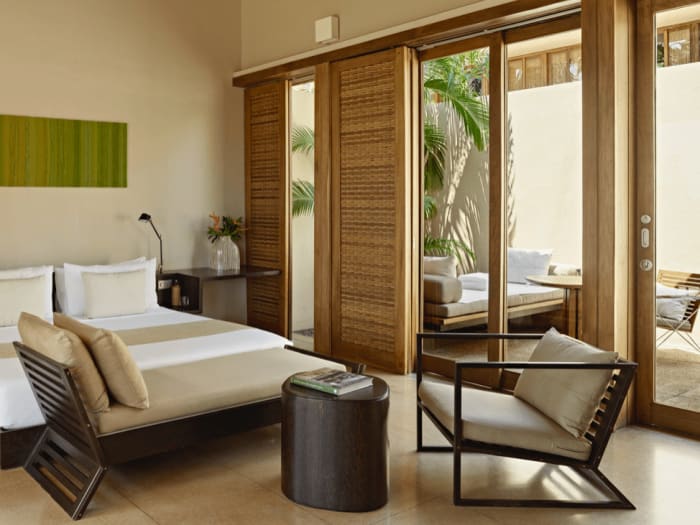
At Amanwella, accommodation extends the property’s overall philosophy with consistency: space, quiet and continuity with the surroundings. Without relying on decorative effects, the rooms and suites are conceived as true places to inhabit rather than simple stopovers between beach and restaurant. What one finds here is what the best contemporary coastal retreats understand so well: a sense of openness, clean lines, a calming palette and a fluid movement between indoors and out.
Local inspiration can be read in the way the spaces are organised and in the importance given to light, air and materials. Rather than demonstrative luxury, Amanwella favours a form of architectural comfort. The volumes breathe. Openings frame the landscape. Terraces become rooms in their own right, inviting outdoor living whenever the climate allows. This direct relationship with the exterior turns the room into a private observatory of the site: one notices the shifting light, the presence of vegetation, the movement of air and, of course, the constant nearness of the ocean.
In such a context, furniture and layout are meant to support rest. Nothing appears superfluous. This apparent economy in fact requires great precision: balanced proportions, comfortable seating, discreet storage, bathrooms designed to prolong the feeling of ease, and a simple flow between the different parts of the room. The overall impression is one of quiet luxury, measured by quality of use rather than by accumulation of objects or visible signs.
For couples, Amanwella offers a particularly fitting setting. The arrangement of space encourages privacy without ever feeling enclosed. It is easy to shape simple yet memorable days here: a slow waking with views of nature, an unhurried breakfast, a few hours between beach and pool, then a return to the room as the heat softens. Travellers in search of serenity value precisely this ability of the place to make daily life feel lighter, almost slower.
The rooms and suites also suit those who think of a hotel as a sensory refuge. Noise is contained, views are open, and the architecture works in favour of a kind of mental rest. In a destination where the outdoors can be vivid, bright and sometimes intense, returning to a balanced private space becomes a genuine privilege. Amanwella achieves that delicate point: immersion in the landscape without sacrificing the protection required for comfort.
Ultimately, the accommodation does not seek to impress; it seeks to remain in the memory. Not through excess, but through rightness. These are spaces in which one reads, sleeps deeply, looks out towards sea or gardens, and recovers a personal rhythm. That may be their greatest quality: allowing each guest to inhabit the stay fully, with the rare sense that nothing disturbs the balance between elegance, simplicity and place.
Dining
At Amanwella, dining follows the same logic as the rest of the property: cuisine designed to accompany the climate, the rhythm of the stay and the nearness of the ocean. In a coastal hotel of this kind, gastronomic pleasure does not depend solely on technical sophistication, but on the rightness of each moment. A light lunch after the beach, dinner taken as daylight fades, a breakfast lingering on a terrace: these sequences, more than display, shape the culinary memory.
The Sri Lankan setting brings particular richness to the experience. The country has a deep culinary tradition, marked by spices, aromatic herbs, slow cooking, seafood and an abundance of tropical fruit. At a property such as Amanwella, one may expect a refined interpretation of that heritage, able to move between local flavours and more international options in order to suit the varied rhythm of travellers. The aim is not to overplay exoticism, but to offer cuisine that is clear, fresh and appropriate to the setting.
The proximity of the Indian Ocean naturally suggests an important place for seafood, served in a spirit of elegant simplicity. On a coastline such as Tangalle’s, eating with the sea in view feels entirely natural: the landscape sharpens the appetite, the heat calls for balanced plates, and the evenings encourage more settled meals. The personalised service noted among the hotel’s strengths is especially meaningful here. It allows the experience to be shaped around the mood of the moment, whether that means a discreet meal, a romantic dinner or an informal pause between swims.
Atmosphere matters as much as what is on the plate. Amanwella is not one of those properties where dining becomes a self-contained performance; rather, it forms part of a broader way of living, defined by calm, view and recovered time. Dining spaces, whether open to the outdoors or more sheltered, benefit from that restraint. One comes to eat well, certainly, but also to prolong the state of ease established from arrival.
For curious travellers, the table can also serve as an entry point into Sri Lankan culture. Without any need for overt demonstration, certain flavours, accompaniments and ways of using spices or handling ingredients tell the story of the destination. It is often in such details that the truth of a stay resides. A hotel like Amanwella, precisely because it favours quiet authenticity over effect, lends itself well to that gradual discovery.
In the end, gastronomy here appears as a natural extension of the overall experience: attentive without being heavy, refined without rigidity, rooted in place without limiting itself to a single register. Dining by the sea in the fullest sense, where one comes as much for the quality of flavour as for the rare feeling of eating within a landscape rather than merely beside it.
Spa & Wellbeing
Wellbeing at Amanwella transcends a mere dedicated space; it permeates the entire experience. Overlooking the Indian Ocean, the natural surroundings, tranquillity, and open architecture invite relaxation. The spa is part of a broader experience, focused on rediscovering time, nurturing the body, and achieving serenity.
The setting of Tangalle is particularly conducive to this. The southern coast of Sri Lanka encourages a slower pace of life. One alternates between walking on the sand, swimming, reading in the shade, and indulging in treatments or massages. This seamless transition between the outdoors and indoors is significant. At Amanwella, everything contributes to a shared state of relaxation.
In the spirit of understated luxury, the treatment offerings lend themselves to a personalised approach. Some guests seek recovery after a long journey, while others establish a gentle routine over several days, incorporating massages, rest, hydration, light meals, and restorative sleep. The bespoke service allows for this adaptation.
Sri Lanka also boasts ancient wellness traditions, which often enrich the approach to wellbeing at the island's finest establishments. The cultural context fosters a holistic view of rest, where touch, oils, breathing, nutrition, and environment all contribute to a shared equilibrium.
Beyond treatments, Amanwella primarily offers a spatial form of wellbeing. One moves from the room to the terrace, from the terrace to the pool, from the pool to the beach, and then to relaxation. All of this occurs without disruption or agitation. Guests do not come to follow an intensive programme but to rediscover a quality of self-attention.
This is where the strength of the establishment lies. Wellbeing is not an abstract promise here; it becomes a natural consequence of the location, the service, and the adopted rhythm. For many travellers, this distinction sets a simple beach holiday apart from a contemporary retreat.
Concierge & Services
At Amanwella, the quality of service is measured by its relevance. The understated luxury of the establishment is built upon attentive and seamless concierge services.
In Tangalle, this intelligence of service takes on particular significance. Guests come seeking calm, nature, the beach, and a sense of retreat.
They expect a five-star hotel to provide a reliable, precise, and adaptable presence. Organising a transfer, recommending the best time for the beach, arranging a late meal, or booking a treatment enhances the stay.
In the Aman universe, personalised service is characterised by great discretion. The staff remains available without encroaching on private space.
This restraint is well-suited to couples and guests looking to recharge. One appreciates an attentive team while still enjoying the sensation of an intimate refuge.
The concierge also acts as an interface with the local area. Tangalle and the southern coast of Sri Lanka offer much more than a mere beach backdrop.
Beaches, villages, nature, craftsmanship, and daily culture create a rich environment. A good concierge helps choose what aligns with the moment's desires.
Whether it's an early morning outing, a contemplative walk, a culinary discovery, a coastal itinerary, or simply opting to do nothing, all fall under the same art of accompaniment.
The services of an establishment of this calibre must ensure an invisible continuity. The room remains impeccable without disrupting the flow of the stay.
Special requests are handled with ease. Meal times, beach visits, rest periods, and departures flow seamlessly.
This fluidity profoundly transforms the perception of travel. Booking Amanwella also means choosing a particular idea of attentiveness.
An attentiveness that seeks not to impress but to place each guest in the best conditions to enjoy the location. For travellers accustomed to fine establishments, this quality is decisive.
The Tangalle way of life
Staying at Amanwella also means discovering Tangalle according to a rhythm that belongs to Sri Lanka’s southern coast. The local way of life is not limited to the postcard image of a tropical beach; it rests on a particular relationship to time, heat, the sea and everyday gestures. Tangalle retains a quieter atmosphere than some more developed coastal areas. That relative restraint makes it especially valuable for travellers who wish to experience seaside Sri Lanka without giving up a sense of authenticity.
Morning is often when the light is at its finest. It is the hour when the shoreline still feels almost suspended, before the day fully settles in. Walking on the sand, watching the ocean, pausing without urgency: these are simple pleasures, yet they define the place deeply. Tangalle invites one less to accumulate activities than to refine one’s gaze. Attention turns to the changing sky, the silhouettes of palms, the colours of vegetation, the presence of villages and the ordinary life unfolding behind the beachfront.
This part of Sri Lanka also offers contact with a coastal culture that is not reducible to tourism. Markets, minor roads, fishing scenes, temples glimpsed along the way, tropical fruit, spice-laden air and the cadence of daily life all speak of an island country of considerable depth. For a traveller staying at a hotel such as Amanwella, the point is not to see everything, but to choose a few fitting experiences, spaced widely enough to preserve the balance of the stay.
The Tangalle way of life rests precisely on that balance between discovery and retreat. One may devote a morning to exploring the surroundings, then return to the hotel for the beach, the pool, a late lunch and the quiet of one’s room. This alternation is especially pleasant during the dry season, generally considered the most favourable period for enjoying outdoor activities. Climate, sea and light then combine to create long days suited to sustained outdoor living.
For couples, Tangalle offers a naturally romantic setting, though without excessive staging. Its charm comes from the simplicity of the scenery: the Indian Ocean, sandy beaches, vegetation, evening light and the feeling of being slightly removed from the world. For lovers of nature, the destination is equally compelling, as landscape remains present in every movement.
In that sense, Amanwella acts as an elegant filter on Tangalle. The hotel does not replace the destination; it allows one to inhabit it with greater comfort, clarity and depth. It opens the way to a calmer form of travel, in which one does not seek to consume a place, but to attune oneself to it. That may be the true Tangalle way of life: accepting that the beauty of a stay lies as much in what one contemplates as in what one chooses to leave aside.
Booking with MyConciergeHotel
Booking Amanwella through MyConciergeHotel means approaching the stay with the same demand for clarity and precision that one expects from a fine address. A hotel like this is not chosen solely for its category or location. It is chosen for an atmosphere, for a certain relationship with time, for the promise of a stay in which discreet service and harmony of place matter as much as material comfort. It is precisely in this nuanced reading of the experience that MyConciergeHotel’s support becomes most meaningful.
Tangalle attracts guests who plan ahead. The dry season, generally from December to March, is often considered the most favourable period for making full use of the beach, the light and outdoor life. In that context, booking several months in advance remains sound advice, especially for travellers wishing to secure specific dates, organise a broader Sri Lanka itinerary or plan a stay for two under the best possible conditions. The value of dedicated support lies in its ability to make the entire project smoother, from choosing dates to handling particular requests.
MyConciergeHotel approaches booking not as a mere transaction, but as the preparation of a coherent stay. For Amanwella, that may mean checking the fit between the desired rhythm and the travel period, clarifying expectations around calm, dining, wellbeing or local experiences, and ensuring that every practical detail supports the spirit of the stay. This level of attention is particularly valuable for a seaside retreat, where overall balance matters more than the accumulation of activities.
The benefit of assisted booking also lies in personalisation. A couple travelling for a celebration, guests wishing to combine several stops in Sri Lanka, or travellers seeking above all rest and privacy will not share the same priorities. The point is not simply to secure a room, but to create the conditions for the right experience. In a property where personalised service is part of the identity, this preparation often improves the stay from the moment of arrival.
Booking through MyConciergeHotel also means benefiting from both an editorial and a practical perspective. Editorial, because it involves understanding what the hotel truly offers: a peaceful retreat facing the Indian Ocean, inspired by local architecture and designed for restoration. Practical, because a successful stay also depends on concrete elements: availability, ideal length of stay, coordination with transfers, the best moments to enjoy the site and the organisation of any on-property experiences.
For Amanwella especially, this tailored approach makes complete sense. The property speaks to travellers who know that true luxury often begins before departure, in the quality of preparation. Properly booked, properly understood and properly paced, a stay here can become exactly what it promises: an interlude of calm, light and rare attentiveness on Sri Lanka’s southern coast.