History & heritage
In Lijiang, Amandayan is best understood through its cultural setting rather than through overt display. Part of Aman’s collection, the hotel reflects the brand’s long-standing preference for quiet luxury, space and restraint, while drawing deeply on the architectural and cultural character of this historic Yunnan destination. More than a place to stay, it offers a considered vantage point over a city shaped by mountain trade routes, local craftsmanship and a built heritage still closely tied to landscape.
Lijiang is known for its old town fabric, its lanes, courtyards and rooftops, and for the way mountain views remain part of daily life. In that context, Amandayan’s appeal lies in alignment rather than contrast. The property adopts the language of local domestic architecture, with courtyards, pavilions and measured volumes that privilege harmony over spectacle. This is central to the experience: luxury is expressed not through excess, but through proportion, material quality and a strong sense of privacy.
The heritage at play here is not museum-like. It is visible in the continuity between place, craft and ways of living. The hotel’s emphasis on local craftsmanship suggests attention to timber, textiles, decorative objects and artisanal details that reference regional traditions without turning them into pastiche. Aman has often worked with vernacular cues interpreted in a contemporary, understated manner; in Lijiang, that approach feels especially apt.
Amandayan also belongs to a broader idea of mountain travel, where light, air and altitude shape the rhythm of the day. Mornings tend to feel crisp, late afternoons warmer and more golden, and evenings naturally draw guests back indoors, to lounges, terraces and quiet communal spaces. The hotel is therefore experienced less as a checklist destination than as a place to settle into a slower cadence: to walk, observe, pause and then explore again.
In that sense, Amandayan carries a dual inheritance. One comes from Aman, with its vocabulary of restrained elegance and strong sense of place. The other comes from Lijiang itself and its mountain setting, where history is legible in architecture, materials and cultural practice. Together they create a hotel that does not seek to impress instantly, but to establish a lasting relationship with its surroundings.
The setting
Amandayan’s first luxury is its setting. In Lijiang, the relationship between town, mountains and sky is ever-present, and the hotel makes the most of it through open views over the surrounding peaks. This landscape is not merely decorative; it shapes the mood of the stay. Depending on the hour, the light reveals rooftops, inner courtyards, mineral walls and distant ridgelines in different ways. The result is a highly visual yet consistently calm experience, free from unnecessary theatrics.
The property is also defined by its balance between tradition and modernity. In a destination such as Lijiang, that phrase can sound generic; here it has a more precise meaning. Tradition appears in the architectural references, in the scale of the buildings, in the importance of transitional spaces such as courtyards, terraces and open lounges, and in an overall sense of dwelling. Modernity is expressed through comfort, circulation, discreet technology and a pared-back aesthetic that avoids decorative excess. The result is neither folkloric nor abstract, but a contemporary place that respects its context.
This sense of integration is strengthened by the hotel’s intimate atmosphere. Amandayan is not conceived as a showy resort, but as an address with the feel of a retreat. Its communal spaces seem designed to encourage rest without imposing social performance. Guests can linger over tea, read, watch the changing light or plan an outing. There is conviviality, but it remains understated, which matters for travellers seeking privacy while staying connected to the city and its cultural attractions.
Nature also remains central. Even within the hotel, the mountains are never far away, visually or symbolically. They remind guests that Lijiang is not only a heritage destination but also a gateway to a broader territory of valleys, paths, villages and upland scenery. Amandayan captures this duality by offering a setting that invites both contemplation and departure. Returning after a walk feels less like coming back to a hotel than to a quiet, stable base.
For travellers familiar with Aman, the address carries an immediate clarity. One recognises the brand’s particular way of creating spaces that are both restrained and enveloping, where visual and mental noise are carefully reduced. What makes Amandayan distinctive, however, is the way this philosophy meets a mountain city with its own texture, craftsmanship and light.
Rooms and Suites
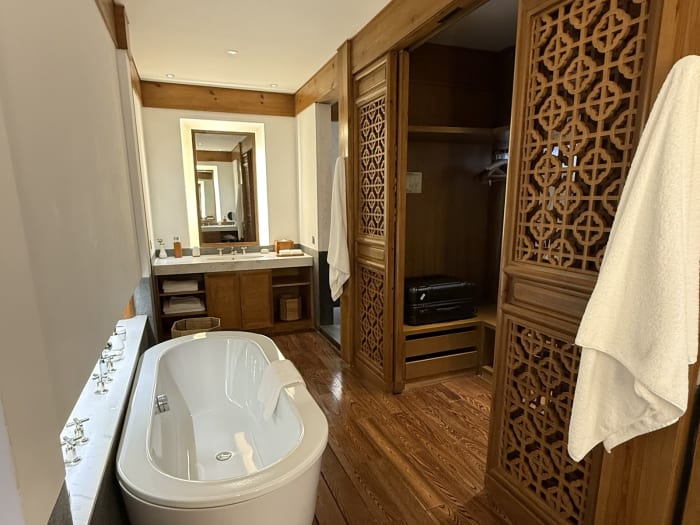
At Amandayan, the experience of the rooms and suites is a continuation of the location itself. Here, the same principles of balance, tranquility, and attention to materials are expressed in a more intimate form. The accommodations extend the overall architecture with their sense of proportion, understated elegance, and ability to allow space to breathe.
In a hotel of this nature, comfort is often measured by what is not immediately visible. The flow is seamless, the volumes are clear, the light is well managed, and the acoustics are preserved. Amandayan prioritises a restful atmosphere, where each element finds its place without overwhelming the eye. Materials inspired by the local context, natural tones, and finishing details create a continuity with the surrounding environment. The decoration remains discreet, never veering into anonymity.
The views play an essential role here. The mountains surrounding Lijiang transform the experience of a room. Waking up to the contours of the landscape, observing the light change throughout the day, and witnessing the darker outlines of the scenery in the evening: these simple gestures add depth to the stay. The window, terrace, or opening onto a courtyard become integral components of comfort.
The rooms and suites at Aman are designed as retreats, conducive to rest and reflection. This is reflected in the measured furniture, clean lines, generous bedding, bathrooms designed for relaxation, and a careful connection between the interior and exterior. At Amandayan, this philosophy truly comes to life. After a day spent in the old town, exploring workshops, alleys, or the surrounding landscapes, returning to one's room feels like rediscovering a slower pace of life.
The suites extend this idea of refuge. They are less about ostentation and more about the quality of life they offer. With more space, greater separation between different aspects of the stay, and the possibility to read, work occasionally, or contemplate the landscape in silence, this approach finds its natural place in Lijiang.
The rooms and suites at Amandayan do not attempt to divert attention from the location; rather, they deepen it. They provide an interior version of what the hotel offers on a larger scale: a dialogue between tradition and modernity, an aesthetic of restraint, and a constant relationship with light, materials, and the mountains. For couples, the setting remains serene. For solo travellers, it becomes a rare space for breathing.
The Dining Experience
At Amandayan, gastronomy is regarded as an integral part of the location, on par with architecture and landscape. In a setting defined by restraint, the dining experience unfolds with a distinct rhythm. Breakfast is enjoyed in the gentle morning light, a light lunch is taken between explorations, and dinner extends the tranquility of the day.
This approach to dining, harmonised with the stay, embodies the spirit of Aman. In Lijiang, a thoughtfully curated menu offers a sensitive interpretation of the region. A meal can serve as a gateway to the environment, the season, local craftsmanship, or cherished memories. The menu may intertwine local references with international cuisine, while maintaining a genuine connection to the area.
Atmosphere is as important as the food itself. In this mountainous setting, the dining experience evolves throughout the day. Mornings call for clarity, freshness, and simplicity. Afternoons invite a more informal pause, perhaps over tea or a light snack. In the evening, the meal becomes a time for reflection after a day spent walking in Lijiang or exploring the surroundings. Here, one seeks a cuisine that is accessible, balanced, and comforting without being heavy.
Discreet luxury is also reflected in the service. It is not about ceremony, but rather about attentive care. Knowing when to intervene, how to advise, and at what pace to allow the meal to unfold is crucial. In an Aman residence, this precision is part of the experience, enabling the traveller to feel supported without ever being overwhelmed.
Private moments also hold a special significance. In a destination where views and light are paramount, breakfast in the room, a meal in intimate surroundings, or a table chosen for its tranquillity take on a unique importance. This type of setting lends itself to personalised dining, tailored to the rhythm of each guest.
The gastronomy of Amandayan is thus appreciated as a natural extension of its identity. It prioritises coherence, sensitivity to context, and the joy of a meal experienced as a moment of respite. In Lijiang, this approach bridges the outdoors and indoors, exploration and relaxation.
Spa & wellness
Wellness at Amandayan is not confined to a dedicated facility; it begins with the way the hotel itself has been conceived. Silence, light, mountain views, natural materials and the property’s overall intimacy already create the conditions for genuine ease. In that context, the spa and related practices take on a broader meaning. They are not an artificial interlude within the stay, but a natural extension of an experience designed to slow the pace, restore breath and encourage a clearer state of mind.
Lijiang’s setting lends itself particularly well to this reading. The altitude, cleaner air, proximity to the mountains and the walking rhythm encouraged by the town and its surroundings all change one’s sense of the body. Recovery, hydration, stretching and deeper rest become more noticeable needs. A hotel such as Amandayan, with its retreat-like atmosphere, offers a coherent framework for meeting them. Wellness feels more credible here because it is aligned with the territory itself.
In the Aman spirit, the spa is generally a place of restraint, precision and personalisation. Without claiming unverified details about facilities or treatments, it is reasonable to expect an approach centred on listening to the guest, adapting care and maintaining a refined sensory environment. In this setting, that would mean spaces suited both to physical release and to mental quiet after travel, sightseeing or time spent in the surrounding landscapes.
Wellness at Amandayan can also be experienced beyond the treatment room. A slow start to the morning, gentle movement facing the landscape, reading in a peaceful corner, tea after a walk, or simply doing very little in a well-judged setting all contribute to the experience. In the best hotels, wellness is not merely a service but a quality that runs through the day. Amandayan seems particularly well suited to offering that continuity between active and restful moments.
For couples, this encourages a stay centred on reconnection without over-programming. For solo travellers, it offers a rarer luxury still: the ability to reset without feeling isolated.
Concierge & Services
At Amandayan, services are valued when they enhance the fluidity of the stay. Luxury lies in a simplicity that is both clear and natural.
In Lijiang, visitors come as much for the local culture as for the mountainous setting. The concierge does not merely organise; it interprets the place for the traveller.
It can recommend the best times to explore the alleys. It can suggest a walking tour. It can guide guests towards local craftsmanship. It can also create a balanced day, blending discovery with moments of respite.
This understanding of tempo is essential. A successful stay in Lijiang also depends on how one experiences it.
For couples, the service often involves discreet orchestration. A well-placed table, a more intimate moment, an excursion planned without apparent constraints.
For solo travellers, the challenge is different. It is about feeling accompanied without being constrained, advised without being directed.
Amandayan, through its positioning and atmosphere, naturally embodies this form of bespoke service.
The emphasis on local craftsmanship opens up a particularly relevant range of services. This can include targeted recommendations, guided visits, workshops, or a more nuanced understanding of objects and materials.
Service thus becomes cultural. It enriches the understanding of the place, going beyond the immediate response to a request.
It is also important to highlight the significance of invisible services. The quality of the welcome, the management of arrivals and departures, the discretion of housekeeping, and the precision of timings.
In a destination where days alternate between urban exploration and contemplation, these details shape comfort. The more the hotel masters these aspects, the lighter the stay feels.
Preparation in advance adds a sense of serenity. Understanding the traveller's profile, choosing the appropriate category, considering the pace, view, or ambiance.
At Amandayan, the experience rests on nuances. The best services are those that allow guests to fully immerse themselves in Lijiang and its landscapes.
The Lijiang way of life
Staying at Amandayan also means discovering a particular way of inhabiting Lijiang. The city is not revealed only through its best-known sights, but through subtler sensations: the texture of its lanes, the presence of water and stone, light on rooftops, the gestures of artisans, the rhythm of walking and the constant backdrop of mountains. Through its setting and attention to local culture, the hotel provides an excellent base from which to enter this way of life without reducing it to a checklist of visits.
Lijiang has an obvious heritage dimension, yet its appeal also lies in the coexistence of memory and daily use. One comes not only to observe an old urban fabric, but to sense how a territory continues to be lived in. That distinction matters. The most perceptive travellers are often looking less for sites than for atmosphere, logic and a way of being in a place. Amandayan responds well to that expectation because it offers more than comfort; it supports a subtler immersion based on walking, observation and unhurried time.
The simplest approach is often the best: to set out on foot, early or towards the end of the day, when the light reveals detail and the city’s rhythm becomes easier to read. This is why exploring on foot makes so much sense here. Walking allows one to understand the transitions between intimate courtyards and livelier passages, between urban perspectives and openings towards the mountains. For guests at Amandayan, whose stay is already shaped by contemplation and measure, this pedestrian experience is especially rewarding.
Local craftsmanship forms another essential thread. In a region where artisanal knowledge remains a living part of cultural identity, a textile, a carved detail or a crafted object often tells a story of transmission. One of Amandayan’s strengths is to make that reading more accessible, not through heavy explanation but through subtle correspondences between the hotel’s atmosphere, the experiences it encourages and what one discovers in town.
There is also in Lijiang a quality of time worth protecting. Many heritage destinations are visited too quickly; this one rewards pauses, returns and observation. Amandayan encourages precisely that availability.
Booking via MyConciergeHotel
Booking Amandayan through MyConciergeHotel means approaching this destination with the preparation it deserves. Not all luxury hotels require the same level of support. Some are chosen for their location, while others, like this one, are better understood when considering the rhythm of the stay, the relationship to the landscape, cultural immersion, and the pursuit of intimacy.
In Lijiang, the question is not merely where to sleep, but how to experience the destination. Some guests favour contemplation, while others prefer cultural walks or a stay focused on rest and wellness. Amandayan can meet these expectations, provided the stay is well calibrated. It is essential to guide guests towards the appropriate accommodation category, depending on the view, intimacy, or proximity to communal spaces.
Booking with MyConciergeHotel also allows for the experiential dimension of the stay to be prepared. Immersive experiences centred around local culture and craftsmanship benefit from being planned in advance, especially if one wishes to avoid an overly packed itinerary or, conversely, an underutilised stay. We assist in finding a balance between time spent at the hotel, walking discoveries, wellness, and gastronomic pauses.
This approach is particularly suited to couples seeking a fluid, intimate, and less standardised atmosphere. It also caters to solo travellers, for whom the right level of support can significantly enhance the experience. In a hotel like Amandayan, where everything hinges on precision rather than accumulation, these preparatory details matter.
Amandayan is not merely a prestigious address; it is a place to be experienced within its context: Lijiang, its mountains, its culture, and its way of life. This method of booking transforms the perspective on travel, allowing one to choose not only a hotel but also a tone, a rhythm, and a way of being on site.
For a destination where calm, light, and cultural depth are as important as comfort, this precision is essential. Amandayan is particularly well-suited to this approach, as its luxury is a matter of nuances.