History & Heritage
Aman Sveti Stefan is rooted in a place whose power comes not from staged scenery but from memory set in stone. The hotel occupies the historic islet of Sveti Stefan, linked to the mainland by a narrow causeway, a silhouette that has become one of the most recognisable on the Adriatic. Long before it was associated with contemporary hospitality, this fortified outcrop served defensive and communal purposes. Its dense layout, stone houses with tiled roofs, narrow lanes and small squares reflect an older way of inhabiting the Montenegrin coast, closely tied to terrain and sea winds.
What stands out here is the continuity between heritage and present-day use. Aman has not attempted to erase the site’s character beneath a standardised aesthetic. Instead, the spirit of the place rests on preserving vernacular architecture and interpreting what already exists with restraint. Historic buildings retain their original presence: stone walls, modest volumes, framed views of the sea, and circulation defined by passages, steps and terraces. This measured approach gives the whole a rare density. One does not enter a resort created from scratch, but an old village reimagined through the lens of contemporary comfort.
That approach largely explains the singularity of Aman Sveti Stefan within the Mediterranean hotel landscape. Where so many seaside addresses rely on display, this one favours precision. Luxury comes from the self-evidence of the setting, the quality of the silence, and the sense of being welcomed into a fragment of Adriatic history rather than a simple beach hotel. The relationship with time is particular here: materials seem as though they have always belonged, light reveals forms without exaggerating them, and the stay unfolds with an almost monastic slowness.
The Aman name adds another layer. The brand is known for choosing places of strong identity, where architecture, landscape and hospitality answer one another without unnecessary effect. In Sveti Stefan, that philosophy finds especially coherent ground. The property does not try to compete with the history of the site; it accompanies it. This discretion is essential to understanding the overall atmosphere: nothing feels imposed, everything seems to arise from a dialogue between local heritage and international standards of service.
To stay here is therefore to experience inhabited heritage. The stones are not museum pieces but the living framework of a stay oriented towards the sea, rest and privacy. The islet retains its symbolic force, almost theatrical when seen from the shore, yet once crossed it reveals a world of details: an old doorway, steps worn by time, a sheltered garden, a terrace catching the blue of the Adriatic. This historical depth gives the address a dimension that very few hotels can claim with such natural ease.
The Property
Aman Sveti Stefan’s first privilege is geographical: few hotels can claim a setting so instantly legible, so photogenic and yet so calming once experienced from within. The islet rises from the Adriatic with an almost unreal clarity, but the lived experience is less about spectacle than sensation. One comes for the light, for the constant nearness of the sea, for the feeling of being both sheltered and open to the horizon. That tension between refuge and panorama lies at the heart of the place.
The property stands out for the harmony with which it is integrated into the landscape. Nothing here disrupts the balance between architecture and nature. Historic buildings, restored with respect for their character, converse with lush gardens and sea views without trying to dominate them. The relief, stone walls, narrow passages and terraces create an intimate, almost labyrinthine topography that encourages a slower pace. Rather than crossing a monumental lobby before reaching one’s room, guests move through a collection of houses and outdoor spaces where each turn opens a new perspective over the coast or tiled roofs.
This layout gives the stay a very different tone from that of large seaside resorts. The address favours the sensation of inhabiting a place rather than merely occupying it. Shared spaces follow the same logic of discretion: they accompany the site more than they command it. Luxury is expressed through material quality, careful circulation, the framing of views and an overall impression of calm. Even when welcoming travellers from around the world, the atmosphere remains contained, almost confidential.
The Adriatic is present everywhere, not as a simple backdrop but as an active component of the stay. Its light changes throughout the day, from a clear blue in the morning to softer reflections towards late afternoon. From many points on the islet, the eye travels far across the water, while gardens and old walls create pockets of shade and coolness. This alternation between openness and retreat is part of the property’s charm. One can seek out the view, then return to a more protected, quieter space.
The exceptional natural setting reinforces this sense of chosen seclusion. Although the hotel is accessible by road and linked to the mainland, it retains a rare quality of separation. Once settled in, one feels a very tangible form of disconnection. The noise of the outside world seems to recede. The rhythm adjusts to walking, to the weather, to the desire to linger on a terrace or head towards the sea. For couples, this naturally creates a romantic experience, but it is equally suited to travellers simply seeking rest in a coherent environment free from unnecessary bustle.
Aman Sveti Stefan does not impress through display; it convinces through composition. A historic site, preserved Montenegrin architecture, gardens, the sea, and a keen sense of proportion: this alliance makes the property distinct, more contemplative than ostentatious, more rooted than theatrical.
Rooms and Suites
At Aman Sveti Stefan, accommodation is not best understood as a simple sequence of categories, but as a way of inhabiting a historic village with the comfort expected of a high-end address. That distinction matters. Rooms, suites and residences are set within old buildings whose structure and scale create a more intimate relationship with space. One may not find the symmetry or standardised volumes of a conventional modern hotel; in return, there is a stronger sense of authenticity, individuality and connection to the site.
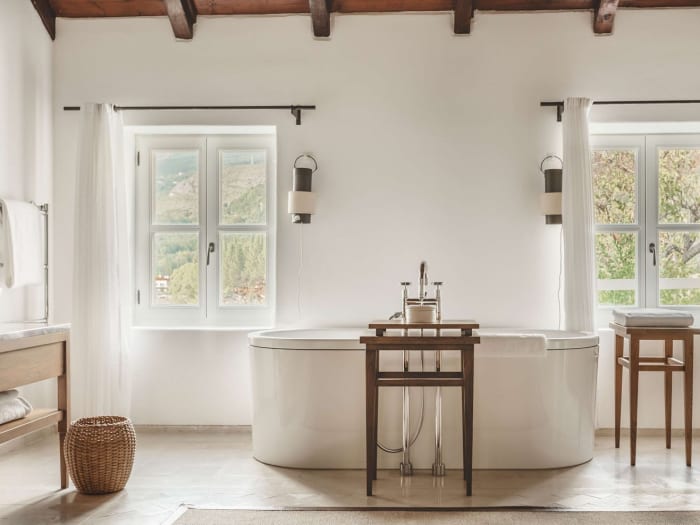
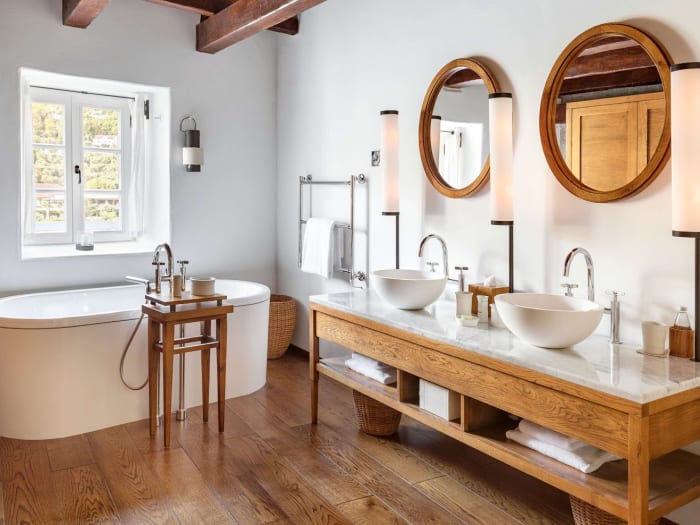
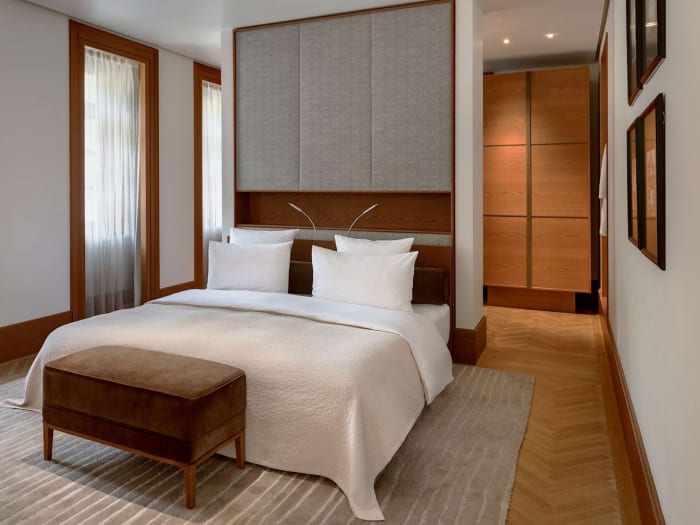
Traditional Montenegrin architecture forms the starting point of the experience. Stone walls, openings that frame the light, tiled roofs and the immediate nearness of the sea create a very particular envelope. The hotel intervention aims less to transform than to reveal. Interiors, in the Aman spirit, generally favour restrained lines, natural materials and a calming palette that allows the architecture to breathe. This reserve suits the place perfectly: it avoids competing with the historic character of the buildings and lets the view, the light and the textures take the lead.
Comfort is therefore expressed in details. Bedding designed for deep rest, bathrooms conceived as spaces of retreat, seating positioned for a panorama or a quiet read, and an internal flow that encourages calm all help make the room a refuge rather than a mere stopover. In a site of such visual power, it would have been easy to place all emphasis on the exterior. The intelligence of an address like Aman Sveti Stefan lies in preserving, within the accommodation itself, a quality of silence and concentration that extends the experience of the place.
Part of the charm lies in the diversity of settings. Depending on the location of a room or suite, the experience may differ: closer proximity to the sea, views over the island’s roofs, a more direct relationship with the gardens, or the sensation of being suspended between sky and Adriatic. This variety contributes to the property’s personality. It is a reminder that one is staying in a reinterpreted historic ensemble rather than a uniform building. For travellers sensitive to architecture, this dimension is especially valuable.
The overall atmosphere naturally suits stays for two. The setting, discreet circulation, softness of materials and constant presence of the landscape encourage a form of elegant withdrawal. Yet these rooms also appeal to solo travellers or aesthetes seeking a place where luxury is not expressed through technological or decorative display. Here, sophistication is quiet. It is measured in the quality of space, the coherence between indoors and outdoors, and the room’s ability to prolong the spirit of the island.
Booking a sea-view category obviously makes sense in a property of this nature. Yet beyond the panorama, the essential thing remains this rare impression of inhabiting a fragment of Adriatic heritage without giving up comfort. It is this delicate and difficult-to-reproduce alliance that makes the rooms and suites at Aman Sveti Stefan far more than accommodation: they are an experience of place.
Dining
The dining experience at Aman Sveti Stefan is best appreciated through its setting. Eating here is not simply about booking a table; it is about taking one’s place within a landscape. The nearness of the sea, Adriatic light, terraces opening onto the horizon and the presence of historic buildings give each meal an almost scenographic quality, yet never in an overdone way. The setting acts discreetly, as a natural extension of the plate and of the rhythm of the stay.
In a property of this kind, one expects less a display of virtuosity than a cuisine that is precise, readable and suited to the place. A Mediterranean register feels natural, shaped by the coastal geography and by the idea of dining that accompanies the day rather than interrupts it. One readily imagines light lunches facing the sea, more settled dinners as the stone still holds the day’s warmth, and breakfasts where the simplicity of the produce matters as much as the view. Without overloading the description with unverified details, it is fair to say that the spirit sought here is that of refined resort dining, attentive to seasonality, texture and freshness.
Part of the charm also lies in the scale of the setting. Because the hotel is spread across a historic ensemble, the culinary experience can feel more intimate than in a large resort. Dining spaces are embedded within the existing architecture and benefit from that distinct Adriatic relationship between indoors and outdoors. A terrace, a courtyard, a stone room open to the light: each subtly changes the perception of a meal. Here, the setting is not an extra; it forms part of the sensory experience.
For travellers, gastronomy often plays a central role in the memory of a stay. At Aman Sveti Stefan, that memory is likely to depend as much on atmosphere as on what is on the plate. The attentive service for which the property is known finds a natural field of expression at the table. Well-judged pacing, a fine reading of expectations, and the ability to preserve the intimacy of a lunch for two or a sunset dinner are the qualities that distinguish leading houses more than any flourish.
The address is particularly well suited to slow moments. A coffee facing the Adriatic at the start of the day, an extended lunch after a swim, an aperitif as the light fades, a terrace dinner carried by the discreet sound of the sea: dining here accompanies a way of inhabiting time. It suits couples, certainly, but also travellers who see the meal as an essential pause in a stay, a moment of observation as much as pleasure.
In that sense, the true luxury may be coherence. Cuisine designed for the place, service without stiffness, views that seek not to impress but to soothe, and the sense that nothing is separate: not the landscape, not the architecture, not the hospitality. At Aman Sveti Stefan, the table fully belongs to the overall experience, that of an Adriatic retreat where one comes as much to absorb the place as to dine well.
Spa & Well-being
At Aman Sveti Stefan, well-being transcends a mere dedicated space; it begins with the very location itself. The island, the sea, the gardens, and the pathways create a form of gentle therapy.
Even before treatments commence, a tangible sense of physical calm washes over you. Your gaze drifts far away, sounds diminish, and the pace of life slows down. In a place designed as a refuge, this quality of environment is essential.
Within the Aman universe, well-being is rooted in a philosophy of simplicity, precision, and personalisation. The approach favours bespoke treatments, relaxation rituals, and a focus on overall balance.
The spa here takes on a profound significance as an extension of the landscape. It invites a slower rhythm, allowing you to shed the tensions of travel. The Adriatic Sea, the light, and the sea air all contribute to this sensation of rejuvenation.
Well-being permeates the entirety of your stay. A morning walk on the island, a moment of reading in a garden, a silent pause on a terrace, or a restful time in your room are as valuable as a massage.
For couples, the atmosphere lends itself to intimate moments, fostering a spirit of calm and discretion. For solo travellers, the location offers a rare quality of re-centering.
From May to September, the mild and sunny climate allows for a full experience of the interplay between indoor and outdoor spaces, the sea, and areas for relaxation.
Attentive service takes on particular importance here. In the realm of well-being, the quality of a location is often measured by its capacity for listening. Understanding fatigue, adapting the pace, suggesting without imposing, and preserving intimacy are all vital.
At Aman Sveti Stefan, this relational intelligence harmonises with the spirit of the place, characterised by restraint, silence, and unpretentious comfort.
Ultimately, well-being here is about a holistic experience. The spa is one expression of this, but not the only one. The true luxury perhaps lies in the sensation of being removed from noise, facing the sea, and being available for deep rest.
The Art of Living in Sveti Stefan
Staying at Aman Sveti Stefan is to discover a certain vision of the southern Adriatic. Bright light, pale stone, Mediterranean vegetation, and a direct relationship with the sea.
Sveti Stefan is not a large city. It is a coastal place of relief and contemplation. The art of living here hinges on the quality of moments. Walking, swimming, leisurely lunches, observing the light, retreating into a garden, watching the evening fall over the water.
The island village imposes a unique rhythm. Here, you move on foot, in contact with stone and wind. This human scale transforms the stay. Luxury becomes a rediscovered availability. You notice a façade, a perspective between two houses, the way the roofs respond to the horizon. This simplicity can sometimes be surprising, but it quickly becomes one of the charms of the place.
The Montenegrin coast possesses a distinctive identity. It combines spectacular geography, historic villages, ancient coastal culture, and a sense of preservation. In Sveti Stefan, this identity is reflected in the traditional architecture, materials, and the relationship between the built environment and the landscape. The hotel, through its harmonious integration, allows you to experience this dimension without excessive filtering. You are not cut off from the territory; rather, you are subtly introduced to it.
For couples, the local art of living takes the form of a romantic stay, almost suspended in time. Days are organised around simple pleasures: waking up to the sea, having breakfast on the terrace, swimming, enjoying a late lunch, taking a nap in the shade, and then having an aperitif as the Adriatic changes colour. This economy of pleasure corresponds to the spirit of the place and explains why it attracts those seeking quality over animation.
However, Sveti Stefan is not merely a romantic postcard. It is also a starting point for understanding the Montenegrin coastline. Here, one perceives the coexistence of history and leisure, of built heritage and maritime landscape, of apparent simplicity and real sophistication. Travellers sensitive to architecture, photography, silence, or the notion of retreat will find a rich terrain.
The best time to visit extends from May to September. The coast fully reveals itself during this period, with bright days, mild evenings, and an omnipresent outdoor life. Even in high season, the true luxury here lies in preserving a sense of retreat. This is perhaps the essence of the art of living in Sveti Stefan: being on the edge of a coveted destination while inhabiting a measured, calm world turned towards the sea.
Booking via MyConciergeHotel
Booking Aman Sveti Stefan through MyConciergeHotel means approaching this unique destination with the preparation it deserves. Such a singular place cannot be chosen solely based on photographs; it requires an understanding of the site’s logic, the spirit of the stay, and the experience sought. Our role is to assist you in making these distinctions accurately: selecting an appropriate category, anticipating the season, arranging transfers, and considering the stay as a whole.
The hotel is particularly suited for couples seeking romance and travellers looking for a peaceful setting. This orientation directly influences the booking advice provided. Some may wish to maximise their view of the Adriatic, while others may prioritise intimacy, ease of access, or proximity to the island's historical fabric. Expectations vary between a few nights and a longer stay, and guidance helps refine these choices in advance.
The season also plays a crucial role. The period from May to September is the most favourable, featuring a mild and sunny climate. This leads to high demand, especially in the height of summer. Booking several months in advance is often the best way to secure the desired dates and configuration. For a place like this, the quality of the stay heavily relies on these preparatory details.
Access to the island is via the road, and transfer services are available. An accompanied reservation streamlines the experience from the moment of arrival. After the journey, the difference is measured in continuity: coherent schedules, a seamless welcome, special requests communicated in advance, and the travel rhythm respected. In a home where calm and attention are paramount, this preparation is part of the stay.
Booking through MyConciergeHotel also provides you with an independent editorial perspective on the destination. We strive to verify the alignment between a place and your expectations. Aman Sveti Stefan will particularly appeal to those who appreciate characterful hotels, heritage sites, understated beauty, and stays where one slows down. If you are seeking a lively atmosphere or a flashy resort, it is best to know this before confirming.
Finally, our support helps you consider the stay beyond the room: moments to prioritise on-site, the ideal rhythm based on duration, special requests for a couple's occasion, or optimising the experience. In a place like Aman Sveti Stefan, where everything hinges on the quality of sensation, these nuances matter. Booking is about preparing the conditions for a stay that is just, seamless, and true to the spirit of the place.