History & heritage
Amanemu belongs to a dual lineage that immediately defines its identity. On one side stands Aman, a hotel brand known for discreet luxury, a strong sense of space, and a way of bringing architecture, landscape and silence into conversation. On the other is traditional Japan, where hospitality is measured not by display but by the quality of attention, the precision of gestures and the intimate relationship between a place and its setting. In Shima, this meeting takes a particularly coherent form: a contemporary retreat inspired by Japanese aesthetics, designed to slow the pace and place the stay within a calmer rhythm.
The very name of the property says much about this intention. The Aman universe has long suggested addresses conceived as sanctuaries, often rooted in powerful natural settings, where the experience relies more on serenity than spectacle. At Amanemu, that philosophy finds an ideal setting in the Shima region, known for its gentle relief, bays, forests and maritime atmosphere. The hotel does not seek to dominate the site; rather, it seems to settle into it with restraint, in a spirit recalling certain traditional Japanese residences open to nature and attentive to the seasons.
The cultural heritage referenced here is never museum-like. This is not about reproducing a postcard version of Japan, but about retaining enduring principles: simplicity of line, the importance of natural materials, the balance between indoors and outdoors, the presence of water, the role of emptiness, and the essential idea that comfort comes as much from harmony as from equipment. The result is an address that speaks both to travellers familiar with Japan and to those wishing to encounter a more contemplative expression of it.
In this sense, Amanemu can be read as a contemporary interpretation of the Japanese art of staying well. Wellbeing occupies a central place, echoing the culture of bathing and hot springs that has shaped an important part of daily life and travel in Japan for centuries. Calm is not a marketing promise here; it is the very substance of the experience. Guests come to inhabit a landscape, to recover a form of inner availability, and to experience a kind of luxury that privileges presence.
This notion of heritage is also felt in the way the property embraces its belonging to a specific territory. Shima is not an interchangeable backdrop. The light, sea air, vegetation and seasonal shifts between spring, summer, autumn and winter give each stay a different tone. Amanemu draws its singularity from this relationship with place, which is perhaps what makes it timeless: it rests not on trend, but on a thoughtful reading of what the Japanese landscape can offer when respected and interpreted with intelligence.
The Establishment
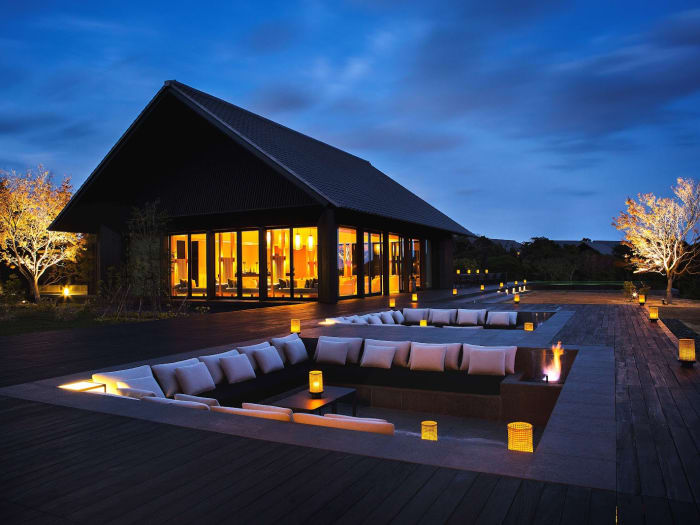
At Amanemu, the foremost luxury is that of space. The establishment unfolds as a collection of low volumes, tranquil pathways, and vistas of nature. Nothing appears abrupt here. The architecture favours a gentle integration into the landscape of Shima, drawing inspiration from traditional Japanese forms while offering a contemporary interpretation of materials, light, and proportions. This formal restraint instils a sense of calm from the moment of arrival.
The natural setting plays a pivotal role. Close to the Inland Sea of Seto, the hotel enjoys an environment where water, terrain, and vegetation create a dynamic backdrop. In the morning, the light accentuates the clarity of architectural lines and the simplicity of materials. As the day wanes, the landscape becomes more diffuse, almost meditative. This relationship with the outdoors is essential. Amanemu is a place to contemplate, to listen, and to gradually attune oneself to the surroundings.
The communal spaces extend this philosophy. They are designed to provide comfort and breathing space, devoid of decorative overload. The lounges, terraces, and transitional areas allow for significant visual silence. Japanese design references are evident, with horizontal lines, wood, mineral tones, and framed openings that capture the landscape. The emptiness becomes a compositional element. This coherence produces an immediate effect. One feels enveloped in a retreat structured around balance.
The overall atmosphere is suited to those seeking an introspective stay. It does not exclude the simple pleasure of inhabiting a beautiful hotel. Amanemu combines sophistication with discretion. The service supports without intruding. The spaces maintain intimacy, whether one travels as a couple, alone, or with family.
What also distinguishes the establishment is its ability to evoke a sense of timelessness. In many luxury hotels, the focus is on the accumulation of amenities. Here, the experience rests on the quality of one’s presence in the place. Walking between different spaces, observing the variations in the sky, lingering on a terrace, returning from a treatment or a meal—time seems to slow down naturally. This apparent simplicity is, in reality, meticulously constructed.
Amanemu thus appeals to travellers who appreciate destinations where architecture is not an autonomous decoration but acts as a mediation between man and landscape. In Shima, this mediation takes a particularly fitting form. The hotel does not seek to compete with nature; rather, it offers a framework for observation and experience. It is this intelligence of place that gives the whole its depth.
Rooms and Suites
The rooms and suites at Amanemu extend the language of the establishment: clean lines, natural materials, a calming palette, and a constant connection to the landscape. Comfort is derived from a sense of clarity, fluidity, and spaciousness. The Japanese spirit is evident in the composition of the spaces, the light, the attention to textures, and a discreet elegance.
The interiors are designed to promote rest. The volumes allow the gaze and air to flow, while the furniture reinforces a sense of order and calm. Natural materials play a crucial role: wood, mineral tones, understated textiles, and surfaces that absorb light. Each element supports an atmosphere of retreat.
One of the major attractions of a stay at Amanemu lies in the relationship between the accommodation and the external environment. From the room or suite, the landscape remains close. The openings, terraces, and transitional spaces invite one to observe the variations in the weather, the vegetation, the light of Shima, and the natural rhythm of the site. This continuity between indoors and outdoors signifies a true interpretation of Japanese hospitality.
For couples, the experience takes the form of a silent refuge. For solo travellers, these rooms provide a conducive setting for reading, resting, contemplation, or quiet work. Families can find a peaceful base, especially if they seek a stay focused on serenity.
What is particularly striking is how the accommodation complements the slowing pace of the stay. One returns after a treatment, a walk, or dinner with the impression of entering a space that shields from the noise of the world. Here, luxury is found in a room that does not unnecessarily demand attention. It welcomes, it rests, it centres.
Amanemu offers a refined vision of the contemporary holiday room: a place of intimacy, silence, and connection with nature. Travellers sensitive to interior architecture, the art of detail, and calming atmospheres will find an experience true to the Aman spirit: contained elegance, profound comfort, and a lasting sense of harmony.
Dining
At Amanemu, dining naturally follows the broader logic of the place: precision, seasonality, apparent simplicity and attention to the overall experience rather than effect. In a property where landscape and wellbeing are central, the table is there to extend that sense of balance. Guests come in search of cuisine that is clear in intention, rooted in its surroundings and served in a setting that leaves ample room for calm and contemplation.
The context of Shima suggests a cuisine attentive to place. In this maritime region, the relationship to the sea, local produce and the rhythm of the seasons naturally forms part of the Japanese experience. Without claiming unconfirmed details about menus or specific culinary signatures, it is fair to say that a stay at Amanemu calls for an approach in which freshness, clarity of flavour and respect for ingredients take precedence. This is a constant in great Japanese hospitality: sophistication lies not in visible complexity, but in the accuracy of cooking, seasoning, texture and progression.
The setting of the meal matters as much as the plate. In a hotel of this nature, the restaurant is not merely a place to eat; it shapes the rhythm of the day. Breakfast may become a gradual awakening, in dialogue with morning light and the quiet of the site. Lunch often belongs to a lighter tempo, suited to a day of rest or spa. Dinner, meanwhile, extends the retreat-like quality of the stay, with a more hushed atmosphere conducive both to quiet conversation and to silent meals facing the landscape.
For international travellers, Amanemu also offers an accessible introduction to a certain idea of contemporary Japanese dining: cuisine that values season, origin and purity of flavour while meeting the expectations of a deeply comfortable hotel. Couples will find a setting particularly suited to meals for two, without excessive theatricality. Solo travellers may appreciate the serenity of the place, which makes dining alone feel entirely natural. Families, too, can enjoy an orderly and peaceful environment, provided they share that same desire for calm.
What distinguishes dining in such a context is its ability to integrate into a broader experience of staying well. After a day shaped by bathing, rest or contemplation, the meal becomes a way of extending attentiveness to oneself. It is not only about eating well, but about eating appropriately, in a setting where every detail seems to invite a slower pace. This coherence between cuisine, architecture and landscape is one of Amanemu’s more subtle pleasures.
In practical terms, it makes sense to approach dining here as an essential component of the stay, on a par with the spa or the room. Reserving certain moments, allowing time for an unhurried dinner, or simply giving oneself over to a long breakfast can transform one’s perception of the place. At Amanemu, gastronomy is not a separate spectacle: it is part of an art of staying founded on harmony.
Spa & Wellness
At Amanemu, wellness is one of the focal points of the stay. In Shima, the spa takes on a unique dimension, extending the landscape, architecture, and the Japanese approach to the body and rest.
In Japanese culture, the experience of bathing and hot springs transcends the Western notion of a spa. It encompasses hygiene, comfort, regeneration, and a certain quality of presence. Amanemu embraces this heritage with a contemporary interpretation of wellness. The facilities and personalised treatments are primarily aimed at recreating a state of balance.
The atmosphere of the spa is as important as the treatments themselves. At Aman, one finds an aesthetic of restraint, fluid circulation, and spaces designed for decompression. Silence, light, materials, and the relationship with water all contribute significantly to the experience. This continuity between the place and the gesture distinguishes exceptional wellness experiences from mere hotel services.
Couples will find an environment conducive to reconnection and shared relaxation, while solo travellers will appreciate the opportunity to make the hotel a personal retreat. On a longer stay, wellness becomes a daily thread—taking a bath, enjoying a treatment, resting, walking, and then returning to calm in the room.
It is advisable to book treatments in advance. The best slots often allow guests to enjoy the morning light or the relaxation of the day's end. It is also wise to organise one's stay around this spa time. At Amanemu, wellness is not an add-on; it is a way of inhabiting the place.
The hotel offers a luxury experience centred on deep recovery. The possibility of truly resting, breathing, and returning to the present makes it a unique destination.
Concierge & Services
At a venue like Amanemu, the services stand out for their ability to make the stay seamless, quiet, and tailored to the traveller's expectations. Luxury here is not about overt excess; it manifests in the quality of the welcome, the discreet anticipation of needs, the availability of the staff, and that rare impression that everything has been thoughtfully arranged to simplify the experience without rigidifying it. This is the type of service associated with the Aman collection.
The concierge plays a vital role in this orchestration. In an environment like Shima, where guests come both to retreat and to explore, it allows for a finely tuned experience. Some travellers will organise their time around the spa, meals, and rest, while others may wish to enrich their stay with outings, walks, or local experiences. The value of a good concierge lies in its ability to read rhythms, understand preferences, and suggest without imposing.
Personalised service takes on full meaning here. It can be expressed in preparing for a serene arrival, paying attention to staying habits, coordinating treatment or dining schedules, or managing special requests with efficiency and restraint. In the best hotels, service never interrupts the feeling of intimacy; it protects it. Amanemu belongs to that category of establishments where one feels cared for without feeling observed.
This quality of service is particularly appreciated for stays as a couple, where one desires everything to flow naturally, without apparent logistics. It is equally beneficial for solo travellers, who can rely on a reassuring and precise environment, or for families seeking a calm, well-organised atmosphere that respects each individual's rhythm. In all cases, the success of the stay often hinges on invisible details: a well-coordinated transfer, a treatment booked at the right moment, a table confirmed effortlessly, a recommendation suited to the weather or the day's energy.
One of the great merits of a hotel like Amanemu is understanding that high-level service is not about occupying space but making it more habitable. This requires teams trained in listening, discretion, and consistency. In the Japanese context, this expectation aligns with a culture of hospitality founded on attention, precision, and respect for the visitor.
Booking through an attentive contact or a specialised concierge can enhance this experience, allowing for the anticipation of the stay's priorities even before arrival. For a venue focused on well-being and serenity, this advance preparation directly contributes to the quality of time spent on-site. At Amanemu, services find their accuracy when they serve a singular purpose: to leave the traveller with the rare feeling of a perfectly attuned stay.
The Art of Living in Shima
Staying at Amanemu is to discover a certain idea of Shima: a less urban, more pastoral, and quieter Japan. This part of the country captivates with its relationship to the sea, gentle hills, and bays. For the traveller, this distinction is precious. It allows one to approach Japan through nature, the seasons, daily gestures, light, and attention to detail.
The local art of living hinges on this constant proximity to the environment. In Shima, the gaze is drawn to the water, the lines of the shore, the vegetation, and the changing skies. The stay then takes on a contemplative tone. One walks, observes, breathes more deeply. Even without multiplying excursions, simply inhabiting this landscape alters the perception of time. Amanemu, through its location and atmosphere, fosters this experience.
Rural or coastal Japan often offers a more subtle interpretation of hospitality and daily life. One perceives the importance of the seasons, the value of silence, the beauty of simple materials, and the care taken in transitions. These are precisely the elements that the hotel showcases. A stay at Amanemu does not necessarily involve filling one’s days but rather accepting a form of availability: taking the time for a bath, a meal, a walk, or a pause on a terrace.
Spring and autumn align well with this logic. They are seasons when Japanese nature presents itself with intensity, without the climatic extremes of summer or winter. The colours, light, and temperatures invite enjoyment of outdoor spaces and the relationship with the landscape. The other seasons retain their appeal, but these periods offer a pleasant balance for a stay oriented towards relaxation.
For couples, Shima can become the backdrop for an intimate interlude, away from the usual tourist circuits. For solo travellers, the region provides a conducive setting for reflection, reading, and centring oneself. Families will find less a destination for activities than a quality environment, where one travels with greater calm and attention.
In Shima, the art of living rests on a simple truth: the luxury of time. Time to look, to rest, and to feel a place without rushing through it. Amanemu embodies this philosophy with coherence. The hotel is not merely a comfortable base; it becomes a way to enter a more introspective Japan, where elegance arises from the relationship between nature, architecture, and hospitality.
Book with MyConciergeHotel
Booking Amanemu through MyConciergeHotel means approaching the stay with the level of preparation that an address founded on serenity, the right rhythm and attention to detail truly deserves. In a hotel where the experience depends less on an accumulation of activities than on the quality of the sequence between arrival, accommodation, dining, spa and free time, support before arrival has genuine value. It is not simply a matter of confirming a room, but of creating the conditions for a stay that feels fluid, coherent and aligned with expectations.
This preparation is all the more useful because Amanemu attracts travellers in search of calm, often attentive to the quality of timings, the structure of the stay and the possibility of reserving key moments in advance. A spa treatment, dinner at the preferred hour, a desired balance between rest and discovery, or the planning of a more introspective couple’s stay are all elements that benefit from being considered before arrival. In this kind of property, details have a direct impact on the overall perception of the experience.
MyConciergeHotel makes it possible to give that shape to the journey. The value of editorial and concierge support lies not only in the booking itself, but in the ability to guide the stay with discernment. For Amanemu, this may mean recommending the best period according to sensitivity to climate and landscape, suggesting a stay length suited to the pace of the place, or simply underlining the importance of booking the spa in advance in order to fully enjoy the hotel’s wellbeing dimension.
For couples, this approach helps create an interlude that is genuinely restful, without logistical friction. For solo travellers, it provides a clear and reassuring framework, particularly valuable when choosing a retreat destination. For families, it helps assess the fit between the hotel’s atmosphere and the aims of the trip. In every case, the objective remains the same: to ensure that the experience begins before departure, through preparation that is precise without being excessive.
Booking through MyConciergeHotel also means benefiting from an editorial perspective capable of placing Amanemu within a more demanding geography of contemporary luxury. The hotel does not suit every traveller profile in the same way, and that is precisely part of its value. It is above all for those seeking calm, space, wellbeing and a sensitive immersion in a Japanese landscape. The right advice, then, is not to overdo things, but to book appropriately: the right season, the right rhythm, the right moments.
In Amanemu’s case, that sense of appropriateness changes everything. A well-prepared stay allows guests to grasp what is most precious about the place: its ability to slow time, restore attention and offer a rare form of luxury founded on harmony. That is the promise MyConciergeHotel helps translate into practical terms, turning a reservation into a carefully composed stay.