History & heritage
Amanfayun is less a hotel in the conventional sense than a retreat: a preserved hamlet where contemporary hospitality is set within surroundings that feel as though they have always been there. In Hangzhou, a city long associated with landscape, poetry, gardens, wooded hills and temples, that setting carries particular resonance. The Aman approach finds natural expression here: not ostentation, but restraint; not spectacle, but slowness; the sense of being welcomed into a place that values depth of time over immediate effect.
The name Fayun refers to an area historically connected to Hangzhou’s western hills, close to spiritual sites and old pathways. In this part of the city, urban life gradually gives way to bamboo groves, plantations, footpaths and traditional villages. Amanfayun belongs to that continuity, reinterpreting a cluster of local-style houses restored with notable sobriety. The significance of the property lies precisely in this approach: preserving domestic scale, materials, simple volumes, courtyards, passageways and rooflines rather than imposing a dramatic architectural gesture. One does not arrive at an urban grand hotel; one enters a discreet, almost silent composition that allows the site to speak.
This way of inhabiting heritage without freezing it aligns closely with Aman’s identity. The brand has built its reputation on addresses where architecture, landscape and the rhythm of a stay form a coherent whole. At Amanfayun, that philosophy feels especially persuasive because it engages with a region where harmony between the built environment and nature is deeply rooted in the cultural imagination. The property does not attempt to recreate an idealised past; it preserves its spirit while delivering the comfort expected of a five-star hotel.
A sense of inheritance is also present in the everyday experience. Paths, courtyards, thresholds, gardens and shared spaces suggest a place that has been lived in rather than staged. That quality is rare. It stems as much from the restoration as from the way the stay is conceived: gentle circulation, privacy, respect for quiet, and attention to useful detail rather than demonstrative signs of luxury. In Hangzhou, where history and landscape are constantly intertwined, Amanfayun offers a particularly intelligent reading of hospitality: an address that recedes just enough to let the memory of the place emerge.
The setting
Amanfayun’s first luxury is its setting. In Hangzhou, the property sits within an environment where nature is not merely a backdrop but a constant presence. Hills, plantations, vegetation-lined paths and the nearby rice fields create a landscape that immediately encourages a slower pace. It quickly becomes clear why this part of the region appeals to travellers in search of space to breathe: the light shifts throughout the day, sounds are softened, and the sense of remove is genuine without severing access to the city.
What stands out is the way the hotel merges with this setting. Amanfayun does not attempt to dominate the landscape; it belongs to it. Low-rise buildings, natural materials, inner courtyards and pedestrian pathways create the impression of a discreet, almost hidden village. This harmonious integration is one of the property’s most persuasive qualities. It shapes the stay in a distinctive way: one does not simply look at nature from the hotel, one feels temporarily immersed in it.
The relationship to space is designed to encourage switching off. Here, transitions matter as much as destinations: walking from one pavilion to another, crossing a shaded lane, pausing in a garden, reaching a shared space without ever losing contact with the outdoors. That fluidity contributes to the deeply calming atmosphere. For couples, but equally for solo travellers or guests simply wishing to step away from urban rhythm, Amanfayun offers a form of quiet that is not absolute silence, but a subtle balance between human presence and the natural world.
The property is particularly suited to those seeking a stay rooted in place. Hangzhou is renowned for its scenery and its gentler pace of life; Amanfayun offers an intimate interpretation of both, away from the main flows. One comes here to walk, read, watch the weather change, linger over tea and recover a slower relationship with time. The milder seasons are especially pleasant for enjoying the outdoors, though the property’s charm also lies in its ability to feel like a refuge when the air turns cooler or more humid.
In practical terms, the hotel combines this sense of retreat with the service standards of an international luxury house. Access remains comparatively straightforward for an address of this nature, allowing a stay to be planned without undue complexity. Once on site, everything is arranged so that the environment can do the rest: less display, more precision. It is exactly this restraint that sets Amanfayun apart among destination hotels.
Rooms and suites
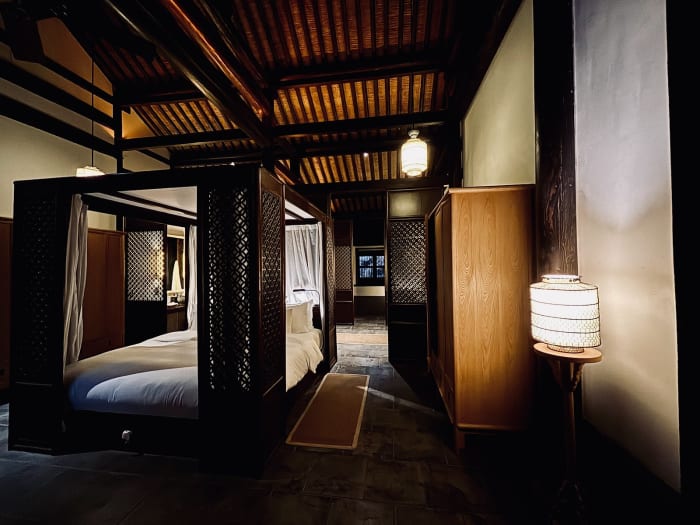
At Amanfayun, accommodation extends the wider logic of the estate: prioritising lived-in space, materiality and quiet over effect. Rooms and suites are set within buildings inspired by local architecture, creating the distinctive impression of inhabiting a house rather than a standard hotel unit. That is an important nuance, because it changes the nature of the stay. One does not merely occupy a comfortable room; one enters a more domestic, more settled rhythm in which each return to one’s private space becomes a moment of retreat.
The interior style is defined by controlled simplicity. Lines remain clean, volumes legible, and palettes generally soothing. Natural materials, wood, matte textures, understated fabrics and filtered light all contribute to an atmosphere of serenity. Nothing feels overworked. The elegance lies in balance, in the quality of finishes, and in the sense of continuity between interior space and the surrounding landscape. That restraint is especially valuable in a place dedicated to switching off: the eye rests, and so does the mind.
Depending on the category selected, layouts offer greater scale and more separation between sleeping and living areas, yet the spirit remains constant. There is the same commitment to privacy, to framing views of greenery or the estate’s pathways, and to creating a direct relationship with the environment. Openings, thresholds, sightlines and, in some cases, private outdoor areas extend the feeling of living in step with the site. For couples, this configuration works particularly well: it encourages quiet time, unhurried mornings and the gentle return from a walk without any abrupt break from the atmosphere outdoors.
Comfort meets the standards expected of an international five-star address, though here it is expressed without emphasis. Bedding, bathrooms, essential in-room amenities and the quality of room service all contribute to a seamless experience designed never to distract from the place itself. That is often the mark of the most accomplished hotels: the features are all present, yet they do not insist on being noticed.
These rooms and suites will particularly appeal to travellers sensitive to architecture, to the idea of retreat and to a certain aesthetic of silence. Those seeking a dramatic décor or overt theatricality will find more demonstrative expressions of luxury elsewhere. Amanfayun offers something different: deep comfort rooted in the landscape, where one sleeps well, reads willingly and takes time to do very little. In a destination as evocative as Hangzhou, that controlled simplicity may well be one of the stay’s greatest privileges.
Dining
Dining at Amanfayun follows the same logic as the rest of the stay: an experience designed to accompany the setting rather than divert attention from it through performance. Guests come here in search of a certain quality of presence, and the table plays a full part in that feeling. Meals take on an almost ritual dimension, not through excessive sophistication, but because they are woven into a slower, more attentive rhythm. An unhurried breakfast, a light lunch after a walk, a quiet dinner: each moment gains depth when placed within this environment of hills, greenery and relative silence.
In a property of this kind, the interest lies not only in what is on the plate, but in how the cuisine engages with the territory. Hangzhou has a recognised culinary culture shaped by seasonality, freshness and a search for balance rather than display. Without claiming unverified details about menus or chefs, it is fair to say that Amanfayun naturally lends itself to a local reading of dining, attentive to regional flavours and a certain delicacy of execution. That approach suits the spirit of the place perfectly.
Dining spaces in such a context are essential. They must provide comfort without breaking the atmosphere of retreat. One expects calm rooms, terraces or openings onto greenery when the weather allows, and a discreet staging in which conversation, light and landscape remain in the foreground. For couples, these meals often become among the most lasting memories of a stay precisely because they are not overloaded with effects. The luxury lies in the availability of time, in the quality of service, and in the attention paid to the guest’s own rhythm.
Service matters as much as the cooking. In the Aman universe, it is generally distinguished by precision and restraint. At Amanfayun, that quality makes particular sense: being present without intruding, accompanying without over-formalising, understanding that dinner in a place like this is as much about atmosphere as technique. This intelligence of service is especially valuable in a hotel chosen above all for restoration and calm.
Dining here will therefore appeal to travellers who appreciate cuisine that remains in tune with its environment, without theatrical presentation. Rather than functioning as a standalone gastronomic destination, Amanfayun offers a way of eating in harmony with the stay: meals that extend the sense of quiet, leave room for the landscape and contribute in very concrete terms to the experience of switching off. In a hotel world often tempted by excess, that coherence carries real value.
Spa & wellbeing
At Amanfayun, wellbeing does not begin and end with the spa. It starts on arrival, in the quality of the quiet, in the presence of greenery, and in the way the buildings allow air and light to move through them. That is perhaps what makes the experience especially convincing: treatment does not feel like an isolated activity added to the stay, but the natural extension of an environment designed to soothe. The spa then gives more structured form to that feeling, offering a dedicated setting for release, bodily attention and the recovery of inner rhythm.
At an Aman property, one expects a certain precision in wellness: restrained spaces, a hushed atmosphere, personalised treatments and, above all, a refined understanding of what guests are actually seeking. At Amanfayun, that approach feels entirely appropriate. The hotel draws travellers who often come to withdraw, rest and recentre themselves. The spa answers that expectation by creating an experience in which the quality of time matters as much as the treatment itself. Booking ahead is sensible, not least because such moments integrate so naturally into the stay.
The value of a spa like this also lies in its dialogue with the outdoors. After a walk nearby, a morning spent exploring Hangzhou’s landscapes or simply a few quiet hours reading and resting, a treatment feels like a continuation rather than a break. One does not step into an artificially separate world; one deepens a state of calm already in progress. For couples, this is especially appealing, allowing a stay to be shaped around simple rituals: a walk, tea, a treatment, a quiet dinner, a restful night.
Beyond the treatments themselves, wellbeing at Amanfayun amounts to a broader hygiene of the stay. Sleeping in a quiet environment, walking in natural surroundings, reducing visual noise and regaining a finer attention to sensation: all of this forms part of a kind of luxury that has become increasingly rare. The body rests because the mind is no longer being constantly solicited. From this perspective, the spa is not merely an expected feature of a five-star hotel; it becomes one of the anchors of a more comprehensive experience of disconnection.
This property will therefore particularly suit travellers for whom wellbeing is not simply a checklist of facilities, but a quality of atmosphere. Amanfayun offers what few hotels assemble with such coherence: a natural setting conducive to relaxation, a calm mood centred on restoration, and a spa that fits seamlessly into the whole. Here, taking care of oneself is not an intensive programme; it is a way of inhabiting the place slowly and attentively.
Concierge & services
In a place such as Amanfayun, the most valuable services are often those that barely announce themselves. The property does not rely on a visible accumulation of amenities, but on an ability to make a stay feel fluid, calm and precisely attuned to each guest’s expectations. That discretion is itself demanding. It requires a concierge team capable of anticipating without imposing, organising without burdening, and understanding that travellers who choose Amanfayun are primarily seeking serenity.
The role of concierge takes on particular importance here because a stay is often built around a subtle balance between retreat and discovery. Some guests will wish to devote most of their time to the estate, its spa, its restful spaces and its immediate surroundings. Others will want to explore more of Hangzhou — its emblematic landscapes, pathways, temples or livelier districts — before returning to evening calm. The value of good service lies precisely in this ability to modulate the rhythm, to offer relevant suggestions, to reserve a treatment, arrange a transfer, or recommend the right moment for a walk or visit.
In the Aman world, service is generally associated with considerable restraint. At Amanfayun, that quality is essential. Staff accompany the stay without altering its tone. Attention is directed towards real comfort: a thoughtful welcome, efficient assistance, constant availability that never feels heavy-handed. It is this kind of service that allows a place to remain faithful to its atmosphere. Too much formality would break the sense of retreat; too much distance would undermine the feeling of being genuinely looked after. Balance is therefore central.
For couples, this intelligence of service often translates into great ease of use. It becomes simple to imagine a tailor-made rhythm: a quiet breakfast, an outing nearby, a return for a treatment, a dinner without excessive time pressure. Practical details, when well handled, free up mental space. And in a hotel designed for switching off, that inner availability matters enormously.
Booking certain experiences or treatments in advance remains advisable, especially if wellbeing is to structure the stay. Beyond that, Amanfayun works precisely because it does not overwhelm the traveller with options. Services exist to support a particular quality of presence to the place. This philosophy will appeal to those who expect a great hotel not to multiply stimuli, but to create the conditions for a stay that is simple, elegant and deeply restorative.
The Hangzhou way of life
Staying at Amanfayun also means approaching Hangzhou through one of its most subtle faces. The city has long been associated in the Chinese imagination with a form of landscaped elegance and cultivated gentleness. People come for the hills, tea plantations, temples, shaded pathways, the region’s celebrated waters and the very particular way in which landscape structures daily life. Even without attempting to see everything, simply being based in this setting is enough to understand why Hangzhou occupies a singular place.
Amanfayun enables precisely this more sensitive reading of the destination. The property does not merely provide a comfortable base; it places the traveller in the right frame of mind to feel the territory. Morning light on the greenery, the possibility of setting out on foot or easily reaching certain sites during the day, and the return to quiet in the evening all shape an experience in which the city is approached not as a sequence of attractions, but as a way of life. For travellers who prefer depth to accumulation, that distinction is essential.
Hangzhou is particularly well discovered at a measured pace. It is often more fitting to favour a few walks, contemplative pauses and time spent outdoors rather than an overly dense programme. Amanfayun’s surroundings naturally support this approach. The proximity of rural scenery and rice fields, the presence of pathways and the general atmosphere of the area all invite gentle exploration. For couples, this way of travelling is ideal: it leaves room for spontaneity, conversation and the feeling of sharing a place rather than consuming it.
The local art of living is also expressed through attention to simple gestures: drinking tea, observing seasonal change, appreciating a cuisine that does not need to be demonstrative in order to be memorable, and considering walking an activity in itself. Amanfayun captures this dimension particularly well. The hotel does not imitate Hangzhou; it offers a hospitable translation of it that feels coherent and respectful. That is what makes it especially relevant both for a first stay and for a more contemplative return.
For French travellers drawn to destinations where landscape, culture and daily rhythm form a whole, Hangzhou has an evident appeal. And Amanfayun offers one of the calmest entry points into it. Here one encounters an idea of luxury measured not only by material comfort, but by the quality of one’s relationship with place. In that sense, the stay becomes more than a hotel interlude: it becomes a way of listening to a city whose reputation has, for centuries, rested on the balance between nature, culture and serenity.
Book with MyConciergeHotel
Booking Amanfayun through MyConciergeHotel means choosing editorial and practical guidance suited to a property whose value depends largely on the accuracy of the stay. Luxury hotels are not all booked in the same way. Some require comparison of room categories; others demand particular attention to views, location or facilities. Amanfayun, above all, asks that one clearly understands what one is coming for: calm, immersion in a natural environment, a retreat-like experience for couples or solo travellers, and a slower relationship with time. That is precisely where informed advice makes a difference.
Our role is to help you choose the right rhythm and the right stay configuration. Depending on the season, the length of stay and your priorities, it may be wiser to spend more time on site rather than attempting an overly ambitious regional programme. Amanfayun is especially well suited to stays in which doing less allows one to feel more. We can therefore advise on ideal duration, the value of reserving treatments in advance, and the best way to balance discovery of Hangzhou with restorative time at the estate.
For couples, the property works remarkably well as a restorative escape. For solo travellers, it offers a rare setting for recentring. For a first introduction to Hangzhou, it allows entry into the destination through landscape and serenity rather than bustle. These are important nuances, and they matter when booking. A successful stay at Amanfayun often depends on apparently small decisions: the right room category, a sufficiently unhurried schedule, a treatment booked at the right moment, a transfer arranged without friction.
Booking with MyConciergeHotel also means benefiting from an independent perspective attentive to the overall coherence of the experience. We do not seek to sell an accumulation of options, but to help shape a stay that remains faithful to the spirit of the place. In the case of Amanfayun, that often means recommending simplicity: arrive with time, avoid overloading the days, and leave genuine space for the spa, walking, rest and spontaneity.
If you are considering this address, it is worth planning ahead, particularly for the most pleasant times of year and for spa appointments. Amanfayun appeals precisely because it offers a form of rarity that has become increasingly precious: the feeling of being elsewhere without excessive complication, in a setting where everything encourages disconnection. Properly booked and thoughtfully prepared, the stay can become one of those interludes remembered less for what one did than for how one felt there.