History & heritage
Amanjena holds a distinctive place in Marrakesh’s hotel landscape. The property belongs to Aman, a collection known for a vision of luxury shaped less by display than by space, quiet, precision of service and a deliberate sense of retreat. In Morocco, that approach feels particularly apt. Marrakesh is a city of contrasts, sensory density, colour, movement, voices and scent. To stay here on an estate conceived as a pause from the city is not incidental; it is a way of experiencing the destination without being overwhelmed by its constant intensity.
Amanjena’s identity is rooted in that balance. Its architecture draws on the language of traditional riads, pavilions arranged around courtyards, framed views, water basins and the play of shade that has long shaped Moroccan domestic life. This is not a folkloric reconstruction but a contemporary reading of regional heritage: warm-toned walls, arcades, restrained geometry and a fluid dialogue between indoors and out. That measured interpretation of tradition contributes to the property’s sense of timelessness.
The name itself says something about its spirit. Within the Aman world, “Aman” suggests peace. Paired with water, a central element in both Moroccan aesthetics and the estate’s experience, it evokes a form of serenity that is almost architectural. At Amanjena, that peace is not simply a promise of comfort; it structures the entire stay. Spaces are designed to slow the pace, to let light shift across the day, to make the gardens and the breeze more present than the city beyond.
This heritage is also one of hospitality. Morocco has a long tradition of receiving guests with care, through gestures, thresholds, shared tea and the art of ushering a visitor into a protected space. Amanjena translates that culture of welcome into an international hotel language without losing warmth or attention to detail. The result appeals to travellers seeking not a stage set but a refuge: couples, Aman regulars, architecture-minded guests and visitors to Marrakesh who want to alternate urban immersion with calm.
In a city where many addresses embrace decorative exuberance, Amanjena favours restraint. That is precisely what defines its contemporary legacy. The hotel does not try to compete with the energy of the medina; it offers a counterpoint. That position, consistently held, explains both the loyalty of its clientele and the enduring reputation of the place. Amanjena is not only somewhere to stay in Marrakesh; it is a particular way of inhabiting the city, at a measured distance, in a calmer and more contemplative relationship with time.
The property
To stay at Amanjena is first to experience an estate. The hotel unfolds away from the bustle of Marrakesh, in surroundings that favour openness, breathing room and a palpable sense of space. That slight remove from the centre does not distance the city; it changes one’s perception of it. Guests can reach Marrakesh’s cultural attractions, gardens, palaces, souks and historic quarters, then return to a place where the pace immediately drops. For many travellers, this is one of the address’s greatest strengths: access to the destination without carrying its noise back into the room.
The estate is conceived as a sequence of calm moments. Pathways, courtyards, water features and gardens create a discreet choreography through which the eye moves easily. Architecture inspired by traditional riads gives the property unusual coherence. Rather than a single imposing building, the layout favours low volumes, horizontal lines and transitional spaces that maintain a constant dialogue between indoors and out. Marrakesh’s changing light plays a central role. In the morning it reveals the pink and earthy tones of the walls; later in the day it lengthens shadows and heightens the visual coolness around the water.
The atmosphere, often cited among Amanjena’s defining qualities, comes from this overall composition. Everything seems designed to soothe without ever feeling static. Public spaces are elegant but never overloaded. The décor does not chase effect; it supports the stay. There is a sense of authenticity in the materials, proportions and in the way the property invites guests to inhabit time differently. Reading in the shade of an arcade, taking tea beside a basin, crossing a silent courtyard after a day in town: simple gestures take on unusual depth here.
This quality of place suits several styles of travel. Couples find a setting conducive to privacy and retreat. Regular visitors to Marrakesh appreciate being able to alternate exploration and rest in an environment that feels almost meditative. First-time visitors gain a reassuring base from which to organise their days without sacrificing the sense of refuge. Amanjena is not an urban hotel in the strict sense; it is a destination estate that maintains a deliberately measured relationship with Marrakesh.
It is also worth noting the property’s sensory dimension. Relative quiet, the presence of water, ordered perspectives, the mineral warmth of the façades and the surrounding greenery all contribute to a lasting impression of harmony. In a destination as rich as Marrakesh, where it is easy to want to see everything, Amanjena is a reminder that a successful stay also depends on the quality of one’s return. It is a hotel that does more than accommodate; it frames the experience of the city, giving it breath, proportion and depth.
Rooms and suites
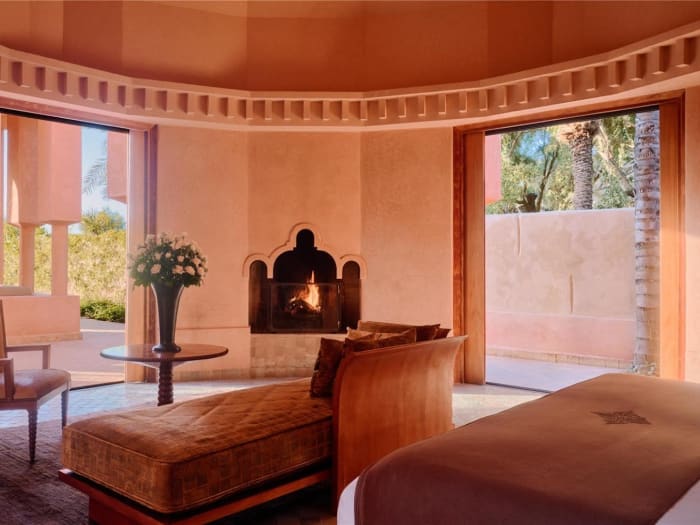
At Amanjena, the accommodation faithfully extends the language of the estate. The same balance is present between Moroccan architecture inspired by riads, restrained lines and a strong sense of space. More than somewhere simply to sleep, the room becomes an extension of the hotel’s overall calm. Movement feels easy, volumes breathe, and each element appears chosen to avoid visual excess. That restraint matters: it allows the eye to settle, the body to slow down and natural light to play a full role in the experience of the stay.
Materials and tones contribute to that atmosphere. Warm, mineral and earthy colours sit naturally within the context of Marrakesh. Openings onto courtyards, terraces or gardens reinforce the feeling of staying in an inhabited place rather than a standardised room. The influence of traditional Moroccan houses can be read in the relationship between privacy and protected outdoor space: one is never exposed, yet never entirely cut off from the sky, air, greenery or the murmur of water. It is this subtle articulation that gives the accommodation its particularly soothing character.
At Amanjena, comfort is not limited to equipment. It lies in the quality of proportion, the discretion of the furnishings, the sense of preserved coolness and the attention paid to service details. A successful room in this kind of address is one that asks nothing of the traveller by way of adjustment. One settles in immediately, as though the place had already anticipated essential needs: rest, quiet, privacy and ease of use. That impression is reinforced by the hotel’s personalised approach, which seeks to adapt the stay to each guest’s rhythm and preferences.
For couples, the rooms and suites provide an especially apt setting. Romance here is not theatrical; it comes from the quality of retreat. Taking time in the morning, reading on a terrace, getting ready slowly before heading into town, returning at day’s end to a calm and ordered space: these practical uses are what create the feeling of luxury. Travellers seeking restoration also benefit greatly. After the intensity of Marrakesh, returning to accommodation that functions almost as a decompression chamber changes the entire perception of the trip.
It is also useful to see these rooms and suites as vantage points onto Amanjena’s wider spirit. Nothing feels decorative in a superficial sense. Everything is about coherence, continuity between the estate, the architecture and the hospitality. Travellers who choose this address are not looking for an accumulation of effects, but for a form of sensitive precision. The accommodation answers that expectation exactly, offering a calm, legible and lasting luxury that accompanies the discovery of Marrakesh without ever trying to eclipse it.
Dining
At Amanjena, dining follows the same logic as the rest of the stay: a carefully shaped experience that is clear, pleasurable and never overstated. In a destination such as Marrakesh, where the table can be festive, generous, fragrant and at times highly theatrical, the appeal of a hotel like Amanjena lies in offering a setting where one finds measure. That does not mean austerity. It means that meals fit harmoniously into the rhythm of the day, support the mood of the moment and leave room for conversation, rest and contemplation.
Breakfast is easily imagined as one of the stay’s highlights. On an estate this peaceful, beginning the day outdoors, on a terrace or in a softly lit setting, takes on particular value. Before heading to the medina, a garden or a museum, it helps guests attune themselves to the place. The personalised service, one of the hotel’s defining traits, is especially important here: true luxury at table often lies in attention to pace, in the accuracy of recommendations and in the ability to make each meal feel simple and seamless.
At lunchtime, the hotel can become a welcome refuge for those who would rather avoid the heat or bustle outside. Returning to the estate after a morning of visits, settling into a calm setting and finding clear flavours within an inviting atmosphere is part of the travel comfort itself. Dinner, meanwhile, often takes on a more enveloping tone. At Amanjena, one expects less a gastronomic stage set than an experience consistent with the spirit of the house: discreet elegance, a carefully composed setting, attentive service and a preserved sense of privacy.
The Moroccan context naturally enriches this experience. Marrakesh is a city of strong culinary traditions, aromatic produce, spices, pastries, fruit, vegetables and multiple influences. In a hotel of this level, the interest often lies in how local grounding is brought into dialogue with assured international execution. Without overloading the plate or caricaturing the destination, dining can become an intelligent extension of the journey. Guests wishing to discover the city through flavour find a comfortable point of entry; those simply seeking a serene meal after a dense day appreciate the consistency and quality of the setting.
More broadly, dining at Amanjena contributes to the idea of complete hospitality. Eating is not merely about meeting a need; it structures the day, creates sensory memories and allows for pauses. A late lunch after the spa, tea in the late afternoon, a quiet dinner before a silent night: these moments matter as much as the major visits. That is why, especially in high season or on a short stay, it is wise to plan certain dining moments or related experiences in advance. In a place where everything depends on fluidity, booking ahead helps preserve that sense of effortless ease that defines the best houses.
Spa & wellness
Wellness at Amanjena is not limited to a spa in the functional sense; it belongs to a broader conception of the stay. The estate itself operates as a calming device. Its relative remove from urban bustle, the presence of water, architecture inspired by riads, the gardens and the quality of quiet all create an environment naturally conducive to rest. In that context, the wellness area does not compensate for overstimulation; it extends an atmosphere already in place. That is what makes the experience especially coherent.
For travellers arriving in Marrakesh with a desire to restore themselves, Amanjena answers a specific need: slowing the pace without giving up the richness of the destination. One can spend a day in the medina, the souks, monuments or gardens, then return for a treatment, a period of relaxation or simply recovery time. This alternation between external intensity and inward recentring is one of the stay’s great pleasures. It also explains why it is wise to reserve treatments on arrival, or even beforehand, especially when the most sought-after times fill quickly.
The idea of personalisation, central to the hotel’s identity, finds a natural expression here. A good wellness programme is not necessarily the longest or most elaborate; it is the one that suits the traveller, their energy, the length of stay and their relationship to rest. Some will want a massage after a flight or after a day of walking; others may prefer to shape their escape around several appointments, making the spa a thread running through the trip. In every case, Amanjena’s strength lies in its ability to place these moments within an overall experience of calm and continuity.
Morocco also offers a rich wellness imagination linked to purification rituals, water, scent, texture and a certain culture of unhurried time. Without assuming the exact details of the treatments available, one can say that a hotel of this level generally draws on that heritage in a measured way, adapting it for an international clientele. The desired result is not surface exoticism but a genuine sense of renewal. At Amanjena, that promise feels all the more credible because the treatment does not begin at the door of a room; it begins in the way one inhabits the estate, slows down and rediscovers a fuller breath.
Wellness here can also take very simple forms. Walking through the gardens early in the morning, sitting for a few minutes beside a water basin, reading in the shade, extending the silence after a treatment, choosing to do nothing between outings: these gestures have real value in a place designed to receive them. That may be Amanjena’s most precious quality. The hotel does not merely sell moments of relaxation; it creates the conditions for a deeper, more lasting rest that accompanies the traveller well beyond the duration of any single treatment.
Concierge & services
One of Amanjena’s most convincing qualities lies in the standard of its personalised service. The phrase is often overused in luxury hospitality; here it deserves to be understood in its most practical sense. Successful service is not merely about availability or courtesy. It means reading the stay, anticipating needs without making that anticipation visible, adjusting the rhythm of each day and smoothing the transitions between the estate and the city. In a place set apart from the bustle yet close to Marrakesh’s cultural attractions, that organisational intelligence becomes especially valuable.
The concierge is central to this experience. Marrakesh is a rich and sometimes dense destination, where the abundance of possibilities can make choices harder rather than easier. Between the medina, the souks, gardens, palaces, museums, excursions beyond the city and more intimate experiences, thoughtful guidance matters. The value of a good concierge is not to multiply options, but to suggest the right ones at the right time. A first stay does not call for the same recommendations as a return visit; a romantic trip is not planned in the same way as a stay focused on heritage or wellness. Amanjena, by virtue of its positioning, is particularly well suited to this tailored approach.
Service is also visible in the details of daily life. The welcome, the ease of arrival and departure, the way teams handle a specific request, discretion in public spaces and respect for quiet all contribute to the feeling of being looked after without ever being managed too heavily. The best houses create this rare impression of obviousness. The traveller feels that things simply happen naturally, when in fact they rest on very precise organisation. That is often where the difference lies between a beautiful hotel and one that feels truly complete.
At Amanjena, this quality of service benefits both guests who want to do a great deal and those who chiefly want to slow down. The former can rely on the team to structure their days efficiently, reserve experiences, organise transfers or make the most of a short stay. The latter will appreciate a discreet presence capable of protecting their peace, suggesting a treatment, a quieter dining time or the right moment to explore the city. In both cases, attention to detail makes the difference. It gives the stay a smoother, calmer and more personal texture.
Booking with an adviser familiar with this kind of address therefore makes particular sense. For a hotel such as Amanjena, where the experience depends on balancing estate life, city discovery, rest and cultural exploration, advance planning is a genuine advantage. Choosing the right season, thinking ahead about treatments, dining, cultural visits or moments of retreat allows guests to make full use of the stay. The hotel concierge and expert support before arrival do not compete; they complement one another. Together, they make possible what great hotels do best: turning a series of services into an experience that feels coherent, easy to live and lasting in memory.
The Marrakesh art of living
Staying at Amanjena also means choosing a particular way of approaching Marrakesh. The city never fully reveals itself in haste. It asks for time, attention and a willingness to accept contrasts. There is the density of the medina, the souks and their textures, palaces with silent courtyards, gardens that reintroduce shade and water, more contemporary districts, cafés, workshops and thresholds barely visible behind high walls. The Marrakesh art of living lies precisely in this alternation between intensity and retreat, movement and pause, exposure and intimacy. Amanjena offers an especially convincing translation of that rhythm.
Because it is set apart from the bustle while remaining close to the city’s cultural attractions, the hotel allows for a more nuanced stay. One can leave early to explore the medina before its busiest hours, devote a morning to a garden or museum, have lunch in calm surroundings, then return to the estate to slow down. This ability to modulate the day changes everything. It prevents Marrakesh from becoming a mere sequence of images or sites to tick off. The journey becomes more breathable, more personal and more faithful to the city’s deeper spirit.
Marrakesh is often described through its colours and energy. That is true, but incomplete. The city also possesses a culture of interiors, patios, protected coolness and suspended time behind façades. Riads are the best-known expression of this. By drawing on that architecture, Amanjena does more than adopt a style; it aligns itself with a local way of inhabiting space. The traveller can then better grasp what makes Marrakesh singular: not only what is shown, but what is discovered through successive thresholds, in a slow, almost initiatory progression.
For couples, the city offers a particularly rich setting. Romance here lies less in cliché than in the quality of shared moments: an early departure for a garden, tea in a shaded courtyard, a late-afternoon walk, the return to the calm of the estate as the light fades. Culturally minded travellers also find inexhaustible material, provided they accept that not everything can be absorbed at once. Amanjena helps precisely with that. By offering a stable and serene refuge, it allows guests to look at the city with greater availability, and therefore with greater accuracy.
The best advice for experiencing Marrakesh from Amanjena is probably to leave empty spaces in the programme. The city rewards those who give it room. An improvised visit, a longer pause than expected, an early return to the hotel to enjoy the estate, a dinner taken without hurry: these moments matter as much as the major sights. It is in this balance that a true art of living emerges. Amanjena does not impose a reading of Marrakesh; it suggests an ideal rhythm for it, shaped by curiosity, comfort, recovered quiet and attention to detail.
Book with MyConciergeHotel
Booking Amanjena through MyConciergeHotel means approaching the property with the preparation it deserves. A hotel like this cannot be reduced to a room category or a rate; its value lies in the balance of the stay as a whole. One needs to think about the right time to travel, the desired rhythm between cultural discovery and rest, treatments to plan, meals worth securing and experiences best arranged in advance. In a house where personalised service and attention to detail are central to the experience, the quality of the booking process already forms part of the journey.
The first benefit of dedicated guidance is clarity. Are you looking for a romantic interlude for two, with ample time on the estate and a few carefully chosen outings in Marrakesh? Do you instead want to explore the city intensively while returning each evening to a calm refuge? Would you prefer a wellness-led stay, with treatments reserved from the outset, or a more cultural approach shaped around gardens, palaces and historic districts? Depending on the project, the advice will differ. It is precisely this work of perspective that turns a simple reservation into a stay that feels properly tailored.
MyConciergeHotel can also help anticipate what, in this kind of address, often makes the difference between a pleasant trip and one that feels entirely seamless. At Amanjena, certain experiences are best booked ahead, especially spa treatments or specific dining and activity moments. Seasonality also matters: spring and autumn are generally especially appealing times to enjoy Marrakesh in comfortable temperatures, but they are also in high demand. It is therefore wise to plan early, particularly for short breaks where every half-day matters.
Booking with an adviser who understands the codes of luxury hospitality also allows the property to be approached with greater discernment. Not all travellers expect the same thing from Amanjena. Some will be drawn above all to the architecture inspired by riads and the estate’s authentic atmosphere; others will prioritise proximity to cultural attractions or the possibility of restoring themselves away from the bustle. The key is to make the hotel fit your way of travelling, not the other way round. That alignment is what produces the most successful stays.
In Amanjena’s case, the promise is clear: a peaceful estate, attentive hospitality, a balanced relationship with Marrakesh and a restrained form of luxury. Booking through MyConciergeHotel gives that promise the best chance of being fulfilled. Before arrival, the project is refined; on site, the hotel takes over with its own quality of service. Between the two lies a valuable continuity, shaped by useful advice, anticipation and ease. For an address of this nature, it is often the best way to travel: with less uncertainty, more precision and the sense that every detail has been considered in the right order.