History & heritage
In Vienna, the idea of a grand hotel is never merely about a place to spend the night. It belongs to an urban culture shaped by music, diplomacy, historic cafés, monumental façades and a style of hospitality that values precision over display. The Ritz-Carlton Vienna fits naturally into that tradition. The hotel occupies several historic 19th-century buildings, an essential detail in understanding its character: here, luxury does not rely on theatrical excess, but on the continuity between Viennese heritage and the expectations of the modern traveller.
This setting within period buildings gives the property a particular depth. In Vienna, the architecture of the Ringstrasse and the grand boulevards speaks of imperial ambition, cultural influence and the city’s singular place in Central Europe. Staying in a hotel of this kind means, even briefly, inhabiting a certain idea of the Austrian capital: a city where aristocratic tradition, intellectual life and discreet modernity have long coexisted. The Ritz-Carlton Vienna adopts that vocabulary without freezing it in time. There is a sense of volume, noble materials and carefully judged detail, yet interpreted in a more fluid way, suited to contemporary habits.
The Ritz-Carlton heritage brings its own immediately recognisable grammar of service. Here, attention to the guest is not conceived as distant ceremony, but as a form of elegant anticipation. That suits Vienna particularly well, a city where courtesy, restraint and a sense of rhythm matter as much as décor. The experience is therefore not only aesthetic; it is relational too. A stay takes shape through the way one is welcomed, guided, assisted and then left in peace at the right moment.
What sets the hotel apart is precisely this ability to hold several temporalities together. On one side, the historical depth of the city and its buildings; on the other, an international hospitality model designed for business travellers, couples on a city break and visitors drawn by the cultural calendar. The address does not attempt to recreate an idealised past. Instead, it retains the essentials: composure, quality materials, respect for calm and a commitment to genuine comfort.
In a city as codified as Vienna, that approach makes sense. Travellers find a credible anchor point here, neither museum nor interchangeable backdrop. The hotel speaks the language of its surroundings while remaining legible to a cosmopolitan clientele. It is this dual identity, Viennese in setting and international in service, that forms its true heritage. More than simply a five-star hotel, The Ritz-Carlton Vienna offers a contemporary reading of the grand urban hotel, informed by history without ever becoming trapped by it.
The hotel
The first appeal of The Ritz-Carlton Vienna lies in its central location. For a stay in Vienna, that changes everything: it allows guests to approach the city on foot, reach major cultural institutions without complicated logistics and feel, the moment they step outside, that particular urban elegance which defines the Viennese atmosphere. This is not a secluded retreat, but a city hotel in the noblest sense, designed for those who want to inhabit the capital rather than observe it from afar.
The property, formed from several historic buildings brought together, has a strong architectural presence. This composition often creates a sense of depth and variation: the public spaces do not have the cool uniformity of a contemporary block, but the breathing rhythm of an address rooted in the city’s older fabric. It can be felt in the circulation, in the way volumes connect, in the balance between representation and intimacy. The lobby, lounges and transitional areas all contribute to this discreet staging of a stay, where one may pause between appointments or extend a quiet moment away from the pace outside.
The interior design, described as a dialogue between tradition and modernity, provides another point of balance. In Vienna, that is a delicate exercise: too much classicism can make the experience feel static, while too much minimalism can detach it from its setting. The hotel chooses a more convincing middle path. References to local heritage are not treated as decorative quotations, but as a basis from which to build contemporary comfort. The result is a refined, legible atmosphere without excess. It offers what many discerning travellers seek: a setting with poise but no rigidity, and character without overstatement.
The address is particularly well suited to different styles of travel. Couples will find an ambience conducive to romantic stays, thanks to the softness of the spaces and the quality of service. Business travellers, meanwhile, generally value the central location, the smoothness of the welcome and the hotel’s ability to provide effective transitions between work and downtime. That versatility matters in a major European capital: it prevents the property from being reduced to a single promise.
What remains most striking is the way the hotel filters the city. Vienna is a capital dense with references, music, history and social ritual. The Ritz-Carlton Vienna does not try to compete with that richness; it organises it. It offers a stable, elegant and comfortable framework from which the city becomes more accessible, more coherent, almost more intimate. That is often the most valuable quality of a great urban hotel: not to replace the destination, but to make it inhabitable.
Rooms and suites
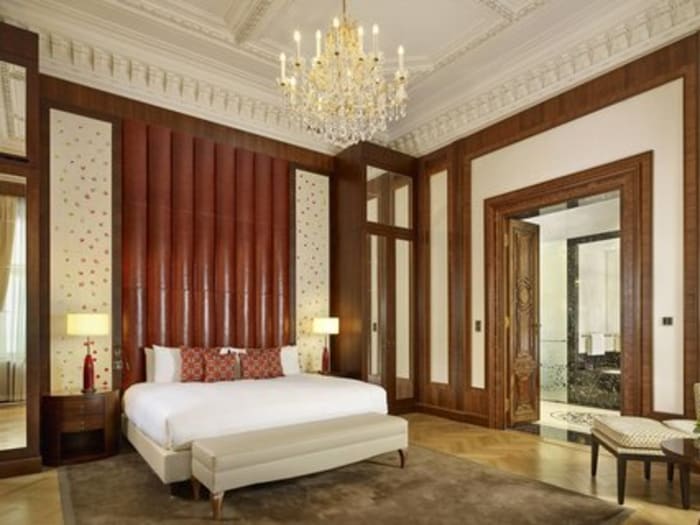
In a great city hotel, the room is not merely a place to sleep; it must function as a refuge, a discreet office, a private sitting room and sometimes even an observatory over the local rhythm. At The Ritz-Carlton Vienna, that versatility appears central to the experience. The overall spirit, consistent with the rest of the property, rests on a balance between classical codes and contemporary comfort. One can therefore expect spaces designed to endure in taste rather than impress through passing decorative effects.
The essential promise is one of controlled comfort. In a capital as active as Vienna, true luxury often lies in returning at the end of the day to a room where everything feels in place: easy circulation, welcoming bedding, well-judged lighting, sufficient storage and a bathroom designed both for lingering and for the quick preparations of a business appointment. These elements, more than any ostentatious sign, define the quality of a stay. The hotel seems to understand this, favouring a refined yet serene atmosphere suited equally to short visits and longer city breaks.
The dialogue between tradition and modernity becomes particularly legible here. In rooms and suites, this generally translates into elegant lines, carefully chosen materials and a palette that encourages calm. Nothing should distract from the essential task: feeling settled immediately. That sensation matters for international travellers who may be moving through several cities in a matter of days. A successful room does not impose a décor; it provides a framework within which one quickly regains one’s bearings.
The suites, by nature, extend that logic with more space and a more residential experience. They suit romantic stays, trips combining work and private time, or simply those who appreciate the possibility of receiving, reading, working or resting in separate zones. In Vienna, where one may move from a concert to dinner, from a meeting to a walk along the grand boulevards, such flexibility makes perfect sense. It allows the hotel to be lived not as a standardised interlude, but as a genuinely inhabited temporary address.
Service naturally contributes to this impression. Turndown, daily housekeeping and attention to the details of a stay all create that form of silent continuity which characterises the great houses. Nothing demonstrative, but a series of adjustments that make the experience more fluid. For couples, this reinforces a sense of intimacy. For business travellers, it guarantees discreet efficiency. In both cases, the room becomes more than accommodation: a personal space protected from the outside.
That is perhaps where The Ritz-Carlton Vienna succeeds most clearly on the accommodation side. The rooms and suites do not try to compete with the city in visual intensity; instead, they offer a counterpoint. After the architectural, musical and cultural richness of Vienna, one finds here a form of ordered calm, precise comfort and measured softness. A very fitting way to end the day in a capital where elegance is as much about rhythm as it is about décor.
Dining
In Vienna, gastronomy transcends haute cuisine; it encompasses a broader spectrum, comprising cafés, patisseries, breakfast rituals, elegant dinners, and conversations over drinks. Within this context, the culinary offerings of a grand hotel enhance the overall experience. The Ritz-Carlton Vienna embodies this philosophy, with dining experiences that accompany various moments of the day and cater to diverse needs, from professional meetings to more intimate dinners.
The primary challenge for an establishment of this calibre is consistency. Travellers expect a clear quality, reliable execution, and a service that adapts to individual rhythms. Whether it’s breakfast before a day of sightseeing, lunch between meetings, an afternoon drink, or dinner in a more subdued atmosphere, successful hotel dining knows how to shift gears without losing its identity. The setting plays a crucial role here. In a city where ambiance, table setting, and conversational comfort are highly valued, the décor and pace of service are as important as the food itself.
The appeal of a hotel like The Ritz-Carlton Vienna also lies in its ability to offer an international interpretation of dining while remaining in tune with local spirit. In Vienna, this means avoiding excessive ostentation and favouring a form of elegant precision. The contemporary traveller appreciates clear menus, well-prepared ingredients, precise cooking, coherent pairings, and a team that can guide without imposing. This approach particularly suits a cosmopolitan clientele, who may wish to dine at the hotel one evening and explore Vienna's culinary institutions the next.
Breakfast deserves special mention, as it often shapes the overall perception of a stay. In a grand urban hotel, it should provide comfort, efficiency, and a certain pleasure in reclaiming time. In Vienna, a city known for its leisurely mornings and coffee culture, this moment takes on a unique resonance. A good breakfast is not just nourishing; it sets the tone for the day, allowing for a smooth transition from room to city.
For couples, the dining and bar spaces contribute to the atmosphere of their stay. Luxury often lies in simple yet thoughtful details: a well-placed table, flattering lighting, attentive service without intrusion, and the opportunity to extend the evening without leaving the hotel. For business travellers, these same venues become transitional spaces, ideal for receiving guests, discussing matters, or unwinding.
Ultimately, dining at The Ritz-Carlton Vienna is understood as a component of the hotel’s art of living rather than an isolated destination. It accompanies the stay with moderation, embodying comfort, clarity, and elegance. In a city that has elevated meals, coffee, and conversation to the status of culture, this is what one expects from a prestigious address.
Spa & wellness
In a capital such as Vienna, hotel wellness has a particular function. It is not only about offering a moment of relaxation, but about creating breathing space within a stay often filled with visits, meetings, concerts, museums and urban movement. The spa of a great city hotel thus becomes a place of recalibration: somewhere to slow down, to recover physical continuity after the intensity of the day. The Ritz-Carlton Vienna, through its positioning and its attention to overall comfort, fits naturally into that logic.
The first luxury of an urban wellness space is contrast. Outside, the city imposes its rhythm, façades, routes and timetables. Inside, everything should contribute to a sense of withdrawal: softer light, controlled acoustics, precise gestures, a different temporality. Even when a traveller has only an hour to spare, that shift in pace can transform the perception of a stay. One is not necessarily seeking spectacle; rather, a reliable, calm and coherent environment in which the body can finally catch up with the mind.
In a hotel of this category, wellness does not stop at treatments. It begins in the room, extends through sleep quality, the smoothness of service and the possibility of carving out time for oneself. The spa is its most visible expression, but the experience is broader. For a couple, it may become a shared moment, almost a travel ritual. For a business traveller, it often serves as a useful transition between professional obligations and the evening ahead. In both cases, it answers a very contemporary expectation: luxury matters only if it genuinely helps one feel better.
Vienna lends itself particularly well to this search for balance. The city possesses an elegance that is never aggressive; it invites measure, detail and a certain gentle discipline. A successful wellness space should extend that spirit. This implies discreet welcome, clear protocols, rigorously maintained facilities and an atmosphere that does not force emotion. Refinement here lies in restraint. Guests come to relax, but also to regain a form of inner clarity before returning to the city.
The value of a hotel spa is often measured by its ability to integrate into a stay without weighing it down. It should be accessible, easy to book and simple to combine with a cultural or professional programme. That flexibility is essential in a destination like Vienna, where days fill quickly. A treatment in the late afternoon, time in the wellness facilities after a long walk, a quiet pause before dinner: all these sequences restore quality to travel.
At The Ritz-Carlton Vienna, wellness therefore forms part of a broader conception of hospitality. It is not about adding yet another service to an already long list, but about completing the experience of the city with a space for recentring. In a successful stay, one remembers not only the places visited, but the way one felt while being there. That is precisely what the wellness dimension of a distinguished address should preserve: a quality of presence to oneself, rare and valuable in the rhythm of a European capital.
Concierge & Services
In the realm of luxury hospitality, services are valued for their ability to make a stay simpler, smoother, and more precise. The Ritz-Carlton Vienna is built on this principle. A successful service does not interrupt the experience; it orchestrates it.
The presence of a concierge and a reception available 24/7, daily housekeeping, turn-down service, luggage storage, laundry, and wake-up calls creates a reassuring environment for an international clientele.
The concierge plays a central role here. In a city like Vienna, it can make all the difference. Concert schedules, restaurant reservations, seasonal itinerary advice, transfer management, and adapting the programme to the length of stay are all part of a good concierge's repertoire. A skilled concierge helps shape the journey, which is invaluable in a rich destination where one might easily be tempted to do too much. The art lies in prioritising, suggesting, and simplifying.
The constant availability of the reception and service team addresses another reality of contemporary travel. Late arrivals, early departures, last-minute programme changes, and practical needs outside standard hours are all catered for. For business travellers, this continuity is essential. For couples on a city break, it provides a welcome freedom to explore the city at their own pace without logistical concerns. Here, luxury is not about visible abundance; it is the assurance that someone can intervene effectively at the right moment.
Daily housekeeping and turn-down service contribute to a quieter quality. They maintain the room in a state of constant comfort, almost invisibly. This discretion is a hallmark of great establishments. One may not always notice what has been done, but one feels the absence of what would be lacking if it were not there.
Laundry services, luggage storage, and wake-up calls fall under the same practical intelligence. These are often considered secondary services, yet they significantly structure the experience, especially during short stays or multi-stop travels. The ability to arrive early, depart late, have an outfit pressed before dinner or a meeting, and organise a full day without being burdened by luggage—all of this enhances the quality of available time.
The presence of multilingual staff aligns with the hotel’s international positioning. In Vienna, a city of culture, congresses, diplomacy, and global tourism, clear communication is a form of comfort. It avoids friction, builds trust, and allows for more precise assistance.
Ultimately, the services at The Ritz-Carlton Vienna define a hospitality of precision. They do not seek to impress with abstract promises but aim to secure every step of the stay. This is often what distinguishes a great address—the feeling that everything has been thoughtfully designed not for show, but for seamless functionality.
The Viennese art of living
Staying at The Ritz-Carlton Vienna also means choosing a particular way of entering Vienna. The city does not fully reveal itself to those who rush through it. It asks for a measure of attention, a readiness for detail, rhythm and transitions. Its art of living lies as much in its great institutions as in its daily habits: coffee taken without haste, walks along broad avenues, an evening concert, pastry in mid-afternoon, the discreet elegance of shopfronts and façades, the very natural coexistence of monumental heritage and ordinary urban life.
From a central address, this experience becomes especially fluid. Vienna can be approached in sequences rather than through accumulation. In the morning, the city still belongs to walkers, architecture lovers and those who enjoy observing the details of buildings, squares and perspectives. During the day, it reveals its cultural density: museums, musical institutions, shopping districts and historic cafés. In the evening, it changes tone. The light softens, façades gain relief and one better understands why Vienna remains associated with a form of sophistication without agitation.
One of the great pleasures of a Viennese stay lies in alternating registers. The city allows one to move from highly codified moments, such as a performance or a dressed dinner, to much simpler, almost domestic interludes in a café or along a quiet street. This mix is precious because it prevents Vienna from becoming a fixed postcard. It remains a living capital, inhabited and shaped by contemporary uses. A hotel such as The Ritz-Carlton Vienna supports that reality well: it offers the level of comfort and service expected from a major international address while allowing the city to retain the leading role.
For couples, Vienna possesses a particular kind of romance, less demonstrative than in other European capitals. It lies in the music, certainly, but also in the quality of the light, the softness of interiors and the taste for unhurried time. A successful day may be composed of very simple things: breakfast taken calmly, a museum visit, a coffee pause, a walk, a return to the hotel to get ready and then an evening that extends effortlessly. Viennese elegance lies there: in continuity rather than event.
For business travellers, the city offers another form of art of living, shaped by calm efficiency. One can work seriously here without giving up the pleasure of the stay. A meeting may be followed by a concert, a day of appointments by a carefully judged dinner, a brief trip by a genuine cultural experience. That is one of the strengths of Europe’s great capitals, and Vienna embodies it with unusual coherence.
Ultimately, the Viennese art of living rests on a simple idea: the quality of time. The Ritz-Carlton Vienna allows access to it without friction. Through its location, atmosphere and service, the hotel serves as a point of entry into a city that rewards those who slow down just enough to understand it. More than a backdrop, Vienna then becomes a cadence, and the stay acquires a depth that only certain capitals know how to offer.
Book with MyConciergeHotel
Booking The Ritz-Carlton Vienna through MyConciergeHotel means approaching the stay through advice rather than mere transaction. In luxury hospitality, that distinction is decisive. A reservation is not simply a matter of choosing dates and a room category; it shapes the way the property will be experienced, how the location will be used, how the purpose of the trip is taken into account and how the details that truly matter on arrival are anticipated. In a city like Vienna, where cultural life, seasons and the rhythm of events strongly influence the experience, such guidance makes particular sense.
The value of a specialist point of contact lies first in clarifying the stay. A romantic trip does not call for the same priorities as a business journey or a long weekend centred on museums and concerts. Depending on the case, one will not be looking for the same room atmosphere, the same organisation of time or the same balance between hotel life and city life. MyConciergeHotel makes it possible to address these parameters in advance, with a more nuanced reading than that of a standardised booking process.
This approach is especially useful in a property such as The Ritz-Carlton Vienna, whose strength lies in the overall quality of the experience. To enjoy it fully, it is often worth thinking beyond the displayed rate: room placement within the hotel, suitability for the length of stay, arrival and departure rhythm, concierge needs, expectations in terms of comfort or discretion. These elements are rarely spectacular, yet they very concretely determine the success of a trip.
Booking with guidance also saves time. In a major European capital, stays are sometimes short and densely scheduled. It is therefore better to arrive with a coherent plan, clearly formulated requests and a realistic sense of what one wishes to experience. This applies equally to a couple wanting to prioritise the softness of a city break and to a business traveller needing to combine efficiency, rest and centrality. The role of advice is to simplify those choices.
MyConciergeHotel also provides a form of continuity between editorial inspiration and the actual booking. The property is not presented merely as a five-star hotel in the heart of Vienna; it is placed within a context, a style of travel and a certain idea of the city. That perspective helps guests book more accurately. It avoids poorly calibrated expectations and instead encourages an experience better aligned with the traveller’s profile.
Finally, choosing an expert channel to book a house such as The Ritz-Carlton Vienna is a way of recognising that a great hotel is best experienced when well prepared. True luxury often begins before arrival: in the quality of information, the relevance of recommendations and the ability to ask the right questions. For an address where attentive, personalised service forms part of the very identity of the stay, that coherence upstream is especially valuable. It allows one to enter Vienna more smoothly, and the hotel already with the feeling of being expected.