History & heritage
The Ritz-Carlton Shanghai Pudong belongs to a generation of luxury hotels that accompanied Pudong's rise as Shanghai's international face. While the former concessions and the Bund speak of the city's mercantile past, Pudong expresses its contemporary momentum: glass towers, financial headquarters, vertical perspectives and metropolitan-scale infrastructure. To stay here, in a Ritz-Carlton address, is therefore to choose a particular reading of Shanghai: not one of nostalgia, but one of movement, ambition and cosmopolitan energy shaped by the river.
The Ritz-Carlton name brings with it a recognisable hospitality language: highly structured service, attention to detail, a hushed atmosphere and a form of luxury defined more by precision than by display. In a city that can feel relentlessly fast-paced, that heritage provides a reassuring anchor. It offers the idea of an urban refuge able to filter the intensity outside without denying it. This is one of the strengths of Shanghai's great hotels: they create a sense of interior calm while remaining fully connected to a spectacular urban setting.
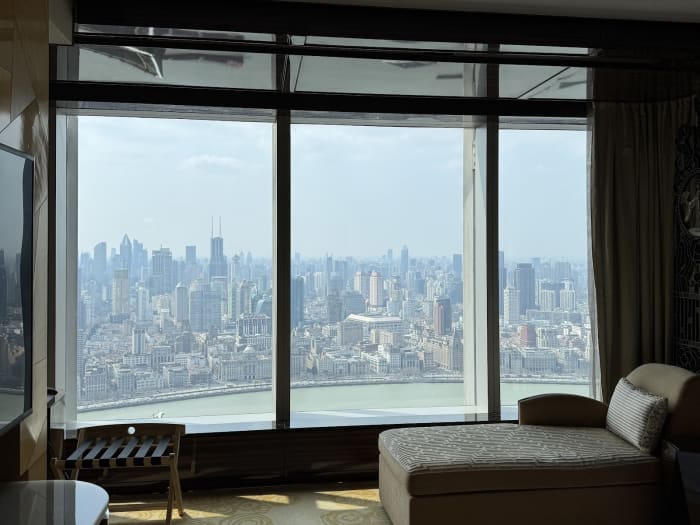
The hotel's position on the riverfront is central to this identity. The Huangpu is not merely a backdrop; it is one of the city's great symbolic axes. It separates and connects, staging the contrasts between historic districts and the newest developments. From the upper floors of a hotel such as this, the view becomes almost explanatory. One begins to understand Shanghai through its lines, reflections, flows and shifts in scale.
Its heritage, then, does not rest on centuries of hotel history, but on its place within a decisive chapter of the city's own story. It is a hotel that speaks of twenty-first-century Shanghai: business-driven, globally connected, shaped by major international brands and by travellers moving constantly between continents while seeking high standards without losing a sense of place. That balance between the global language of luxury and Shanghai's particular character is essential. It can be felt in the emphasis on views, in the relationship to the skyline, in the proximity to key business districts, and in the rhythm of the stay itself: breakfast above the river, meetings in Lujiazui, a crossing towards the Bund, and an evening return to a calmer setting.
For a European traveller, the appeal of the address lies precisely in its ability to condense an idea of contemporary Shanghai without reducing it to a simple panorama. The Ritz-Carlton Shanghai Pudong offers more than a viewpoint; it frames a coherent urban experience in which one senses the city's economic intensity, cosmopolitan polish and appetite for dramatic horizons. In that sense, its heritage is already clear: it stands as a witness to Pudong's international maturity and as an address designed for those who wish, for the duration of a stay, to inhabit Shanghai at its most current.
The hotel
Choosing The Ritz-Carlton Shanghai Pudong is, first and foremost, choosing an address. Pudong, and more specifically the Lujiazui district, concentrates much of Shanghai's visual and economic power. Its landmark towers shape an instantly recognisable skyline, while the Huangpu River structures the views and reminds visitors that the city's history has always been written in relation to water. In this context, the hotel enjoys a location that speaks equally well to business travellers and to visitors discovering the metropolis: central, practical, connected and unmistakably urban.
The sense of arrival matters here. One moves from the intensity of one of the world's densest megacities into a more contained, quieter environment where materials, proportions and the quality of the welcome immediately restore a sense of balance. In a hotel of this kind, luxury is not simply a matter of display; it lies in the feeling of ease. Circulation is fluid, public spaces are arranged to preserve privacy, and it quickly becomes clear that everything is designed to make the city feel more legible rather than more overwhelming.
One of the hotel's greatest privileges is its relationship with the panorama. Views over the Huangpu add depth to the stay and create a constant dialogue with Shanghai itself. The landscape changes register throughout the day: softer morning light over the river, the density of daytime activity, then the evening shimmer as façades illuminate and boats draw moving lines across the water. Even for seasoned travellers in Asia's major capitals, the river brings a particular sense of space. It is a reminder that Shanghai is not only a vertical city, but also one defined by circulation, trade and reflection.
Its proximity to numerous attractions further strengthens the address. Without claiming a purely heritage-led immersion, the hotel allows guests to move easily between several faces of the city: Pudong's major commercial and financial hubs, walks towards the Bund, cultural institutions, and districts visited as much for their architecture as for their local rhythm. This versatility is especially valuable for short stays, common in Shanghai, where efficiency and a rich urban experience must often coexist.
The hotel therefore suits several kinds of traveller without losing coherence. Couples will appreciate the dramatic setting that Shanghai invites, particularly through the views and the refined atmosphere. Families benefit from the clarity of service and the reassurance of a major international brand. Business travellers, meanwhile, find a natural base aligned with the district and with the demands of a tight schedule. This ability to answer different needs without becoming diffuse is one of the hallmarks of strong urban hotels.
Ultimately, The Ritz-Carlton Shanghai Pudong is not a retreat from the world; it is a highly accomplished way of inhabiting the city. One stays here to be in the right place, at the right level of comfort, with the feeling that Shanghai unfolds before you without ever becoming inaccessible. It is an address of perspective, in every sense: it offers a view of the city, but also helps organise it, understand it and make the most of it according to the length and purpose of the journey.
Rooms and suites
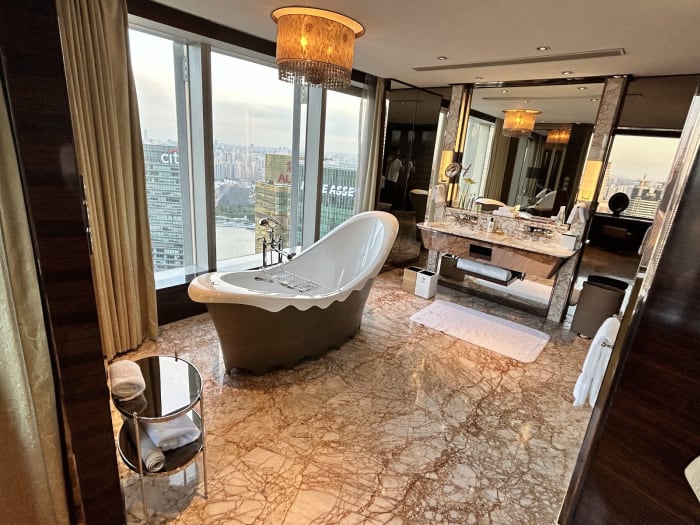
In an urban hotel of this calibre, the room is never merely a place to sleep. It must function as an observation point, a space for recovery and a natural extension of the rhythm of travel. At The Ritz-Carlton Shanghai Pudong, that role takes on particular significance because of the city outside: Shanghai is dense, vertical, sonorous and visually intense. Returning to one's room after a day of meetings, visits or transfers is therefore more than practical; it is a change of tempo. Comfort is expected, certainly, but above all the room must restore continuity and calm.
Rooms and suites in a major international address such as this are generally designed around two requirements that work especially well here. The first is clarity: well-ordered furnishings, intuitive circulation, considered lighting, and clearly defined areas for work and rest. The second is openness: broad views, a constant relationship with the city, and that distinctly Shanghai sensation of temporarily inhabiting height. When the room looks over the Huangpu, the experience immediately changes scale. The river is no longer a distant urban element; it becomes the thread of the stay, visible on waking, at dusk and in the night-time reflections that animate the glass.
The value of this kind of accommodation also lies in its ability to serve very different uses. On a business trip, the room must allow efficient work, perhaps a late call across time zones, and then a seamless shift into rest. On a leisure stay, it becomes more of a panoramic cocoon, a place to pause and watch the city before heading out again. For couples, the emotional value of the view is obvious; for families, clarity of service and a sense of reassurance may matter more. In every case, the desired balance is the same: discreet sophistication, tangible comfort and an absence of friction.
Suites, when chosen, naturally extend this logic. They allow the day to be divided more comfortably, make it easier to host a meeting, or simply provide a more expansive, residential stay. In a city such as Shanghai, where one may move quickly between a highly external programme and long periods of recovery at the hotel, that generosity of space makes real sense. It gives the journey an additional breath.
Beyond square footage or room categories, what matters most is the sensory quality of the experience. The relative quiet at height, the changing light through the day, the comfort of a carefully prepared bed, evening turndown, and the order restored by housekeeping: these are the elements that form the true memory of a successful stay. In major cities, one often remembers not decorative details, but the precise feeling of having found a point of balance.
That is why the rooms and suites at The Ritz-Carlton Shanghai Pudong should be understood as an interface between the city and the self. They do not attempt to compete with Shanghai's intensity; they frame it, make it inhabitable, almost domestic. Here one finds what is expected of a strong five-star hotel: disciplined service, consistent comfort, elegance without excess, and above all the sense that the room is not a neutral interlude, but one of the essential places of the experience.
Dining
In Shanghai, dining is an integral part of travel. The city is one of Asia's most cosmopolitan centres, and its culinary scene reflects that plurality: regional Chinese traditions, major international cuisines, tea culture, panoramic bars, business dining and more intimate tables. In this context, a grand hotel's food offering can no longer be a mere internal service; it must provide a credible reading of the city and answer a wide range of needs, from an efficient breakfast before a demanding day to a more ceremonial dinner with a view.
At The Ritz-Carlton Shanghai Pudong, one expects precisely this dual competence. On the one hand, the discipline of an international house able to deliver consistency, service quality and broad availability. On the other, the ability to make dining a moment of connection with Shanghai itself, especially through the setting and the relationship to the panorama. In a city where one may move from a professional meeting to an evening of discovery within a short journey, the hotel must know how to support those transitions. This is often where the maturity of an address reveals itself: in its capacity to serve both a quick morning coffee and a dinner lingering long enough to watch the light change over the river.
Breakfast deserves particular attention in a hotel of this kind. It is often the first real moment of the stay, when one regains bearings, checks the weather and sets the day's rhythm. In Shanghai, that moment has something strategic about it. One sees business travellers already focused, visitors still adjusting to jet lag, couples planning their routes and families negotiating different appetites. A strong hotel succeeds at breakfast when it allows that diversity to feel fluid without losing the impression of calm.
The rest of the culinary offer then follows the day. A light lunch between meetings, a pause over tea, cocktails at the end of the afternoon, a more composed dinner: each sequence corresponds to a distinct use of the hotel. The view over the Huangpu plays an obvious role here. It turns a meal into an experience of place without requiring excess. In Shanghai, many venues seek to impress; the most persuasive are often those that allow the panorama and the quality of the welcome to create the main effect.
For European travellers, there is also a practical point to make about a good hotel table in a city of this scale. After a dense day, dining in-house may be preferable to re-entering traffic or crossing town in search of a reservation. When the hotel maintains a coherent level of cuisine and service, that choice is not a compromise; it becomes an elegant way to close the day. This is particularly true on short stays, when every movement matters.
Dining at The Ritz-Carlton Shanghai Pudong therefore belongs to a broader logic: that of a hotel which understands that travel is also shaped by rhythms, views and uses. To eat here is not simply to be fed; it is to extend one's relationship with the city within a controlled setting. The meal becomes a way of reading the landscape, reorganising time and, at times, finding a welcome pause in the middle of a metropolis that rarely slows down.
Spa & wellness
In a city such as Shanghai, wellness is not a decorative extra; it is almost a structural necessity of the stay. Jet lag, intense schedules, transfers, visual and sonic density, and the alternation between meetings and sightseeing all make the spa and relaxation areas central to the hotel experience. The advice to book a treatment as soon as you arrive is therefore particularly sound. In major international hotels, the most desirable slots disappear quickly, especially in the late afternoon and evening, when guests are looking to reset their rhythm.
The spa in a hotel such as The Ritz-Carlton Shanghai Pudong first serves as a place of transition. Guests come to move from one state to another: to leave travel fatigue behind, recover after a day of meetings, regain energy before dinner, or simply claim a private moment in a city that constantly demands attention. This threshold quality matters. A good urban spa does not merely provide treatments; it creates the conditions for genuine slowing down. Light, silence, welcome and the tempo of the gestures should all contribute to lowering intensity.
For frequent travellers, that quality is decisive. A well-timed massage can alter the perception of an entire destination. The point is not to erase the city, but to move through it better. In Shanghai, where days can be long and schedules wide-ranging, the spa becomes a way of reclaiming one's time. It is also a space where the hotel expresses its attention to detail differently from classic service: in preparation, listening and adaptation of the treatment to the need of the moment.
Wellness, however, is not limited to the treatment menu. In a strong five-star hotel, it extends through a series of discreet signs: sleep quality, turndown service, staff availability, the ability to organise the day without friction, and the overall sense of being looked after with accuracy. The spa is the most visible expression of this, but it belongs to a broader philosophy of comfort. That is what distinguishes hotels where one truly unwinds from those where one merely consumes a service.
For couples, time at the spa can shape the romantic dimension of the stay, especially in a city as dramatic as Shanghai. For business travellers, it is often the most valuable space in the day, the moment to decompress before starting again. For someone on a long transit or a short stay, it may even be the key to adapting better to the time zone. This versatility explains why treatments are so sought after in hotels of this level.
At The Ritz-Carlton Shanghai Pudong, the wellness experience should therefore be understood as a counterpoint to the city's energy. Where Shanghai accelerates, the spa slows down. Where the outside world multiplies stimuli, it simplifies. And where travel imposes its own rhythm, it restores continuity to body and mind. That is precisely what one expects from a great urban address: not artificial isolation, but the ability to create, in the heart of the metropolis, a space for genuine recovery.
Concierge & services
In luxury hospitality, services matter not only because of what is offered, but because of how they are orchestrated. A 24-hour concierge, round-the-clock reception, turndown service, daily housekeeping, luggage storage, laundry, wake-up calls and multilingual staff form a strong foundation. In a city such as Shanghai, however, that foundation becomes especially significant. The scale of the metropolis, journey times, the diversity of districts, occasional language barriers and the intensity of many itineraries make the quality of hotel mediation decisive.
The concierge, first of all, acts as a translator in the broadest sense. It is not simply a matter of arranging a car or recommending a table; it is about helping guests prioritise the city. For a first stay, this is essential. Shanghai can be overwhelming in scale and in the speed with which one moves from one world to another. A good concierge turns that abundance into readable itineraries: organising an efficient half-day, suggesting the best moment to cross towards the Bund, anticipating traffic constraints, or directing guests towards experiences suited to their profile. On a short stay, that gain in clarity can be worth as much as any dramatic facility.
The 24-hour front desk responds to a very concrete reality of international travel. Late arrivals, early departures, jet lag and last-minute needs are all part of daily life in Shanghai. Knowing that the hotel remains fully operational at any hour provides a discreet but fundamental sense of security. This is particularly true for business travellers, whose schedules may be dictated by flights and meetings, but also for families and couples who wish to keep their plans flexible.
Daily housekeeping and turndown belong to another dimension of luxury: continuity. In a major city, one goes out, returns, and leaves again. To find the room restored, prepared for the night, with that sense of silent care, changes the quality of the stay profoundly. These are modest gestures in appearance, but they say much about a hotel's service culture. They allow the traveller to devote energy to the city rather than to domestic logistics.
Laundry and luggage storage answer highly practical needs that are often underestimated. On Asian itineraries, where several stops may follow one another in quick succession, being able to refresh a wardrobe or leave luggage with ease before a late flight becomes a real comfort. Wake-up service, meanwhile, retains its relevance in a world saturated with smartphones: when an important meeting or an early departure is at stake, redundancy is reassuring.
Finally, multilingual staff are more than a courtesy. They condition the fluidity of the stay, the precision of requests and the quality of exchanges. At a hotel such as The Ritz-Carlton Shanghai Pudong, one expects exactly this ability to make the experience international without making it impersonal. The best services are those that simplify without intruding, anticipate without theatricality, and give the traveller the rare feeling of being accompanied with accuracy. In Shanghai, that accuracy makes all the difference.
The Shanghai way of life
To stay at The Ritz-Carlton Shanghai Pudong is to enter a particular idea of Shanghai: a city of managed contrasts, where commercial history, architectural ambition and a taste for everyday refinement coexist without cancelling one another out. The Shanghai way of life is neither pure excess nor pure nostalgia. It lies instead in a very particular ability to alternate registers: coffee or tea with a view, a crossing towards historic districts, a pause in a major retail address, a calm dinner after a dense day, then a return to the light of the river. That fluidity is one of the city's signatures.
From Pudong, the contemporary dimension of this way of life is immediately apparent. Here, verticality is not merely spectacle; it is part of daily existence. One rises and descends, observes the city from different heights, moves from highly public spaces to more hushed interiors. This relationship to height changes the way one travels. It gives the eye useful distance and turns the panorama into a genuinely sensory experience. The ever-present Huangpu, meanwhile, reminds visitors that Shanghai is also a city of circulation and trade, shaped by exchange. The river connects eras as much as it separates banks.
The local art of living also reveals itself in the rhythm of the day. Morning often belongs to efficiency: early departures, meetings, movement, careful organisation. The afternoon may open more readily to walking, visits, observation of districts and architectural detail. In the evening, Shanghai changes tone again. The city lights up, façades reflect in the water, bars and restaurants take over from offices, and the stay becomes more contemplative. A well-located hotel allows one to follow these variations without undue effort.
For European travellers, Shanghai offers a form of sophistication that is not without resonance. There is a shared appreciation for fine materials, for the staging of places, for dining as a social moment, and for service as a discreet language. Yet here that sophistication is expressed at another speed, on another scale, with a distinctly Asian urban intensity. That difference is what makes the city so stimulating. It imitates no European model; it proposes its own version of cosmopolitanism, more vertical, faster and often more visual.
The hotel then becomes a privileged observation point for this way of life. Thanks to its central address, river views and elegant setting, it allows guests to move from the immediate experience of the city to a more reflective reading of what it represents. One can plan a day of discovery here, return to recover, and then set out again with a different perspective. This is often how Shanghai reveals itself best: in successive layers, between intensity and retreat.
Ultimately, the Shanghai way of life may consist in accepting the constant coexistence of speed and precision, spectacle and discipline, collective energy and highly personal comfort. The Ritz-Carlton Shanghai Pudong fits naturally within that logic. It does not attempt to simplify the city excessively; it provides the right conditions in which to inhabit it with elegance. And that is perhaps what one asks of a great address in a metropolis of this scale: not to shield one from the city, but to provide the right frame through which to see, feel and understand it.
Book via MyConciergeHotel
Booking The Ritz-Carlton Shanghai Pudong through MyConciergeHotel means approaching a stay in Shanghai with a sense of precision. In such a vast metropolis, the location, orientation of the room, and pace of travel significantly influence the overall experience.
The editorial and concierge support helps to contextualise the choice. A view of the Huangpu River holds different value depending on the time spent outdoors. A late arrival or an early departure can also shift priorities.
Intelligent booking involves asking the right questions in advance. Considerations such as actual duration of stay, need for recovery, time allocated for the spa, interest in panoramic views, tolerance for travel, and desire to dine frequently at the hotel are all crucial.
MyConciergeHotel allows for this reflection to be integrated into a more qualitative relationship with hospitality. It is about understanding what the hotel can offer to a specific profile.
For The Ritz-Carlton Shanghai Pudong, this means assessing the relevance of its central location, the significance of the views, and the convenience of a hotel suited for varied stays. This perspective is particularly useful in Shanghai, where distances, jet lag fatigue, or the impact of an overly packed day can be easily underestimated.
Booking in this manner also allows for better anticipation of key moments during the stay. Spa treatments can fill up quickly, and certain requests related to the room, transfers, or the flow of the stay are best made prior to arrival.
For travellers accustomed to large international hotels, this approach adds intention to the booking process. For those discovering Shanghai, it provides welcome clarity.
The Ritz-Carlton Shanghai Pudong truly comes into its own when chosen for the right reasons: the view, centrality, quality of service, and the balance between urban intensity and comfort. MyConciergeHotel helps to clarify these reasons and refine the decision-making process.