History & heritage
Kempinski Hotel Yinchuan can be read through a dual lens: on one side, the heritage of a major European hotel house; on the other, the momentum of a regional Chinese capital asserting itself with confidence. This meeting between codified hospitality and an evolving city gives the property a distinct identity. Luxury here is not built on theatrical excess, but on a more durable promise: a stay that feels structured, fluid and attentive, where details are designed to simplify travel without diminishing it.
The Kempinski signature provides an immediately recognisable framework for guests familiar with international grand hotels. One finds a sense of welcome that is formal without being stiff, an effort to balance representation with genuine comfort, and an understanding of hospitality as an art of receiving rather than a mere list of facilities. In a city such as Yinchuan, where business trips, exploratory stays and longer stopovers intersect, this continuity of standards matters. It reassures corporate travellers while offering leisure guests a stable base from which to discover a destination that remains relatively discreet on the international stage.
Yinchuan, capital of the Ningxia Hui Autonomous Region, has its own history as a crossroads. Set within a territory shaped by exchange, trade routes and the presence of the Yellow River, the city combines layered influences: imperial legacies, Hui Muslim traditions, semi-arid landscapes and contemporary urban development. Staying in a hotel of this category therefore also means observing how a regional Chinese city presents itself today: ambitious, organised, forward-looking, yet still tied to a highly specific cultural and geographical context.
The hotel is not presented as a historic monument in the heritage sense; its interest lies rather in the way it reflects a period in international hospitality when a five-star address is expected to be at once a landmark, a refuge and a platform for movement. Its modern shared spaces support this contemporary reading. Lines, volumes and circulation appear conceived for varied uses: business meetings, late arrivals, discreet pauses, couples’ stays or family travel.
It is also useful to think of Kempinski Hotel Yinchuan as a place of transition in the noblest sense. Guests arrive to work, explore, rest, organise a stopover or extend a journey through Ningxia. This versatility is not a compromise; it is central to the property’s positioning. Where some hotels seek to impose a dramatic narrative, this one seems to favour an elegance of operation. The traveller finds less a fixed stage set than a reliable framework, capable of adapting both to the rhythm of the city and to individual needs.
In that sense, its heritage is not only that of a brand. It also belongs to a certain idea of the contemporary grand hotel: an address able to welcome different kinds of guests without losing coherence, one that embraces the modernity of its surroundings and makes service quality its primary language. In Yinchuan, that approach feels particularly apt, turning the hotel into a comfortable gateway to a city still unfamiliar to many European travellers.
The hotel
One of the first strengths of Kempinski Hotel Yinchuan lies in its setting within a lively part of the city. Simple as that may sound, it profoundly shapes the stay. A well-located hotel does more than shorten journeys: it changes the way a destination is experienced. Here, the address appears to offer the kind of practical centrality sought by both business travellers and visitors wishing to take the measure of Yinchuan. One can come and go with ease, organise meetings, reach local points of interest, and return at the end of the day to a setting that feels more ordered and composed.
A lively neighbourhood does not necessarily mean constant noise or agitation. In high-end international hospitality, it often suggests an environment that is active, connected and useful, where the city remains accessible without intruding on the privacy of the stay. That balance seems to define the property. Guests benefit from urban energy, everyday conveniences and proximity to local attractions, while still preserving a sense of retreat. The ability to filter the city rather than erase it is often the mark of a well-conceived hotel.
The shared spaces, noted for their modern design, play a central role in this impression. In a contemporary grand hotel, the lobby, lounges, corridors and waiting areas are no longer merely transitional zones. They form a visual and social grammar through which the tone of the house is immediately understood: more or less formal, more or less theatrical, more or less oriented towards efficiency. At Kempinski Hotel Yinchuan, the emphasis on a modern aesthetic suggests clear volumes, functional furnishings, a controlled palette and circulation designed for ease. The aim is not distraction, but a sense of composure and comfort.
This modernity suits Yinchuan particularly well, as the city is discovered not only through its sights but also through its daily rhythm. From the hotel, the destination can be approached as a sequence of moments: an early departure for a meeting, a return for a pause, an outing in the late afternoon, dinner, then retreat into a quieter environment. The property accompanies these transitions with the discretion expected of an international five-star hotel. It becomes a reliable point of reference in a city many travellers do not yet know in advance.
Its versatility is worth underlining. Some hotels are clearly designed for leisure, others for business. Here, everything suggests an ability to accommodate both without friction. Couples find a comfortable base for exploring the city, families a reassuring and legible setting, and professional travellers a simplified logistics framework. This flexibility depends less on image-making than on a sound understanding of real uses: arrivals at all hours, the need for continuous services, the importance of efficient reception, and the quality of transitional spaces.
Ultimately, the hotel stands out through a form of clarity. It does not attempt to compete with remote resorts or highly staged destination properties. Its strength lies in a well-kept urban promise: to offer Yinchuan a reference address, modern in expression, comfortable in operation, and sufficiently open to the city to make discovery easier. For a discerning traveller, that is often where true luxury begins: in the feeling that everything is in its place, and that the hotel understands exactly what is expected of it.
Rooms and suites
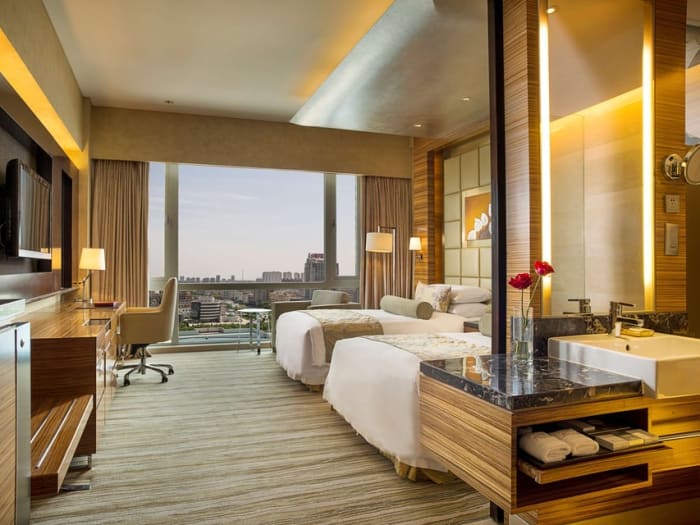
The rooms at Kempinski Hotel Yinchuan are described above all as spaces designed for comfort. The phrase may sound broad, yet it says something essential when taken seriously. In a hotel of this category, comfort is not limited to bedding quality or the presence of expected amenities; it depends on a subtler composition of proportions, insulation, ergonomics, light and continuity between the different moments of a stay. A successful room is one that allows a guest both to recover from a long journey and to work for a few hours, prepare for an appointment or slow down after a day in the city.
At a Kempinski address, one may reasonably expect a classic reading of hotel wellbeing: intuitive circulation, sufficient storage, a bathroom designed for ease of use, comfortable seating, a functional work area and an atmosphere conducive to rest. What often distinguishes a good hotel room is not the multiplication of effects, but the disappearance of irritants. Anything that clutters, tires or complicates the stay should recede. Luxury then becomes a form of controlled simplicity.
In Yinchuan, this quality of room matters particularly. The city may be a business destination, a stop on a wider itinerary or a place of discovery in its own right. In each case, the room plays a different role. For the business traveller, it must provide a stable, almost architectural setting in which to breathe between obligations. For the leisure guest, it becomes a discreet observation post, a place to sort impressions and prepare the next stage of the journey. For couples or families, it should allow harmonious cohabitation, with enough physical and mental space for each person to keep their own rhythm.
Suites, when chosen, generally extend this logic by introducing greater separation between uses. In an urban grand hotel, that advantage is valuable: one can receive, work, rest or simply stretch time without everything taking place in a single room. Even without detailing a precise typology, it is fair to assume that the property responds to this expectation of gradation between room and suite, between short stay and longer installation.
In keeping with the modern shared spaces, the interior aesthetic is likely to favour legible elegance over demonstrative décor. This is often the best choice for an international clientele. Travellers do not necessarily seek a literal interpretation of local folklore; they tend instead to value a calm, well-drawn environment capable of evoking its setting without becoming trapped by it. A successful room in this register leaves space for the guest. It does not impose a narrative; it accompanies one.
Lastly, room comfort also depends on the service that surrounds it. Daily housekeeping and turndown service, both mentioned among the known facilities, are fully part of that experience. They reintroduce a classic, almost ceremonial hotel rhythm that still distinguishes good houses. Returning in the evening to a room that has been reset, finding an atmosphere prepared for the night, noticing that the space has been discreetly adjusted in one’s absence: these are simple gestures, yet they profoundly alter the feeling of a stay. At Kempinski Hotel Yinchuan, everything suggests that the rooms and suites are conceived not as mere accommodation units, but as the true core of the experience, where travel becomes personal, quiet and entirely habitable.
Dining
Without a detailed inventory of restaurants or any unsupported claim regarding culinary signatures, the dining offer at Kempinski Hotel Yinchuan can nevertheless be situated within what one expects from a major international hotel: food and beverage conceived as an extension of the stay, able to support very different uses, from a business breakfast to a more settled dinner, as well as the informal pauses that structure a day of travel. In this kind of property, dining is not merely an additional service; it contributes to the overall coherence of the house.
In an urban hotel of this category, the first meal that truly matters is often breakfast. It sets the tone for the day and reveals much about the level of attention paid to guests. Good hotels understand that breakfast is not simply about abundance, but about rhythm, legibility and quality of execution. The business traveller needs efficiency; the leisure guest, time; families, flexibility. A well-organised room, attentive yet unobtrusive service, and an offer varied enough to accommodate international habits: these are what make the difference, far more than overly theatrical presentation.
In Yinchuan, dining also carries a cultural dimension. Ningxia has a distinct identity shaped by its history, exchanges and regional culinary traditions. Without attributing a specific menu to the hotel where none is documented, it is reasonable to imagine that a property of this level seeks a dialogue between international standards and local anchoring. This is often where a hotel table becomes interesting: offering familiar reference points to a cosmopolitan clientele while allowing flavours, products or inspirations that recall the territory to come through.
Guests staying several nights particularly value this adaptability. One evening calls for a structured meal; the next, something lighter; another day, a meeting over tea, coffee or a drink in a comfortable setting. The dining spaces of a grand hotel should be able to respond to these variations without losing coherence. They serve not only to feed, but to punctuate the stay. One meets there, waits there, sometimes works there, and lets the day settle.
In a house belonging to the Kempinski collection, the art of receiving generally passes through this attention to transitions. Ideal table service does not interrupt; it accompanies. It knows how to recognise the guest in a hurry as well as the one wishing to prolong the moment. It maintains a sense of form without stiffness. This quality of presence is especially important in a city where the hotel may function both as an exploration base and as a meeting place.
Finally, in luxury hospitality, dining is not measured only by the exceptional. It is also judged by consistency, precision and the ability to make each moment simpler and more pleasant. A coffee served at the right time, a dinner taken without complication after a dense day, a discreet refreshment between outings: these modest experiences often shape the truest memory of a property. At Kempinski Hotel Yinchuan, dining is best understood in that way: not as a spectacular manifesto, but as an essential component of overall comfort, in service of an elegant, practical and well-paced urban stay.
Concierge & Services
In a five-star hotel, services form the invisible backbone of the experience. At the Kempinski Hotel Yinchuan, they create a seamless stay.
A 24-hour concierge, 24-hour reception, daily housekeeping, turndown service, luggage storage, laundry, wake-up calls, and multilingual staff make up this comprehensive offering.
The continuously open reception caters to the rhythms of contemporary travel. Late arrivals, delayed connections, or extended days do not compromise the quality of the welcome.
The 24-hour concierge extends this philosophy. Whether booking a transfer, guiding guests to a neighbourhood, organising a day out, or facilitating practical arrangements, it connects the hotel to the city.
In Yinchuan, this role takes on particular significance for an international clientele. The service becomes both a landmark and a comfort.
Room amenities play an equally vital role. Daily housekeeping ensures a consistent level of quality.
The turndown service reintroduces the evening attentiveness characteristic of grand hotels. These discreet gestures set the rhythm of the stay.
Laundry services and luggage storage meet very practical needs. They become invaluable during an extended stay, an early arrival, or a late departure.
The wake-up call service also retains its importance. It serves as a reminder that a hotel is an organisation attentive to its guests' time.
Finally, the multilingual staff facilitates every interaction. They bridge the gap and simplify requests.
At the Kempinski Hotel Yinchuan, these services compose a promise of reliability. A silent quality, grounded in precision and availability.
The Yinchuan way of life
Staying at Kempinski Hotel Yinchuan also means accepting Yinchuan for what it truly is: not a Chinese metropolis immediately legible to the Western visitor, but a regional capital whose interest lies in its nuances. The local way of life does not always present itself through obvious monumental drama; it is discovered in rhythms, landscape contrasts, the coexistence of urban modernity with older inheritances, and in the way the city is rooted within the wider territory of Ningxia.
Yinchuan has a particular relationship with its environment. The region evokes desert margins, irrigation linked to the Yellow River, cultivated land, multiple cultural influences and a history of movement. This geography gives the city a singular tone. One does not find here either the overwhelming density of China’s largest metropolises or the fixed folklore of destinations staged for tourism. Instead, there is a kind of clarity, at times almost austere, that may appeal to travellers drawn to threshold cities, edge landscapes and strong regional identities.
From a well-located hotel, the experience of Yinchuan can be built in layers. One sets out in the morning towards a local site, a lively district, a more administrative or commercial area; one then returns to the hotel to pause; later one goes out again with a more receptive eye. This alternation between immersion and retreat suits a destination that often reveals itself better over time than through rapid consumption. The luxury of a good urban base lies precisely in making such gradual reading possible.
The Yinchuan way of life also depends on a particular quality of time. The city invites observation more than frenzy. One perceives the codes of contemporary China, certainly, but filtered through a more measured scale and through regional traditions that remain perceptible. For the curious traveller, this opens a rare field of attention. It becomes possible to notice the texture of an avenue, the organisation of a district, the way residents occupy public space, and the transitions between lively zones and quieter sectors.
Ningxia is also associated, in the imagination of many travellers, with open landscapes and a distinct regional culture. Even when a stay remains primarily urban, this proximity to the wider territory changes the perception of the city. Yinchuan is not only a destination in itself; it may also be understood as a gateway to a broader region, with its reliefs, horizons and traditions. The hotel, through its centrality and services, helps make that wider reading of the journey possible.
For a French or European audience, the appeal of a stay here often lies in this sense of managed displacement. One is neither in the ultra-classic nor in postcard exoticism. Instead, one encounters a less commented, more lateral China, yet one that is highly revealing of the country’s diversity. In that context, Kempinski Hotel Yinchuan plays a precise role: offering a familiar framework in its standards so as to make a destination worthy of curiosity and openness easier to approach.
Ultimately, the local art of living cannot be reduced to a list of attractions. It lies in a way of inhabiting travel, allowing the city to reveal itself at its own pace, and combining international comfort with attentiveness to context. That is exactly the kind of stay this address appears to make possible.
Book with MyConciergeHotel
Booking Kempinski Hotel Yinchuan through MyConciergeHotel means choosing an editorial and guided approach to hotel travel. In a market saturated with standardised information, interchangeable fact sheets and often contradictory reviews, real value no longer lies only in comparing rates or star categories. It lies in understanding what a property truly offers, whom it suits, in what context it makes the most sense, and how to integrate it intelligently into an itinerary. That is precisely where informed guidance makes a difference.
An address such as Kempinski Hotel Yinchuan is not chosen merely because it carries five stars. It is chosen because it answers a particular kind of journey: an urban stay in an important regional city, a business trip requiring continuous services, the discovery of a less expected China, or the need for a reliable framework in a destination that may still feel unfamiliar. To book with discernment is therefore to move beyond category and consider actual use. MyConciergeHotel enables that more precise reading.
The value of assisted booking also lies in preparation. Depending on the nature of the stay, expectations will differ. A couple may prioritise calm, room comfort and ease of exploration. A family may look more closely at logistical fluidity, timings and the simplicity of services. A business traveller will attach particular importance to a 24-hour front desk, concierge support, laundry or flexibility around arrivals and departures. Setting these priorities in perspective allows for a more accurate recommendation.
MyConciergeHotel follows this logic of reasoned selection. The aim is not to overpromise, nor to impose the same discourse on every luxury address. On the contrary, it is to restore the personality of a hotel, its verifiable strengths, its likely atmosphere and its suitability for different kinds of travellers. In the case of Kempinski Hotel Yinchuan, that reading highlights a modern urban address, part of a recognised collection, well located, comfortable and structured around continuous service. That is already a great deal, and often exactly what discerning travellers are seeking.
Booking through a concierge or an editorial platform also allows the stay to be approached more coherently. The hotel is no longer an isolated element, but part of a whole: the rhythm of the journey, the ideal duration, transfer arrangements, time management, and the balance between work and discovery. In a destination such as Yinchuan, that coherence is especially valuable. It avoids approximation and helps turn simple accommodation into a genuine base for the stay.
Finally, choosing MyConciergeHotel means favouring a certain idea of luxury hospitality: informed, precise and free from unnecessary emphasis. The role of the concierge is not to manufacture abstract dream imagery, but to make travel more accurate, fluid and personal. For a property such as Kempinski Hotel Yinchuan, that approach is particularly fitting. It allows one to book with full awareness, and with a clear understanding of what the hotel actually offers: well-run international hospitality, a practical location, modern shared spaces and a level of service designed to support both leisure stays and professional travel.