History & Heritage
In Xiamen, a port city in southeastern China, luxury hospitality is deeply rooted in a history of maritime exchanges and cosmopolitanism. The Kempinski Hotel Xiamen is situated within this coastal geography, where the sea, commerce, and foreign influences converge.
Affiliation with Kempinski lends a distinct tone to the stay. The brand emphasises the codes of classic, readable, and functional luxury. In Xiamen, this signature manifests as contemporary elegance interspersed with traditional touches. The experience is grounded in warm hospitality, the tranquillity of communal spaces, the comfort of the rooms, and the continuity of service.
The hotel caters equally to business travellers and visitors eager to explore the Fujian coastline. It captures the unique rhythm of Xiamen, which is more maritime and airy than many major metropolises. When the view opens up, it evokes the structuring presence of the sea. This relationship with the landscape instils a sense of retreat, a rarity in a large urban hotel.
The identity of the Kempinski Hotel Xiamen is less about architectural heritage and more about the art of hospitality. It is built on consistency, discretion, and clarity of service. Guests find a reception open at all hours, an available concierge, turn-down service, and meticulous daily maintenance. The teams support stays of varying durations.
Finally, the hotel reflects the evolution of Xiamen. The city combines modern infrastructure, easy access to points of interest, and a desire for more serene stays. Here, luxury is founded on a balance between efficiency and serenity, international standards, and local perceptions of time.
The Establishment
The foremost merit of the Kempinski Hotel Xiamen lies in its ability to offer a setting that balances openness with retreat. The hotel provides easy access to local attractions, situated in a city where movement between business districts, shopping areas, and points of interest remains fluid. On-site, the experience recreates a sense of distance from the external hustle and bustle. This duality allows one to experience Xiamen without being constantly subjected to its pace.
From the communal spaces, the establishment asserts an aesthetic of balance. Modern elegance intertwines with traditional touches, creating a visual continuity that is soothing rather than jarring. Contemporary lines bring clarity, while more classical or local references add warmth and depth. The hotel is quickly understood and easily navigated, with well-defined areas for passage and pause.
The sea view plays a central role in this perception. In a coastal city like Xiamen, seeing the water from the hotel is not merely an aesthetic pleasure; it is a way to connect with the locale. The maritime landscape introduces a broader scale, calming the gaze and lightening the urban sensation. Depending on the orientation of the spaces and rooms, this presence is more or less direct, contributing to the overall identity of the address. Even without being directly by the water, the sea remains a mental and visual landmark.
The communal areas have been designed for relaxation, which is an important aspect. Many business hotels prioritise efficiency without creating genuine respites. Here, the shared spaces accommodate varied uses: waiting for an appointment, extending a conversation, reading, working briefly, or simply slowing down between moments of the day. This tranquil versatility often signifies a well-thought-out hotel. Luxury does not solely stem from materials or furnishings; it also lies in how the space supports the rhythms of one’s stay.
For leisure guests, the hotel serves as a comfortable base to explore Xiamen, its seaside promenades, vibrant neighbourhoods, and cultural sites. For business clientele, it offers a structured environment that allows for a seamless alternation between meetings, returns to the room, and moments of recuperation. Here, calm takes on its full meaning. It is not an abstract silence but a general ambience that avoids saturation. One can arrive late, leave early, juggle appointments, or take their time. The hotel never feels out of sync.
Ultimately, the Kempinski Hotel Xiamen holds together several promises without opposing them: the city and retreat, functionality and pleasure, international flair and more rooted touches. The establishment does not impose a heavy narrative; it offers a coherent, serene framework that is sufficiently flexible for each guest to project their own stay. In the hotel landscape of a major coastal city, this restraint often constitutes a lasting quality.
Rooms and Suites
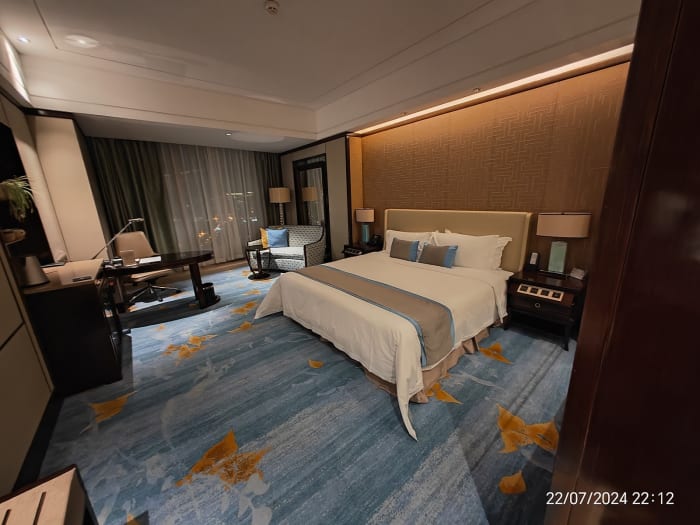
In a hotel like the Kempinski Hotel Xiamen, the room is not merely a place to rest. It serves as the gravitational centre of the stay. For business travellers, it extends a continuity of comfort after a busy day. For leisure travellers, it becomes a vantage point over the city and, depending on the orientation, the sea. What one expects from an establishment of this calibre is a sense of mastery. Just proportions, fluid circulation, well-managed light, coherent amenities, and a stable atmosphere.
The decor blends contemporary and classic styles. In the rooms, this approach suggests interiors that avoid fleeting trends. This is essential for a hotel that welcomes a diverse international clientele. A successful room is not just photogenic; it must remain pleasant from late arrival to departure preparation. Classic references provide a sense of permanence, while contemporary elements ensure clarity and functionality. This combination fosters immediate comfort, requiring no effort to adapt.
The views are a major asset. A sea view alters the perception of the stay. It brings openness, light, and a sense of breathability. In a coastal city, starting the day facing an unobstructed horizon or returning in the evening to the presence of water transforms the relationship with the room. It ceases to be a mere enclosed volume and becomes an interface with the landscape. Even for travellers who spend little time there, this perspective subtly modifies the experience.
Comfort also lies in the details of service. Turn-down service, daily maintenance, the option to request a wake-up call, and the assistance of teams available at all hours extend the experience of the room. In high-end hospitality, well-being often arises from this interplay between private space and discreet service. A room can be elegant, but it truly becomes welcoming when supported by seamless logistics. Returning in the evening to a space tidied and prepared for the night contributes to this impression of constant care.
The various categories of rooms and suites cater to distinct needs. Short stays, business trips, romantic getaways, and longer stays requiring more comfort. What matters is not just the size, but the coherence of the overall experience. A successful suite is not merely larger; it allows for better separation between rest, work, potential hosting, and downtime.
At the Kempinski Hotel Xiamen, the room stands as a contemporary refuge. A calm, well-appointed space connected to the city without being subservient to it. In a destination where one alternates between meetings, strolls, and urban discoveries, this quality of retreat becomes crucial. It allows for a stay at one's own pace. This is often where the success of a grand hotel is measured: in its ability to make the room a space of stability, comfort, and silent attentiveness.
Dining
In an urban property of this category, dining plays a broader role than that of a simple food service. It structures the day, sets a tone for the hotel and offers travellers another way of entering the city without immediately leaving their base. At Kempinski Hotel Xiamen, even without precise details regarding restaurants or culinary signatures, the property’s overall positioning suggests a certain idea of dining: an offer designed to answer multiple uses, with the same concern for balance found elsewhere in the experience.
Breakfast is often the first moment at which a hotel’s personality becomes clear. In a city such as Xiamen, it carries particular weight, as it accompanies days that may differ greatly from one another: business appointments, departures towards local attractions, slower walks by the water, or simply a pause dedicated to rest. What one expects from a major international hotel is clean execution, attentive service without over-presence, and a range broad enough to suit varied cultural habits. The quality of breakfast is measured as much by its rhythm as by its content.
Beyond the morning, hotel dining fulfils a function of continuity. For some guests, it is a practical solution between obligations. For others, it becomes a comfortable refuge when they prefer to avoid additional movement at the end of the day. In both cases, success depends on the property’s ability to offer spaces in which one feels equally at ease for a full meal or for something lighter, a tea, coffee or drink taken in a calm atmosphere. Hotels that understand this know that hospitality also lies in flexibility of use.
The setting matters as much as the plate. In a hotel described as elegant, serene and open to maritime views, one can readily imagine dining spaces where light, materials and layout contribute to the experience. A well-conceived room does not need spectacle; it should support conversation, preserve a degree of visual privacy and accompany the different times of day. Lunch does not call for the same energy as dinner, just as a business meeting differs from a meal for two. Good hotel dining is that which absorbs these variations without losing its unity.
In Xiamen, a destination shaped by its relationship with the sea and by a rich regional culinary tradition, curious travellers will naturally want to explore the local scene. That is precisely why a strong in-house offer need not replace everything. It should complement the city instead: providing a composed start in the morning, a reliable option at certain moments, and perhaps a more hushed setting when one wishes to slow down. In that sense, dining at Kempinski Hotel Xiamen appears as a logical extension of the hotel itself: international in standards, adaptable in use, and sufficiently poised to suit very different kinds of stay.
The dining experience here therefore seems to rest on a form of rightness. Not the accumulation of concepts, but the ability to accompany a stay with consistency. That is often what seasoned travellers seek: not to be surprised at every meal, but to rely on a level of quality, comfort and service that makes each moment simple, pleasant and well judged. In a grand hotel, that discreet reliability can be worth more than an overly emphatic promise.
Spa & Well-being
At the Kempinski Hotel Xiamen, well-being takes centre stage at K SPA, a 2,600 m² complex designed to slow down the pace of life. The atmosphere prioritises continuity, weaving together treatments, water, and moments of pause.
The spa features 13 treatment rooms, allowing for a blend of solitary retreats and more enveloping rituals. The layout of the spaces promotes smooth circulation, without interruption, creating the rare sensation of being removed from the urban rhythm.
The indoor pool naturally extends the experience, providing a stable environment, shielded from external variations, conducive to calm lengths and moments of recovery.
The signature of the venue is expressed through Tea Inspired therapies. These treatments draw from the world of tea, offering a unique gesture and sensory experience, with an approach that invites more to tranquillity than to demonstrative effects.
Together, these elements compose a spacious spa where each sequence finds its place. A few laps, a treatment, followed by the silence of a suspended moment: a simple and genuine way to inhabit Xiamen differently.
Concierge & services
The quality of a grand hotel is often judged less by what it displays than by what it makes possible. From that perspective, Kempinski Hotel Xiamen appears to rest on a particularly clear service foundation, designed to support stays with very different needs without ever complicating the experience. A 24-hour concierge, round-the-clock front desk, daily housekeeping, turndown service, luggage storage, laundry and wake-up service form a classic but essential base. In luxury hospitality, it is precisely these fundamentals that give a stay its fluidity.
The concierge in particular plays a decisive role in a city that is sometimes discovered within a limited timeframe. It does not merely answer occasional requests; it helps turn a theoretical programme into a workable experience. Organising transport, suggesting the right moment to visit a district, facilitating a reservation, directing guests towards accessible local attractions: all these gestures, when well executed, significantly reduce the mental load of travel. Contemporary luxury often lies in that discreet simplification.
The 24-hour operation of both front desk and concierge is especially valuable in Xiamen, a destination welcoming international guests and business travellers subject to variable schedules. Late arrivals, early departures, programme changes and last-minute requests all belong to the reality of travel. Knowing that the hotel remains fully operational at any hour creates a form of quiet security. Guests do not need to anticipate every detail; they know that a solution can be found, even outside the most convenient hours.
Daily housekeeping and turndown service belong to another, more intimate dimension of hospitality. They directly shape the quality of the room as a lived space. A room that is carefully maintained, regularly reset and prepared for the night offers more than comfort; it establishes continuity of care. That regularity matters greatly during longer stays, but also during shorter ones in which every hour must be optimised. The traveller returns to an environment that is stable, clear and immediately habitable.
Services such as laundry, luggage storage or wake-up calls may appear secondary on paper, yet they become decisive in practice. Laundry supports extended business stays or denser itineraries. Luggage storage allows guests to make full use of their final hours in the city without material constraint. A wake-up call, when requested, remains a very concrete marker of reliability. These attentions are not spectacular, but they reflect a mature hospitality, aware that real comfort often depends on the most practical details.
Finally, the presence of multilingual staff, mentioned in the amenities extract, deserves emphasis. In an international hotel, the quality of communication directly shapes the perception of service. Being understood quickly, being able to formulate a request precisely and receiving a clear answer all determine the sense of ease. At Kempinski Hotel Xiamen, these services together suggest a simple but demanding promise: to allow guests to focus on the reason for their visit — work, discovery or rest — while the hotel discreetly takes charge of everything that might otherwise interrupt the smoothness of the stay.
The Art of Living in Xiamen
Staying at the Kempinski Hotel Xiamen also offers a glimpse into a particular idea of Xiamen. A major Chinese city whose identity is not limited to speed or density.
The local art of living is rooted in the alliance between urbanity and the presence of the coastline. The sea acts as a principle of balance. It opens perspectives, softens the light, and introduces a breath of fresh air into the urban fabric.
For visitors, this translates into a more fluid, airy, and at times contemplative city experience compared to other major centres in the country.
Xiamen is appreciated for its relatively serene atmosphere, its promenades, its relationship with the landscape, and its ability to harmonise economic activity with quality of life. This is what the hotel seems to capture and extend.
Its calmness, communal spaces designed for relaxation, and sea views resonate with the personality of the destination. A good hotel does not merely shelter the traveller; it provides a key to understanding the place.
Here, this key could be measured enjoyment—knowing how to appreciate the city without consuming it too quickly.
To discover Xiamen, one must embrace the alternation between movement and pause. A morning may be dedicated to meetings or visiting local sites, followed by a slower moment facing the water.
The luxury of the stay lies in this freedom of modulation. The city does not impose a single rhythm; it allows for multiple intensities.
Easy access to local attractions enhances this quality of stay, enabling the composition of flexible days without overly burdensome logistics.
One can explore Xiamen in successive touches: a neighbourhood, a view, a shopping moment, a cultural stop, a culinary sequence, and then a return to a calmer setting.
The art of living in Xiamen also involves an awareness of the seasons. Spring and autumn are particularly pleasant times to explore the city.
It is beneficial to plan one’s days around this relative mildness, favouring walking outings, allowing time for observation, and enjoying the views and light.
In this sense, the Kempinski Hotel Xiamen functions as a balancing post. One returns there to find calm, reliable service, a comfortable room, perhaps a treatment at the spa.
This is what one expects from a grand establishment in a destination of this kind: not to replace the city but to help one experience it more fully.
Xiamen is then discovered not as a checklist of places to tick off, but as an atmosphere to be experienced, between the marine horizon, discreet elegance, and a chosen rhythm.