History & heritage
In Ulaanbaatar, where layers of Mongolian history unfold between monasteries, Soviet-era avenues, contemporary buildings and emerging business districts, Kempinski Hotel Khan Palace occupies a distinctive place. The hotel belongs to a fast-changing capital, yet it maintains a style of hospitality built on consistency, clarity of service and a certain international refinement. Its identity rests less on decorative storytelling than on the meeting of two worlds: the heritage of a city shaped by trade, diplomacy and cultural exchange across Inner Asia, and the expertise of a major European hotel brand, adapted here to the pace and expectations of a destination still relatively unfamiliar to many luxury travellers.
The very name of the hotel carries historical resonance. In the Mongolian imagination, the figure of the khan evokes sovereignty, territorial organisation, mobility and a culture of welcome long associated with caravan routes. Without resorting to theatrical reconstruction, the property draws on the idea of a place of shelter within a vast, contrasting city marked by dramatic seasonal shifts. This reading feels particularly apt in Ulaanbaatar, the country’s principal capital and the natural gateway to urban Mongolia before any onward journey to the steppe, mountain valleys or the Gobi.
Its Kempinski affiliation adds another layer. The brand is associated with a classical approach to hospitality: structured arrivals, efficient concierge service, careful attention to public spaces and the ability to serve a mixed clientele of business travellers, diplomats, international visitors and couples on a cultural stay. In this context, Khan Palace does not rely on overt folklore; instead, it favours a measured interpretation of Mongolian tradition in dialogue with contemporary standards of comfort. It is precisely this restraint that gives the hotel its coherence.
The heritage of the place is therefore expressed less through a celebrated founding date than through its urban role: providing a dependable base in a capital visited as much for work as for a deeper understanding of a country with a strong identity. Travellers find a reassuring sense of stability here, especially in a destination whose codes may feel less familiar than those of Western Europe. That stability does not exclude character. It appears in the attention paid to local culture, in the proximity to historic and cultural landmarks, and in the way the spirit of an international grand hotel is balanced with the Mongolian setting.
For a stay in Ulaanbaatar, this sense of heritage has practical value. It encourages guests to approach the city not merely as a logistical stop, but as a destination in its own right, with its institutions, memories and contrasts. Kempinski Hotel Khan Palace supports that perspective with understated elegance: the kind that understands that, in a capital in motion, true luxury often lies in the quality of welcome, the clarity of the experience and the accuracy of the connection between place and hospitality.
The hotel
Kempinski Hotel Khan Palace is first defined by its address in Ulaanbaatar, conceived as a point of balance between urban immersion and ease of stay. To be based in the Mongolian capital is to experience a city of contrasts, where administrative centres, residential districts, cultural institutions and places of memory form a shifting landscape. In that context, the hotel plays an essential role: it offers a clear, calm and immediately functional setting while remaining connected to the city’s principal points of interest. Its proximity to cultural and historic sights is not merely a location claim; it genuinely shapes the guest experience, whether the stay is business-led or exploratory.
Arrival sets the tone. The hotel follows the classical language of an international grand hotel, with public spaces designed to support different rhythms of travel: a brief pause before a meeting, a slower settling-in after a long-haul flight, a quiet moment with a book, an informal conversation or a business discussion. This versatility matters in Ulaanbaatar, where stays often combine professional obligations, institutional visits and cultural curiosity. The hotel responds to that mix without stiffness, offering spaces that remain elegant without feeling overly formal.
One of the property’s strengths lies in its blend of Mongolian tradition and modern style. This is not a themed décor, but an atmosphere. Certain visual cues, materials, tonal palettes or spatial arrangements may suggest the local context, while the overall experience remains rooted in contemporary international comfort. This approach suits travellers who want to feel the destination without giving up clear and familiar standards. The result is a hotel that does not disappear behind its brand, yet does not overstate its local references either.
The property also lends itself naturally to business use. Spaces suited to meetings are an evident asset in a capital where companies, institutions, organisations and travellers in transit to other parts of the country frequently converge. Here again, luxury is measured in fluidity: ease of organisation, straightforward circulation, professional welcome and the ability to move from work to rest without disruption. Khan Palace appears to have been designed with that continuity in mind.
Yet the address is more than functional. It also provides a way of reading Ulaanbaatar in all its complexity. From the hotel, one better understands the singularity of a high-altitude capital where rapid modernisation coexists with deeply rooted traditions. The city does not always reveal itself at first glance; it requires time, attention and a place to stay that can both shelter from the pace outside and encourage exploration. This is where Kempinski Hotel Khan Palace feels particularly well judged. It does not isolate guests from the urban context; it offers a more ordered, more comfortable and more hospitable version of it.
For French and European travellers, that quality is decisive. In a destination still relatively untouched by mass tourism, having a hotel able to combine international reference points, personalised service and proximity to local heritage can profoundly shape the stay. The property becomes more than accommodation: an observation point, a place of transition and, at times, a key to understanding the city itself.
Rooms and Suites
In a capital city characterised by significant temperature fluctuations and a brisk urban pace, the hotel room occupies a unique position. At the Kempinski Hotel Khan Palace, it provides a refuge designed to restore a balance between the outside world and the interior. Here, the traveller seeks rest, an efficient workspace, or simply a continuation of comfort after a long journey.
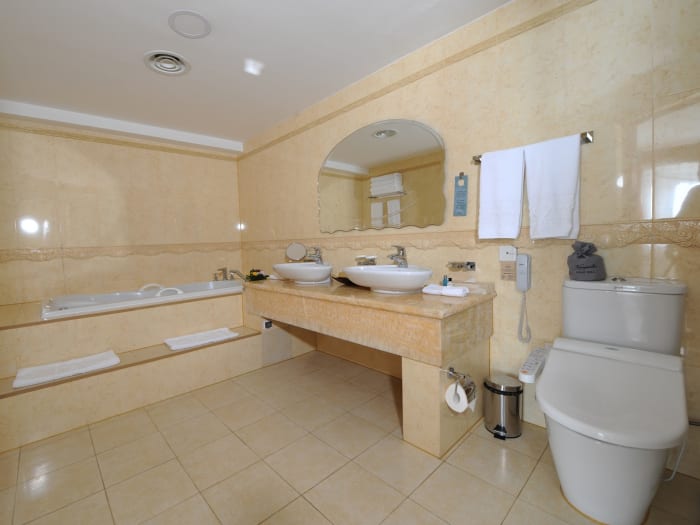
The rooms and suites embody a classic aesthetic, clear and free from unnecessary embellishments. The spaciousness promotes ease of movement, while the furniture remains functional. The bedding, storage, bathrooms, and privacy all contribute to an overall sense of comfort. Whether for business or leisure, these elements are immediately significant.
Daily service plays a central role in this experience. The daily housekeeping and turn-down service enhance the feeling of a consistently attended stay. The room is tidied and prepared for the various moments of the day. In a city where appointments and travel are relentless, this regularity holds real value.
For international travellers, the room must also adapt to different needs. Some seek an environment conducive to work, while others prefer a more spacious setting for a stay as a couple. Still others desire a simple and comfortable stopover before heading to the Mongolian regions. In all cases, the goal remains the same: to provide a stable base.
The suites extend this concept with greater ease and a clearer separation of functions. They are ideal for those wishing to host, work more comfortably, or simply slow down the pace. In a city like Ulaanbaatar, this additional space makes perfect sense.
Ultimately, the rooms and suites at the Kempinski Hotel Khan Palace facilitate the transition from travel to rest seamlessly. They absorb the stresses of movement while maintaining enduring comfort. In a large urban hotel, this is often where the essence of the experience lies.
Dining
In a luxury urban hotel, dining is never merely a supplementary function; it plays a vital role in the overall experience and daily rhythm of the establishment. At the Kempinski Hotel Khan Palace, the culinary offerings naturally extend the hotel's identity. The standards are international, while the atmosphere remains attuned to the local context. The dining options cater to a variety of needs, from business breakfasts to more leisurely dinners.
In Ulaanbaatar, this aspect is particularly significant. The city attracts a cosmopolitan clientele, including business travellers, diplomats, international visitors, and local residents, all of whom bring diverse culinary references. A Kempinski hotel must therefore provide a dining experience that resonates with multiple cultural tastes. This requires reliable execution, precise service, and adaptable hours. Here, luxury lies in this mastered flexibility.
Breakfast deserves special attention. In a destination where days begin early, it serves as a true anchor point. Guests expect a smooth morning service and a sufficiently varied offering to accommodate international habits. The setting should be suitable for both solitary moments and informal professional meetings. It is often in this context that the true quality of a great hotel is measured.
Throughout the day, the dining spaces shift in function, becoming transitional areas between the city and the hotel. Guests can enjoy international cuisine, occasionally accented with regional references or Mongolian inspirations. In a capital still relatively devoid of well-known dining options for the European public, the hotel often serves as a reliable culinary landmark. It allows for serene dining on-site, hosting a local contact, or extending a conversation in a calm environment.
The quality of the dining experience is also reflected in the service. The gastronomic experience truly comes to life through attention to preferences, management of time constraints, and a keen sense of detail. For a business traveller, this translates to efficiency without coldness. For a couple, it means a more relaxed dinner after a day of sightseeing. For a guest accustomed to large international chains, it ensures solid standards in a distant destination.
Ultimately, the dining experience at the Kempinski Hotel Khan Palace embodies a cultivated sense of comfort. Its value lies in its accuracy, offering a service that aligns with the realities of travel, considers the context of Ulaanbaatar, and transforms each meal into a moment of continuity. In a city where landmarks can sometimes be fluid for visitors, this continuity is reassuring.
Wellness & Rhythm of Stay
At the Kempinski Hotel Khan Palace, wellness is appreciated through a discreet and tangible approach. It is tied to the rhythm offered to the traveller.
After a long-haul flight, the aim is to recover more easily. Between meetings, the hotel should provide an opportunity to pause. Comfort also matters in the face of altitude and the continental climate.
In Ulaanbaatar, this aspect deserves particular attention. The city experiences distinct seasons, with harsh winters and summers more conducive to urban exploration.
In this context, wellness is fundamentally based on essentials. Controlled indoor temperature, comfortable rooms, attentive service, quality bedding, relative calm, and smooth organisation.
The nightly turndown service and daily maintenance enhance this comfort. In the evening, the room is prepared for the night. In the morning, the space is restored to order.
These gestures alleviate the mental load of travel. For a business stay, they support concentration. For a leisure visit, they free up time and energy.
Wellness also extends to communal spaces. A lobby, lounge, or dining area allows guests to unwind without remaining in their rooms.
In a capital marked by stark contrasts, these moments of respite are significant. They help to moderate the urban experience rather than endure it.
In Ulaanbaatar, luxury can hinge on this balance. Organising a busy day with the assistance of the concierge. Returning to the hotel before dinner. Taking the time for a simple meal. Then enjoying a room that has been carefully prepared.
At the Kempinski Hotel Khan Palace, wellness thus stems from a holistic quality of experience. It arises from the alliance of personalised service, consistent comfort, and adaptation to the local context.
Concierge & services
In a destination such as Ulaanbaatar, the quality of hotel services takes on heightened importance. Travellers expect not only flawless execution, but also orientation, anticipation and adaptability. Kempinski Hotel Khan Palace appears to meet that expectation through a particularly relevant set of services for an international clientele: 24-hour concierge, 24-hour front desk, luggage storage, laundry, wake-up service, multilingual staff, daily housekeeping and turndown service. Considered separately, these are the standards of a major hotel. Taken together, they create a stay designed around fluidity.
Round-the-clock concierge service is likely one of the property’s most valuable assets. In a capital where flight schedules, traffic constraints, business appointments and cultural visits may combine in complex ways, having a knowledgeable contact available at any hour materially changes the stay. This is not only about arranging a transfer or suggesting an address; it is about helping to shape a coherent day, securing certain movements and giving travellers the clarity that can otherwise be lacking when discovering a distant city.
The 24-hour front desk serves the same logic. Late arrivals, very early departures and last-minute changes are part of the reality of international travel. Knowing that the welcome remains constant whatever the hour contributes to a deeply reassuring sense of continuity. In Ulaanbaatar, where air connections may involve unusual timings, this permanence is not an incidental luxury; it becomes a structural comfort.
Laundry, luggage storage and wake-up service also belong to this practical intelligence of travel. They allow guests to move more lightly, manage a stopover between stages, optimise a tight schedule or prepare a departure without friction. These services may seem discreet, yet they matter enormously in the real assessment made by experienced travellers. Luxury is not only aesthetic; it also lies in removing the small constraints that burden movement.
Multilingual staff likewise deserve emphasis. In a destination whose language and codes may be less familiar to European visitors, the team’s ability to bridge several cultural worlds is essential. It facilitates simple requests as well as more complex situations, reduces misunderstandings and makes the entire stay calmer. Here again, personalised Kempinski service takes on a very concrete form.
Finally, the quality of service is measured by tone. A grand hotel must not only be efficient; it must be efficient with accuracy, without excessive formality or misplaced familiarity. Trust is built in that balance. At Kempinski Hotel Khan Palace, everything suggests an approach in which hospitality supports the traveller without overwhelming them, assistance remains available without becoming intrusive, and each service helps make Ulaanbaatar more legible. In a city that can feel impressive at first encounter, that gentle mediation is one of the greatest assets of a successful stay.
The Art of Living in Ulaanbaatar
Staying at the Kempinski Hotel Khan Palace offers a different perspective on Ulaanbaatar, beyond merely being a gateway to the vast Mongolian landscapes. The capital possesses its own density, visual language, and urban rituals. It lacks the immediately discernible charm of certain European capitals, demanding a more patient attention. This is what makes it intriguing. With a blend of Buddhist heritage, memories of the 20th century, contemporary economic growth, and very tangible daily life, the city creates a unique art of living, characterised by contrasts.
From a well-located hotel, the discovery takes on a new dimension. The proximity to cultural and historical sites allows for the city to be explored in sequences. One can dedicate a morning to institutions and memorial sites, another to observing urban life, and yet another to selective shopping or professional meetings. Ulaanbaatar is often understood in fragments: a square, a monastery, a museum, an avenue, a café, a change of light in the late afternoon. The luxury of a good hotel lies in providing the framework from which these fragments gain meaning.
The local art of living is also influenced by the season. In summer, the city opens up more. Travel becomes simpler, and the relationship between the capital and the surrounding landscapes is more apparent. In winter, the experience becomes more introspective, more graphic as well, with a unique light and a heightened awareness of the continental climate. A comfortable, well-organised hotel that is attentive to the traveller's needs can transform this constraint into an experience.
For the French visitor, Ulaanbaatar may surprise with its blend of ruggedness and discreet refinement. The city is not always spectacular in the expected sense. It reveals a culture of resilience, adaptation, and hospitality. Mongolian traditions are not merely presented in staged displays; they are also reflected in the relationship with time, in certain forms of politeness, in the importance of welcome, and in the coexistence of urban modernity and nomadic imaginations.
The Kempinski Hotel Khan Palace complements this discovery well, as it does not seek to simplify the city. It offers a comfortable, structured, international entry point while allowing the traveller the opportunity to form their own perspective. Too many hotels impose a fixed narrative of their destination. The best provide reference points while leaving room for personal experience.
Thus, an art of living during a stay in Ulaanbaatar emerges. Departing in the morning with a clear plan. Returning to the hotel for a break. Setting off again towards a cultural site. Dining in a reassuring setting. Then preparing for the next leg of the journey with the help of the concierge. This alternation between exploration and retreat, intensity and comfort, is a fitting way to approach the Mongolian capital. It serves as a reminder that the journey is also played out in the quality of transitions.
Booking via MyConciergeHotel
Booking the Kempinski Hotel Khan Palace through MyConciergeHotel makes perfect sense for a simple reason: in Ulaanbaatar, preparation directly influences the quality of your stay. In a destination less familiar than major European or Middle Eastern capitals, choosing the right hotel is not always sufficient. One must also consider arrival logistics, daily rhythms, transfers, flight schedules, travel expectations, and sometimes the connection to a broader itinerary in Mongolia. Editorial and concierge support can transform these parameters into a seamless experience.
One of the primary concerns is arrival. Pre-booking your airport transfer is particularly wise. After a long-haul flight, in a city where you are still unfamiliar with the surroundings, being met and escorted smoothly to the hotel immediately changes your perception of the journey. This simple gesture avoids unnecessary fatigue, reduces uncertainty, and allows you to enter your stay with greater calm. It is the detail that distinguishes a standard reservation from one that has been thoughtfully arranged.
Using MyConciergeHotel also provides a more accurate understanding of the establishment. The Kempinski Hotel Khan Palace is suitable for both couples and business travellers, but for different reasons. Some will prioritise proximity to cultural and historical sites, while others will need spaces conducive to meetings and flawless logistics. Still others will seek primarily personalised service in a reassuring international setting. The value of human support lies in matching these expectations to the right stay, at the right pace, and with the right services.
Seasonality should also be considered from the moment of booking. Summer and winter tell different stories about the city and Mongolia. Depending on the chosen period, visits, rest times, early departures, or extensions outside the capital will be organised differently. Informed advice can help anticipate these differences without dramatizing climatic constraints. It is not about promising a uniform experience but rather assisting the traveller in choosing the moment that best reflects their preferences.
Finally, booking via MyConciergeHotel places the hotel within a broader vision of the journey. The Khan Palace is not merely a room in a large city; it serves as a base from which to understand Ulaanbaatar, organise meetings, prepare for an extension in the country, or experience the capital with greater comfort and clarity. Our role is to make this preparation tangible: facilitating special requests, guiding towards the right services, and ensuring that the experience is as well-prepared as it will be lived.
In the realm of luxury, the difference is not always found in the visible exceptional. It often lies in the details before arrival, in the precision of choices, the quality of advice, and the elimination of uncertainties. For a venue like the Kempinski Hotel Khan Palace, this preparation is particularly invaluable. It allows one to approach Ulaanbaatar with confidence, curiosity, and the feeling that everything has been thoughtfully considered.