History & sense of place
Jumeirah Olhahali Island belongs to a contemporary vision of Maldivian island luxury: a retreat designed for slowing down, stepping away from ordinary rhythms and reconnecting with a refined form of simplicity. Here, history is not expressed through centuries of architecture or aristocratic lineage, but through the more recent evolution of high-end hospitality in the Maldives, where the private-island resort has become a language of its own. The Jumeirah name brings with it a service culture shaped by international luxury hospitality, with particular attention to comfort, privacy and the smooth flow of a stay.
What makes the property compelling is precisely this balance between brand signature and local spirit. On one side are the codes of a house accustomed to discerning travellers: discreet organisation, carefully composed spaces, a promise of serenity and a genuine sense of detail in everyday service. On the other, the Maldivian setting establishes its own hierarchy of pleasures: shifting light throughout the day, the constant presence of the ocean, the direct relationship between accommodation and landscape, and the rare feeling of inhabiting an island rather than merely staying on one. This immediate connection to nature gives the experience unusual depth. It turns the simplest gestures — opening the curtains in the morning, walking towards the shore, lingering at dusk — into fully felt moments.
The resort therefore appeals to different kinds of travellers without losing coherence. Couples find the privacy and softness sought for a journey for two; families appreciate an organisation capable of accommodating different rhythms without disturbing the island’s overall harmony. This is not a hotel built around bustle or display. Its identity rests instead on space, ease, contemporary comfort and a clear emphasis on wellbeing.
Within the landscape of North Malé Atoll, Jumeirah Olhahali Island belongs to a generation of resorts that favour a current aesthetic and a holistic experience over decorative excess. Its heritage is less architectural than cultural: that of international hospitality applied to one of the Indian Ocean’s most distinctive settings. For the traveller, this is felt from the moment of arrival: the sense of a place designed to offer time, calm and consistent attentiveness, never through overstatement but through measured assurance. It is this restraint, more than any formula, that gives the address its character.
The Establishment
Nestled on an island in the North Malé Atoll, Jumeirah Olhahali Island embodies the essence of what the Maldives have to offer. It provides a sense of remoteness without harshness, comfort without excess, and natural beauty that remains unspoiled.
The setting is that of a private island, surrounded by the myriad shades of blue that the archipelago is renowned for. The gaze wanders between the sky, lagoon, lush vegetation, and contemporary lines. Nothing truly interrupts the connection to the outside.
The North Malé Atoll is among the most well-known areas of the Maldives, celebrated for its clear waters, diverse water sports, and ease of access. Thus, the stay begins without excessive logistics. Once on the island, the pace shifts. Life unfolds outdoors, hours are measured by the light, and a more instinctive relationship with the climate and horizon is rediscovered.
Architecture and communal spaces play a vital role here. Modern facilities and elegant spaces complement the landscape without attempting to compete with it. Open volumes and seamless transitions between indoor and outdoor areas enhance this sense of ease. Luxury is expressed through the generosity of space, the quality of circulation, and the preserved tranquillity.
The atmosphere remains peaceful, which is highly valued here. Guests come to rejuvenate, and the location delivers on this promise. The island allows for a balance of swimming, water activities, dining, relaxation, and wellness interludes. Everything seems organised to maintain genuine flexibility during the stay.
Jumeirah Olhahali Island caters equally well to couples and family vacations. The establishment provides intimacy without excluding shared moments. It offers spaces for retreat as well as areas for conviviality. The island thus becomes a temporary living environment that is coherent and soothing.
Rooms, Villas & The Art of Staying
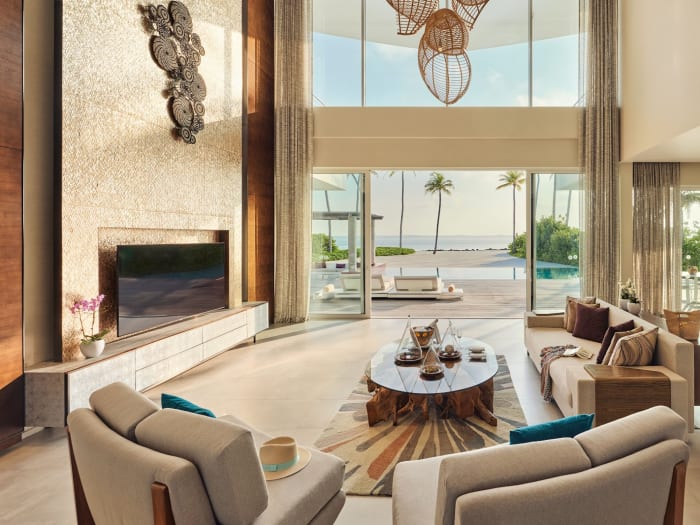
In the Maldives, the quality of a stay is often measured by the relationship between the accommodation and its immediate surroundings. At Jumeirah Olhahali Island, this relationship is at the heart of the experience. The property embodies the tradition of high-end island resorts: accommodations designed as private sanctuaries, open to the landscape. Comfort is also found in how the space allows guests to live at their own pace, seamlessly blending the temperate interior with the inviting exterior.
In the Maldivian context, the room is more than just a place to rest. It serves as a space for reading, swimming, enjoying a light lunch, gazing at the sea, and then returning to the terrace in the late afternoon. This continuity of use lends fluidity to the stay, explaining why the best resorts in the Maldives often leave guests feeling as if they have spent as much time outdoors as indoors.
The contemporary aesthetic of Jumeirah Olhahali Island enhances this sensation. Clean lines, a soothing palette, and a layout that embraces natural light create a harmonious environment. Luxury is expressed through a controlled simplicity: welcoming bedding, bathrooms designed for relaxation, integrated storage, and seating areas conducive to tranquillity. The openings frame views of the lagoon or lush vegetation.
For couples, the appeal of these accommodations lies in the intimacy they offer. The stay transforms into a retreat for two, punctuated by swims, quiet meals, and long stretches of free time. For families, the focus shifts to having a flexible space that accommodates various rhythms, balancing adult relaxation, children's play, and shared moments.
Daily service also contributes to the room experience. Regular maintenance, turndown service, and attentive organisation transform the accommodation into a cocoon. After a day at sea or a sun-soaked moment, returning to a space that has been tidied and prepared for the night enhances comfort. This effective discretion supports the essence of the experience: the feeling of inhabiting a private space open to a vast marine backdrop for a few days.
Dining
In an island resort, dining is never merely an ancillary service. It structures the days, creates moments of connection, and contributes to the memory of the place. At Jumeirah Olhahali Island, situated on a private island, the choice of dining venues is an integral part of the experience. This aspect is not a constraint; rather, it allows guests to experience gastronomy as a rhythm, tailored to their desires, the light, or the weather.
In the Maldives, breakfast often takes on a special significance. It is not just a meal to start the day. Guests settle into the gentle warmth of the early hours, when the heat is still manageable and the lagoon appears almost still. In a setting focused on wellness and relaxation, one expects a proposal that caters to various styles of stay. From a light awakening to a more generous brunch, the emphasis is on freshness, fruits, and international cravings. The setting is as important as the plate itself—terrace seating, unobstructed views, attentive yet unobtrusive service.
The rest of the day calls for a cuisine that is straightforward, suited to island life. After swimming or water activities, travellers often seek light lunches—dishes that leave room for the afternoon. In the evening, dinner becomes a more ceremonial affair, enhanced by the natural surroundings. The sunset, the night over the ocean, and the slower pace of the island invite more leisurely meals. Time is taken to choose, to share, and to extend the evening.
In an establishment of this calibre, one also expects a genuine capacity for adaptation. Couples may desire a more intimate dinner, while families may require more flexible timings and options. Some travellers prioritise a diet focused on balance and wellness. The quality of dining is measured as much by the variety of contexts as by the cuisine itself. A grand resort knows how to accommodate these expectations without feeling vast or impersonal.
Finally, the culinary experience in the Maldives is inseparable from the chosen sense of isolation. Dining on an island, surrounded by water, alters the perception of time. Guests are more willing to make reservations, to anticipate, and to return to a favoured table. This form of trust is part of the pleasure. At Jumeirah Olhahali Island, dining is envisioned as one of the guiding threads of the stay—not as an accumulation of effects, but as a succession of meaningful moments, in harmony with the serene elegance of the location.
Spa & Wellness
Jumeirah Olhahali Island places significant emphasis on the well-being of its guests. In the Maldives, this focus often serves as one of the primary reasons for travel.
Guests come here to change their pace, regain sleep, lighten mental burdens, and spend time outdoors. The venue must provide an environment where relaxation feels natural.
Well-being begins with the surroundings. The private island, tranquil atmosphere, constant presence of the sea, and low visual density of the landscape all promote relaxation.
The body responds to this simplicity. Walking barefoot becomes more frequent. Breathing changes. One moves from a bath to reading, from a nap to a stroll by the water.
These elemental gestures create a genuine hygiene of the stay. The spa deepens a state already initiated by the location itself.
The approach to treatments is based on personalisation, attentiveness, and quality of execution. Travellers seek less the accumulation of treatments than their appropriateness.
A massage after a journey, a restorative treatment following hours in the sun, or a recovery interlude find their place here. The value of the spa also lies in its atmosphere.
Silence, measured welcome, transitional spaces, and the sensation of being cared for without being directed. Well-being extends into the room, the quality of sleep, and the rhythm of meals.
For couples, this aspect often manifests as a reconnection retreat. For families, it requires a sufficiently flexible organisation so that everyone can find their balance.
What distinguishes good wellness venues is their ability not to turn relaxation into an obligation. At Jumeirah Olhahali Island, the focus on well-being is part of a hospitality philosophy.
Providing the conditions for rest, allowing the traveller to choose their pace, and accompanying without imposing. This approach restores one of luxury's most compelling definitions: to feel better, sustainably, throughout the stay.
Concierge & Services
In luxury hospitality, the quality of a stay often hinges on seemingly unremarkable yet crucial elements. The availability of a team, the precision of logistics, and the ability to respond quickly are of great importance. Jumeirah Olhahali Island offers a 24-hour concierge service and a continuously open reception. On a private island, these services take on particular significance. Guests rely more heavily on the hotel to organise their time, adjust activities, address practical needs, or obtain reliable information.
The concierge thus becomes much more than an assistance desk. It connects the desires of the guest with the possibilities of the location. Whether it's booking a water activity, anticipating a schedule, adapting a meal, organising a special gesture for an intimate occasion, or managing an early departure or late arrival, all these requests contribute to the overall experience. When handled with ease, they significantly lighten the stay. Here, luxury translates into a seamless continuity without apparent effort.
The daily housekeeping and turndown service follow the same principle. They are not mere embellishments but markers of attentiveness. In a warm climate, returning to a space that has been tidied, refreshed, and prepared for the night makes a tangible difference to comfort. The quality of execution matters: staff discretion, consistency, attention to detail, and the ability to intervene without disrupting the intimacy of the stay.
Practical services such as laundry, luggage storage, or wake-up calls may seem secondary. However, they become essential in long-haul travel or multi-stop stays. Being able to have personal items cared for, to deposit luggage with ease, or to rely on a trustworthy wake-up call contributes to a complete hospitality experience. The presence of multilingual staff enhances this fluidity, allowing for more precise exchanges and better-adjusted service.
For both couples and families, this invisible infrastructure makes a difference. It allows couples to maintain the impression of a private retreat while helping families enjoy a harmonious stay despite a more complex logistics. In both cases, the best service is that which remains unobtrusive. At Jumeirah Olhahali Island, attentive and calm hospitality supports the beauty of the location through well-managed organisation.
The Art of Living in North Malé Atoll
Staying in North Malé Atoll offers the experience of a unique island lifestyle, where the destination merges with a way of inhabiting time. Unlike a bustling capital or a resort town structured by its streets and shops, the Maldives impose a different grammar of travel. The space is fragmented among islands, lagoons, and channels. Movement becomes a moment in itself. The day is organised around light, sea, and wind. In this context, Jumeirah Olhahali Island provides an entry point into this culture of slowing down.
North Malé Atoll is often chosen for its balance between accessibility and a sense of escape. Here, one finds what makes the archipelago strong: clear waters, open horizons, an outward-facing lifestyle, water activities, and excursions. Even when one decides to do almost nothing, simply being there alters the perception of the stay. Mornings invite swimming or contemplation. The warm hours call for retreat, reading, and rest. The late afternoon reopens the landscape. Evenings bring a form of silence that few destinations still retain.
This art of living also relies on a renewed attention to the elements. The colour of the water, the texture of the sand, the movement of clouds, and the quality of the breeze become tangible markers. One rediscovers a sensoriality that daily life often dulls. Water activities and excursions naturally fit into this logic. They allow for a deeper understanding of the marine territory, a different approach to the lagoon, and varied perspectives on the island and its surroundings.
For couples, North Malé Atoll evokes a form of understated romance: dinners by the water, sunsets, long conversations on the beach, the feeling of being far from the world without losing comfort. For families, it offers a shared experiential ground, where children discover an immediate connection to nature and adults find a simpler rhythm. In both cases, the stay benefits from being viewed not as a series of activities, but as an immersion in a different cadence.
The best time to visit the Maldives generally spans from November to April, when the weather is drier. However, beyond the seasons, what matters here is the traveller's disposition: to accept slowing down, to observe, to listen, and to allow the sea to dictate the pace of the day. Perhaps this is, at its core, the art of living in North Malé Atoll: an elegance of retreat, a luxury of simplicity, and the rediscovery of a less fragmented time.
Booking via MyConciergeHotel
Booking Jumeirah Olhahali Island through MyConciergeHotel means approaching this island stay with the right level of anticipation. In the Maldives, preparation is more critical than in many other destinations. A significant part of the experience unfolds before arrival: choosing dates, understanding the season, organising transfers, selecting activities, dining options, and the profile of the stay. A well-supported reservation avoids uncertainties and makes the stay more fluid.
The value of an editorial concierge service like MyConciergeHotel lies in placing the hotel within its context of use. Jumeirah Olhahali Island is not merely a five-star address on an island in the North Malé Atoll. It is a resort suited for travellers seeking tranquillity, contemporary comfort, and an atmosphere focused on rejuvenation. This perspective helps determine whether the establishment meets your expectations. Some travellers seek a more vibrant scene, while others prioritise intimacy, quality spaces, and the opportunity to unwind. The advisory role is to ensure this alignment with precision.
Booking in advance also optimises the moments that matter. In an island resort, certain experiences depend on availability, weather conditions, and the best times of day. Anticipation does not rigidify the stay; rather, it allows for full enjoyment of highlights without needing to organise everything on-site. This applies to water activities, excursions, as well as certain meals or special gestures.
For couples, the reservation can include requests related to the intimacy of the stay, the desired pace, or a special occasion. For families, it clarifies practical needs, verifies the suitability of the address, and ensures a smoother experience from the moment of arrival. In all cases, it is better to view the experience as a cohesive whole rather than a collection of services.
Finally, MyConciergeHotel adds a layer of insight: distinguishing between the essential, the enjoyable, and the dispensable. In a destination as sought-after as the Maldives, this hierarchy is invaluable. It allows for discerning reservations, choosing the right period—often between November and April for drier weather—and approaching Jumeirah Olhahali Island for what it truly is: a contemporary retreat on a private island, designed for rest, well-being, and a stay by the lagoon.