History & heritage
In a city shaped by layers of history, dynasties and successive modernities, The St. Regis Cairo belongs less to the tradition of a converted historic palace than to that of a contemporary grand hotel in dialogue with an ancient capital. Its sense of heritage is therefore not based on a preserved pastiche of the past, but on the arrival of an international address within an urban landscape still ordered by the Nile. That distinction matters: the hotel does not attempt to imitate history, but rather to accompany it, offering a current interpretation of luxury hospitality in a city defined by institutions, business districts, diplomatic life and monumental memory.
The St. Regis signature brings with it a recognisable language: ceremony, attention to the rhythm of a stay, personalised service and an elegance that favours continuity over theatrical effect. In Cairo, this approach takes on particular relevance. The city can be intense and densely layered, marked by constant contrasts between traffic, architecture, riverbanks, residential quarters and major thoroughfares. A hotel of this standing becomes more than a place to sleep; it acts as a stable frame, somewhere travellers can recover a sense of order, consistent hospitality and a discreet form of refinement.
The property’s heritage is also tied to its relationship with the Nile. For centuries, the river has shaped travel narratives in Egypt, directing views, itineraries and imaginations alike. To stay close to its banks, in a hotel designed to make the most of those vistas, is to reconnect with that essential geography, albeit in a distinctly urban register. This is not the Egypt of river cruises or remote retreats, but that of a living metropolis, where the hotel serves as a bridge between the city’s energy and the need for retreat.
For travellers accustomed to major international addresses, The St. Regis Cairo recalls the tradition of hotels able to receive both business guests and couples seeking a composed, comfortable stay. This is a heritage of use as much as one of style. Butler service, a concierge available around the clock, and careful attention to the transitions of the day — arrival, return from meetings, evening, preparation for the night — all belong to a hospitality culture in which every detail is designed to make the experience flow. In a city where days can be long and transfers demanding, that command of the in-between moments becomes a luxury in itself.
In that sense, the hotel’s story is already being written through contemporary Cairo. It is built in the way the address accompanies international travellers, couples looking for a stay structured around comfort and views, and professionals seeking a central, reliable and calm base. The heritage here is not only architectural; it is relational. It lies in the ability to sustain, in the heart of a millennia-old capital, an art of hospitality that remains legible, coherent and enduring.
The property
One of the immediate strengths of The St. Regis Cairo lies in its setting: in the heart of Cairo, close to the Nile, in a part of the city that combines urban access, open views and a reassuring sense of anchorage. In a capital as vast and contrasted as this one, a hotel’s location is never a minor detail. It determines how one enters the city, how one absorbs its rhythm and how each day is organised. Here, the promise is clear: to provide a strategic base for exploring Cairo while preserving, indoors, a far more hushed atmosphere.
The property speaks to varied types of guest, which suits the realities of contemporary travel in the Egyptian capital. Couples will appreciate a setting suited to time away together, not least because of the river’s presence in the landscape and the sense of retreat created by the public spaces. Business travellers, meanwhile, benefit from an environment designed to accommodate meetings, working hours and moments of recovery. This dual purpose is not incidental; it shapes the hotel’s identity, which seeks less to impose a single mood than to offer clarity of use.
Inside, the spaces are arranged around two often complementary needs: rest and business. This balance is especially relevant in Cairo, where the intensity outdoors calls for interiors capable of absorbing visual and sonic fatigue. The public areas therefore matter greatly. They are not merely decorative; they function as transition zones between the city and the room, between activity and relaxation, between the public dimension of a stay and its more intimate side. A successful grand hotel is often recognised by its ability to create such pauses, and The St. Regis Cairo appears to belong to that tradition.
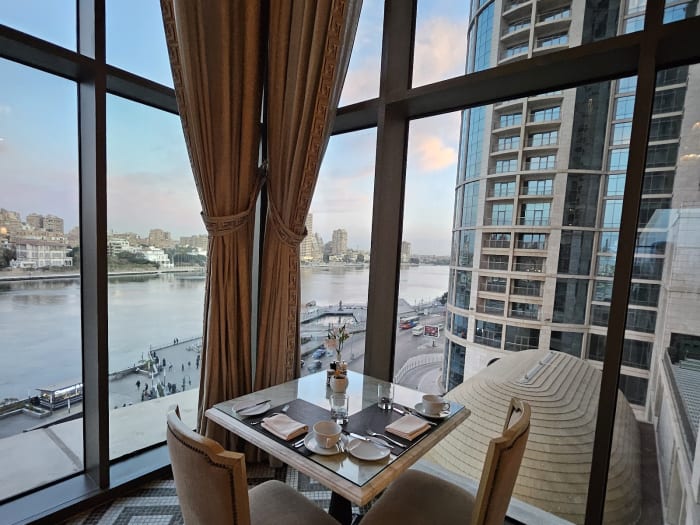
The proximity of the Nile adds a quality of presence that is difficult to replicate elsewhere. Even if one does not spend the day gazing at the river, knowing it is there, visible from certain vantage points, changes the perception of the place. The eye travels farther, the horizon opens and the city feels less compressed. In a destination as dense as Cairo, that relationship with water has genuine value. It brings a visual calm that complements physical comfort.
The hotel also embraces a contemporary form of sophistication without neglecting the fundamentals expected of an international five-star address: continuous reception, smooth organisation, attentive service, daily housekeeping and care for practical details. The overall impression is not of a theatrical setting designed to overwhelm, but of a coherent whole in which elegance serves function. That is often what seasoned travellers seek: a place able to be beautiful without becoming inconvenient, distinctive without becoming overbearing.
To choose The St. Regis Cairo is therefore to choose a particular way of inhabiting Cairo. Not by withdrawing from it entirely, but by giving oneself the means to approach it with greater comfort, measure and continuity. The property acts as a well-calibrated filter between the city and the guest: close enough to feel its energy, protected enough to manage its intensity.
Rooms and suites
In a destination such as Cairo, the room does not merely serve its expected role as a private space; it becomes a genuine instrument of recovery. After a day spent between meetings, visits, urban crossings or simply moving through the city, one quickly understands the value of accommodation able to provide relative quiet, intelligible comfort and a sense of order. At The St. Regis Cairo, that function appears central. Everything suggests an approach to the stay based on reassurance, continuity of service and attention to details which, though never theatrical, materially improve the quality of a night.
The presence of butler service, together with turndown and daily housekeeping, places the experience within the grand-hotel tradition in which the room is treated as a living, attended space rather than one merely assigned to a guest. The distinction is subtle, but important. It means that the stay is not limited to occupying a handsome room; it is organised around a series of gestures intended to simplify the traveller’s day. Preparing the room for one’s return in the evening, maintaining impeccable presentation and smoothing practical needs all contribute to a sense of control and lasting comfort.
The rooms and suites naturally derive part of their appeal from their visual relationship with the Nile whenever available. A river view in Cairo is not simply an aesthetic argument. It changes the tempo of the stay. In the morning, it introduces a degree of distance from the city’s agitation; in the evening, it prolongs the feeling of being in Cairo without being entirely consumed by it. For couples, that opening onto the landscape gives the room a more contemplative dimension. For business travellers, it creates a more breathable setting between working sequences.
One may also reasonably expect, given the hotel’s positioning, interiors designed around international expectations: generous bedding, bathrooms conceived as an extension of comfort, storage suited to both short and longer stays, and technology integrated without unnecessary display. In the best addresses of this category, luxury lies not in accumulation but in the right proportions, the quality of materials, the ergonomics of movement and the coherence of the whole. It is this kind of precision that experienced travellers tend to value.
Suites, for their part, generally answer a need for additional space, whether to receive visitors, work in better conditions or simply create a clearer distinction between the different moments of a stay. In a capital where professional obligations and personal time often coexist within the same trip, that flexibility is especially valuable. It allows the accommodation to function as a genuine living base rather than a mere high-end hotel room.
Ultimately, what one expects from the rooms and suites here is that they extend the property’s broader promise: to provide a sophisticated, serene and functional setting suited equally to a couple’s escape and to a more structured agenda. In Cairo, where the outside world constantly demands attention, having an interior that soothes without becoming dull is a precise art. It is often there that the success of a stay is decided.
Dining
In a major urban hotel, dining plays a role that goes well beyond convenience. It structures the day, responds to the irregular rhythms of travel and contributes to the property’s identity. At The St. Regis Cairo, this dimension is best understood as a natural extension of the overall experience: a setting in which one may begin the morning without haste, arrange a business lunch, enjoy dinner for two or choose something more informal between engagements. The advice to reserve a table on arrival says something important in itself: dining matters here within the economy of the stay.
In a city such as Cairo, where the external dining scene is broad but can demand time, logistics or local knowledge, having high-level in-house dining is a genuine comfort. This does not mean withdrawing from the city’s culinary life, but rather being able to alternate between exploration and reassurance. A successful grand hotel knows how to answer that expectation: by offering spaces where one eats well, in good conditions, with service that understands both the constraints of a business schedule and the desire for a more composed evening.
The proximity of the Nile and the possibility of river views naturally shape the perception of meals. Morning does not feel the same when it opens onto broader light and a landscape that breathes more freely than the street. In the evening, the presence of the river introduces a slower, almost ceremonial tempo that particularly suits dinner. Even when the plate remains central, the visual context matters. It contributes to that sense of suspension travellers often seek in major addresses.
One may expect from a property of this standing an offer designed for multiple uses: clear international cuisine, attention to ingredient quality, precise service and the ability to welcome very different guest profiles. Couples will look for an elegant and calm setting; business travellers for reliable execution, suitable hours and an environment conducive to conversation. In both cases, what matters most is not display but consistency. A good hotel restaurant need not overstate itself; it should above all be accurate, dependable and pleasant to return to over several days.
In-room dining should also be considered an important component of the experience. In a metropolis where one may return late or wish to preserve a private moment, the possibility of dining in one’s room or taking breakfast without leaving one’s own space is a very concrete luxury. Here again, butler service and the general attentiveness surrounding the stay reinforce the sense of a hotel able to adapt dining to each guest’s personal rhythm.
Ultimately, dining at The St. Regis Cairo belongs to a logic of cultivated comfort. It seeks not only to feed, but to organise, calm and accompany. At its best, it becomes one of the stay’s reference points: somewhere one returns not by default, but because the quality of execution, setting and service corresponds exactly to what a major urban hotel ought to provide.
Spa & Well-being
In a city as vibrant as Cairo, well-being quickly becomes an essential part of the stay. Fatigue often accumulates here, with heat, urban density, commutes, and appointments constantly demanding attention.
In this context, spaces dedicated to relaxation take on particular significance. They provide a counterpoint to the city. More than just a treatment menu, they establish a different rhythm. Softer lighting, controlled acoustics, and slower movements facilitate the transition.
After a day in Cairo, this change of pace is genuinely valuable. It helps to regain a fuller breath and prepares one for both the evening and restful sleep.
For couples, well-being naturally nourishes the hedonistic aspect of their stay. It creates shared moments that are distinct from sightseeing and dining. This time of retreat often ranks among the most enduring memories.
For business travellers, the stakes are different but equally tangible. A treatment, a visit to the relaxation facilities, or simply a moment of calm can rebalance the day.
At The St. Regis Cairo, the approach to well-being aligns with the standards of five-star hospitality. A carefully curated environment, attentive service, and moments of relaxation accompany the rhythm of the stay. Luxury often lies in this availability; being able to carve out an hour for decompression transforms the perception of travel.
The relationship with the Nile also contributes to this sense of calm. The river's presence and the views it offers broaden one's perspective. In a densely populated capital, this visual respite is significant. The relaxation areas extend this philosophy.
At The St. Regis Cairo, well-being is not an abstract luxury. It addresses a concrete necessity of travelling in Cairo: to take breaks, regain balance, and maintain the quality of attention.
Concierge & Services
It is often through its services that a great hotel reveals its true quality. The impressive décor upon arrival, the captivating views, and the reassuring comfort of the room all play their part. However, it is the invisible mechanisms of the stay that ultimately determine the feeling of being genuinely taken care of. At The St. Regis Cairo, this backbone is supported by a 24-hour concierge service, a 24-hour reception, butler service, daily housekeeping, turn-down service, luggage storage, and laundry facilities. Together, these services create a valuable continuity in a city like Cairo.
The concierge plays a central role here. In a vast and densely populated metropolis, having a team available at all hours significantly enhances the quality of the journey. It is not merely about booking a table or arranging a transfer; it also involves adjusting an itinerary, anticipating travel times, prioritising a schedule, or securing a practical task. In this context, luxury often consists of reducing uncertainty. A good concierge does not simply execute requests; it simplifies the experience.
The butler service reinforces this logic of personalised assistance. Within the St. Regis universe, it embodies attentive hospitality, where the stay is monitored with finesse. For the business traveller, this can mean a more flexible organisation of daily routines and better management of unexpected events. For couples, it often translates into a smoother stay, where practical details do not interrupt the pleasure of being together.
Housekeeping and turn-down services take on particular importance in a large urban hotel. They ensure cleanliness, presentation, and the rhythm of returning to the room. Finding a space tidied up and prepared for the night contributes to the impression of ongoing care. Laundry services, luggage assistance, and round-the-clock reception complete the offering. They address very concrete needs, especially during early arrivals, late departures, or multi-stage stays.
What strikes one about this type of establishment is how the services allow each guest to experience the hotel differently. Some may see it as a well-oiled operational base, while others perceive it as an urban cocoon where everything seems simpler. The best establishments manage to satisfy both perspectives. They offer both efficiency and comfort, precision and discretion.
At The St. Regis Cairo, the promise of service is less about ostentation and more about reliability. This is one of the most decisive criteria for choosing a hotel in Cairo. In a city that demands energy, being welcomed into a place where everything is thoughtfully considered and consistently maintained transforms the nature of the stay. This is what turns a good stay into a serene one.
The Cairo way of life
To stay at The St. Regis Cairo is also to choose a particular way of approaching Cairo: not through the haste of a checklist, but through an urban art of living built on balance between intensity and retreat. Cairo is not a city that yields itself all at once. It is understood in fragments: light on the Nile, a crossing through a district, a hushed lounge in which to recover one’s breath, a table that extends the evening, a meeting that reveals another geography of the capital. A well-located grand hotel makes precisely this nuanced reading possible by offering a fixed point from which the city becomes more legible.
The proximity of the Nile is decisive here. In both imagination and lived experience, the river gives Cairo a form of breathing space that one feels immediately. This is not simply a matter of a beautiful view, but of orientation. Days take on a different shape when organised around that presence. One goes out to explore the city, then returns towards a bank, a perspective, a broader light. This alternation between immersion and return contributes greatly to the quality of the stay. It prevents the capital from being reduced to its turbulence alone.
For couples, Cairo can be experienced as a city of elegant contrasts: the monumentality of its history, the energy of its avenues, then the refuge of a hotel where calm, service and comfort are restored. A successful stay does not necessarily depend on multiplying activities, but on composing the right rhythm. A slower morning, an unhurried lunch, a late afternoon devoted to rest, a dinner reserved in advance: such simple choices transform one’s perception of the city. Luxury here often consists in not being overwhelmed by Cairo, but in learning how to inhabit it.
For business travellers, the Cairo way of life depends on a different intelligence of time. One must know how to manage transfers, preserve moments of recovery and choose a hotel that allows a smooth transition between work and rest. From that perspective, The St. Regis Cairo offers a coherent framework: centrality, continuous service, spaces suited to business as well as relaxation, and that relationship with the Nile which introduces a useful distance. Even during a tightly structured trip, the city can then be experienced as something other than a sequence of obligations.
Cairo rewards travellers who accept its complexity without trying to over-simplify it. It is a capital of density, memory and movement, but also a city of lounges, conversations, views and returns. A hotel such as this one allows that plurality to be experienced in good conditions. It does not replace the city; it becomes its discreet interpreter.
Ultimately, the Cairo art of living, from The St. Regis Cairo, rests on a simple idea: alternation. Alternation between outside and inside, momentum and pause, exploration and comfort, attention to the world and care for oneself. It is within that well-calibrated oscillation that the capital often reveals its most compelling face.
Book with MyConciergeHotel
Booking The St. Regis Cairo through MyConciergeHotel means approaching the stay as a matter of composition rather than mere transaction. In a destination such as Cairo, where the experience depends as much on the hotel itself as on the way arrivals, timings, meals, rest and possible professional obligations are arranged, preparation matters almost as much as the choice of address. A well-located grand hotel provides the frame; a well-supported booking allows one to make full use of it.
The value of an editorial and concierge intermediary lies precisely in this capacity for anticipation. For a couple, this may mean favouring a room category suited to the desired rhythm, paying particular attention to views whenever available, or arranging dinner reservations on arrival in order to secure the key moments of the stay. For a business trip, the priorities may differ: smooth arrival, management of timings, flexibility of services and clarity regarding the spaces most useful for work and rest. In both cases, the aim is the same: to reduce friction and increase the actual quality of the experience.
The St. Regis Cairo lends itself particularly well to this tailored approach. Its position in the heart of Cairo, its proximity to the Nile, its suitability for both couples and professional travellers, and the presence of continuous services make it an address where organisational details have a direct impact on comfort. Knowing when to arrive, how to pace the first hours, when to reserve dinner, how to include a wellness pause or how best to use the concierge: these may seem modest decisions, yet they are often decisive in the success of a stay.
Booking through MyConciergeHotel also means benefiting from an editorial perspective that places the hotel within its context. Rather than a simple accumulation of commercial claims, the address is considered according to its actual uses: what it makes possible in Cairo, whom it suits and in what kind of journey it makes most sense. That reading is especially useful in a capital as dense and many-sided as this one. It helps one choose not only a hotel, but a way of staying there.
For travellers accustomed to major international addresses, this mediation brings a discreet yet tangible value. It allows a standard booking to become a more coherent, better-prepared stay, one more faithful to initial expectations. And for those discovering Cairo for the first time, it offers a reassuring framework able to order the experience without over-determining it.
Ultimately, booking The St. Regis Cairo through MyConciergeHotel is a way of understanding luxury for what it often is in practice: not excess, but accuracy. Accuracy in choice, rhythm, attentions and decisions. In a city as rich and demanding as Cairo, that accuracy makes all the difference.