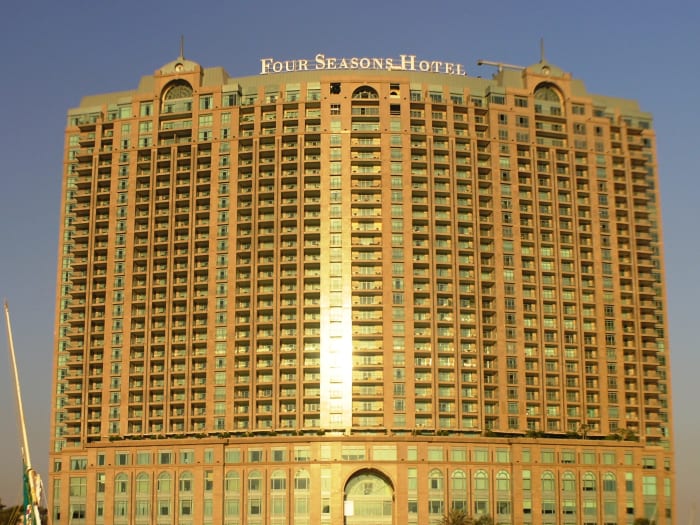
History & a Presence on the Nile
In a city as layered as Cairo, a grand hotel is never merely an address. It belongs to a wider geography of the Nile, central districts, embassies, institutions and riverfront promenades. Four Seasons Hotel Cairo at Nile Plaza is best understood in that context: not as a theatrical evocation of the past, but as a contemporary international luxury hotel with a distinctly local sense of place. Its identity begins with its relationship to the Nile, which in Cairo is far more than a view; it is orientation, rhythm and relief.
In a city defined by contrast, the hotel functions as a point of balance. It suits business travellers, families, couples and diplomatic guests alike, while retaining the feel of a refuge. That matters in Cairo, where urban intensity is part of the journey. Returning to an address that offers open views, composed interiors and a genuine sense of calm is not incidental; it shapes the way the city is experienced. The hotel belongs to the tradition of the metropolitan grand hotel that filters the surrounding energy rather than denying it.
Its heritage is therefore less about antiquity than about a particular idea of high-end hospitality applied to one of the Arab world’s most compelling capitals. The Four Seasons name suggests consistency, discretion and attention to detail; here, those qualities are inflected by Egyptian hospitality and by the centrality of the setting. The result is neither a mere stopover hotel nor a museum-like palace, but an address designed to accompany the real rhythm of a stay.
What lingers is the hotel’s role as an urban belvedere. From public spaces and many rooms, the river is a constant reminder that Cairo is not only movement and noise. There is another tempo here, more fluid and contemplative, and it gives the stay its depth. In a destination naturally associated with monuments, museums and historic quarters, this anchoring on the Nile provides an essential counterpoint. Luxury, in this setting, lies not only in comfort but in the ability to feel the city without being overwhelmed by it.
The Hotel, Between Centrality and Calm
The hotel’s most immediate strength is unusually clear: it sits in the heart of Cairo while preserving a genuine sense of remove. That duality explains much of its appeal. For first-time visitors, the location offers relatively easy access to the city’s principal districts, cultural institutions, riverfront areas and major routes towards historic sites. For returning travellers, the same centrality means something else: the comfort of a stable base in a vast, dense and often unpredictable metropolis.
Its relationship with the Nile shapes the stay in a meaningful way. In many urban hotels, a view is an amenity; here, it is part of the atmosphere. The river opens the horizon, softens the city’s density and introduces a calmer visual rhythm. At different hours, the light changes distinctly across the water. Choosing a room or suite facing the Nile genuinely alters the experience, not only for aesthetic reasons but because the river brings order and relief.
The hotel also answers a very contemporary luxury expectation: the ability to move seamlessly from one mode to another. A meeting can be followed by a restorative pause without any sense of rupture. That fluidity suits Cairo especially well, where days can be long and intense. Returning to a hotel that manages transitions — between outside and inside, work and rest, appointments and contemplation — is a form of travel comfort in itself.
Aesthetically, the address favours a durable international elegance over theatrical effect. Spaces are designed to be lived in, circulation is clear, and the atmosphere is polished without stiffness. Luxury here lies in overall composure, service consistency and experiential quality rather than spectacle. In a city already rich in visual and sensory intensity, that restraint is particularly welcome.
Rooms and Suites, with the Privilege of a View
In a major city hotel, the room is never only a place to sleep. It is an observation point, a place to recover, sometimes a temporary office and often a refuge. At Four Seasons Hotel Cairo at Nile Plaza, that multi-layered role is especially clear. Rooms and suites are designed to support very different kinds of stays, from tightly scheduled business trips to more contemplative visits centred on discovering Cairo. The essential promise lies in the balance between contemporary comfort, clear spatial planning and outward openness, particularly when the room overlooks the Nile.
The simplest advice is also the best: when available, a category with a river view is worth prioritising. In a city as dense as Cairo, an open outlook transforms the daily experience. In the morning it sets a calmer tone; in the evening it offers a stable horizon after the intensity of movement, meetings or sightseeing. The Nile is not merely decorative here. It gives the stay depth and a sense of release.
The spirit of the rooms is one of functional luxury in the best sense. Everything is intended to make travel easier without overloading the space. One expects quality bedding, comfortable bathrooms, impeccable upkeep and that quiet sense of order that allows a guest to settle in immediately. Known services such as daily housekeeping, turndown and round-the-clock reception and concierge support reinforce that continuity.
Suites answer a different use of the hotel. They suit travellers who want more room, those combining work and private time, families needing greater flexibility, or anyone for whom comfort means a clearer separation of functions. In Cairo, where it can be wise to pause at the hotel between outings, that extra space has real value.
Dining, Between Cosmopolitan Rhythm and Hospitality
In a city such as Cairo, hotel dining serves a particular purpose. It is not simply about feeding guests or providing a pleasant setting; it must respond to multiple rhythms, international expectations and the desire, after a dense day, to find a reliable and welcoming table on site. Four Seasons Hotel Cairo at Nile Plaza belongs to the tradition of the cosmopolitan grand hotel where dining is an integral part of the overall experience. What matters is consistency, quality of execution and flexibility.
Breakfast naturally assumes a central role. In a city where days often begin early, the first meal should be both efficient and enjoyable. At this level, one expects attentive service, a broad enough choice to suit different habits and, above all, a setting that eases one into the day. If morning light and a sense of openness accompany the meal, so much the better.
At lunch or dinner, the value of a central hotel lies in versatility. One can arrange a business meal, pause between appointments or simply choose not to cross the city again in the evening. Practicality does not diminish pleasure; it often sustains it. A good hotel table in Cairo should combine service precision, relative acoustic comfort, a measured pace and a clear offer.
The expected culinary spirit is that of an international address attentive to its setting. Without overstatement, dining at this level should speak to guests from many backgrounds while leaving room for local context and regional hospitality. What counts is not theatrical signature but overall rightness: well-handled ingredients, steady service, coherent atmosphere and adaptability throughout the day.
Spa & Wellness: A Necessary Pause in the Cairo Rhythm
Wellness becomes a strategic component of any stay in a city like Cairo. Amidst the commutes, the intensity of sightseeing, the heat, and the urban density, the body absorbs a great deal.
At the Four Seasons Hotel Cairo at Nile Plaza, this dimension naturally extends the experience of the establishment. Here, one finds tranquility, structured service, a central location, and a soothing relationship with the Nile.
In contemporary luxury hospitality, the spa also serves as a transitional space. Guests come to release tension, regain an inner rhythm, or simply to take time for themselves.
In Cairo, this function takes on a particular significance. After a morning of sightseeing or a day of meetings, a massage or a moment of relaxation can rebalance the stay.
An establishment of this calibre meets specific expectations. The quality of the welcome, punctuality, a well-maintained environment, and flexibility with available time are just as important as the treatments themselves.
Not all travellers have two hours to spare. Some seek targeted treatments between obligations, while others prefer to dedicate an entire half-day to recovery.
Light and views also play their part. With such a location on the Nile, the very idea of relaxation takes on a different tone.
The river acts as a counterpoint to the urban hustle and bustle. A simple routine can then fully embrace the essence of the establishment: treatment, a moment of calm, returning to the room, and then dining on-site.
For business travellers, wellness helps maintain clarity and energy. For couples, it creates shared time. For families, it offers a breather in a packed schedule.
In all cases, the spa and its associated services contribute to the balance of the stay. They allow guests to fully experience Cairo and then return to a more serene environment at the hotel.
Concierge & Services: The Discreet Mechanism of a Grand Hotel
What sets a prestigious urban address apart is not merely its location or the quality of its rooms, but the reliability of its service. At the Four Seasons Hotel Cairo at Nile Plaza, this aspect is paramount. With 24-hour concierge service, round-the-clock reception, daily housekeeping, evening turndown service, luggage storage, laundry, wake-up calls, and multilingual staff, the hotel offers a discreet yet essential infrastructure.
The concierge service plays a particularly valuable role in Cairo. In such a vast metropolis, having a team available at all hours significantly enhances the quality of one’s stay. It is not just about obtaining information; it is about gaining clarity, saving time, and ensuring peace of mind. Organising a transfer, adjusting an itinerary, recommending a departure time, or facilitating a special request all contribute to this seamless experience.
The continuously open reception operates under the same principle. Cairo is a destination where late arrivals, early departures, and changes in plans are commonplace. Knowing that the hotel remains operational at all hours provides a discreet yet essential sense of security. This continuity is especially important for international travellers and business guests.
In-room services, including daily maintenance, evening turndown, and laundry, also contribute to the quality of the stay. In a climate that is often warm, the feeling of a space that is consistently kept in order holds real value. It allows for a continuity of comfort without having to think about it. This is where a grand hotel makes a difference.
The multilingual staff also deserves special mention. In an international setting, this skill ensures the precision of communication, the quality of recommendations, and the trust of the guest. It enables the hotel to cater to a diverse range of travellers.
The services at the Four Seasons Hotel Cairo at Nile Plaza thus embody a mature hospitality, devoid of ostentation. They exist to ensure that the stay unfolds naturally. In Cairo, this quality of service takes on particular significance, allowing guests to fully enjoy the destination with the assurance of a reliable and attentive environment.
Cairo Living, Seen from the Nile
Staying at Four Seasons Hotel Cairo at Nile Plaza also means adopting a certain way of experiencing Cairo. Not by trying to see everything too quickly, but by understanding that the city reveals itself in sequences, contrasts and changing rhythms. The great advantage of a central yet calm address is that it allows for this more nuanced reading. One can leave early for major sites, devote a morning to a museum or historic district, return to rest, then go out again in the softer light of late afternoon.
The Nile plays an almost pedagogical role in this experience. It reminds the visitor that Cairo is not only a city of movement and density, but one shaped for millennia by a river that structures its imagination. Seeing the water from a room or public space places the stay within a wider continuity.
Cairene art de vivre also lies in the coexistence of registers. The city is monumental and everyday, historic and intensely contemporary, formal and full of vitality. A successful stay is not only about ticking off landmarks; it also depends on making room for in-between moments. This hotel supports that quality of experience by offering a stable centre from which the city becomes more legible.
Ultimately, the hotel does not dilute Cairo; it makes it more inhabitable. That is perhaps its finest promise.
Book with MyConciergeHotel
Booking Four Seasons Hotel Cairo at Nile Plaza through MyConciergeHotel means approaching the property in terms of the stay itself rather than simple availability. In Cairo, hotel choice directly shapes travel quality: transfer times, ease of organisation, recovery, the value of the view and the fluidity of service. A well-considered booking therefore involves more than selecting a room category; it requires thinking about the rhythm and purpose of the trip.
The first decision often concerns the view, and here it matters greatly. A room facing the Nile does more than add visual pleasure; it changes the daily experience of the hotel. For a first stay in Cairo, it provides immediate orientation. For business travel, it offers genuine relief between obligations. For couples, it adds a more contemplative dimension.
The second factor is the nature of the stay. A short city break does not call for the same priorities as a business trip or a family journey. Some travellers will value absolute efficiency, others more space and flexibility, and others a balance between sightseeing, rest and dining on site. Concierge-style guidance helps clarify those priorities before arrival.
Booking with MyConciergeHotel also means placing the hotel within Cairo’s real context. The city rewards thoughtful planning, and the right recommendation can make a meaningful difference. For this address, that approach is especially relevant: its strength lies in a rare balance between centrality and calm.