History & heritage
In a city where layers of civilisation are visible in plain sight, staying at Four Seasons Hotel Cairo at The First Residence is less about withdrawing from Cairo than about approaching it from a particularly comfortable vantage point. The property belongs to the tradition of grand urban hotels that function at once as refuge, anchor and elegant filter between the intensity of the metropolis and the traveller’s private rhythm. The Four Seasons name brings a clear promise: codified hospitality, consistent attention to detail, and a way of making a complex destination easier to navigate without erasing its energy.
Cairo is not a city that reveals itself in a single glance. It is understood in fragments: the river, the older districts, cultural institutions, broad avenues, gardens, mineral silhouettes on the horizon. In this context, a well-positioned address carries particular value. The First Residence belongs to that geography of contemporary Cairo which allows the different uses of a stay—business, heritage discovery, a couple’s escape, family travel—to be combined without wasting time in unnecessary transitions. This also explains the hotel’s enduring appeal: it answers both the logic of efficient travel and that of atmosphere.
The property’s heritage therefore lies less in a monumental narrative than in a form of continuity in the experience. One finds the expected markers of a major international house: round-the-clock welcome, structured service, daily housekeeping, discreet staff, and common areas designed to create breathing space. Yet in Cairo these elements take on particular resonance. In a vibrant, sometimes dense and often fascinating city, luxury is not only about multiplying outward signs of refinement; it also lies in the ability to organise time, simplify movement, and preserve a quality of quiet and attention.
This address therefore speaks to travellers who wish to stay in the Egyptian capital without giving up a sense of stability. First-time visitors find a setting that is legible and immediately reassuring. Regular guests appreciate the consistency of service and the ease of use that comes with a well-established international brand. The hotel then becomes a fixed point in a moving city, a place to which one returns with the certainty of familiar bearings.
Finally, the heritage of such a house must be understood on the scale of contemporary travel. The grand urban hotel is no longer merely a backdrop; it is an instrument. It must allow one to move from a meeting to a visit, from a moment of rest to a cultural outing, from a professional stay to something more personal. Four Seasons Hotel Cairo at The First Residence fits precisely within this logic: that of an address which does not seek to compete with the city, but to offer a smoother, calmer and more inhabitable reading of it.
The property
One of the hotel’s first strengths lies in its setting within a lively, practical district that is well connected to the rest of the city. In Cairo, this matters enormously. An address is judged not only by its aesthetics or the quality of its rooms, but by its ability to make the city accessible without the logistical fatigue that a major capital can sometimes impose. Here, the immediate surroundings make it possible to shape a flexible stay, alternating meetings, visits and moments of rest with relative ease.
The property stands out for the way it combines urban animation with a sense of retreat. The common areas, designed for comfort, play a central role in that perception. They are not merely transit zones; they organise the transition between outside and inside. After the intensity of Cairo’s streets, returning to a controlled lobby, lounges where one can settle, legible circulation and service that is present without being intrusive changes the quality of a stay considerably. Luxury here is measured by the ability to absorb the city without being overwhelmed by it.
Four Seasons Hotel Cairo at The First Residence is particularly well suited to those who want to make Cairo a full experience rather than a simple stopover. Its location facilitates access to local attractions as well as to the historic and cultural landmarks that shape the city’s imagination. This does not mean everything is reduced to a checklist of sites; on the contrary, the value of such an address lies in enabling a more nuanced discovery. One can leave early for a day of visits, return mid-afternoon to rest, then go out again for dinner or professional engagements while the hotel remains the centre of gravity of the stay.
Architecturally and operationally, the property answers the expectations attached to a major international hotel: legible services, permanent welcome, efficient organisation and rigorous upkeep. Yet it avoids, at its best, the impersonal neutrality that can sometimes affect this category of address. In Cairo, a hotel’s value is also measured by its ability to create a bubble of continuity: temperature, light, rhythm, staff availability, the quality of seating, the feeling of being expected. These often discreet elements matter more than decorative effects.
The address therefore speaks to several types of traveller. Business guests find a reliable setting suited to stays governed by schedules and obligations. Couples appreciate the ease with which the hotel allows moments of calm within a dense city. Families, meanwhile, benefit from a service structure that simplifies everyday practical needs. This versatility is not incidental; it lies at the heart of a successful grand urban hotel.
Ultimately, the property does not seek to impose itself as a closed world. It functions instead as an elegant interface with Cairo: protective enough to offer respite, open enough to encourage exploration. It is this balance—rare in major cities—that gives the address its lasting appeal.
Rooms and suites
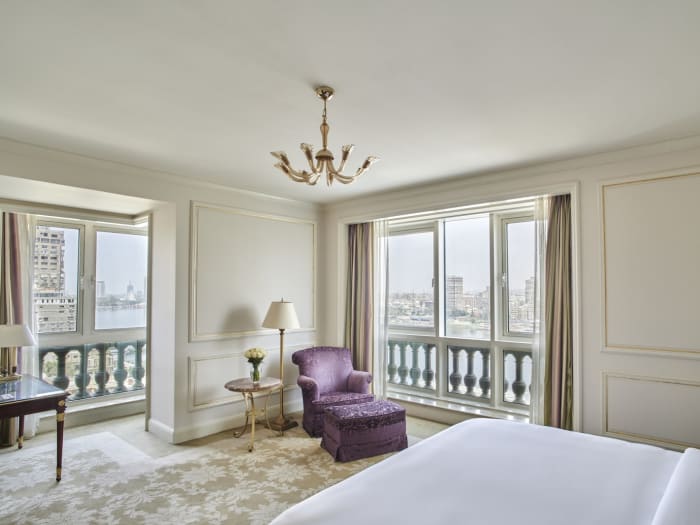
In a grand city hotel, the room is never merely a place to sleep. It must repair the fatigue of travel, provide a credible working environment, allow for moments of retreat and, at its best, give the stay its true breathing space. At Four Seasons Hotel Cairo at The First Residence, this function is central. The address attracts travellers with very different rhythms—business stays, couple’s escapes, family trips—and the room experience must answer precisely to that plurality of uses.
One expects here a level of comfort aligned with the standards of a major international house: carefully considered bedding, daily housekeeping, turndown service, efficient spatial organisation, a bathroom designed for ease of use, and that essential impression that everything has been prepared to make the stay simple. It is often the least spectacular details that matter most: the quality of relative quiet, the ease with which one can dismantle and rebuild the day, the possibility of working without turning the room into an improvised office, the feeling of returning to an ordered space after several hours spent in the city.
The rooms and suites of such an address must also answer to a psychological requirement specific to Cairo. In a dense, active and at times overwhelming capital, returning to one’s room has the value of rebalancing. What one seeks is less ostentation than coherence: legible volumes, a calming atmosphere, well-managed light, materials and tones that do not add noise to the noise of the city. True luxury then lies in continuity of comfort rather than in effect.
For couples, the room becomes a refuge in which to pick up the thread of the journey between outings. For business travellers, it must offer a reliable base capable of absorbing programme changes, late arrivals, early departures and the need for recovery. For families, the idea of space becomes especially important: easy circulation, storage, responsive service and constant upkeep. Here again, success lies not in an abstract promise, but in the way the hotel concretely supports real uses.
Daily service contributes strongly to this sense of continuity. Housekeeping, evening turndown, staff availability, luggage handling and attention to the guest’s rhythm all shape the overall quality of the experience. A great hotel room is not only well designed; it is well served. It is this articulation between private space and nearly invisible service that makes the difference over several nights.
Finally, suites, in the spirit of an address such as this, extend the same logic by offering greater ease for longer stays, trips combining work and leisure, or simply the desire for a more residential experience. They allow the different times of travel to be better compartmentalised: receiving, resting, reading, working, having a light dinner, preparing a day of visits. In a city as rich as Cairo, having a space capable of absorbing this variety of moments changes one’s perception of the stay considerably.
Dining
In a capital such as Cairo, hotel dining plays a more important role than it may first appear. It is not merely one service among others; it structures the rhythm of a stay. A well-run breakfast can set the tone for a day of visits or meetings. Lunch on site avoids unnecessary logistics. Dinner at the hotel, meanwhile, allows the day to end without having to re-enter the city’s intensity. At a Four Seasons address, one expects precisely this ability to make dining a natural extension of hospitality.
Without resorting to rhetoric, the essentials lie elsewhere: quality of execution, consistency, broad availability, attention to guest preferences, and the ability to accommodate different uses. A business traveller does not have the same expectations as a couple on a discovery trip or a family looking for a simple solution after a dense day. A major house knows how to answer these varied temporalities, whether through an early coffee, a quick meal between obligations or a more settled moment in the evening.
In Cairo, hotel dining also has a mediating function. It creates a pause between the outside world and the intimacy of the room. One finds there a form of continuity: attentive service, a controlled environment, comfortable seating, a calmer rhythm than that of the city. This quality of transition matters greatly. It gives the meal an almost architectural dimension: that of a time-space in which one recentres before setting out again or withdrawing for the night.
For international travellers, the value of an address at this level also lies in the legibility of the offer. One knows one can rely on a certain standard, on teams accustomed to special requests, on dependable execution and on careful presentation without excessive rigidity. This does not replace culinary exploration in the city—quite the opposite; it complements it. The hotel becomes a point of balance between discovery and consistency.
Room service, in this context, deserves to be considered a full component of the dining experience. After a late arrival, before an early departure, or simply when one wishes to prolong the calm of the room, being able to dine or take breakfast in private contributes fully to the comfort of the stay. In a grand hotel, this possibility is never incidental: it says something about the house’s ability to adapt to the actual rhythm of its guests.
Finally, dining contributes to the memory of a place. One rarely remembers a hotel only for its décor; one remembers it for the way it accompanied the day. The morning coffee before heading towards historic sites, the afternoon pause, the unhurried dinner after urban bustle: these repeated sequences create the impression of being well somewhere. From this perspective, dining at Four Seasons Hotel Cairo at The First Residence fully participates in its identity as a refined, practical and durably liveable urban address.
Spa & wellness
In a city as dense and magnetic as Cairo, wellness is not a decorative extra; it is an essential component of the hotel experience. The traveller is not merely looking for somewhere to sleep, but for a place capable of restoring balances tested by flights, jet lag, traffic, seasonal heat and the sheer intensity of urban discovery. From this perspective, any wellness offering within a grand hotel acquires particular value: it organises the return to oneself.
Four Seasons Hotel Cairo at The First Residence fits within this logic of reassurance and recovery. Even without detailing specific facilities when they are not explicitly documented, one may say that an address at this level should offer a relaxation experience conceived as a natural extension of service. This means spaces in which to slow down, a controlled atmosphere, attention to sensory comfort, and the possibility of carving out time in the day that is neither productive nor touristic, but simply restorative.
Wellness in an urban hotel is not limited to the idea of performance or programme. It is often a sum of simple gestures: taking time in the morning before going out, returning in the late afternoon to release accumulated tension, finding a quality of air, quiet and light that allows the body to change rhythm. The best establishments understand this. They do not treat relaxation as an isolated argument, but as a continuation of overall hospitality.
For business travellers, this aspect is often decisive. A day of meetings or movement benefits from being punctuated by a moment of recovery, if only to regain clarity before dinner or a late engagement. For couples, wellness introduces a slower dimension into the stay, a way of not experiencing the city solely in itinerary mode. For families, it also represents a discreet resource: a hotel’s comfort is measured by its ability to create genuine pauses.
It should also be noted that wellness often begins well before a treatment or any formalised relaxation moment. It is found in the quality of service, the availability of the concierge, the smoothness of check-in, the upkeep of the room, the possibility of requesting a precise wake-up call or logistical assistance without friction. Feeling well somewhere in a grand hotel depends on a coherent chain of attentions. The spa, in the broad sense, is only one more visible expression of this.
In Cairo, this dimension takes on particular relief between autumn and spring, a period often favoured for visiting the city. Days may then be fully occupied by cultural and heritage discoveries, making the return to a setting in which one can slow down all the more valuable. Wellness here is therefore not an abstract luxury; it becomes a way of inhabiting the city more justly, more sustainably and, ultimately, more elegantly.
Concierge & services
The quality of a grand hotel is often measured less by what it displays than by what it makes possible. In that respect, concierge and guest services form the true discreet engine of a stay. At Four Seasons Hotel Cairo at The First Residence, this dimension is particularly important because Cairo requires a certain logistical intelligence. A vast, lively city rich in historic and cultural sites imposes choices of timing, reservations, transport arrangements and sometimes last-minute adjustments. The hotel comes fully into its own when it can turn that complexity into a fluid experience.
The presence of a 24-hour concierge and a front desk open around the clock first answers a simple reality: travel rhythms are never perfectly linear. Late arrivals, early departures, programme changes, unforeseen needs, specific requests linked to a business or family stay—all require a service structure that is available and reliable. In an address at this level, round-the-clock presence is not merely a selling point; it is a condition of peace of mind.
Daily housekeeping, turndown service, luggage storage, laundry, wake-up service and multilingual staff together create a very concrete ecosystem of comfort. Each of these elements may seem ordinary in isolation, yet their combination produces what one truly expects from a grand hotel: the disappearance of friction. Being able to leave luggage before a late departure, have clothing attended to promptly, return to a room restored at the end of the day, request a precise wake-up call before an excursion or flight, and be understood immediately without unnecessary language barriers—these are the details that change the texture of a stay.
The concierge in particular plays the role of interpreter of the city. It does not merely answer requests; it helps to rank possibilities. In a destination as dense as Cairo, that role is precious. It may involve shaping a day of visits, suggesting the best time to leave, helping to build a realistic programme, or simply resolving practical needs efficiently so as to free mental space. Contemporary luxury often lies there: in reducing the burden of organisation.
For business travellers, this service mechanism guarantees a form of professional continuity. For couples, it allows more energy to be devoted to the pleasure of travel than to its logistics. For families, it provides concrete reassurance: that of a setting capable of absorbing the unexpected. In every case, service has value only if it remains discreet, precise and consistent.
This is precisely what one expects from a Four Seasons address: hospitality that never dramatizes effort, that anticipates without overplaying, and that accompanies the stay with calm efficiency. In a city as stimulating as Cairo, that quality of service is not incidental. It allows one to travel better—that is, with greater availability, greater comfort and a lasting impression of control without rigidity.
The Cairo way of life
Staying in Cairo means accepting a city of contrasts, densities and overlapping temporalities. Few capitals offer with such intensity the coexistence of the most immediate everyday life and such considerable historical depth. That is precisely what makes the experience so powerful—and what justifies choosing a hotel capable of serving as a point of balance. Four Seasons Hotel Cairo at The First Residence allows one to approach that complexity with greater flexibility by giving the traveller a stable framework from which to read the city.
The Cairo way of life cannot be reduced to monuments. It also lies in a way of inhabiting the day, of moving from one register to another without a sharp break. One may devote the morning to cultural visits, continue with a quieter lunch, return to rest, then set out again in the late afternoon when the light changes and the city adopts another rhythm. This alternation between intensity and retreat is perhaps the best way to approach Cairo. A well-located grand hotel makes this movement not only possible, but enjoyable.
Proximity to historic and cultural sites is obviously a major asset. It allows a rich stay to be built without turning every journey into an expedition. Yet the value of such an address also lies in its ability to make the contemporary city felt: its flows, its energy, its animation, its uses. Cairo is not visited only as an open-air museum; it is lived through its contrasts, its accelerations and its moments of pause as well. The hotel then acts as a framework for reading, not as a screen.
For couples, the city offers a deeply sensory experience: light, perspectives, the relationship to the river, gardens, cafés, and sequences of unexpected calm amid the bustle. For families, it becomes a living field of learning where history and the present meet at every step. For business travellers, it is a reminder that a professional stay can also open onto a finer understanding of a major capital of the Arab world. In every case, the journey benefits from being paced rather than saturated.
Choosing the right season remains important. Autumn, winter and spring are generally the most pleasant periods for discovering the city, with milder temperatures and better physical ease for long days of visiting. This directly influences the way one inhabits the hotel: breakfast taken without hurry, an early departure towards the sites, a return during the day, a calmer evening. The stay is then organised as a sequence of breaths rather than an accumulation.
Ultimately, the Cairo way of life may consist in accepting that not everything reveals itself at once. It requires time, returns, pauses, and a reliable address to which one can come back. That is where Four Seasons Hotel Cairo at The First Residence finds its full meaning: not as simple accommodation, but as an instrument for a more nuanced, more comfortable and more lasting discovery of the city.
Book with MyConciergeHotel
Booking Four Seasons Hotel Cairo at The First Residence through MyConciergeHotel means choosing an editorial and guided approach to travel rather than a simple transaction. For a destination such as Cairo, that nuance matters. The quality of a stay depends not only on selecting a five-star hotel; it also lies in how the address is placed in perspective, the right time to travel, the type of stay envisaged, the ideal duration, and the desired rhythm between visits, professional obligations and moments of rest. A well-considered booking always begins before arrival.
Our role is precisely to place the hotel within its real use. This address suits several traveller profiles: a business trip requiring a reliable setting and continuous services, a couple’s stay seeking an elegant base from which to explore the city, or a family journey calling for comfort, flexibility and logistical assistance. Booking with discernment therefore also means choosing the right room or suite category according to the nature of the stay, its expected length, and the need for space or quiet.
Cairo often calls for more attentive preparation than other capitals. Journey times, the density of possible visits, the season, arrival hour, the organisation of an early departure or an ambitious cultural programme can all significantly alter the experience. This is why anticipation is useful. Booking in advance not only secures the stay, but also helps to articulate the journey as a whole: transfers, special requests, bedding preferences, family-related needs, scheduling constraints, or simply the wish to experience the city at a calmer pace.
MyConciergeHotel favours this qualitative reading. We do not seek to promise the imprecise; we help guests make the right choice on the basis of concrete elements. In the case of Four Seasons Hotel Cairo at The First Residence, this means highlighting what truly gives the address its value: the Four Seasons signature, easy access to local attractions, proximity to historic and cultural sites, the comfort of the common areas, and a service structure suited to varied stays. These points are decisive in understanding whether the hotel matches the way you travel.
Booking through MyConciergeHotel also means benefiting from an editorial perspective that remains independent in tone while attentive to realities on the ground. We favour useful information, substantial descriptions and sound advice. For Cairo, this notably means considering the most pleasant periods, generally from autumn to spring, when temperatures are more conducive to discovering the city.
Ultimately, booking this address through us means preparing a more coherent stay. A grand hotel provides the framework; a good booking reveals its potential. Between Cairo’s intensity and the comfort expected of an international house, the challenge is to find the right balance. That is precisely what a booking conceived as guidance rather than formality makes possible.