History & identity
Jumeirah Nanjing belongs to a distinctly contemporary reading of international luxury hospitality. Its appeal is not that of a historic grand hotel in the European sense, but of an address that marks the arrival of a major hospitality name in one of China’s most important former capitals. Nanjing has unusual cultural depth, shaped by dynasties, city walls, wooded hills, riverfronts and a long intellectual tradition. Within that context, the hotel plays a precise role: to offer a modern, elegant and well-structured base able to connect the city’s heritage with its more contemporary face.
The Jumeirah identity brings with it a recognisable language: attentive service, carefully composed lines, comfort considered in detail and an atmosphere of controlled calm. Guests choosing this address are not seeking a decorative recreation of imperial China, but a more urban interpretation of refinement, where the quality of welcome and the coherence of the spaces matter as much as the prestige of the name. That positioning gives Jumeirah Nanjing its relevance: a city hotel designed for business stays as much as cultural breaks, with a promise of ease rather than display.
In Nanjing, a city of memory as much as transformation, that approach makes particular sense. The hotel speaks to travellers who want to move between meetings, cultural visits, riverside walks and moments of rest without any change in tone. Luxury here is less demonstrative than functional: a front desk available around the clock, attentive concierge service, orderly spaces, evening turndown and an overall sense of calm. These are often the elements that define a truly successful stay.
The property also reflects a broader idea of contemporary travel in China: one in which regional metropolises are developing their own codes of luxury, distinct from Beijing or Shanghai. Nanjing, with its historical importance and economic dynamism, calls for addresses able to accompany that dual identity. Jumeirah Nanjing answers with a clear proposition, international in standards yet suited to the local rhythm.
The hotel may therefore be understood as a successful point of balance between several temporalities: the old city and the city of today, the business trip and the cultural escape, the efficiency of a major group and the desire for a more personal experience. It is in that balance that its identity is formed. More than simply a place to sleep, Jumeirah Nanjing stands as a well-considered base for those who wish to inhabit the city with comfort, clarity and a certain idea of contemporary elegance.
The establishment and its surroundings
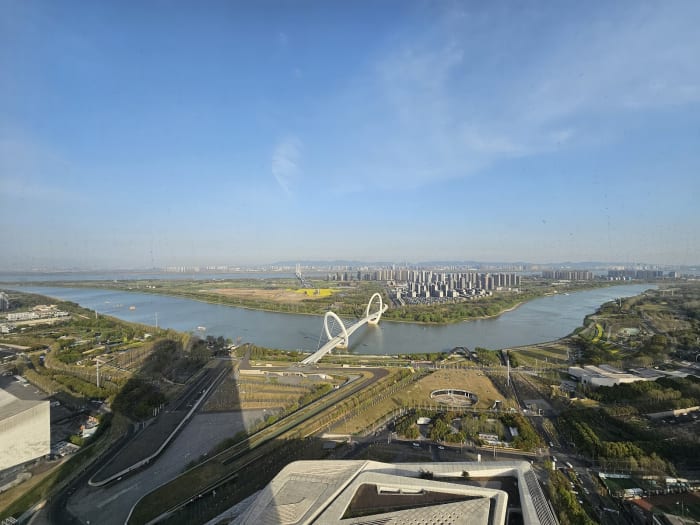
The Jumeirah Nanjing enjoys a prominent location in a vibrant area of the city. This setting enhances the experience, balancing urban energy with opportunities for retreat.
The hotel is integrated into the lively fabric of a contemporary Chinese metropolis. This location is ideal for both business travellers and those looking to explore the city efficiently.
The address facilitates a seamless stay, allowing guests to alternate between meetings, exploration of modern districts, leisurely breaks, and a return to tranquillity.
The Jumeirah Nanjing has been designed as a counterpoint to the external intensity. Here, one finds a sense of moderation, clarity, and a form of silence after the day's hustle and bustle.
The interior architecture and modern design extend this impression. The establishment favours a contemporary aesthetic, characterised by clean lines, clear volumes, and carefully selected materials.
In a hotel of this calibre, the design also enhances functionality. It makes circulation intuitive, spaces welcoming, and waiting times more pleasant.
The lobby, communal areas, corridors, and lounges form a cohesive ensemble. Each space complements the various moments of the stay.
The relationship with the city is also significant. Nanjing juxtaposes imperial heritage, institutions, business districts, residential areas, riverbanks, and contemporary thoroughfares.
Staying at the Jumeirah Nanjing allows one to approach the city from its current perspective, without excluding its historical dimensions. Guests begin from a comfortable and well-connected base, then radiate out according to their desires.
For international travellers, this clarity is essential. A 24-hour reception and concierge service available at all times simplify the experience.
Late arrivals, early departures, transfer arrangements, itinerary recommendations, or practical assistance: the hotel becomes the gravitational centre of the stay.
Ultimately, the establishment maintains a just urban balance. It combines the vitality of an active neighbourhood, a recognised signature, contemporary design, and a commendable calm.
Rooms and Suites
At the Jumeirah Nanjing, a room transcends mere rest; it becomes a space for rejuvenation, essential for an urban stay.
After a day filled with meetings, travel, or sightseeing, the traveller seeks a sense of control. A place to unwind, work if necessary, prepare calmly, and ultimately enjoy a restful night’s sleep.
The rooms and suites at Jumeirah Nanjing embody a contemporary spirit. The focus is on the clarity of space, the quality of bedding, the ergonomics of the furniture, and the subtlety of technical solutions.
In the finest establishments of this calibre, everything hinges on balance. There is enough sophistication to evoke a sense of a well-crafted space, without visual overload or unnecessary complexity.
Calmness remains paramount. In a bustling city, luxury often lies in creating an impression of retreat.
This is achieved through sound insulation, soothing materials and colours, thoughtfully designed lighting, and impeccable maintenance. The daily housekeeping and turndown service contribute directly to this atmosphere.
For business travellers, the room must also function as a secondary office. A comfortable chair, an appropriate work surface, and a reception available at all hours can significantly enhance the stay.
For couples or those on a getaway, the same room can transform into a sanctuary. It accommodates moments of reading, relaxation, or preparation before an evening out.
The suites operate under a different logic. They offer more space, greater privacy, and sometimes a clearer separation between work and rest.
In Nanjing, they are suitable for both long stays and trips requiring more flexible arrangements. The hotel caters equally well to short and extended visits.
Ultimately, what matters is not the accumulation of external signs, but coherence. A successful room at Jumeirah Nanjing naturally extends the essence of the hotel.
Contemporary without coldness, elegant without ostentation, practical without banality. A place to open your laptop, request an early wake-up call, prepare for a day of sightseeing, or disconnect from the urban pace.
Dining and the rhythm of the stay
In the absence of precise details regarding the hotel’s restaurants or culinary signatures, it is more accurate to consider dining at Jumeirah Nanjing as part of the overall rhythm of the stay. In a major urban hotel, food and drink do not simply serve to feed; they structure the day, create pauses and give a particular tone to the experience. Early breakfast, a business lunch, an afternoon pause, a more settled dinner or in-room dining all answer different needs, yet each contributes to the guest’s overall perception of the property.
In a contemporary five-star hotel, one expects first a form of elegant reliability. Service should be precise, opening hours suited to varied schedules and the atmosphere flexible enough to welcome both a professional meeting and a more intimate moment. Jumeirah Nanjing, by its positioning, appears to fit that logic. Its lively urban setting calls for an offer capable of following dense days, while the hotel’s calm atmosphere invites slower meals taken without haste.
Breakfast often plays a decisive role. In hotels of this category, it is less a simple buffet than a true threshold between the night and the city. It is the moment when one organises the day, observes the movement of other travellers and regains a sense of comfort before stepping back outside. For business guests, it may be the first useful interval of the day; for leisure visitors, it marks the beginning of a freer itinerary. In both cases, the quality of service and the serenity of the setting matter as much as what is on the plate.
Dinner, by contrast, often serves another function. After the intensity of Nanjing, it can be deeply welcome to return to a controlled environment at the hotel without having to reorganise the evening’s logistics. This is where a major hospitality name makes a difference: through smooth reservations, the ability to advise and the option either to dine in-house or to be directed to outside tables according to mood. The 24-hour concierge becomes especially valuable here, particularly for international travellers less familiar with the city.
One should also consider the quieter uses: a coffee before an early departure, a light meal between appointments, a tray taken in the privacy of the room or simply the pleasure of extending a conversation in a well-kept common area. These details, often underestimated, give a hotel its daily density. They allow the property to be lived in not as a static backdrop but as a genuinely inhabited place.
At Jumeirah Nanjing, dining should therefore be understood as a natural extension of service and comfort. Even without relying on overt signature effects, well-conceived food and beverage can anchor the stay in a form of elegant continuity. That is often what experienced travellers seek: not a display, but a sequence of well-judged moments, properly served and attuned both to the city’s tempo and to their own.
Wellness, Rest and Decompression
At Jumeirah Nanjing, wellness is first and foremost appreciated through the overall experience. It is characterised by tranquility, attentive service, and the hotel's ability to provide a genuine opportunity for relaxation.
The first aspect is spatial. A well-designed hotel soothes even before any dedicated services are offered. Everything hinges on the fluidity of movement, the restraint of the design, acoustic control, light, and a sense of order. Jumeirah Nanjing embodies this philosophy. Its calm atmosphere and contemporary aesthetic invite guests to catch their breath.
The second aspect pertains to service. With a 24-hour reception, concierge available at all times, wake-up calls, daily room maintenance, and turn-down service, the hotel alleviates the stresses of travel. Comfort does not solely rely on what is visible; it also rests on everything that becomes effortless. Arriving late without hassle, requesting practical assistance, finding a perfectly maintained room, or organising a serene departure all contribute to this sense of rest.
For business travellers, this wellness often manifests as a restored balance. After meetings, transport, or screen time, the hotel must facilitate a clear transition to more personal time. For those on a discovery trip, it is more about creating pauses between urban sequences. In both cases, the ideal address is one that does not add to fatigue. It welcomes, simplifies, and allows space for individual rhythm.
Wellness can also be more intimate. A few minutes of silence in the morning, an extended shower, a moment of reading in the room, an uninterrupted night, or a well-organised wake-up often count for more than an elaborate discourse. This is where the success of a great contemporary hotel is measured: in its ability to make simple things smoother and more restorative.
At Jumeirah Nanjing, the essentials are already in place. An environment conducive to relaxation, seamless organisation, and genuine protection from the external tumult. In a large city, this represents a very tangible form of luxury.
Concierge & Services
Here, your stay is organised with simple, clear, and well-thought-out services. Parking is available, convenient for both independent arrivals and city travel.
The hotel also offers a complimentary round-trip airport shuttle. This service facilitates transfers and eases both arrival and departure times, providing a smoother logistics experience from the moment you land.
For travellers juggling meetings, visits, or connections, this kind of attention alters the rhythm of the stay. It helps to minimise practical constraints and keeps the mind available.
Pets are not permitted. This environment is therefore suited to those seeking a regulated setting, without variation in this regard.
Together, these elements create a clear service experience, centred on the essentials. Useful amenities, without fanfare, discreetly accompany the journey.
Nanjing, between imperial memory and contemporary city
Staying at Jumeirah Nanjing also means choosing a particular way of approaching Nanjing itself. The city does not reveal itself all at once. A former capital on several occasions in Chinese history, it possesses remarkable historical density, yet it is also an active metropolitan centre, academic, administrative and economic. This coexistence of memory and modernity is precisely what makes it compelling. For travellers, the challenge is not to see everything, but to understand the city’s own rhythm: its contrasts, its pauses and its underlying structure.
One of Nanjing’s great pleasures lies in this alternation between monumentality and softness. There are traces of imperial history, commemorative sites, landscaped ensembles, hills, lakes and more recent urban axes that tell the story of another, more contemporary China. The city carries a particular gravity, but it is not static. It is often best discovered in sequences: a morning devoted to a historical site, lunch in a lively district, a calmer walk in the late afternoon and then a return to the hotel for a sense of retreat.
From that perspective, Jumeirah Nanjing serves as a highly relevant base. Its position in a lively district allows guests to feel the present-day city, while its peaceful atmosphere provides the distance needed to absorb what has been seen. It is a valuable balance. Too many travellers approach major Chinese cities through accumulation; Nanjing also asks for a degree of inward availability. One must accept its changes of scale, move from a place of memory to a more animated environment and then return to a slower tempo.
Those interested in urban art de vivre will also find much to observe. Nanjing does not have the demonstrative character of certain megacities; it possesses a more restrained elegance, shaped by history, education, waterside landscapes and a sense of continuity. This can be felt in the way the city is walked, in how its public spaces are inhabited and in the character of its districts. For attentive travellers, that tone is often more memorable than monuments alone.
The hotel then makes it possible to compose a stay to measure. Business travellers can insert moments of discovery between obligations. Couples may favour a more sensitive reading of the city, combining heritage, walks and rest. Longer stays allow for a fuller appreciation of local nuance. In every case, the quality of an address such as Jumeirah Nanjing lies in its ability to support these different uses without imposing a single script.
Nanjing deserves precisely that kind of approach: a city to be explored with method, curiosity and a chosen slowness. From a comfortable, well-organised and calm hotel, the experience gains depth. One no longer merely visits; one begins to perceive the city’s layers. And it is often at that point that a stay acquires real meaning.
Book with MyConciergeHotel
Booking Jumeirah Nanjing through MyConciergeHotel means favouring an editorial and guided approach to high-end travel. In an international hotel landscape that grows ever more abundant, the difficulty is no longer simply finding an available room, but choosing the address that truly matches one’s way of travelling. A business stay does not call for the same priorities as a couple’s escape, a short stopover or a longer stay. The value of a specialist perspective lies precisely in helping guests read a hotel beyond its category alone.
Jumeirah Nanjing presents several clear strengths: a recognised hospitality name, a lively district, modern design, high-end facilities, a calm atmosphere and services suited to business travellers as well as longer stays. Booking through an editorial platform such as MyConciergeHotel makes it possible to place those elements within the logic of an actual stay. One is not merely choosing a property; one is choosing a way of inhabiting Nanjing, of managing time, of balancing obligations with moments of discovery.
This reading is especially useful in a city that combines historical depth with contemporary intensity. Depending on the length of the trip, arrival time, need for flexibility or the type of programme envisaged, certain services become decisive: a 24-hour front desk, round-the-clock concierge, luggage storage, laundry, wake-up service and multilingual staff. These may seem like details, yet they materially change the quality of a stay, especially when transport constraints, meetings or a dense schedule are involved.
MyConciergeHotel is designed precisely to highlight what truly matters. Not to multiply vague promises, but to identify the structural qualities of an address: coherence of positioning, relevance of location, level of service, comfort over time and suitability for different traveller profiles. For Jumeirah Nanjing, that framework is particularly apt. The hotel appears to seek not spectacle, but overall control, which often corresponds to the expectations of experienced travellers.
Booking with MyConciergeHotel also means benefiting from a curated environment oriented towards notable addresses, with attention paid to the overall experience rather than the transaction alone. This editorial approach helps guests anticipate their stay more clearly, identify genuinely useful strengths and choose with better understanding. In the case of Jumeirah Nanjing, it clarifies that the essential lies in balance: an international, contemporary and calm address, well suited to urban life and flexible enough to accommodate several styles of travel.
For a stay in Nanjing, that balance is valuable. It allows one to travel with greater peace of mind, organise time more effectively and enjoy a hotel that supports the city rather than complicating it. That is exactly what a well-considered booking should offer: not merely a room, but a reliable, elegant and intelligently chosen base.